An Inspector Calls Revision Notes

    Introduction

    Comprehensive revision notes for Edexcel IGCSE.

    Summary & Overview

    An Inspector Calls is a gripping, fast-paced 'whodunit' that flips the genre on its head to explore guilt, class, and social responsibility. It's incredibly rewarding to study because J.B. Priestley's critique of Edwardian capitalism and call for collective conscience remains just as relevant and powerful today.

    Study Material

    ![Header image for An Inspector Calls](https://xnnrgnazirrqvdgfhvou.supabase.co/storage/v1/object/public/study-guide-assets/guide_8b5cefd5-90aa-45cb-aec6-c4605aee0e24/header_image.png) ## Overview J.B. Priestley's *An Inspector Calls* is a masterful morality play disguised as a detective thriller. Written in 1945 but set in 1912, it uses this deliberate time gap to create powerful dramatic irony, forcing a post-war audience to reflect on the failures of the past. For Edexcel IGCSE Literature, examiners are looking for your ability to analyse Priestley's dramatic methods (AO2)—how he uses lighting, entrances, and dialogue to build tension—and how these methods convey his socialist message (AO3). A top-tier response won't just narrate the Birling family's downfall; it will evaluate how Priestley uses them as constructs to critique the callousness of Edwardian capitalism and advocate for collective social responsibility. Listen to our revision podcast here: ![An Inspector Calls Revision Podcast](https://xnnrgnazirrqvdgfhvou.supabase.co/storage/v1/object/public/study-guide-assets/guide_8b5cefd5-90aa-45cb-aec6-c4605aee0e24/an_inspector_calls_podcast.mp3) ## Plot/Content Overview **Act 1**: The Birling family is celebrating the engagement of Sheila Birling to Gerald Croft in their affluent Brumley home. Arthur Birling delivers pompous speeches about capitalist self-reliance and the impossibility of war. The mood shifts abruptly when Inspector Goole arrives, announcing the suicide of a young working-class woman, Eva Smith. The Inspector reveals that Arthur sacked Eva from his factory for demanding a pay rise, and Sheila subsequently had her fired from a dress shop out of petty jealousy. **Act 2**: The investigation continues. Gerald confesses that he kept Eva (using the name Daisy Renton) as his mistress before abandoning her. Sheila respects his honesty but breaks off the engagement. Sybil Birling is then questioned; she arrogantly admits to using her influence at a charity committee to deny financial help to the pregnant and desperate Eva. Sybil shifts the blame entirely onto the unborn child's father, unwittingly trapping her own son. **Act 3**: Eric Birling returns and confesses that he forced himself on Eva, got her pregnant, and stole money from his father's business to support her. The family is shattered. The Inspector delivers a damning final speech on social responsibility and leaves. Gerald discovers that Inspector Goole is not a real police officer, and a call to the infirmary confirms no girl has died. Arthur, Sybil, and Gerald are relieved and ready to resume their lives, but Sheila and Eric remain deeply affected. The play ends with a sudden phone call: a girl has just died on her way to the infirmary, and a real police inspector is on his way. ![Key Themes in An Inspector Calls](https://xnnrgnazirrqvdgfhvou.supabase.co/storage/v1/object/public/study-guide-assets/guide_8b5cefd5-90aa-45cb-aec6-c4605aee0e24/themes_overview.png) ## Themes ### Theme 1: Social Responsibility This is the central thesis of the play. Priestley uses the Birling family to represent the selfish individualism of capitalism, contrasting them with the Inspector's socialist message of collective duty. The play charts the conflict between looking after oneself and looking after the wider community. **Key Quotes**: - "a man has to mind his own business and look after himself and his own" (Arthur Birling, Act 1) - Priestley gives Arthur this dialogue just before the Inspector's arrival, framing capitalist individualism as arrogant and flawed. - "We are members of one body. We are responsible for each other." (Inspector, Act 3) - The core socialist message, using religious/communal imagery to emphasise interconnectedness. ### Theme 2: Class and Inequality The play exposes the rigid, hypocritical class system of Edwardian Britain. The Birlings' wealth and status insulate them from the consequences of their actions, while Eva Smith, representing the working class, is utterly vulnerable and ultimately destroyed by those with power. **Key Quotes**: - "Girls of that class-" (Sybil Birling, Act 2) - Demonstrates Sybil's entrenched snobbery and her dehumanisation of the working class. - "But these girls aren't cheap labour - they're people." (Sheila, Act 1) - Sheila begins to recognise the humanity of the working class, rejecting her father's commodification of them. ### Theme 3: Generational Conflict Priestley uses the age divide to explore the possibility of change. The older generation (Arthur and Sybil) are rigid, refusing to accept blame or alter their worldview. The younger generation (Sheila and Eric) are impressionable, accept their guilt, and represent Priestley's hope for a better, more compassionate future. **Key Quotes**: - "the famous younger generation who know it all. And they can't even take a joke-" (Arthur Birling, Act 3) - Shows Arthur's dismissive attitude towards his children's genuine moral awakening. - "It frightens me the way you talk" (Sheila, Act 3) - Sheila's horror at her parents' inability to learn from the evening's revelations. ![Character Relationships in An Inspector Calls](https://xnnrgnazirrqvdgfhvou.supabase.co/storage/v1/object/public/study-guide-assets/guide_8b5cefd5-90aa-45cb-aec6-c4605aee0e24/character_relationships.png) ## Character Analysis ### Arthur Birling **Role**: The patriarch; represents the worst aspects of Edwardian capitalism, arrogance, and lack of social conscience. **Key Traits**: Pompous, self-interested, obsessed with status, dismissive of others. **Character Arc**: Static. He begins the play lecturing on self-interest and ends it desperate to cover up a public scandal, having learned nothing about morality. **Essential Quotes**: - "unsinkable, absolutely unsinkable" - "I can't accept any responsibility." ### Sheila Birling **Role**: The daughter; represents the capacity of the younger generation to change and embrace socialist ideals. **Key Traits**: Initially superficial and petty, but becomes insightful, remorseful, and morally courageous. **Character Arc**: Transformative. She moves from a naive, sheltered girl who abuses her power to a perceptive young woman who challenges her parents and aligns with the Inspector. **Essential Quotes**: - "Oh - how horrible! Was it an accident?" - "I know I'm to blame - and I'm desperately sorry" ### Inspector Goole **Role**: The catalyst; acts as Priestley's mouthpiece and the moral conscience of the play. **Key Traits**: Imposing, authoritative, omniscient, relentless. **Character Arc**: He does not change; rather, he drives the change in others. His origins remain ambiguous (supernatural, time-traveller, or collective conscience). **Essential Quotes**: - "Public men, Mr Birling, have responsibilities as well as privileges." - "If men will not learn that lesson, then they will be taught it in fire and blood and anguish." ## Writer's Methods Priestley employs several crucial dramatic methods that examiners expect you to analyse: **1. Dramatic Irony**: Because the 1945 audience knows that the Titanic sank and two World Wars occurred, Birling's confident predictions in Act 1 make him appear foolish and instantly discredit his capitalist worldview. **2. The 'Whodunit' Structure**: Priestley subverts the traditional detective thriller. Instead of one murderer, everyone is guilty. The chain of events builds tension and reinforces the theme of interconnectedness. **3. Stage Directions and Lighting**: The lighting changes from "pink and intimate" (suggesting the Birlings' rose-tinted, insulated view of themselves) to "brighter and harder" when the Inspector arrives, symbolising the harsh light of truth and interrogation. **4. Entrances and Exits**: Characters leave the stage at critical moments, allowing the Inspector to isolate individuals and build tension. The Inspector's arrival precisely interrupts Birling's capitalist speech. ## Context For AO3, you must integrate an understanding of the play's context into your analysis. Priestley wrote the play in **1945**, just after WWII, for an audience traumatised by conflict and eager for a fairer society (leading to the landslide Labour victory and the creation of the Welfare State). He set it in **1912**, a time of rigid class divisions, extreme inequality, and looming disaster (WWI). By highlighting the moral bankruptcy of the 1912 ruling classes, Priestley was warning his 1945 audience not to return to those selfish ways, but to build a society based on mutual support and social responsibility.

    An Inspector Calls

    Edexcel
    IGCSE
    English Literature

    An Inspector Calls is a gripping, fast-paced 'whodunit' that flips the genre on its head to explore guilt, class, and social responsibility. It's incredibly rewarding to study because J.B. Priestley's critique of Edwardian capitalism and call for collective conscience remains just as relevant and powerful today.

    8
    Min Read
    2
    Examples
    4
    Questions
    8
    Key Terms
    🎙 Podcast Episode
    An Inspector Calls
    0:00-0:00

    Study Notes

    Header image for An Inspector Calls

    Overview

    J.B. Priestley's An Inspector Calls is a masterful morality play disguised as a detective thriller. Written in 1945 but set in 1912, it uses this deliberate time gap to create powerful dramatic irony, forcing a post-war audience to reflect on the failures of the past. For Edexcel IGCSE Literature, examiners are looking for your ability to analyse Priestley's dramatic methods (AO2)—how he uses lighting, entrances, and dialogue to build tension—and how these methods convey his socialist message (AO3). A top-tier response won't just narrate the Birling family's downfall; it will evaluate how Priestley uses them as constructs to critique the callousness of Edwardian capitalism and advocate for collective social responsibility.

    Listen to our revision podcast here: An Inspector Calls Revision Podcast

    Plot/Content Overview

    Act 1: The Birling family is celebrating the engagement of Sheila Birling to Gerald Croft in their affluent Brumley home. Arthur Birling delivers pompous speeches about capitalist self-reliance and the impossibility of war. The mood shifts abruptly when Inspector Goole arrives, announcing the suicide of a young working-class woman, Eva Smith. The Inspector reveals that Arthur sacked Eva from his factory for demanding a pay rise, and Sheila subsequently had her fired from a dress shop out of petty jealousy.

    Act 2: The investigation continues. Gerald confesses that he kept Eva (using the name Daisy Renton) as his mistress before abandoning her. Sheila respects his honesty but breaks off the engagement. Sybil Birling is then questioned; she arrogantly admits to using her influence at a charity committee to deny financial help to the pregnant and desperate Eva. Sybil shifts the blame entirely onto the unborn child's father, unwittingly trapping her own son.

    Act 3: Eric Birling returns and confesses that he forced himself on Eva, got her pregnant, and stole money from his father's business to support her. The family is shattered. The Inspector delivers a damning final speech on social responsibility and leaves. Gerald discovers that Inspector Goole is not a real police officer, and a call to the infirmary confirms no girl has died. Arthur, Sybil, and Gerald are relieved and ready to resume their lives, but Sheila and Eric remain deeply affected. The play ends with a sudden phone call: a girl has just died on her way to the infirmary, and a real police inspector is on his way.
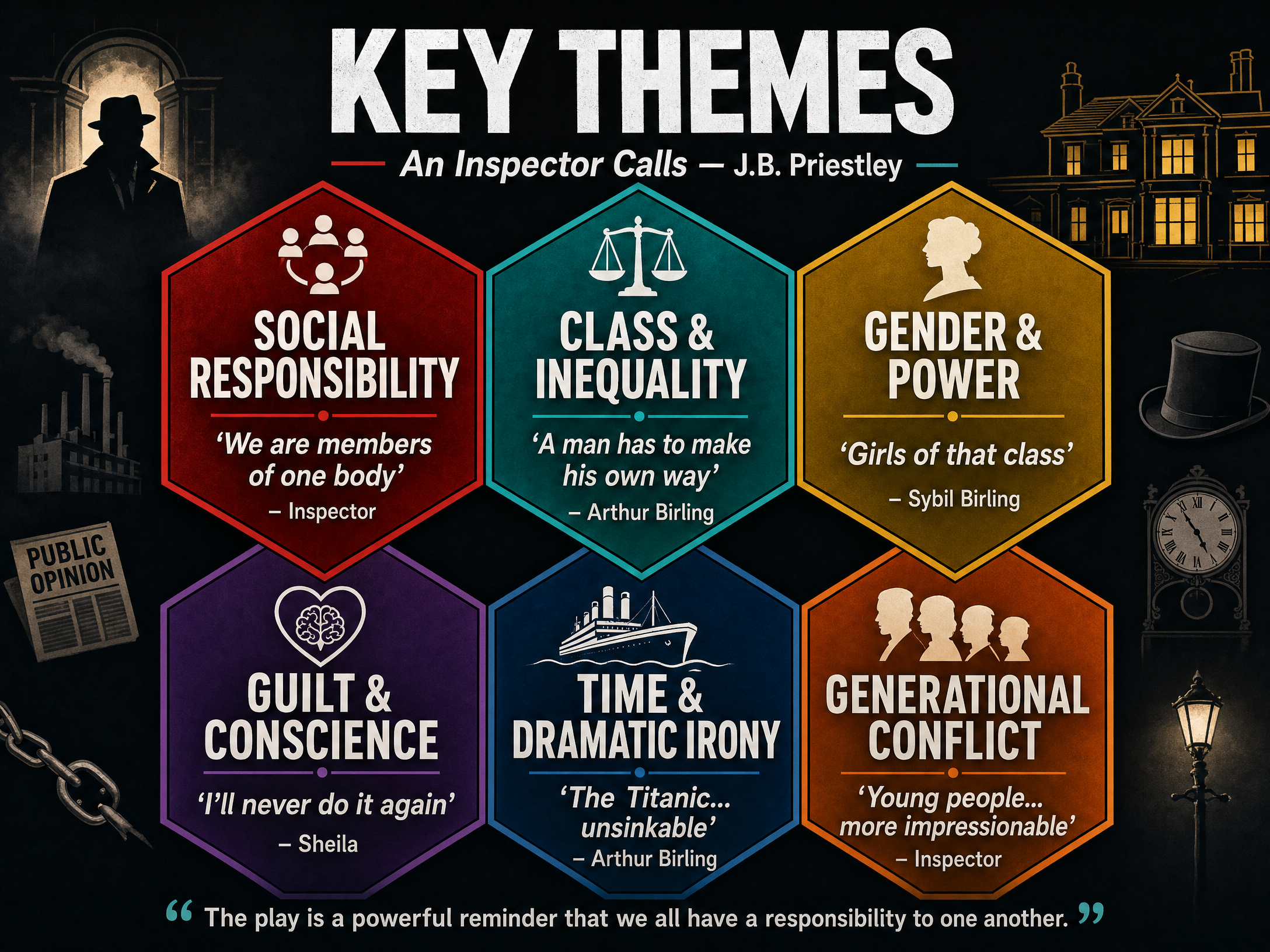
    Key Themes in An Inspector Calls

    Themes

    Theme 1: Social Responsibility

    This is the central thesis of the play. Priestley uses the Birling family to represent the selfish individualism of capitalism, contrasting them with the Inspector's socialist message of collective duty. The play charts the conflict between looking after oneself and looking after the wider community.

    Key Quotes:

    • "a man has to mind his own business and look after himself and his own" (Arthur Birling, Act 1) - Priestley gives Arthur this dialogue just before the Inspector's arrival, framing capitalist individualism as arrogant and flawed.
    • "We are members of one body. We are responsible for each other." (Inspector, Act 3) - The core socialist message, using religious/communal imagery to emphasise interconnectedness.

    Theme 2: Class and Inequality

    The play exposes the rigid, hypocritical class system of Edwardian Britain. The Birlings' wealth and status insulate them from the consequences of their actions, while Eva Smith, representing the working class, is utterly vulnerable and ultimately destroyed by those with power.

    Key Quotes:

    • "Girls of that class-" (Sybil Birling, Act 2) - Demonstrates Sybil's entrenched snobbery and her dehumanisation of the working class.
    • "But these girls aren't cheap labour - they're people." (Sheila, Act 1) - Sheila begins to recognise the humanity of the working class, rejecting her father's commodification of them.

    Theme 3: Generational Conflict

    Priestley uses the age divide to explore the possibility of change. The older generation (Arthur and Sybil) are rigid, refusing to accept blame or alter their worldview. The younger generation (Sheila and Eric) are impressionable, accept their guilt, and represent Priestley's hope for a better, more compassionate future.

    Key Quotes:

    • "the famous younger generation who know it all. And they can't even take a joke-" (Arthur Birling, Act 3) - Shows Arthur's dismissive attitude towards his children's genuine moral awakening.
    • "It frightens me the way you talk" (Sheila, Act 3) - Sheila's horror at her parents' inability to learn from the evening's revelations.
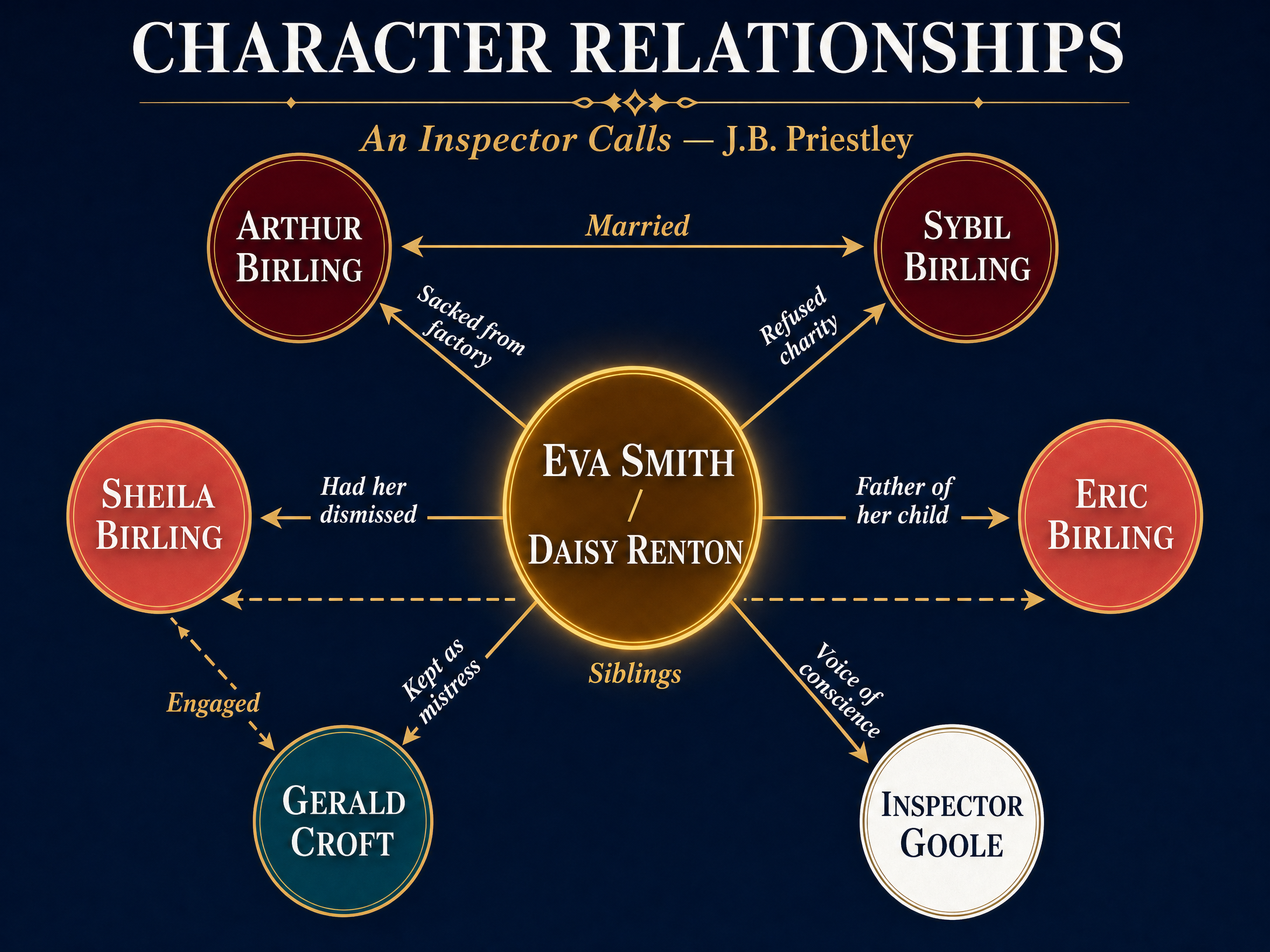
    Character Relationships in An Inspector Calls

    Character Analysis

    Arthur Birling

    Role: The patriarch; represents the worst aspects of Edwardian capitalism, arrogance, and lack of social conscience.

    Key Traits: Pompous, self-interested, obsessed with status, dismissive of others.

    Character Arc: Static. He begins the play lecturing on self-interest and ends it desperate to cover up a public scandal, having learned nothing about morality.

    Essential Quotes:

    • "unsinkable, absolutely unsinkable"
    • "I can't accept any responsibility."

    Sheila Birling

    Role: The daughter; represents the capacity of the younger generation to change and embrace socialist ideals.

    Key Traits: Initially superficial and petty, but becomes insightful, remorseful, and morally courageous.

    Character Arc: Transformative. She moves from a naive, sheltered girl who abuses her power to a perceptive young woman who challenges her parents and aligns with the Inspector.

    Essential Quotes:

    • "Oh - how horrible! Was it an accident?"
    • "I know I'm to blame - and I'm desperately sorry"

    Inspector Goole

    Role: The catalyst; acts as Priestley's mouthpiece and the moral conscience of the play.

    Key Traits: Imposing, authoritative, omniscient, relentless.

    Character Arc: He does not change; rather, he drives the change in others. His origins remain ambiguous (supernatural, time-traveller, or collective conscience).

    Essential Quotes:

    • "Public men, Mr Birling, have responsibilities as well as privileges."
    • "If men will not learn that lesson, then they will be taught it in fire and blood and anguish."

    Writer's Methods

    Priestley employs several crucial dramatic methods that examiners expect you to analyse:

    1. Dramatic Irony: Because the 1945 audience knows that the Titanic sank and two World Wars occurred, Birling's confident predictions in Act 1 make him appear foolish and instantly discredit his capitalist worldview.

    2. The 'Whodunit' Structure: Priestley subverts the traditional detective thriller. Instead of one murderer, everyone is guilty. The chain of events builds tension and reinforces the theme of interconnectedness.

    3. Stage Directions and Lighting: The lighting changes from "pink and intimate" (suggesting the Birlings' rose-tinted, insulated view of themselves) to "brighter and harder" when the Inspector arrives, symbolising the harsh light of truth and interrogation.

    4. Entrances and Exits: Characters leave the stage at critical moments, allowing the Inspector to isolate individuals and build tension. The Inspector's arrival precisely interrupts Birling's capitalist speech.

    Context

    For AO3, you must integrate an understanding of the play's context into your analysis. Priestley wrote the play in 1945, just after WWII, for an audience traumatised by conflict and eager for a fairer society (leading to the landslide Labour victory and the creation of the Welfare State). He set it in 1912, a time of rigid class divisions, extreme inequality, and looming disaster (WWI). By highlighting the moral bankruptcy of the 1912 ruling classes, Priestley was warning his 1945 audience not to return to those selfish ways, but to build a society based on mutual support and social responsibility.

    Visual Resources

    2 diagrams and illustrations

    Character Relationships in An Inspector Calls
    Character Relationships in An Inspector Calls
    Key Themes in An Inspector Calls
    Key Themes in An Inspector Calls

    Interactive Diagrams

    1 interactive diagram to visualise key concepts

    The Chain of Events: Narrative Structure

    Worked Examples

    2 detailed examples with solutions and examiner commentary

    Practice Questions

    Test your understanding — click to reveal model answers

    Q1

    Explore how Priestley presents the differences between the older and younger generations in An Inspector Calls. (30 marks + 4 AO4)

    34 marks
    standard

    Hint: Consider how characters react to the Inspector's revelations. Contrast Arthur/Sybil's denial with Sheila/Eric's acceptance of guilt.

    Q2

    How does Priestley use the character of Inspector Goole to convey his ideas? (30 marks + 4 AO4)

    34 marks
    hard

    Hint: Focus on the Inspector's function as a dramatic device, his control of the structure, and his final speech.

    Q3

    Starting with this extract (Sybil Birling's interview in Act 2), explore how Priestley presents attitudes towards social class. (30 marks + 4 AO4)

    34 marks
    standard

    Hint: Look at Sybil's language in the extract ('impertinence', 'girls of that class') and link it to Arthur's views in Act 1.

    Q4

    Explore the importance of gender in An Inspector Calls. (30 marks + 4 AO4)

    34 marks
    hard

    Hint: Consider how Eva is exploited because she is both poor AND a woman. Contrast this with Sheila's protected status.

    Key Terms

    Essential vocabulary to know