Pearson Edexcel · IGCSE · English Literature
Death and the King's Horseman
Death and the King's Horseman is a profound tragedy that forces us to examine the devastating consequences when a sacred duty is compromised by human weakness and colonial interference. Studying this play offers a rich opportunity to explore complex themes of honour, sacrifice, and cultural clash, rewarding candidates who can analyze Soyinka's sophisticated use of language and dramatic structure.
- 8 min read
- 2 worked examples
- 4 practice questions
- 8 key terms
Study Notes
Overview
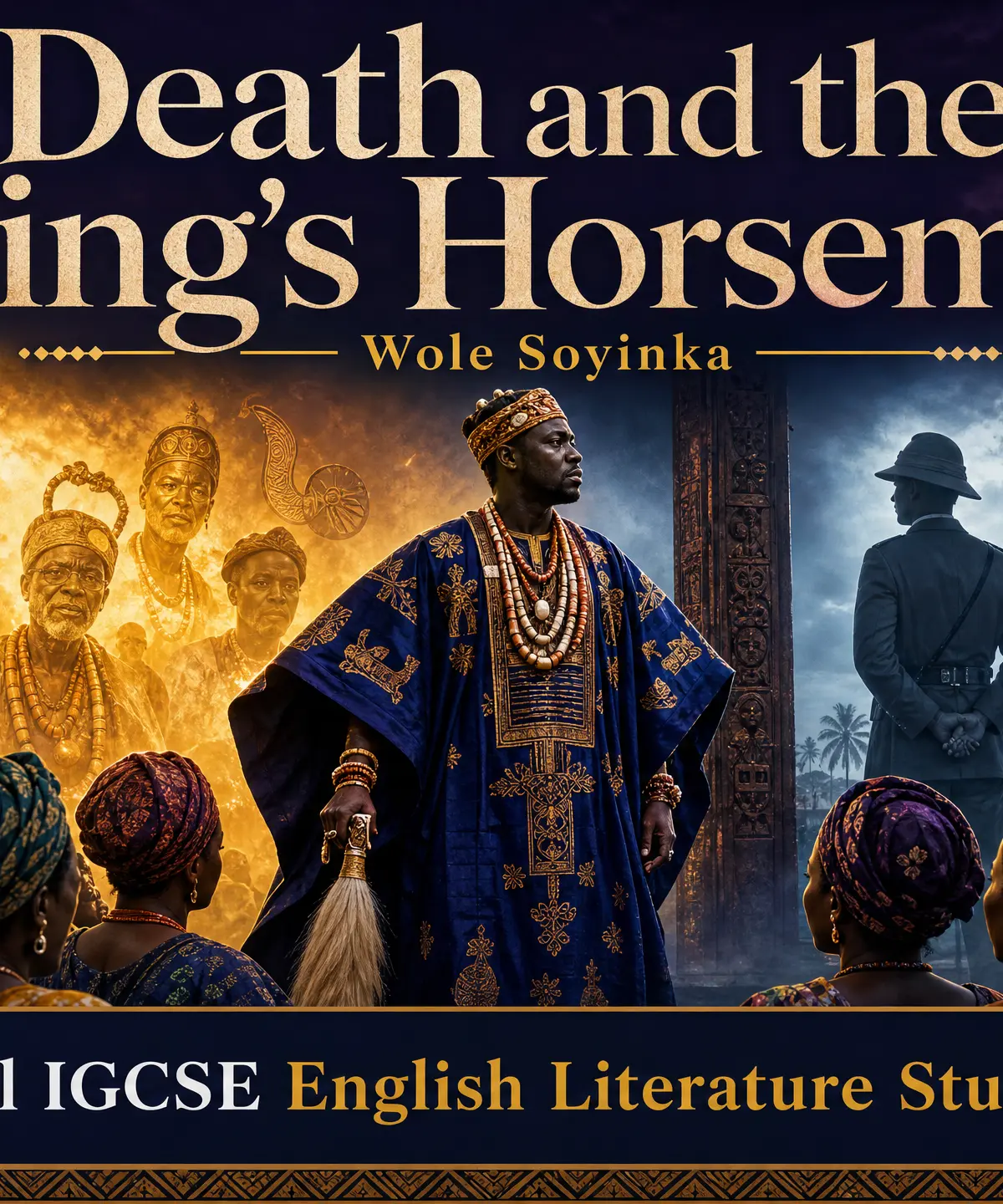
Wole Soyinka's Death and the King's Horseman is a seminal work of postcolonial literature that demands nuanced analysis. Set in 1943 colonial Nigeria, the play explores the catastrophic consequences when the British District Officer, Simon Pilkings, intervenes in a sacred Yoruba ritual. However, Soyinka explicitly warns against reading the play merely as a "clash of cultures." The true tragedy lies in the internal failure of Elesin Oba, the King's Horseman, whose sensual attachment to life causes him to hesitate in his cosmic duty to accompany his deceased king to the afterlife. Examiners reward candidates who recognize this complexity, analyze the distinct linguistic styles contrasting the Yoruba and colonial worlds, and evaluate how the play's structure reinforces its themes of duty, honour, and cosmic balance.
Plot/Content Overview
Act One: The play opens in the vibrant Yoruba market. Elesin Oba, preparing for his ritual suicide, is celebrated by the market women and his Praise-Singer. Despite his impending death, Elesin is joyful and charismatic. He requests to marry a young, betrothed woman for his final night, and Iyaloja reluctantly agrees, warning him not to let earthly desires weaken his resolve.
Act Two: The scene shifts to the British Residency. Simon and Jane Pilkings are preparing for a fancy dress ball, wearing sacred Yoruba egungun costumes—a profound sacrilege. Pilkings learns of Elesin's planned ritual and, viewing it as murder, decides to intervene.
Act Three: Back in the market, Elesin prepares for his transition to the ancestral realm. The Praise-Singer guides him, but Elesin's will falters after consummating his marriage to the young bride.
Act Four: At the Residency ball, Olunde, Elesin's son who has been studying medicine in England, arrives to perform his father's funeral rites. He engages in a profound debate with Jane Pilkings about sacrifice. Elesin is then brought in, alive and in chains. Realizing his father has failed his duty, Olunde disowns him.
Act Five: Elesin is imprisoned. Iyaloja arrives bearing a covered body—Olunde has committed suicide to complete the ritual his father failed to perform. Overcome with shame and grief, Elesin strangles himself with his chains. Iyaloja delivers the final, devastating judgment, focusing on the unborn generation.
Themes
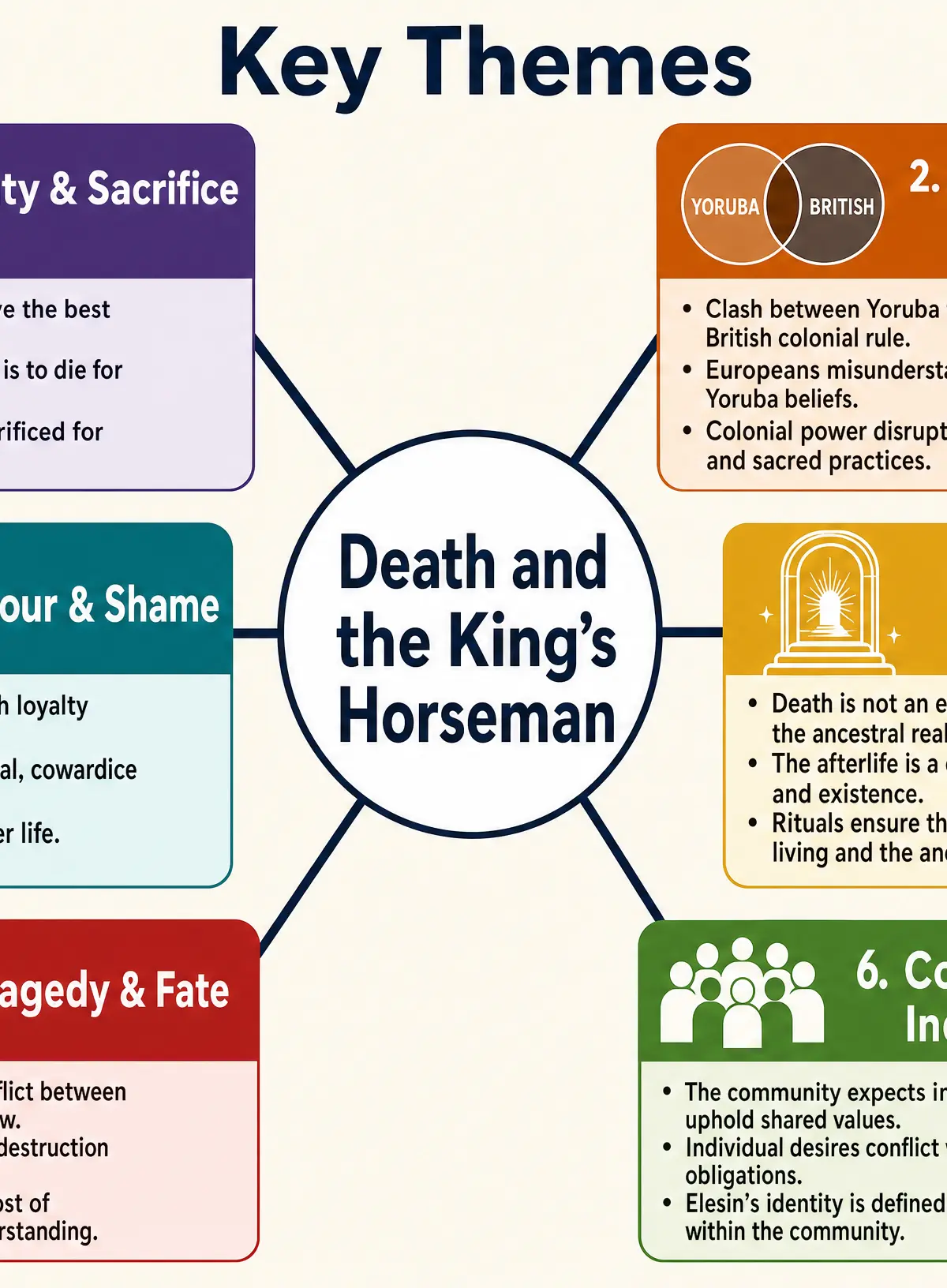
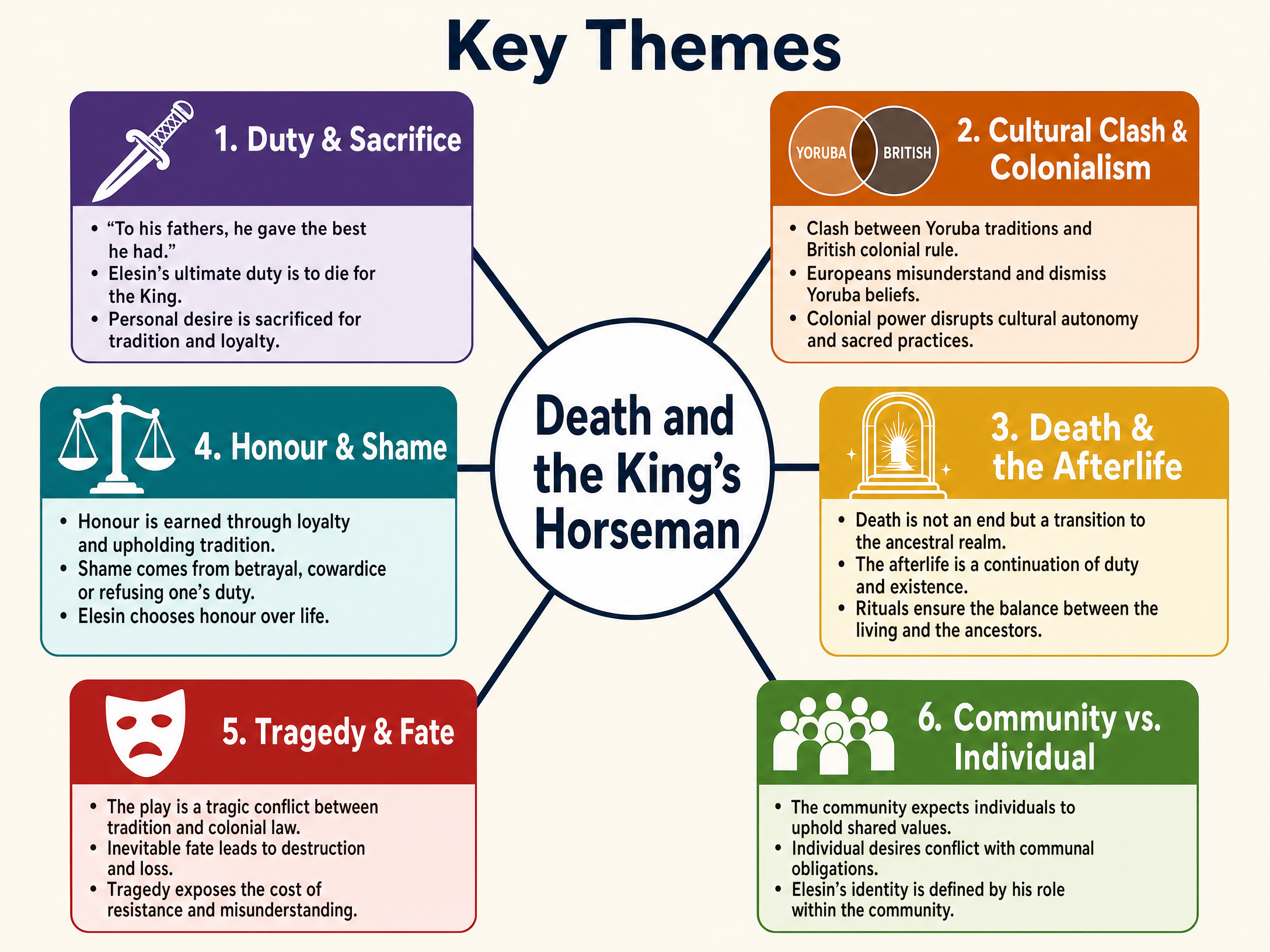
Theme 1: Duty & Sacrifice
Duty is not merely a social obligation in the play; it is a cosmic necessity required to maintain the balance between the living, the dead, and the unborn. Elesin's failure to sacrifice himself disrupts this balance, leading to catastrophe. Olunde's ultimate sacrifice demonstrates the supreme importance of this duty over individual life.
Key Quotes:
- "My will was groomed for the passage." (Act 1) - Elesin asserts his readiness, creating dramatic irony given his later failure.
- "Elesin, we placed the reins of the world in your hands yet you watched it plunge over the edge of the bitter precipice." (Act 5) - The Praise-Singer highlights the cosmic scale of Elesin's failure.
Theme 2: Cultural Clash & Colonialism
The British colonial administration, represented by Pilkings, operates with arrogant ignorance, dismissing Yoruba traditions as "barbaric." Their intervention is presented not as a rescue, but as an act of desecration. However, Soyinka uses Olunde to show that cultural synthesis is possible, contrasting with Pilkings's blind imperialism.
Key Quotes:
- "It is the death of a great chief and they must do him honour." (Act 2) - Amusa attempts to explain the ritual's significance to Pilkings, who refuses to listen.
- "I discovered that you have no respect for what you do not understand." (Act 4) - Olunde challenges Jane Pilkings, exposing the hypocrisy of colonial attitudes.
Theme 3: Honour & Shame
Honour is earned through fulfilling one's communal and ancestral role. Elesin's hesitation brings profound shame not just to himself, but to his lineage. The contrast between Elesin's dishonour and Olunde's restored honour is central to the tragedy.
Key Quotes:
- "I have no father, eater of left-overs." (Act 4) - Olunde's devastating rejection of Elesin, using a deeply insulting Yoruba metaphor.
- "He is gone at last into the passage but oh, how late it all is." (Act 5) - Iyaloja recognizes Elesin's final act of suicide, but notes it cannot undo the shame.
Character Analysis
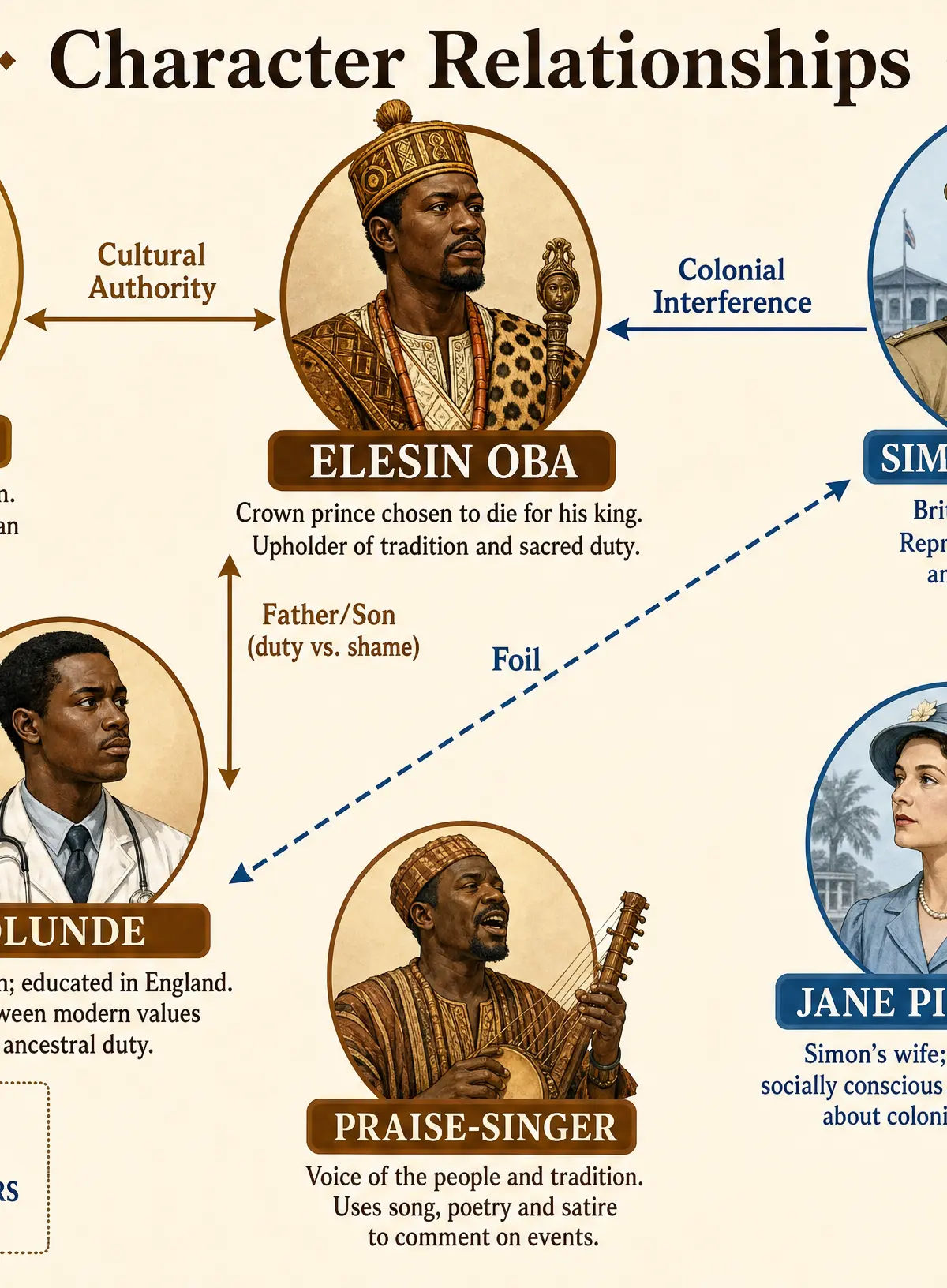
Elesin Oba
Role: The King's Horseman, the tragic hero whose failure drives the narrative.
Key Traits: Charismatic, eloquent, sensual, deeply embedded in tradition but fatally attached to earthly pleasures.
Character Arc: Moves from supreme confidence and celebration to hesitation, devastating shame, and finally, a desperate, belated act of self-destruction.
Essential Quotes:
- "Life has an appetite for me." (Act 1)
- "My will was squelched in the spittle of an alien race." (Act 5) - Elesin attempts to blame the British, though the play suggests his failure was internal.
Olunde
Role: Elesin's son, the embodiment of synthesized identity and ultimate duty.
Key Traits: Intelligent, composed, perceptive, fiercely loyal to his cultural heritage despite his Western education.
Character Arc: Returns expecting to bury his father, confronts the reality of his father's failure, and takes on the sacrificial burden himself.
Essential Quotes:
- "I discovered richer things." (Act 4) - Olunde explaining what he found in England, subverting colonial expectations.
- "He already has the smell of their flesh about him." (Act 4) - Olunde recognizing his father's spiritual death before his physical one.
Simon Pilkings
Role: The British District Officer, the catalyst for the tragedy.
Key Traits: Pragmatic, arrogant, culturally blind, authoritative but ultimately powerless to control the spiritual forces at play.
Character Arc: Remains largely static, moving from dismissive arrogance to uncomprehending shock at the play's conclusion.
Essential Quotes:
- "Nonsense. It's just a lot of mumbo-jumbo." (Act 2)
- "You're just a savage like all the rest." (Act 4) - Pilkings's mask slips when confronted by Olunde's calm logic.
Writer's Methods
Soyinka employs a sophisticated range of dramatic techniques. The most prominent is the linguistic contrast between the Yoruba and colonial characters. Elesin and the Praise-Singer use heightened, poetic language rich in metaphor, proverbs, and rhythm, reflecting an oral tradition where words carry spiritual weight. In contrast, Pilkings speaks in clipped, functional prose, revealing his spiritual emptiness.
The structure of the play, alternating between the market and the Residency, forces the audience to continually shift perspectives, highlighting the vast chasm between the two worlds. The use of dramatic irony is powerful, particularly regarding the egungun costumes and Elesin's initial boasts.
Soyinka also integrates music, dance, and ritual directly into the dramatic action. These are not merely atmospheric; they are essential to the plot, representing the cosmic order that is ultimately disrupted.
Context
Death and the King's Horseman was written in 1975, a postcolonial era, but is set in 1943 during WWII. This setting is crucial: while the British are fighting a war requiring massive sacrifice (which they view as noble), they simultaneously condemn the Yoruba ritual sacrifice as "barbaric." Examiners expect candidates to integrate this context to explain Soyinka's critique of colonial hypocrisy. Furthermore, an understanding of the Yoruba cosmology—the interconnectedness of the living, the dead, and the unborn—is essential for analyzing the true nature of the tragedy beyond a simple anti-colonial reading.
Audio Resource
Listen to our comprehensive 15-minute podcast episode covering the key themes, characters, and exam techniques for this play:

Visual Resources
2 diagrams and illustrations
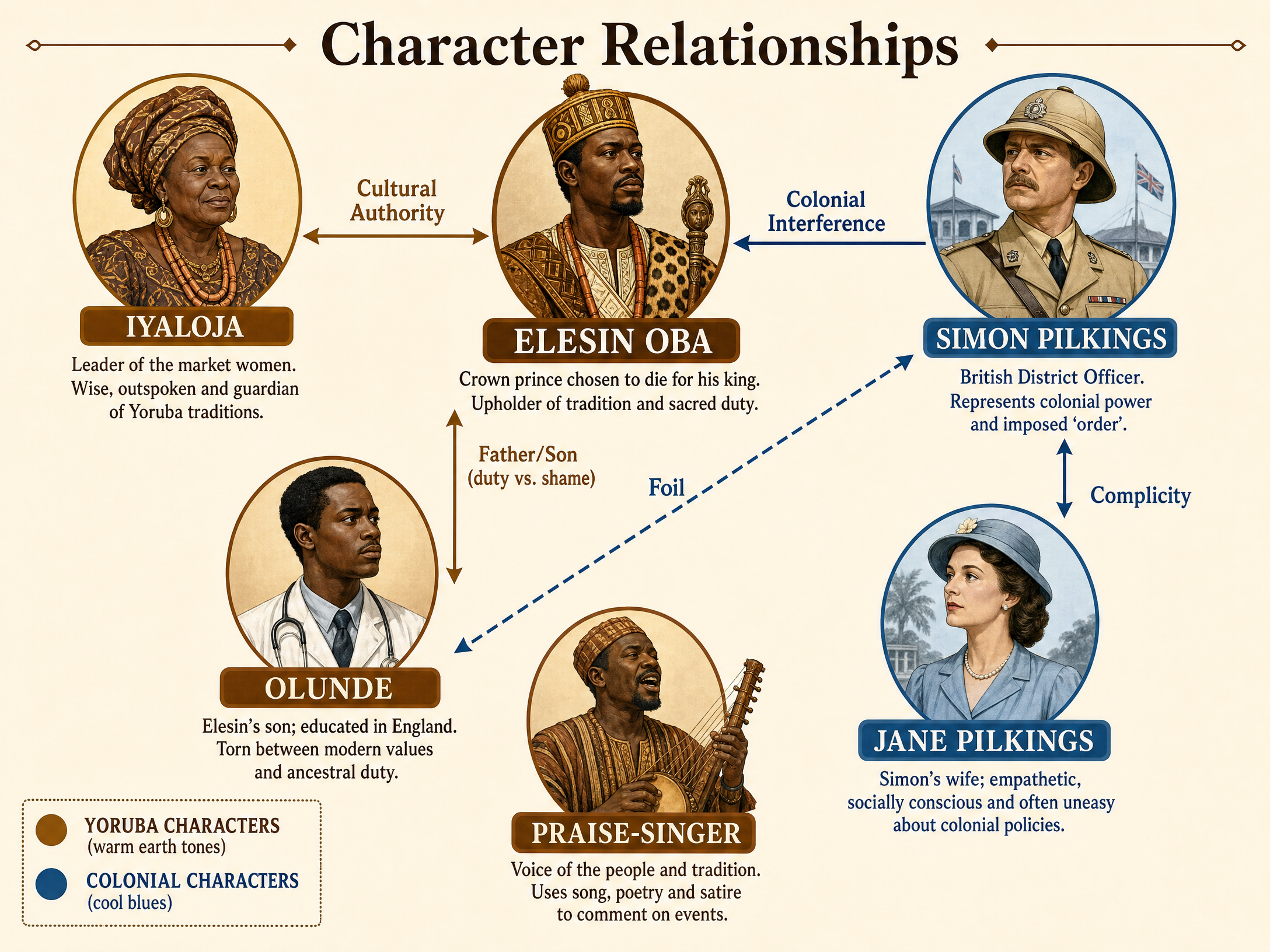
Interactive Diagrams
1 interactive diagram to visualise key concepts
Conceptual Flow Outline
The Tragic Trajectory of Elesin Oba
Worked Examples
2 worked examples — open one to explore the question and available guidance.
Practice Questions
Test your understanding — click to reveal model answers
Explore how Soyinka presents the conflict between individual desire and communal duty in Death and the King's Horseman. (30 marks + 4 AO4)
Hint: Focus on Elesin's internal struggle in Act 3 and contrast it with Olunde's decisive action in Act 5.
How does Soyinka use the character of Iyaloja to convey the play's key themes? (30 marks + 4 AO4)
Hint: Consider her role in Act 1 (warning Elesin) and her role in Act 5 (delivering judgment).
Explore the presentation of cultural ignorance in the play. (30 marks + 4 AO4)
Hint: Look closely at Simon Pilkings's language and actions, particularly the egungun costume incident.
Starting with the final scene of the play, explore how Soyinka presents the theme of tragedy. (30 marks + 4 AO4)
Hint: Analyze Elesin's death and Iyaloja's final words, then link this back to Elesin's earlier actions.