Edexcel Anthology Poetry (Part 3) Revision Notes

    Introduction

    Comprehensive revision notes for Edexcel IGCSE.

    Summary & Overview

    Master the Edexcel IGCSE Anthology Poetry (Part 3) with this comprehensive, multi-modal guide. Discover how to synthesise critical interpretations, evaluate poetic devices, and write Grade 9 comparative essays that examiners reward.

    Study Material

    ![Edexcel IGCSE English Literature Anthology Poetry](https://xnnrgnazirrqvdgfhvou.supabase.co/storage/v1/object/public/study-guide-assets/guide_0af8b2a6-9bfc-4397-9f2a-3bbe3104d267/header_image.png) ## Overview The Edexcel IGCSE Anthology Poetry (Part 3) collection is a diverse selection of 16 poems spanning different eras, cultures, and poetic forms. Examiners are looking for your ability to construct sophisticated, integrated comparative arguments. You must move beyond simple 'feature spotting' and demonstrate a nuanced understanding of how writers use language, form, and structure (AO2) to shape meaning and evoke emotional responses. Crucially, you need to draw perceptive links and connections (AO3) between texts, showing how different poets approach similar themes like identity, conflict, childhood, and power. ## Key Themes and Groupings ### Theme 1: Identity and Belonging Poems exploring cultural heritage, personal growth, and societal labels. **Key Texts**: 'Search for My Tongue', 'Half-caste', 'Poem at Thirty-Nine'. **Detailed Exploration**: In 'Search for My Tongue', Sujata Bhatt uses an extended metaphor of a rotting tongue to convey the anxiety of losing her mother tongue, which then miraculously blossoms in her dreams. John Agard's 'Half-caste' takes a more confrontational approach, using non-standard phonetic spelling and direct address to challenge the racist implications of the term. Both poets explore the deep connection between language and identity, but Bhatt's tone is anxious and ultimately triumphant, whereas Agard's is defiant and satirical. **Key Quotes**: - "rot and die in your mouth" ('Search for My Tongue') - The visceral imagery highlights the physical and emotional pain of cultural loss. - "Excuse me / standing on one leg / I'm half-caste" ('Half-caste') - The sarcastic apology and absurd imagery mock the logic of the racial label. ### Theme 2: Conflict and Society Poems dealing with war, societal indifference, and human suffering. **Key Texts**: 'War Photographer', 'Prayer Before Birth', 'Blessing'. **Detailed Exploration**: Carol Ann Duffy's 'War Photographer' contrasts the ordered, isolated darkroom with the chaotic "nightmare heat" of war, critiquing the fleeting empathy of the British public. Louis MacNeice's 'Prayer Before Birth' uses the perspective of an unborn child to present a terrifying vision of a corrupt, violent world. Both poems condemn societal apathy, but Duffy focuses on the individual's role as a passive observer, while MacNeice paints a broader, apocalyptic picture of systemic evil. **Key Quotes**: - "A hundred agonies in black and white" ('War Photographer') - The metaphor quantifies the massive scale of suffering reduced to flat, easily consumable images. - "I am not yet born; O hear me." ('Prayer Before Birth') - The desperate imperative sets the tone of absolute vulnerability against a hostile world. ### Theme 3: Power and Control Poems examining the abuse of power, divine creation, and authority. **Key Texts**: 'My Last Duchess', 'The Tyger', 'If'. **Detailed Exploration**: Robert Browning's dramatic monologue 'My Last Duchess' reveals the sinister control of the Duke, who had his wife killed for smiling too freely. The poem's strict iambic pentameter and rhyming couplets mirror his obsessive need for control. William Blake's 'The Tyger' explores a different kind of power: the terrifying, awe-inspiring force of divine creation. While the Duke's power is petty and destructive, the Tyger's power is primal and sublime. **Key Quotes**: - "I gave commands; / Then all smiles stopped together." ('My Last Duchess') - The chilling euphemism and abrupt caesura highlight the Duke's absolute, ruthless authority. - "Did he who made the Lamb make thee?" ('The Tyger') - The rhetorical question highlights the paradox of a creator capable of both innocence and terrifying ferocity. ## Writer's Methods (AO2) Examiners reward perceptive analysis of *how* meaning is created. When discussing these poems, focus on: 1. **Form**: Why is 'My Last Duchess' a dramatic monologue? It forces us into the uncomfortable position of the Duke's silent listener. Why does 'Prayer Before Birth' use incantatory, free-verse stanzas that grow longer and more chaotic? It mirrors the escalating terror of the world. 2. **Structure**: Look for shifts in time or perspective (voltas). In 'Piano', the structure moves from the present reality to an overwhelming flood of childhood memory. In 'War Photographer', the rigid six-line stanzas reflect the photographer's attempt to impose order on the chaos of war. 3. **Language**: Analyse specific word choices. In 'Blessing', the water is described with metallic, valuable terms ("silver", "brass", "copper"), elevating a basic necessity to the status of precious treasure. ![Key Themes Across the Anthology](https://xnnrgnazirrqvdgfhvou.supabase.co/storage/v1/object/public/study-guide-assets/guide_0af8b2a6-9bfc-4397-9f2a-3bbe3104d267/poem_themes_diagram.png) ## How to Compare Effectively (AO3) The most common mistake is sequential analysis (writing about Poem A, then Poem B). You must write **integrated comparative paragraphs**. Use this structure for every paragraph: 1. **Point**: A comparative statement addressing the question (e.g., "Both poets present childhood as a time of intense vulnerability, though Fanthorpe focuses on confusion while Scannell highlights betrayal.") 2. **Evidence A**: A short, embedded quote from Poem A. 3. **Analysis A**: Analyse the method (AO2) and its effect. 4. **Connective**: Use a sophisticated comparative phrase (e.g., "Conversely, ...", "Similarly, ...", "In stark contrast, ..."). 5. **Evidence B**: A quote from Poem B. 6. **Analysis B**: Analyse the method (AO2) and how it relates to Poem A. ![How to Write a Grade 9 Comparative Essay](https://xnnrgnazirrqvdgfhvou.supabase.co/storage/v1/object/public/study-guide-assets/guide_0af8b2a6-9bfc-4397-9f2a-3bbe3104d267/comparison_framework.png) ## Podcast Episode Listen to this 10-minute podcast episode for a deep dive into comparative analysis, examiner tips, and a quick-fire recall quiz. ![Mastering Comparative Poetry Analysis Podcast](https://xnnrgnazirrqvdgfhvou.supabase.co/storage/v1/object/public/study-guide-assets/guide_0af8b2a6-9bfc-4397-9f2a-3bbe3104d267/anthology_poetry_podcast.mp3)

    Edexcel Anthology Poetry (Part 3)

    Edexcel
    IGCSE
    English Literature

    Master the Edexcel IGCSE Anthology Poetry (Part 3) with this comprehensive, multi-modal guide. Discover how to synthesise critical interpretations, evaluate poetic devices, and write Grade 9 comparative essays that examiners reward.

    6
    Min Read
    1
    Examples
    4
    Questions
    8
    Key Terms
    🎙 Podcast Episode
    Edexcel Anthology Poetry (Part 3)
    0:00-0:00

    Study Notes

    Edexcel IGCSE English Literature Anthology Poetry

    Overview

    The Edexcel IGCSE Anthology Poetry (Part 3) collection is a diverse selection of 16 poems spanning different eras, cultures, and poetic forms. Examiners are looking for your ability to construct sophisticated, integrated comparative arguments. You must move beyond simple 'feature spotting' and demonstrate a nuanced understanding of how writers use language, form, and structure (AO2) to shape meaning and evoke emotional responses. Crucially, you need to draw perceptive links and connections (AO3) between texts, showing how different poets approach similar themes like identity, conflict, childhood, and power.

    Key Themes and Groupings

    Theme 1: Identity and Belonging

    Poems exploring cultural heritage, personal growth, and societal labels.

    Key Texts: 'Search for My Tongue', 'Half-caste', 'Poem at Thirty-Nine'.

    Detailed Exploration: In 'Search for My Tongue', Sujata Bhatt uses an extended metaphor of a rotting tongue to convey the anxiety of losing her mother tongue, which then miraculously blossoms in her dreams. John Agard's 'Half-caste' takes a more confrontational approach, using non-standard phonetic spelling and direct address to challenge the racist implications of the term. Both poets explore the deep connection between language and identity, but Bhatt's tone is anxious and ultimately triumphant, whereas Agard's is defiant and satirical.

    Key Quotes:

    • "rot and die in your mouth" ('Search for My Tongue') - The visceral imagery highlights the physical and emotional pain of cultural loss.
    • "Excuse me / standing on one leg / I'm half-caste" ('Half-caste') - The sarcastic apology and absurd imagery mock the logic of the racial label.

    Theme 2: Conflict and Society

    Poems dealing with war, societal indifference, and human suffering.

    Key Texts: 'War Photographer', 'Prayer Before Birth', 'Blessing'.

    Detailed Exploration: Carol Ann Duffy's 'War Photographer' contrasts the ordered, isolated darkroom with the chaotic "nightmare heat" of war, critiquing the fleeting empathy of the British public. Louis MacNeice's 'Prayer Before Birth' uses the perspective of an unborn child to present a terrifying vision of a corrupt, violent world. Both poems condemn societal apathy, but Duffy focuses on the individual's role as a passive observer, while MacNeice paints a broader, apocalyptic picture of systemic evil.

    Key Quotes:

    • "A hundred agonies in black and white" ('War Photographer') - The metaphor quantifies the massive scale of suffering reduced to flat, easily consumable images.
    • "I am not yet born; O hear me." ('Prayer Before Birth') - The desperate imperative sets the tone of absolute vulnerability against a hostile world.

    Theme 3: Power and Control

    Poems examining the abuse of power, divine creation, and authority.

    Key Texts: 'My Last Duchess', 'The Tyger', 'If'.

    Detailed Exploration: Robert Browning's dramatic monologue 'My Last Duchess' reveals the sinister control of the Duke, who had his wife killed for smiling too freely. The poem's strict iambic pentameter and rhyming couplets mirror his obsessive need for control. William Blake's 'The Tyger' explores a different kind of power: the terrifying, awe-inspiring force of divine creation. While the Duke's power is petty and destructive, the Tyger's power is primal and sublime.

    Key Quotes:

    • "I gave commands; / Then all smiles stopped together." ('My Last Duchess') - The chilling euphemism and abrupt caesura highlight the Duke's absolute, ruthless authority.
    • "Did he who made the Lamb make thee?" ('The Tyger') - The rhetorical question highlights the paradox of a creator capable of both innocence and terrifying ferocity.

    Writer's Methods (AO2)

    Examiners reward perceptive analysis of how meaning is created. When discussing these poems, focus on:

    1. Form: Why is 'My Last Duchess' a dramatic monologue? It forces us into the uncomfortable position of the Duke's silent listener. Why does 'Prayer Before Birth' use incantatory, free-verse stanzas that grow longer and more chaotic? It mirrors the escalating terror of the world.
    2. Structure: Look for shifts in time or perspective (voltas). In 'Piano', the structure moves from the present reality to an overwhelming flood of childhood memory. In 'War Photographer', the rigid six-line stanzas reflect the photographer's attempt to impose order on the chaos of war.
    3. Language: Analyse specific word choices. In 'Blessing', the water is described with metallic, valuable terms ("silver", "brass", "copper"), elevating a basic necessity to the status of precious treasure.
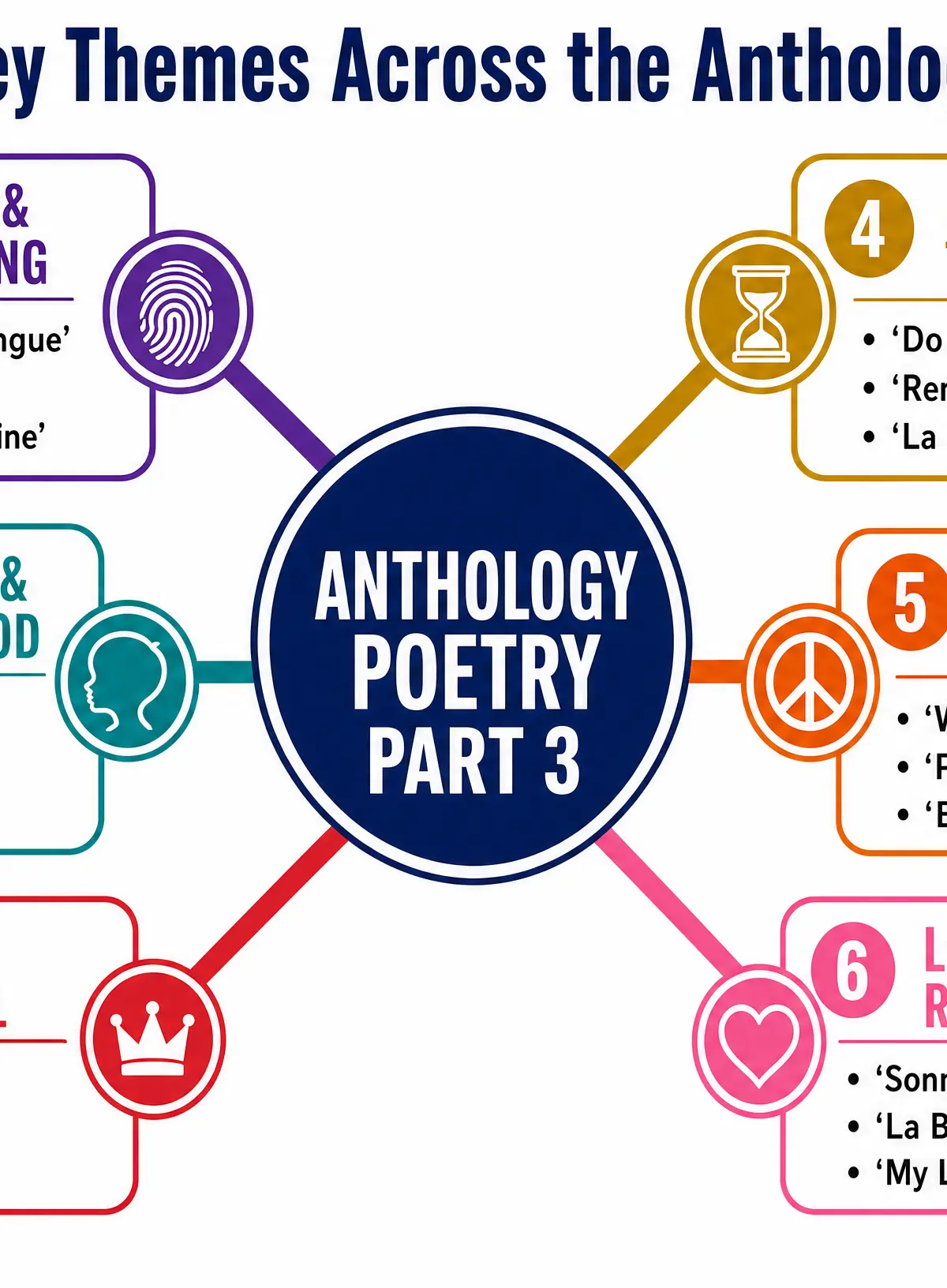
    Key Themes Across the Anthology

    How to Compare Effectively (AO3)

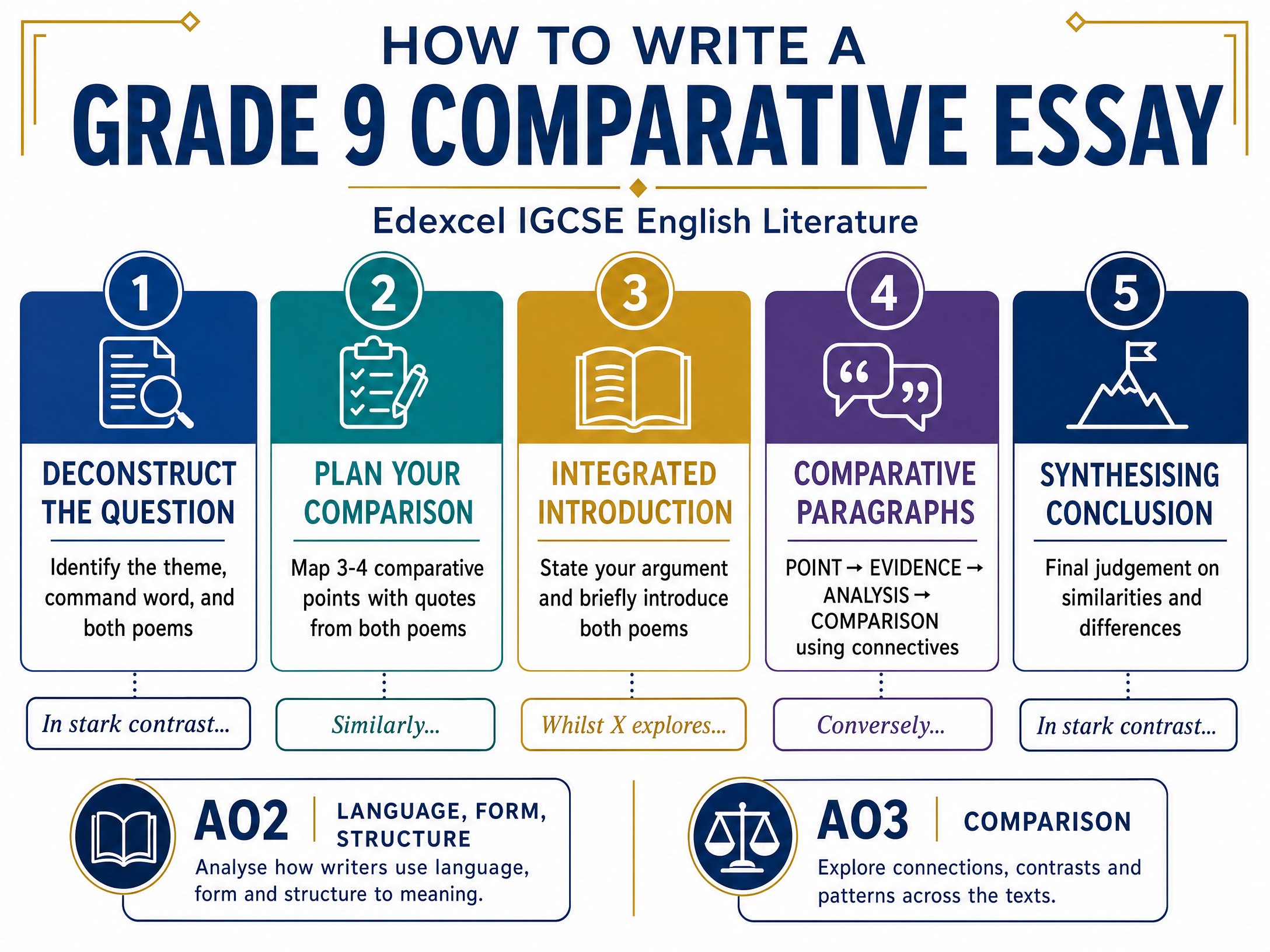
    The most common mistake is sequential analysis (writing about Poem A, then Poem B). You must write integrated comparative paragraphs.

    Use this structure for every paragraph:

    1. Point: A comparative statement addressing the question (e.g., "Both poets present childhood as a time of intense vulnerability, though Fanthorpe focuses on confusion while Scannell highlights betrayal.")
    2. Evidence A: A short, embedded quote from Poem A.
    3. Analysis A: Analyse the method (AO2) and its effect.
    4. Connective: Use a sophisticated comparative phrase (e.g., "Conversely, ...", "Similarly, ...", "In stark contrast, ...").
    5. Evidence B: A quote from Poem B.
    6. Analysis B: Analyse the method (AO2) and how it relates to Poem A.
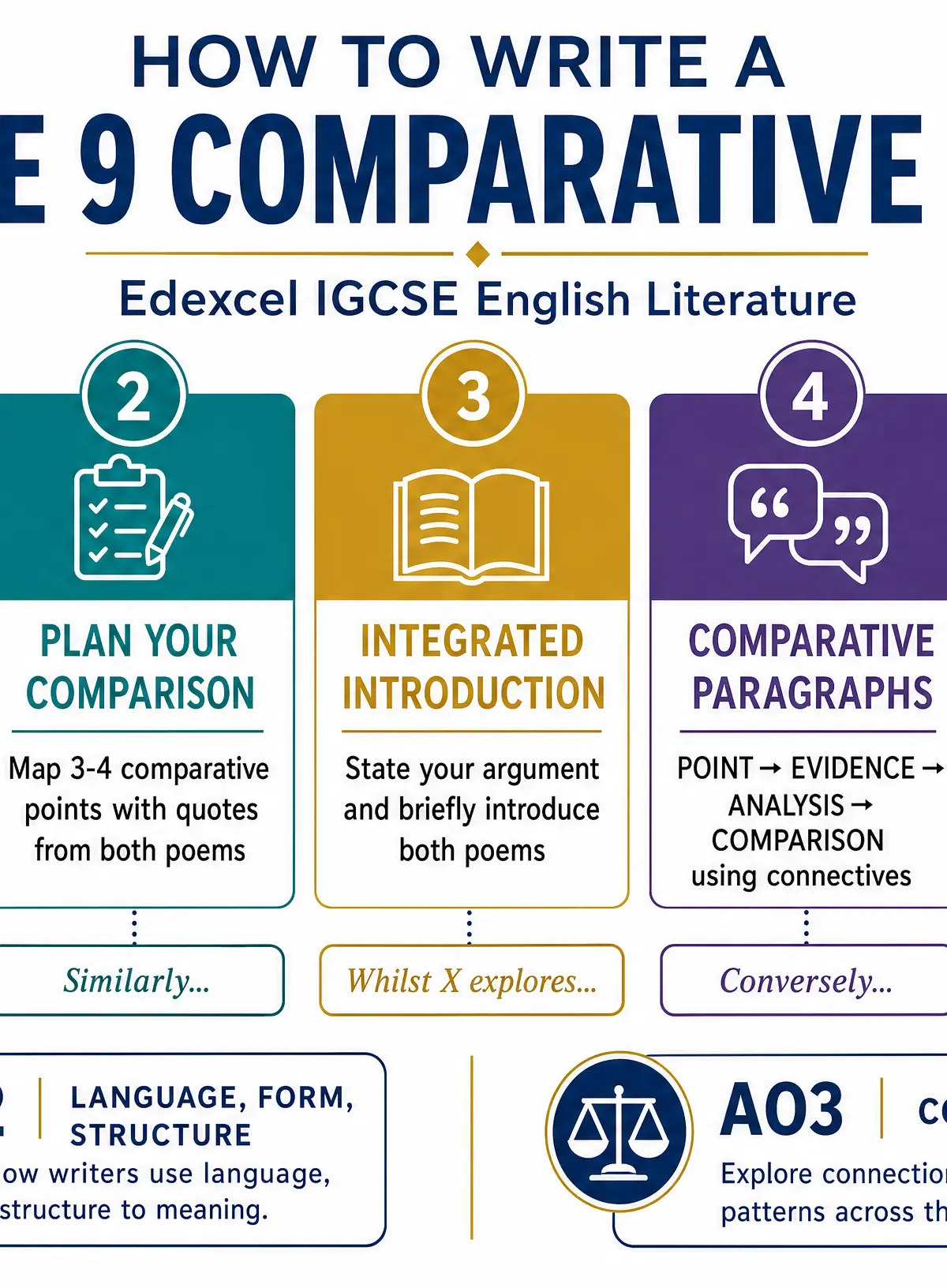
    How to Write a Grade 9 Comparative Essay

    Podcast Episode

    Listen to this 10-minute podcast episode for a deep dive into comparative analysis, examiner tips, and a quick-fire recall quiz.

    Mastering Comparative Poetry Analysis Podcast

    Visual Resources

    2 diagrams and illustrations
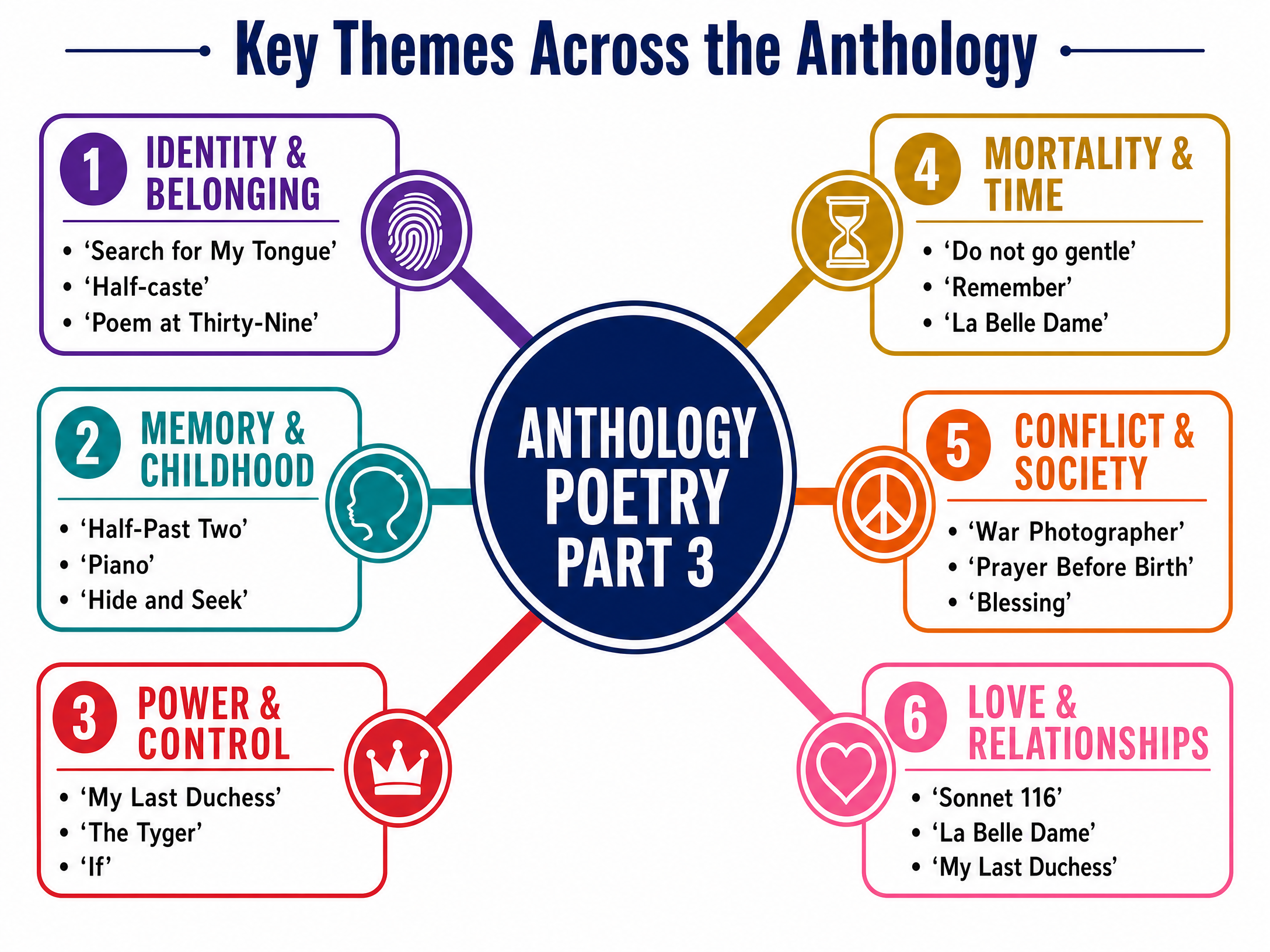
    Key Themes Across the Anthology
    Key Themes Across the Anthology
    How to Write a Grade 9 Comparative Essay
    How to Write a Grade 9 Comparative Essay

    Interactive Diagrams

    1 interactive diagram to visualise key concepts

    Comparative links for the theme of Identity

    Worked Examples

    1 detailed example with solutions and examiner commentary

    Practice Questions

    Test your understanding — click to reveal model answers

    Q1

    Re-read 'Search for My Tongue'. Compare how the writers explore the theme of identity in 'Search for My Tongue' and one other poem from the anthology. (30 marks)

    30 marks
    standard

    Hint: 'Half-caste' is an excellent comparison. Consider how Bhatt's struggle is internal (losing her language), while Agard's struggle is external (fighting societal labels).

    Q2

    Re-read 'My Last Duchess'. Compare the ways the writers present power in 'My Last Duchess' and one other poem from the anthology. (30 marks)

    30 marks
    hard

    Hint: 'The Tyger' works well for a contrast between human, corrupt power and divine, awe-inspiring power. 'War Photographer' works to contrast the Duke's active abuse of power with the photographer's powerless observation.

    Q3

    Re-read 'Half-Past Two'. Compare how the writers present childhood memories in 'Half-Past Two' and 'Piano'. (30 marks)

    30 marks
    standard

    Hint: Focus on how time operates in both poems. In Fanthorpe's poem, the child is trapped outside of time. In Lawrence's poem, the adult is dragged back through time.

    Q4

    Re-read 'Prayer Before Birth'. Compare the ways the writers present the dark side of humanity in 'Prayer Before Birth' and 'War Photographer'. (30 marks)

    30 marks
    hard

    Hint: Look at the scale. MacNeice presents a global, apocalyptic darkness. Duffy presents a specific, documented darkness and the apathy of the public.

    Key Terms

    Essential vocabulary to know