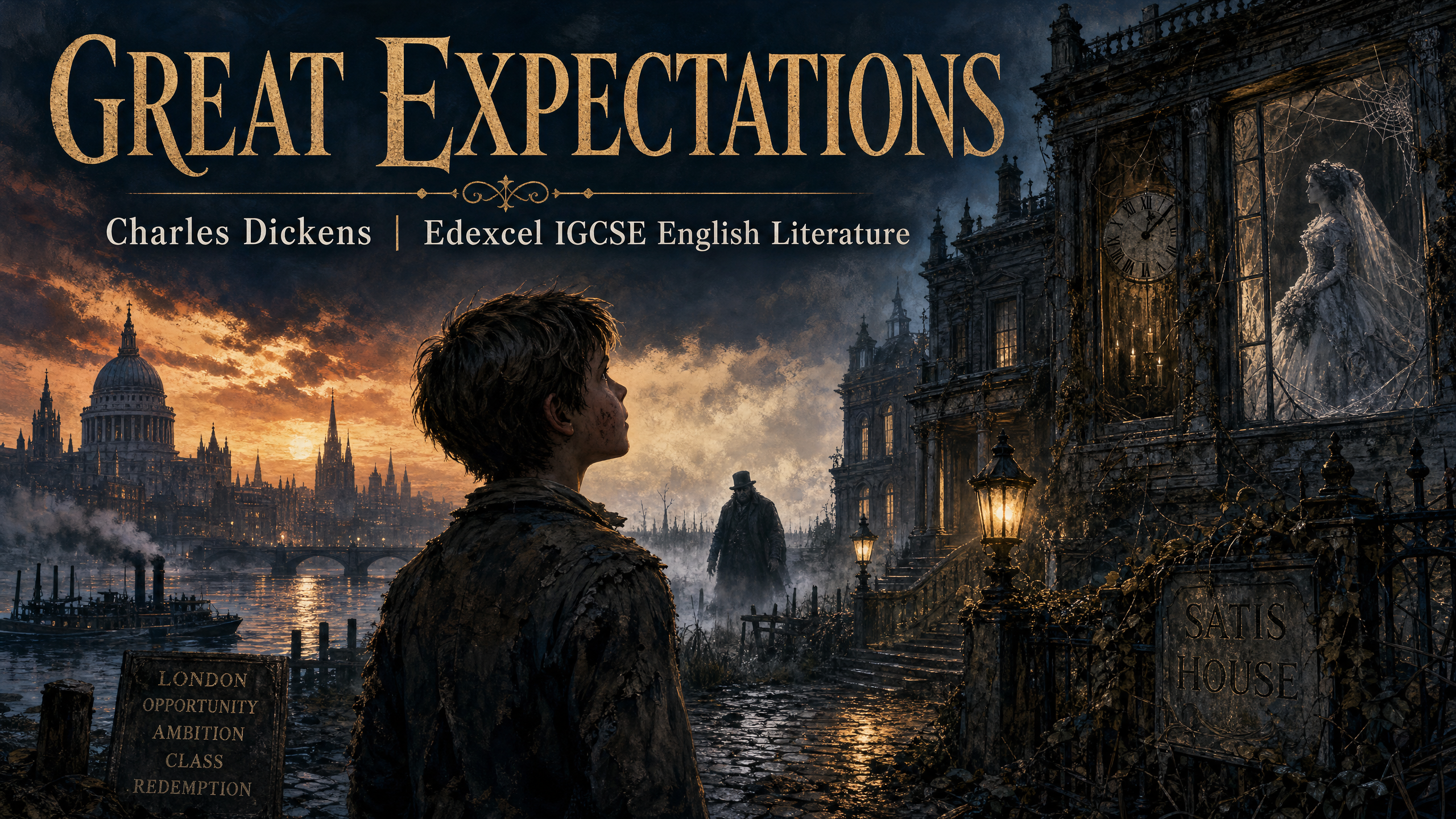
Great Expectations Revision Notes

    Introduction

    Comprehensive revision notes for Edexcel IGCSE.

    Summary & Overview

    Great Expectations is a masterpiece of Victorian literature that dissects the corrupting influence of wealth and the true nature of gentlemanliness. It rewards careful study with its intricate plot, unforgettable characters, and profound moral vision, offering excellent opportunities for sophisticated analysis of Dickens's narrative methods.

    Study Material

    ![Header image for Great Expectations](https://xnnrgnazirrqvdgfhvou.supabase.co/storage/v1/object/public/study-guide-assets/guide_c6ff6371-d5db-4c24-91cf-f9aa98132fab/header_image.png) ## Overview Charles Dickens's *Great Expectations* (1860-61) is a definitive Victorian *Bildungsroman* (coming-of-age novel) that explores the moral education of its protagonist, Pip. For the Edexcel IGCSE Literature exam, examiners are looking for a perceptive understanding of how Dickens uses narrative voice, setting, and characterisation to critique the rigid class structures and justice system of 19th-century England. Candidates must demonstrate an ability to weave close textual analysis (AO2) with an understanding of the novel's historical and social context (AO3), moving beyond plot summary to evaluate the text's deeper thematic concerns. Listen to our 10-minute revision podcast for a comprehensive overview of the novel's key themes and exam strategies: ![Great Expectations Revision Podcast](https://xnnrgnazirrqvdgfhvou.supabase.co/storage/v1/object/public/study-guide-assets/guide_c6ff6371-d5db-4c24-91cf-f9aa98132fab/great_expectations_podcast.mp3) ## Plot/Content Overview **Stage One: The Marshes (Chapters 1-19)** The novel opens with young Pip, an orphan living with his abusive sister Mrs Joe and her kind husband, the blacksmith Joe Gargery. On the desolate Kent marshes, Pip is terrified into helping an escaped convict, Abel Magwitch. Soon after, Pip is invited to Satis House to entertain the eccentric, wealthy Miss Havisham and her beautiful but cruel ward, Estella. Pip falls deeply in love with Estella and becomes ashamed of his working-class origins. **Stage Two: London (Chapters 20-39)** Pip is informed by the lawyer Mr Jaggers that he has come into a handsome property and is to be educated as a gentleman in London. Believing Miss Havisham to be his secret benefactor, Pip moves to London, where he befriends Herbert Pocket. However, Pip becomes increasingly snobbish, neglecting Joe and accumulating debts, while continuing his hopeless pursuit of Estella. **Stage Three: The Return (Chapters 40-59)** The dramatic climax occurs when Magwitch returns from Australia and reveals himself as Pip's true benefactor. Pip is initially horrified but undergoes a profound moral transformation as he attempts to help Magwitch escape the law. Magwitch is captured and dies in prison, while Pip's fortune is forfeited to the Crown. Pip falls seriously ill and is nursed back to health by the ever-faithful Joe. Humbled and repentant, Pip returns to the forge, finally understanding the true value of love and loyalty over wealth and status. ## Themes ![Key Themes in Great Expectations](https://xnnrgnazirrqvdgfhvou.supabase.co/storage/v1/object/public/study-guide-assets/guide_c6ff6371-d5db-4c24-91cf-f9aa98132fab/themes_map.png) ### Theme 1: Social Class and Ambition Dickens presents a scathing critique of the Victorian class system, demonstrating that social status is entirely disconnected from moral worth. Pip's ambition to become a gentleman leads to his moral degradation, as he abandons the genuine affection of Joe for the superficiality of London society. **Key Quotes**: - "I am not what I was" (Chapter 14) - Pip's tragic rejection of his identity and origins in pursuit of a false ideal. - "I wanted to make Joe less ignorant and common, that he might be worthier of my society" (Chapter 15) - Reveals Pip's growing snobbery and the corrupting influence of his ambition. - "a gentleman of great expectations" (Chapter 18) - The irony of the title; his expectations are financial, but his moral expectations are ultimately disappointed. ### Theme 2: Wealth and Moral Corruption Wealth in the novel is consistently associated with decay, crime, and moral emptiness. The money Pip receives is tainted by its origins in the penal colony, and Satis House, a symbol of immense wealth, is a place of literal and metaphorical rot. **Key Quotes**: - "I consumed the whole time in thinking how strange it was that I should be encompassed by all this taint of prison and crime" (Chapter 32) - Pip begins to realise the inescapable connection between wealth and criminality. - "It is a most miserable thing to feel ashamed of home" (Chapter 14) - The psychological cost of Pip's desire for wealth and status. ### Theme 3: Love and Obsession The novel contrasts genuine, selfless love (Joe's love for Pip, Herbert's love for Clara) with destructive obsession (Miss Havisham's obsession with revenge, Pip's obsession with Estella). **Key Quotes**: - "Love her, love her, love her! If she favours you, love her. If she wounds you, love her." (Chapter 29) - Miss Havisham's twisted definition of love as a destructive force. - "I loved her against reason, against promise, against peace, against hope, against happiness, against all discouragement that could be." (Chapter 29) - Pip's acknowledgement of the irrational and destructive nature of his obsession. ### Theme 4: Crime and Justice Dickens critiques the harshness and hypocrisy of the Victorian justice system, highlighting how the law favours the wealthy and punishes the poor. Compeyson, the gentleman, receives a lighter sentence than Magwitch, the lower-class orphan, despite being the mastermind of their crimes. **Key Quotes**: - "He set up fur a gentleman, this Compeyson... He was a smooth one to talk, and was a dab at the ways of gentlefolks." (Chapter 42) - Magwitch highlights how the appearance of class subverts justice. ## Character Analysis ![Character Relationships in Great Expectations](https://xnnrgnazirrqvdgfhvou.supabase.co/storage/v1/object/public/study-guide-assets/guide_c6ff6371-d5db-4c24-91cf-f9aa98132fab/character_relationships.png) ### Pip (Philip Pirrip) **Role**: Protagonist and narrator; the lens through which we view the moral landscape of the novel. **Key Traits**: Ambitious, sensitive, easily influenced, ultimately repentant. **Character Arc**: Moves from innocent childhood to corrupted youth, before finally achieving moral maturity through suffering and the rejection of false values. **Essential Quotes**: - "I took the opportunity of being alone in the court-yard, to look at my coarse hands and my common boots." (Chapter 8) - "I only suffer it to be myself who has made me unhappy." (Chapter 44) ### Miss Havisham **Role**: The embodiment of the destructive power of the past and the dangers of revenge. **Key Traits**: Eccentric, manipulative, vengeful, ultimately tragic. **Character Arc**: Frozen in time since being jilted, she uses Estella to break men's hearts, but eventually realises the horror of what she has done and begs Pip for forgiveness. **Essential Quotes**: - "Break their hearts, my pride and hope, break their hearts and have no mercy!" (Chapter 12) - "What have I done! What have I done!" (Chapter 49) ### Estella **Role**: The object of Pip's obsession; a victim of Miss Havisham's manipulation. **Key Traits**: Cold, beautiful, proud, emotionally damaged. **Character Arc**: Raised to be unfeeling, she suffers in an abusive marriage to Drummle before finally achieving a degree of self-awareness and empathy. **Essential Quotes**: - "I have no heart... I have no softness there, no—sympathy—sentiment—nonsense." (Chapter 29) - "I have been bent and broken, but - I hope - into a better shape." (Chapter 59) ### Joe Gargery **Role**: The moral compass of the novel; the embodiment of true, unpretentious goodness. **Key Traits**: Kind, loyal, humble, forgiving. **Character Arc**: Remains steadfast and unchanging in his goodness, serving as a constant benchmark against which Pip's moral failures are measured. **Essential Quotes**: - "Pip, dear old chap, life is made of ever so many partings welded together... and one man's a blacksmith, and one's a whitesmith, and one's a goldsmith, and one's a coppersmith." (Chapter 27) - "Ever the best of friends; ain't us, Pip?" (Chapter 7) ### Abel Magwitch **Role**: Pip's secret benefactor; a victim of society who seeks redemption through another. **Key Traits**: Rough, terrifying, fiercely loyal, grateful. **Character Arc**: Transforms from a terrifying convict to a devoted father figure, revealing the humanity hidden beneath his criminal exterior. **Essential Quotes**: - "Yes, Pip, dear boy, I've made a gentleman on you! It's me wot has done it!" (Chapter 39) - "I'm your second father. You're my son—more to me nor any son." (Chapter 39) ## Writer's Methods Dickens employs several key techniques that candidates must analyse (AO2): **First-Person Retrospective Narrative**: The novel is told by an older, wiser Pip looking back on his younger self. This creates a dual perspective: we experience the events as the young Pip did, but with the moral judgement of the older Pip. Look for moments of irony or self-criticism in the narrative voice. **Caricature and Grotesque**: Dickens often exaggerates physical features to reflect moral character. Jaggers's constant hand-washing, Wemmick's "post-office" mouth, and Miss Havisham's decaying wedding dress are all examples of this technique. **Symbolism and Imagery**: The novel is rich in symbolic landscapes. The mists of the Kent marshes represent uncertainty and danger; Satis House symbolises decay, stasis, and the corrupting nature of wealth; the forge represents warmth, honesty, and true creation. **Structure**: The novel is divided into three distinct "stages" of Pip's expectations, providing a clear structural framework for his moral journey. The serialised publication format also necessitated cliffhangers and dramatic tension at the end of chapters. ## Context To achieve high marks in AO3, candidates must integrate contextual understanding seamlessly into their analysis: **The Victorian Class System**: Society was highly stratified. The novel explores the anxiety surrounding social mobility and the distinction between a "gentleman" by birth/wealth and a "gentleman" by moral character. **Crime and Punishment**: The harshness of the Victorian penal system, including the use of prison hulks and transportation to Australia, forms a crucial backdrop. Dickens critiques the systemic inequalities that criminalise the poor while protecting the wealthy. **Industrialisation and Urbanisation**: The contrast between the rural forge and the polluted, corrupt environment of London reflects Victorian anxieties about the impact of the Industrial Revolution on human relationships. **Dickens's Biography**: Dickens's own experience of poverty and his father's imprisonment in the Marshalsea debtors' prison profoundly influenced his sympathy for the poor and his critique of social injustice.

    Great Expectations

    Edexcel
    IGCSE
    English Literature

    Great Expectations is a masterpiece of Victorian literature that dissects the corrupting influence of wealth and the true nature of gentlemanliness. It rewards careful study with its intricate plot, unforgettable characters, and profound moral vision, offering excellent opportunities for sophisticated analysis of Dickens's narrative methods.

    9
    Min Read
    2
    Examples
    4
    Questions
    8
    Key Terms
    🎙 Podcast Episode
    Great Expectations
    0:00-0:00

    Study Notes

    Header image for Great Expectations

    Overview

    Charles Dickens's Great Expectations (1860-61) is a definitive Victorian Bildungsroman (coming-of-age novel) that explores the moral education of its protagonist, Pip. For the Edexcel IGCSE Literature exam, examiners are looking for a perceptive understanding of how Dickens uses narrative voice, setting, and characterisation to critique the rigid class structures and justice system of 19th-century England. Candidates must demonstrate an ability to weave close textual analysis (AO2) with an understanding of the novel's historical and social context (AO3), moving beyond plot summary to evaluate the text's deeper thematic concerns.

    Listen to our 10-minute revision podcast for a comprehensive overview of the novel's key themes and exam strategies:
    Great Expectations Revision Podcast

    Plot/Content Overview

    **Stage One: The Marshes (Chapters 1-19)**The novel opens with young Pip, an orphan living with his abusive sister Mrs Joe and her kind husband, the blacksmith Joe Gargery. On the desolate Kent marshes, Pip is terrified into helping an escaped convict, Abel Magwitch. Soon after, Pip is invited to Satis House to entertain the eccentric, wealthy Miss Havisham and her beautiful but cruel ward, Estella. Pip falls deeply in love with Estella and becomes ashamed of his working-class origins.

    **Stage Two: London (Chapters 20-39)**Pip is informed by the lawyer Mr Jaggers that he has come into a handsome property and is to be educated as a gentleman in London. Believing Miss Havisham to be his secret benefactor, Pip moves to London, where he befriends Herbert Pocket. However, Pip becomes increasingly snobbish, neglecting Joe and accumulating debts, while continuing his hopeless pursuit of Estella.

    **Stage Three: The Return (Chapters 40-59)**The dramatic climax occurs when Magwitch returns from Australia and reveals himself as Pip's true benefactor. Pip is initially horrified but undergoes a profound moral transformation as he attempts to help Magwitch escape the law. Magwitch is captured and dies in prison, while Pip's fortune is forfeited to the Crown. Pip falls seriously ill and is nursed back to health by the ever-faithful Joe. Humbled and repentant, Pip returns to the forge, finally understanding the true value of love and loyalty over wealth and status.

    Themes
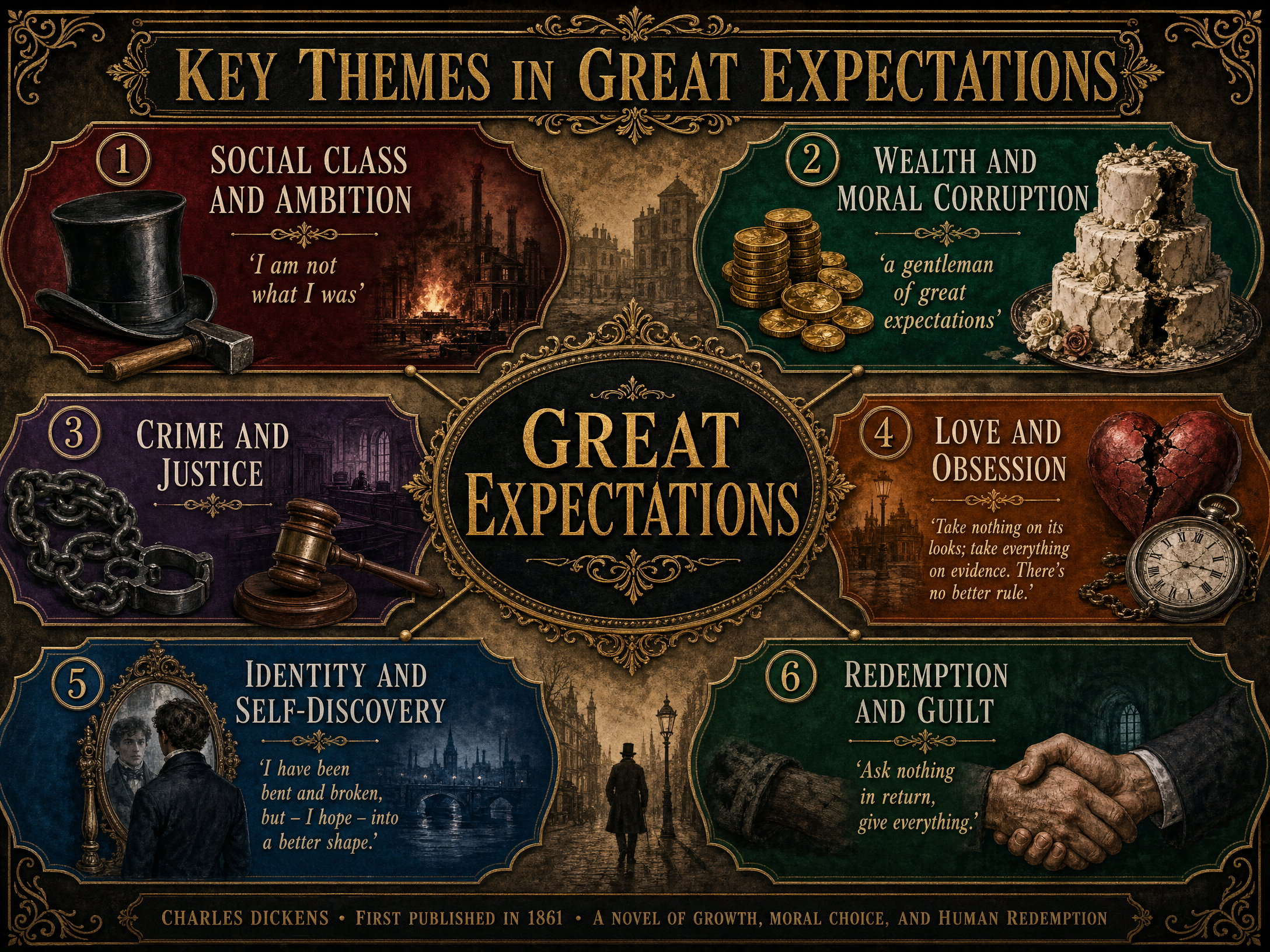
    Key Themes in Great Expectations

    Theme 1: Social Class and Ambition

    Dickens presents a scathing critique of the Victorian class system, demonstrating that social status is entirely disconnected from moral worth. Pip's ambition to become a gentleman leads to his moral degradation, as he abandons the genuine affection of Joe for the superficiality of London society.

    Key Quotes:

    • "I am not what I was" (Chapter 14) - Pip's tragic rejection of his identity and origins in pursuit of a false ideal.
    • "I wanted to make Joe less ignorant and common, that he might be worthier of my society" (Chapter 15) - Reveals Pip's growing snobbery and the corrupting influence of his ambition.
    • "a gentleman of great expectations" (Chapter 18) - The irony of the title; his expectations are financial, but his moral expectations are ultimately disappointed.

    Theme 2: Wealth and Moral Corruption

    Wealth in the novel is consistently associated with decay, crime, and moral emptiness. The money Pip receives is tainted by its origins in the penal colony, and Satis House, a symbol of immense wealth, is a place of literal and metaphorical rot.

    Key Quotes:

    • "I consumed the whole time in thinking how strange it was that I should be encompassed by all this taint of prison and crime" (Chapter 32) - Pip begins to realise the inescapable connection between wealth and criminality.
    • "It is a most miserable thing to feel ashamed of home" (Chapter 14) - The psychological cost of Pip's desire for wealth and status.

    Theme 3: Love and Obsession

    The novel contrasts genuine, selfless love (Joe's love for Pip, Herbert's love for Clara) with destructive obsession (Miss Havisham's obsession with revenge, Pip's obsession with Estella).

    Key Quotes:

    • "Love her, love her, love her! If she favours you, love her. If she wounds you, love her." (Chapter 29) - Miss Havisham's twisted definition of love as a destructive force.
    • "I loved her against reason, against promise, against peace, against hope, against happiness, against all discouragement that could be." (Chapter 29) - Pip's acknowledgement of the irrational and destructive nature of his obsession.

    Theme 4: Crime and Justice

    Dickens critiques the harshness and hypocrisy of the Victorian justice system, highlighting how the law favours the wealthy and punishes the poor. Compeyson, the gentleman, receives a lighter sentence than Magwitch, the lower-class orphan, despite being the mastermind of their crimes.

    Key Quotes:

    • "He set up fur a gentleman, this Compeyson... He was a smooth one to talk, and was a dab at the ways of gentlefolks." (Chapter 42) - Magwitch highlights how the appearance of class subverts justice.

    Character Analysis
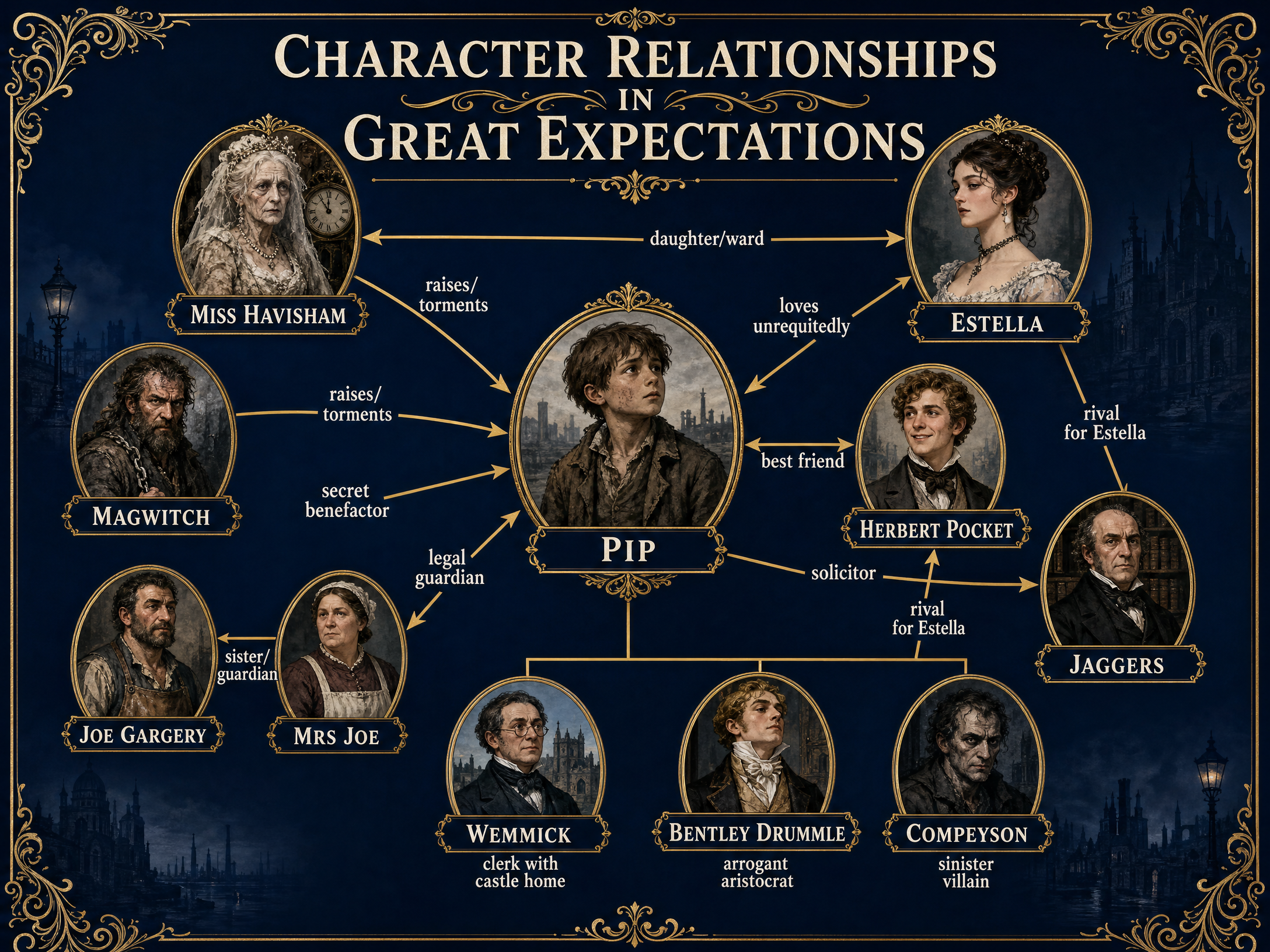
    Character Relationships in Great Expectations

    Pip (Philip Pirrip)

    Role: Protagonist and narrator; the lens through which we view the moral landscape of the novel.

    Key Traits: Ambitious, sensitive, easily influenced, ultimately repentant.

    Character Arc: Moves from innocent childhood to corrupted youth, before finally achieving moral maturity through suffering and the rejection of false values.

    Essential Quotes:

    • "I took the opportunity of being alone in the court-yard, to look at my coarse hands and my common boots." (Chapter 8)
    • "I only suffer it to be myself who has made me unhappy." (Chapter 44)

    Miss Havisham

    Role: The embodiment of the destructive power of the past and the dangers of revenge.

    Key Traits: Eccentric, manipulative, vengeful, ultimately tragic.

    Character Arc: Frozen in time since being jilted, she uses Estella to break men's hearts, but eventually realises the horror of what she has done and begs Pip for forgiveness.

    Essential Quotes:

    • "Break their hearts, my pride and hope, break their hearts and have no mercy!" (Chapter 12)
    • "What have I done! What have I done!" (Chapter 49)

    Estella

    Role: The object of Pip's obsession; a victim of Miss Havisham's manipulation.

    Key Traits: Cold, beautiful, proud, emotionally damaged.

    Character Arc: Raised to be unfeeling, she suffers in an abusive marriage to Drummle before finally achieving a degree of self-awareness and empathy.

    Essential Quotes:

    • "I have no heart... I have no softness there, no—sympathy—sentiment—nonsense." (Chapter 29)
    • "I have been bent and broken, but - I hope - into a better shape." (Chapter 59)

    Joe Gargery

    Role: The moral compass of the novel; the embodiment of true, unpretentious goodness.

    Key Traits: Kind, loyal, humble, forgiving.

    Character Arc: Remains steadfast and unchanging in his goodness, serving as a constant benchmark against which Pip's moral failures are measured.

    Essential Quotes:

    • "Pip, dear old chap, life is made of ever so many partings welded together... and one man's a blacksmith, and one's a whitesmith, and one's a goldsmith, and one's a coppersmith." (Chapter 27)
    • "Ever the best of friends; ain't us, Pip?" (Chapter 7)

    Abel Magwitch

    Role: Pip's secret benefactor; a victim of society who seeks redemption through another.

    Key Traits: Rough, terrifying, fiercely loyal, grateful.

    Character Arc: Transforms from a terrifying convict to a devoted father figure, revealing the humanity hidden beneath his criminal exterior.

    Essential Quotes:

    • "Yes, Pip, dear boy, I've made a gentleman on you! It's me wot has done it!" (Chapter 39)
    • "I'm your second father. You're my son—more to me nor any son." (Chapter 39)

    Writer's Methods

    Dickens employs several key techniques that candidates must analyse (AO2):

    First-Person Retrospective Narrative: The novel is told by an older, wiser Pip looking back on his younger self. This creates a dual perspective: we experience the events as the young Pip did, but with the moral judgement of the older Pip. Look for moments of irony or self-criticism in the narrative voice.

    Caricature and Grotesque: Dickens often exaggerates physical features to reflect moral character. Jaggers's constant hand-washing, Wemmick's "post-office" mouth, and Miss Havisham's decaying wedding dress are all examples of this technique.

    Symbolism and Imagery: The novel is rich in symbolic landscapes. The mists of the Kent marshes represent uncertainty and danger; Satis House symbolises decay, stasis, and the corrupting nature of wealth; the forge represents warmth, honesty, and true creation.

    Structure: The novel is divided into three distinct "stages" of Pip's expectations, providing a clear structural framework for his moral journey. The serialised publication format also necessitated cliffhangers and dramatic tension at the end of chapters.

    Context

    To achieve high marks in AO3, candidates must integrate contextual understanding seamlessly into their analysis:

    The Victorian Class System: Society was highly stratified. The novel explores the anxiety surrounding social mobility and the distinction between a "gentleman" by birth/wealth and a "gentleman" by moral character.

    Crime and Punishment: The harshness of the Victorian penal system, including the use of prison hulks and transportation to Australia, forms a crucial backdrop. Dickens critiques the systemic inequalities that criminalise the poor while protecting the wealthy.

    Industrialisation and Urbanisation: The contrast between the rural forge and the polluted, corrupt environment of London reflects Victorian anxieties about the impact of the Industrial Revolution on human relationships.

    Dickens's Biography: Dickens's own experience of poverty and his father's imprisonment in the Marshalsea debtors' prison profoundly influenced his sympathy for the poor and his critique of social injustice.

    Visual Resources

    2 diagrams and illustrations

    Character Relationships in Great Expectations
    Character Relationships in Great Expectations
    Key Themes in Great Expectations
    Key Themes in Great Expectations

    Interactive Diagrams

    1 interactive diagram to visualise key concepts

    Pip's Bildungsroman Arc: The Journey to Redemption

    Worked Examples

    2 detailed examples with solutions and examiner commentary

    Practice Questions

    Test your understanding — click to reveal model answers

    Q1

    Explore how Dickens presents the character of Joe Gargery and his importance to the novel. (30 marks + 4 AO4)

    34 marks
    standard

    Hint: Consider Joe's role as a moral compass, his contrast with other 'gentlemen', and how Pip's changing attitude towards Joe tracks Pip's own moral decline and redemption.

    Q2

    How does Dickens use settings to reflect the themes of the novel? (30 marks + 4 AO4)

    34 marks
    hard

    Hint: Contrast the forge (warmth, honesty), the marshes (danger, the past, crime), Satis House (decay, stasis, corrupt wealth), and London (superficiality, crime).

    Q3

    Starting with this extract (Magwitch's return in Chapter 39), explore how Dickens presents the relationship between Pip and Magwitch. (30 marks + 4 AO4)

    34 marks
    standard

    Hint: Focus on Pip's initial revulsion in the extract, and then track how this relationship evolves into genuine love and loyalty by the end of the novel.

    Q4

    Explore how Dickens presents the theme of crime and punishment in Great Expectations. (30 marks + 4 AO4)

    34 marks
    hard

    Hint: Look beyond just Magwitch. Consider Compeyson, Jaggers, the Hulks, and how Dickens suggests the entire system is corrupt and biased.

    Key Terms

    Essential vocabulary to know

    Great Expectations Revision Notes — Edexcel IGCSE | MasteryMind