Macbeth Revision Notes

    Subject: English Literature | Level: IGCSE | Exam Board: Edexcel

    Macbeth is a gripping exploration of ambition, guilt, and the supernatural. This guide will equip you with the deep analytical skills and precise textual knowledge needed to excel in your Edexcel IGCSE Literature exam.

    Revision Notes & Key Concepts

    ![Header image for Macbeth](https://xnnrgnazirrqvdgfhvou.supabase.co/storage/v1/object/public/study-guide-assets/guide_c0f359a1-7bb8-4bac-9389-db33beb46082/header_image.png) ## Overview Macbeth, written around 1606, is one of Shakespeare's most profound tragedies. It explores the psychological and political consequences of regicide in a world deeply influenced by Jacobean beliefs about the Divine Right of Kings, witchcraft, and the natural order. For the Edexcel IGCSE Literature exam, examiners are looking for your ability to synthesise plot knowledge with sophisticated analysis of Shakespeare's language, form, and structure (AO2), while seamlessly integrating relevant contextual factors (AO3). Your focus should always be on *how* Shakespeare constructs meaning and *why* he makes specific choices to impact his audience. ## Plot/Content Overview **Act 1**: Returning from a victorious battle, Macbeth and Banquo encounter three witches who prophesy that Macbeth will become Thane of Cawdor and King, while Banquo's descendants will be kings. Duncan names Macbeth Thane of Cawdor. Lady Macbeth reads her husband's letter and immediately plots Duncan's murder, calling on spirits to 'unsex' her. Duncan arrives at Macbeth's castle, Inverness. **Act 2**: Macbeth, plagued by visions of a bloody dagger, murders Duncan in his sleep. Lady Macbeth smears the sleeping guards with blood to frame them. Macduff discovers the body. Duncan's sons, Malcolm and Donalbain, flee, fearing for their lives. Macbeth is crowned King of Scotland. **Act 3**: Fearing the prophecy about Banquo's heirs, Macbeth hires murderers to kill Banquo and his son Fleance. Banquo is killed, but Fleance escapes. At a royal banquet, Macbeth is terrified by the appearance of Banquo's ghost, revealing his psychological deterioration to the lords. Hecate and the witches prepare to further deceive Macbeth. **Act 4**: Macbeth visits the witches, who offer three new prophecies: beware Macduff; no man born of woman shall harm him; and he will not be vanquished until Birnam Wood moves to Dunsinane. Feeling invincible, Macbeth orders the slaughter of Macduff's family. In England, Malcolm tests Macduff's loyalty, and they resolve to march against Macbeth. **Act 5**: Lady Macbeth sleepwalks, consumed by guilt, endlessly washing imaginary blood from her hands. She later dies (implied suicide). Malcolm's army uses branches from Birnam Wood as camouflage, fulfilling the prophecy. Macduff reveals he was 'from his mother's womb untimely ripp'd' (a Caesarean birth), fulfilling the final prophecy. Macduff kills Macbeth, and Malcolm is restored as the rightful King. ![Key Themes in Macbeth](https://xnnrgnazirrqvdgfhvou.supabase.co/storage/v1/object/public/study-guide-assets/guide_c0f359a1-7bb8-4bac-9389-db33beb46082/macbeth_themes_diagram.png) ## Themes ### Theme 1: Ambition Ambition is the driving force of the tragedy, presented not as an inherent evil, but as a destructive flaw when untethered from moral constraint. Shakespeare demonstrates how 'vaulting ambition' corrupts the natural order, leading to psychological ruin and political chaos. **Key Quotes**: - "I have no spur / To prick the sides of my intent, but only / Vaulting ambition, which o'erleaps itself" (Act 1, Scene 7) - Macbeth recognises his fatal flaw. The metaphor of a rider leaping too far and falling foreshadows his inevitable downfall. - "Art not without ambition, but without / The illness should attend it" (Act 1, Scene 5) - Lady Macbeth believes ambition requires ruthlessness ('illness'), highlighting the play's exploration of morality versus power. ### Theme 2: Guilt and Conscience Guilt is presented as an inescapable psychological force that manifests physically and mentally. While Macbeth's guilt precedes the murder and makes him paranoid, Lady Macbeth's guilt is suppressed until it destroys her sanity. **Key Quotes**: - "Will all great Neptune's ocean wash this blood / Clean from my hand?" (Act 2, Scene 2) - Macbeth's hyperbole emphasises the permanence of his sin. The blood is a recurring motif for guilt. - "Out, damned spot! out, I say!" (Act 5, Scene 1) - Lady Macbeth's fragmented prose and imperative verbs reveal her loss of control and the physical manifestation of her suppressed guilt. ### Theme 3: The Supernatural The supernatural elements in Macbeth serve as catalysts for human action, reflecting Jacobean anxieties about witchcraft. The witches represent the temptation of evil and the ambiguity of fate, blurring the lines between external manipulation and internal desire. **Key Quotes**: - "Fair is foul, and foul is fair" (Act 1, Scene 1) - The witches' paradoxical chant establishes the theme of deception and the inversion of moral order. - "Is this a dagger which I see before me" (Act 2, Scene 1) - Macbeth's hallucination questions whether the supernatural is an external force or a projection of his own corrupted mind. ### Theme 4: Appearance vs Reality Shakespeare constantly plays with the dichotomy between what seems to be and what is. Deception is both a political tool and a psychological state, leading to a world where trust is impossible. **Key Quotes**: - "Look like the innocent flower, / But be the serpent under't." (Act 1, Scene 5) - Lady Macbeth's use of juxtaposition and natural imagery highlights the necessity of duplicity in their plot. - "There's no art / To find the mind's construction in the face" (Act 1, Scene 4) - Duncan's tragic flaw is his inability to see past appearances, making him vulnerable to treachery. ![Character Relationships in Macbeth](https://xnnrgnazirrqvdgfhvou.supabase.co/storage/v1/object/public/study-guide-assets/guide_c0f359a1-7bb8-4bac-9389-db33beb46082/character_relationships.png) ## Character Analysis ### Macbeth **Role**: The tragic hero whose fatal flaw (hamartia) leads to his downfall. **Key Traits**: Ambitious, courageous (initially), easily influenced, guilt-ridden, ultimately tyrannical. **Character Arc**: He transitions from a 'valiant cousin' and loyal subject to an isolated, paranoid 'tyrant', losing his humanity and capacity for feeling along the way. **Essential Quotes**: - "Stars, hide your fires; / Let not light see my black and deep desires" (Act 1, Scene 4) - "O, full of scorpions is my mind, dear wife!" (Act 3, Scene 2) - "I am in blood / Stepp'd in so far that, should I wade no more, / Returning were as tedious as go o'er" (Act 3, Scene 4) ### Lady Macbeth **Role**: The catalyst for the tragedy and a subversion of Jacobean gender expectations. **Key Traits**: Manipulative, ruthless, dominant, psychologically fragile. **Character Arc**: She begins as the dominant partner, driving the murder, but becomes increasingly isolated from Macbeth, ultimately succumbing to madness and guilt. **Essential Quotes**: - "Come, you spirits / That tend on mortal thoughts, unsex me here" (Act 1, Scene 5) - "When you durst do it, then you were a man" (Act 1, Scene 7) - "All the perfumes of Arabia will not sweeten this little hand." (Act 5, Scene 1) ### Banquo **Role**: A foil to Macbeth; a character who faces similar temptations but chooses a moral path. **Key Traits**: Noble, loyal, perceptive, cautious. **Character Arc**: He serves as a reminder of the honorable path Macbeth abandons, and his ghost becomes the physical embodiment of Macbeth's guilt. **Essential Quotes**: - "And oftentimes, to win us to our harm, / The instruments of darkness tell us truths" (Act 1, Scene 3) - "Thou hast it now: king, Cawdor, Glamis, all... and, I fear, / Thou play'dst most foully for't" (Act 3, Scene 1) ## Writer's Methods Shakespeare uses a variety of methods to construct meaning in Macbeth: 1. **Imagery and Motifs**: The play is saturated with recurring imagery of blood (representing guilt and violence), sleep (representing innocence and peace), and clothing (representing borrowed or stolen status, e.g., 'borrowed robes'). 2. **Dramatic Irony**: Shakespeare frequently gives the audience knowledge the characters lack, heightening tension. For example, Duncan praising the pleasant atmosphere of Macbeth's castle just before his murder. 3. **Metre and Rhythm**: Noble characters typically speak in blank verse (unrhymed iambic pentameter), conveying rationality and status. The witches speak in trochaic tetrameter, a chant-like rhythm that marks them as unnatural. Lady Macbeth's descent into madness is marked by a shift from verse to fragmented prose. 4. **Soliloquy**: Characters reveal their inner thoughts directly to the audience, creating intimacy and exposing the conflict between their outward actions and internal guilt. ## Context To achieve high marks for AO3, you must integrate contextual understanding seamlessly into your analysis: 1. **The Divine Right of Kings**: The Jacobean belief that the monarch was God's representative on earth. Regicide was not just treason, but a disruption of the natural order (the Great Chain of Being), which is why nature rebels after Duncan's death. 2. **Witchcraft and King James I**: James I was deeply superstitious and wrote *Daemonologie*. The inclusion of witches catered to his interests and reflected societal fears of the supernatural. 3. **The Gunpowder Plot (1605)**: The play echoes the anxieties following the failed Catholic plot to assassinate James I. Themes of treachery, equivocation, and the consequences of rebellion would resonate powerfully with the contemporary audience. 4. **Patriarchal Society**: Jacobean society was strictly patriarchal. Lady Macbeth's dominance and desire to be 'unsexed' would have been shocking, representing a dangerous subversion of the natural order. ![Macbeth Revision Podcast](https://xnnrgnazirrqvdgfhvou.supabase.co/storage/v1/object/public/study-guide-assets/guide_c0f359a1-7bb8-4bac-9389-db33beb46082/macbeth_podcast.mp3)

    Key Terms & Definitions

    Hamartia
    A fatal flaw leading to the downfall of a tragic hero.
    Hubris
    Excessive pride or self-confidence.
    Equivocation
    The use of ambiguous language to conceal the truth.
    Dramatic Irony
    When the audience knows something the characters do not.
    Soliloquy
    A speech given by a character alone on stage, revealing their inner thoughts.
    Blank Verse
    Unrhymed iambic pentameter, typically spoken by noble characters.
    Motif
    A recurring image or idea that develops a theme.
    Foreshadowing
    A warning or indication of a future event.

    Worked Examples

    Practice Questions

    Macbeth

    Edexcel
    IGCSE
    English Literature

    Macbeth is a gripping exploration of ambition, guilt, and the supernatural. This guide will equip you with the deep analytical skills and precise textual knowledge needed to excel in your Edexcel IGCSE Literature exam.

    9
    Min Read
    2
    Examples
    4
    Questions
    8
    Key Terms
    🎙 Podcast Episode
    Macbeth
    0:00-0:00

    Study Notes

    Header image for Macbeth

    Overview

    Macbeth, written around 1606, is one of Shakespeare's most profound tragedies. It explores the psychological and political consequences of regicide in a world deeply influenced by Jacobean beliefs about the Divine Right of Kings, witchcraft, and the natural order. For the Edexcel IGCSE Literature exam, examiners are looking for your ability to synthesise plot knowledge with sophisticated analysis of Shakespeare's language, form, and structure (AO2), while seamlessly integrating relevant contextual factors (AO3). Your focus should always be on how Shakespeare constructs meaning and why he makes specific choices to impact his audience.

    Plot/Content Overview

    Act 1: Returning from a victorious battle, Macbeth and Banquo encounter three witches who prophesy that Macbeth will become Thane of Cawdor and King, while Banquo's descendants will be kings. Duncan names Macbeth Thane of Cawdor. Lady Macbeth reads her husband's letter and immediately plots Duncan's murder, calling on spirits to 'unsex' her. Duncan arrives at Macbeth's castle, Inverness.

    Act 2: Macbeth, plagued by visions of a bloody dagger, murders Duncan in his sleep. Lady Macbeth smears the sleeping guards with blood to frame them. Macduff discovers the body. Duncan's sons, Malcolm and Donalbain, flee, fearing for their lives. Macbeth is crowned King of Scotland.

    Act 3: Fearing the prophecy about Banquo's heirs, Macbeth hires murderers to kill Banquo and his son Fleance. Banquo is killed, but Fleance escapes. At a royal banquet, Macbeth is terrified by the appearance of Banquo's ghost, revealing his psychological deterioration to the lords. Hecate and the witches prepare to further deceive Macbeth.

    Act 4: Macbeth visits the witches, who offer three new prophecies: beware Macduff; no man born of woman shall harm him; and he will not be vanquished until Birnam Wood moves to Dunsinane. Feeling invincible, Macbeth orders the slaughter of Macduff's family. In England, Malcolm tests Macduff's loyalty, and they resolve to march against Macbeth.

    Act 5: Lady Macbeth sleepwalks, consumed by guilt, endlessly washing imaginary blood from her hands. She later dies (implied suicide). Malcolm's army uses branches from Birnam Wood as camouflage, fulfilling the prophecy. Macduff reveals he was 'from his mother's womb untimely ripp'd' (a Caesarean birth), fulfilling the final prophecy. Macduff kills Macbeth, and Malcolm is restored as the rightful King.
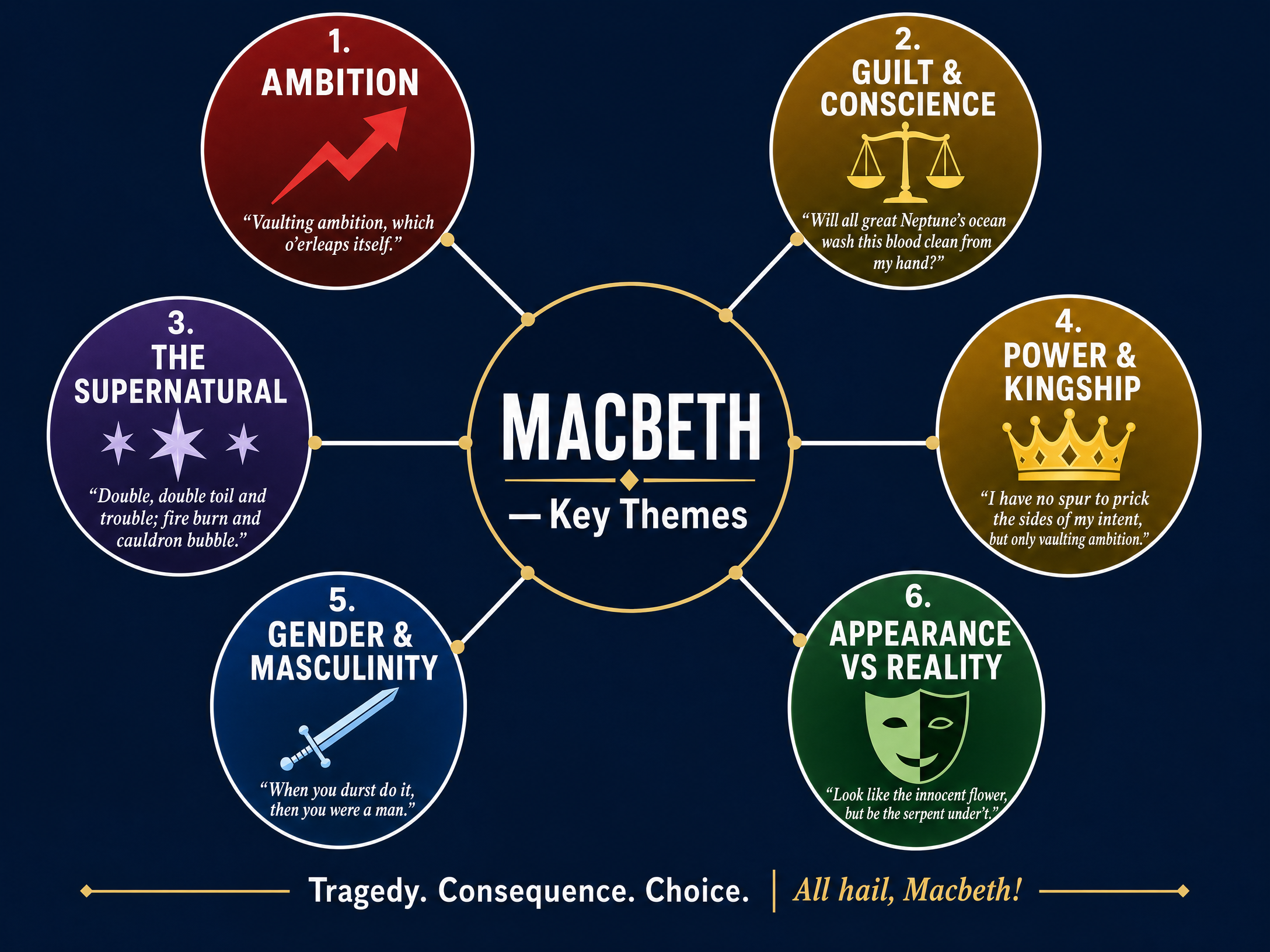
    Key Themes in Macbeth

    Themes

    Theme 1: Ambition

    Ambition is the driving force of the tragedy, presented not as an inherent evil, but as a destructive flaw when untethered from moral constraint. Shakespeare demonstrates how 'vaulting ambition' corrupts the natural order, leading to psychological ruin and political chaos.

    Key Quotes:

    • "I have no spur / To prick the sides of my intent, but only / Vaulting ambition, which o'erleaps itself" (Act 1, Scene 7) - Macbeth recognises his fatal flaw. The metaphor of a rider leaping too far and falling foreshadows his inevitable downfall.
    • "Art not without ambition, but without / The illness should attend it" (Act 1, Scene 5) - Lady Macbeth believes ambition requires ruthlessness ('illness'), highlighting the play's exploration of morality versus power.

    Theme 2: Guilt and Conscience

    Guilt is presented as an inescapable psychological force that manifests physically and mentally. While Macbeth's guilt precedes the murder and makes him paranoid, Lady Macbeth's guilt is suppressed until it destroys her sanity.

    Key Quotes:

    • "Will all great Neptune's ocean wash this blood / Clean from my hand?" (Act 2, Scene 2) - Macbeth's hyperbole emphasises the permanence of his sin. The blood is a recurring motif for guilt.
    • "Out, damned spot! out, I say!" (Act 5, Scene 1) - Lady Macbeth's fragmented prose and imperative verbs reveal her loss of control and the physical manifestation of her suppressed guilt.

    Theme 3: The Supernatural

    The supernatural elements in Macbeth serve as catalysts for human action, reflecting Jacobean anxieties about witchcraft. The witches represent the temptation of evil and the ambiguity of fate, blurring the lines between external manipulation and internal desire.

    Key Quotes:

    • "Fair is foul, and foul is fair" (Act 1, Scene 1) - The witches' paradoxical chant establishes the theme of deception and the inversion of moral order.
    • "Is this a dagger which I see before me" (Act 2, Scene 1) - Macbeth's hallucination questions whether the supernatural is an external force or a projection of his own corrupted mind.

    Theme 4: Appearance vs Reality

    Shakespeare constantly plays with the dichotomy between what seems to be and what is. Deception is both a political tool and a psychological state, leading to a world where trust is impossible.

    Key Quotes:

    • "Look like the innocent flower, / But be the serpent under't." (Act 1, Scene 5) - Lady Macbeth's use of juxtaposition and natural imagery highlights the necessity of duplicity in their plot.
    • "There's no art / To find the mind's construction in the face" (Act 1, Scene 4) - Duncan's tragic flaw is his inability to see past appearances, making him vulnerable to treachery.
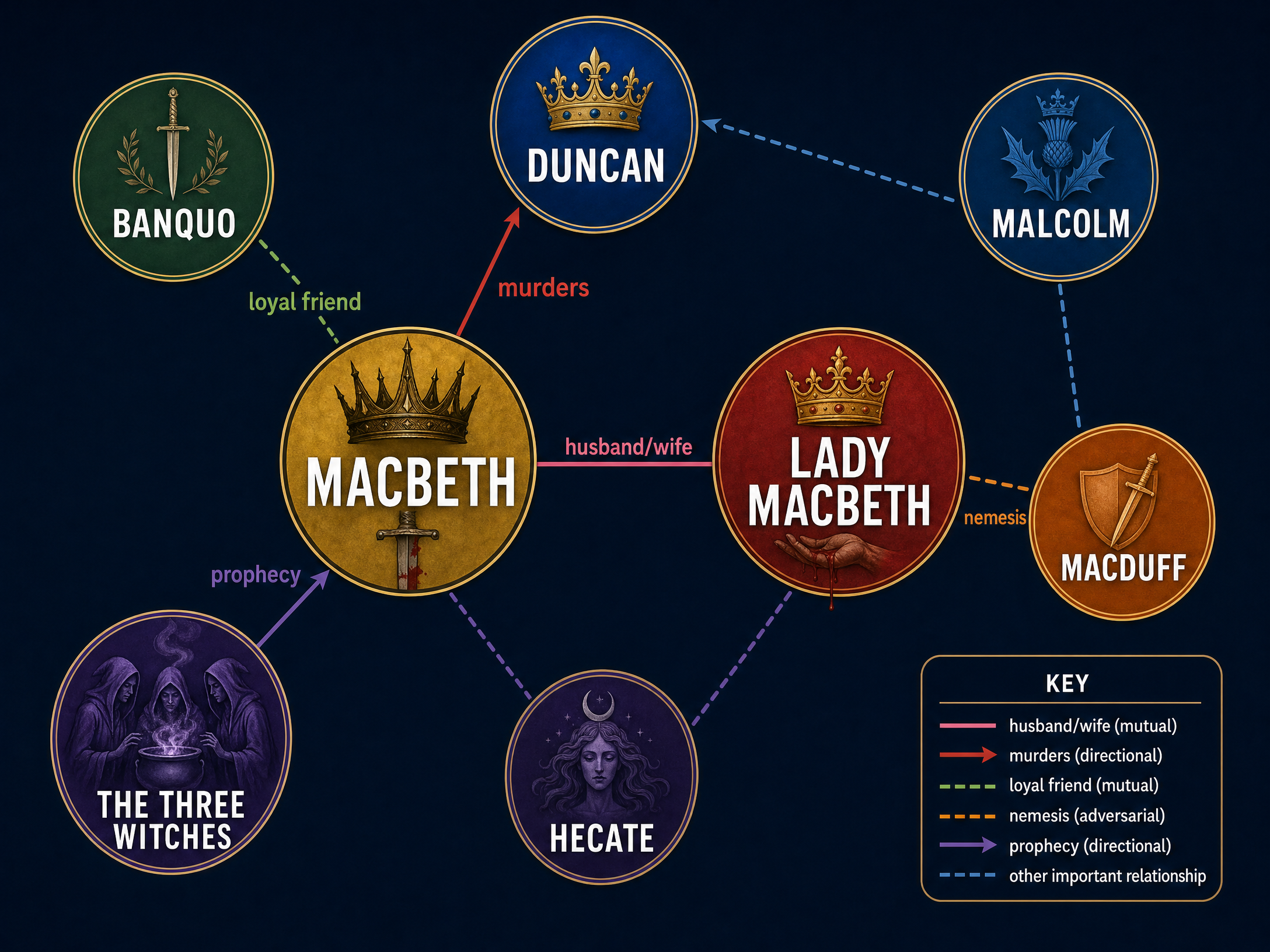
    Character Relationships in Macbeth

    Character Analysis

    Macbeth

    Role: The tragic hero whose fatal flaw (hamartia) leads to his downfall.

    Key Traits: Ambitious, courageous (initially), easily influenced, guilt-ridden, ultimately tyrannical.

    Character Arc: He transitions from a 'valiant cousin' and loyal subject to an isolated, paranoid 'tyrant', losing his humanity and capacity for feeling along the way.

    Essential Quotes:

    • "Stars, hide your fires; / Let not light see my black and deep desires" (Act 1, Scene 4)
    • "O, full of scorpions is my mind, dear wife!" (Act 3, Scene 2)
    • "I am in blood / Stepp'd in so far that, should I wade no more, / Returning were as tedious as go o'er" (Act 3, Scene 4)

    Lady Macbeth

    Role: The catalyst for the tragedy and a subversion of Jacobean gender expectations.

    Key Traits: Manipulative, ruthless, dominant, psychologically fragile.

    Character Arc: She begins as the dominant partner, driving the murder, but becomes increasingly isolated from Macbeth, ultimately succumbing to madness and guilt.

    Essential Quotes:

    • "Come, you spirits / That tend on mortal thoughts, unsex me here" (Act 1, Scene 5)
    • "When you durst do it, then you were a man" (Act 1, Scene 7)
    • "All the perfumes of Arabia will not sweeten this little hand." (Act 5, Scene 1)

    Banquo

    Role: A foil to Macbeth; a character who faces similar temptations but chooses a moral path.

    Key Traits: Noble, loyal, perceptive, cautious.

    Character Arc: He serves as a reminder of the honorable path Macbeth abandons, and his ghost becomes the physical embodiment of Macbeth's guilt.

    Essential Quotes:

    • "And oftentimes, to win us to our harm, / The instruments of darkness tell us truths" (Act 1, Scene 3)
    • "Thou hast it now: king, Cawdor, Glamis, all... and, I fear, / Thou play'dst most foully for't" (Act 3, Scene 1)

    Writer's Methods

    Shakespeare uses a variety of methods to construct meaning in Macbeth:

    1. Imagery and Motifs: The play is saturated with recurring imagery of blood (representing guilt and violence), sleep (representing innocence and peace), and clothing (representing borrowed or stolen status, e.g., 'borrowed robes').
    2. Dramatic Irony: Shakespeare frequently gives the audience knowledge the characters lack, heightening tension. For example, Duncan praising the pleasant atmosphere of Macbeth's castle just before his murder.
    3. Metre and Rhythm: Noble characters typically speak in blank verse (unrhymed iambic pentameter), conveying rationality and status. The witches speak in trochaic tetrameter, a chant-like rhythm that marks them as unnatural. Lady Macbeth's descent into madness is marked by a shift from verse to fragmented prose.
    4. Soliloquy: Characters reveal their inner thoughts directly to the audience, creating intimacy and exposing the conflict between their outward actions and internal guilt.

    Context

    To achieve high marks for AO3, you must integrate contextual understanding seamlessly into your analysis:

    1. The Divine Right of Kings: The Jacobean belief that the monarch was God's representative on earth. Regicide was not just treason, but a disruption of the natural order (the Great Chain of Being), which is why nature rebels after Duncan's death.
    2. Witchcraft and King James I: James I was deeply superstitious and wrote Daemonologie. The inclusion of witches catered to his interests and reflected societal fears of the supernatural.
    3. The Gunpowder Plot (1605): The play echoes the anxieties following the failed Catholic plot to assassinate James I. Themes of treachery, equivocation, and the consequences of rebellion would resonate powerfully with the contemporary audience.
    4. Patriarchal Society: Jacobean society was strictly patriarchal. Lady Macbeth's dominance and desire to be 'unsexed' would have been shocking, representing a dangerous subversion of the natural order.

    Macbeth Revision Podcast

    Visual Resources

    2 diagrams and illustrations

    Key Themes in Macbeth
    Key Themes in Macbeth
    Character Relationships in Macbeth
    Character Relationships in Macbeth

    Interactive Diagrams

    1 interactive diagram to visualise key concepts

    Macbeth's Tragic Character Arc

    Worked Examples

    2 detailed examples with solutions and examiner commentary

    Practice Questions

    Test your understanding — click to reveal model answers

    Q1

    Explore how Shakespeare presents the theme of guilt in Macbeth. You must refer to the context of the play in your answer.

    30 marks
    standard

    Hint: Consider how guilt affects Macbeth and Lady Macbeth differently, and how it manifests physically (blood, sleep deprivation, hallucinations).

    Q2

    Explore how Shakespeare presents Macduff as a foil to Macbeth. You must refer to the context of the play in your answer.

    30 marks
    challenging

    Hint: Look at their different reactions to the king's death, their different views on masculinity (Act 4 Scene 3), and their final confrontation.

    Q3

    Explore how Shakespeare presents the disruption of the natural order in Macbeth.

    30 marks
    standard

    Hint: Link this to the Divine Right of Kings. Discuss the weather, animal behaviour, and mental breakdowns.

    Q4

    Starting with the sleepwalking scene (Act 5, Scene 1), explore how Shakespeare presents Lady Macbeth's loss of power.

    30 marks
    standard

    Hint: Contrast her state in this extract with her dominance in Act 1. Look at her shift from verse to prose.

    Key Terms

    Essential vocabulary to know