Pride and Prejudice
Jane Austen's Pride and Prejudice is a masterful satire of Regency society, wrapped in one of literature's most enduring love stories. Studying this text rewards close attention to Austen's ironic narrative voice and her incisive critique of how wealth and class dictated the lives of women.
Study Notes
Overview
Pride and Prejudice (1813) is a foundational text for Edexcel IGCSE English Literature. It offers a brilliant exploration of Regency England, focusing on the social and economic realities of marriage. Examiners look for candidates who can move beyond the romance plot to analyse Austen's sharp social commentary. You must demonstrate how Austen uses her characters—particularly Elizabeth Bennet and Mr. Darcy—to critique the superficiality, class prejudice, and gender constraints of her era. High-level responses will consistently analyse Austen's narrative methods, especially her use of irony and free indirect discourse, to expose the flaws of her society.
Plot/Content Overview
- Volume I: The arrival of Mr. Bingley and Mr. Darcy at Netherfield sets the plot in motion. Jane Bennet and Bingley form an immediate attachment, while Elizabeth and Darcy clash due to his pride and her prejudice. Mr. Collins visits Longbourn, proposes to Elizabeth (who refuses), and is subsequently accepted by Charlotte Lucas. Wickham arrives and poisons Elizabeth's mind against Darcy.
- Volume II: Jane is heartbroken when Bingley leaves for London. Elizabeth visits Charlotte at Hunsford, where she encounters Lady Catherine de Bourgh and Darcy. Darcy unexpectedly proposes to Elizabeth, but does so insultingly. She rejects him furiously. Darcy writes a letter explaining his interference with Jane and exposing Wickham's true character, forcing Elizabeth to re-evaluate her judgments.
- Volume III: Elizabeth visits Pemberley with her aunt and uncle, where she sees a transformed, gracious Darcy. The crisis hits when Lydia elopes with Wickham, threatening the Bennets with social ruin. Darcy secretly intervenes, paying Wickham to marry Lydia. Bingley returns and proposes to Jane. Lady Catherine attempts to bully Elizabeth into promising not to marry Darcy, which Elizabeth fiercely rejects. Darcy, encouraged by this, proposes again. Elizabeth accepts, and the novel resolves with the triumph of genuine affection over social expectation.
Themes
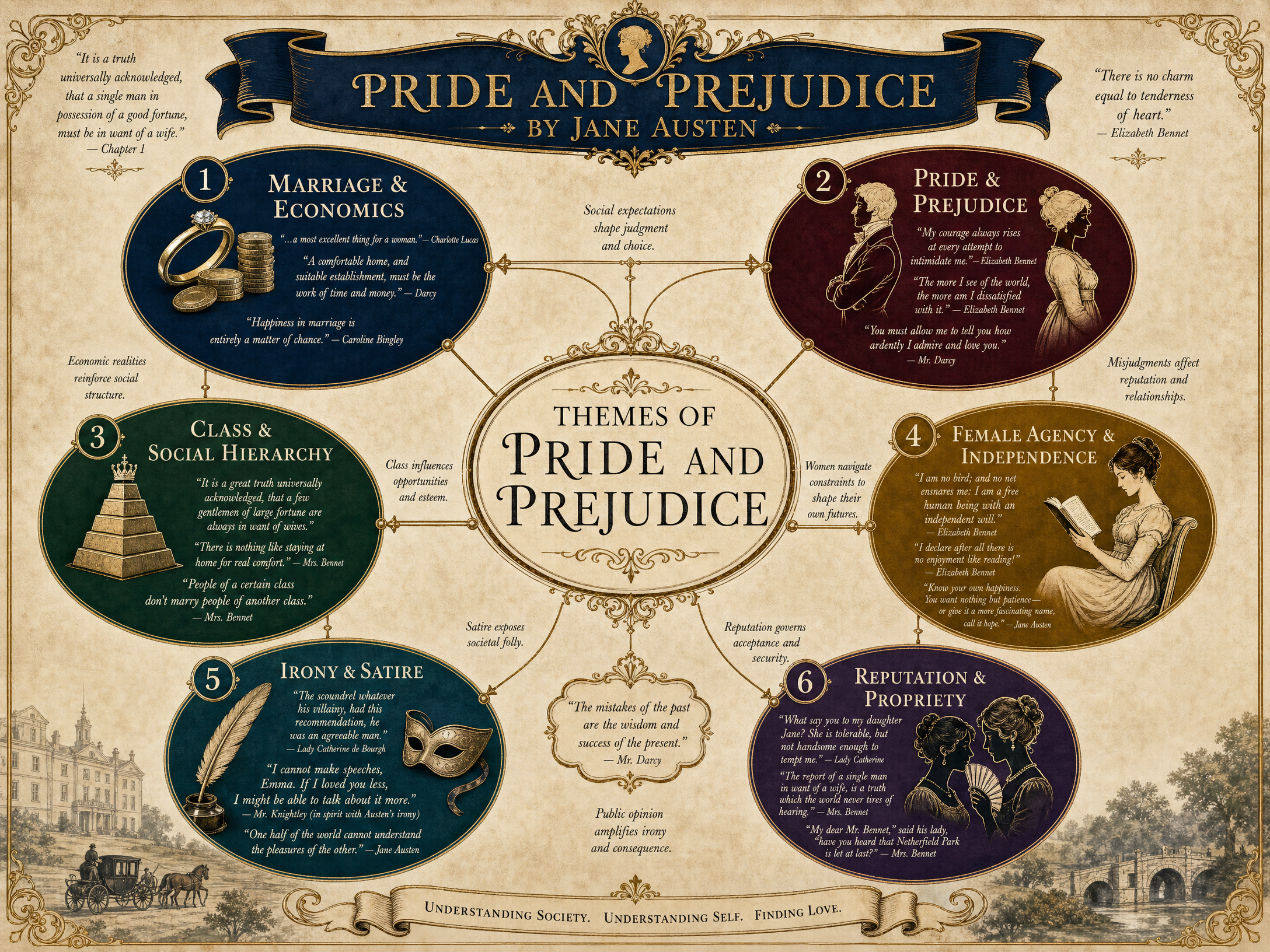
Theme 1: Marriage and Economics
Austen presents marriage not merely as a romantic ideal, but as an economic necessity for women in a society where they could not inherit property or work. The novel explores various models of marriage: the pragmatic (Charlotte and Collins), the reckless (Lydia and Wickham), the flawed (Mr. and Mrs. Bennet), and the ideal partnership of equals (Elizabeth and Darcy).
Key Quotes:
- "It is a truth universally acknowledged, that a single man in possession of a good fortune, must be in want of a wife." (Vol 1, Ch 1) - Austen's ironic opening establishes marriage as a transactional, societal obsession.
- "I am not romantic you know. I never was. I ask only a comfortable home..." (Vol 1, Ch 22) - Charlotte Lucas's pragmatic view highlights the stark economic realities for unmarried women.
Theme 2: Pride and Prejudice
Both central characters suffer from the titular flaws. Darcy's pride in his social standing leads to his initial prejudice against the Bennets. Elizabeth's pride in her own judgement leads to her prejudice against Darcy and her misplaced trust in Wickham. Their character arcs involve unlearning these flaws to achieve true understanding.
Key Quotes:
- "She is tolerable; but not handsome enough to tempt me." (Vol 1, Ch 3) - Darcy's initial pride and dismissiveness at the Meryton assembly.
- "Till this moment, I never knew myself." (Vol 2, Ch 13) - Elizabeth's moment of anagnorisis (recognition) after reading Darcy's letter, realising her prejudice.
Theme 3: Class and Social Hierarchy
Austen critiques the rigid class structure of Regency England. While Darcy represents the established landed gentry and the Bennets the lesser gentry, characters like Lady Catherine embody the arrogant extreme of class consciousness. Austen suggests that true nobility comes from character and behaviour, not just birth.
Key Quotes:
- "He is a gentleman; I am a gentleman's daughter; so far we are equal." (Vol 3, Ch 14) - Elizabeth's assertion of equality to Lady Catherine challenges rigid class boundaries.
- "Are the shades of Pemberley to be thus polluted?" (Vol 3, Ch 14) - Lady Catherine's horror at the prospect of Darcy marrying Elizabeth exposes the absurdity of class snobbery.
Character Analysis
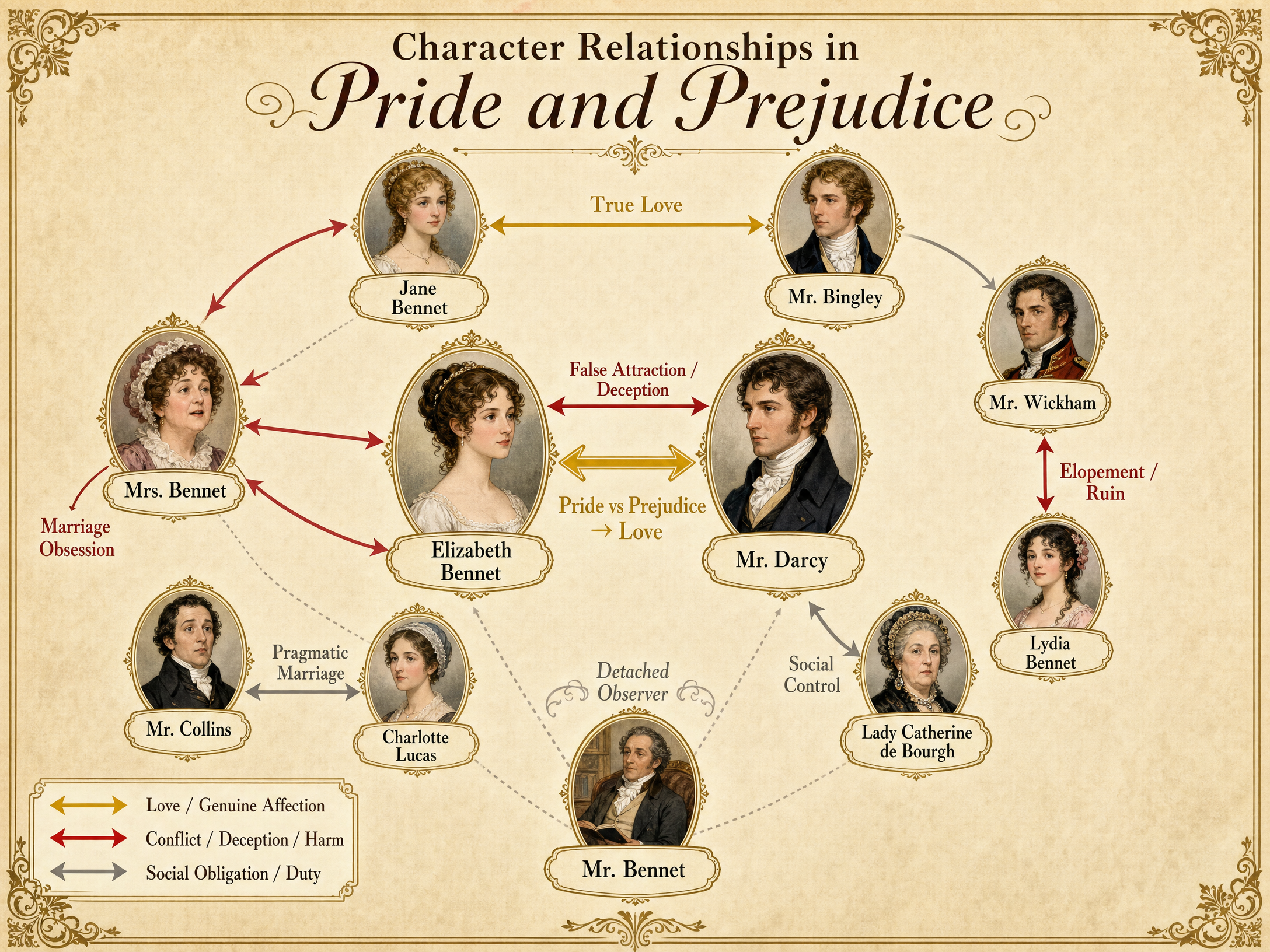
Elizabeth Bennet
Role: The protagonist and the moral centre of the novel.
Key Traits: Intelligent, witty, independent, quick to judge, fiercely loyal.
Character Arc: Elizabeth moves from relying too heavily on her initial impressions (prejudice) to developing a more mature, reflective understanding of character, learning to see past Darcy's exterior and Wickham's charm.
Essential Quotes:
- "I could easily forgive his pride, if he had not mortified mine." (Vol 1, Ch 5)
- "There is a stubbornness about me that never can bear to be frightened at the will of others. My courage always rises at every attempt to intimidate me." (Vol 2, Ch 8)
Mr. Fitzwilliam Darcy
Role: The romantic hero and representation of the landed gentry.
Key Traits: Proud, socially awkward, deeply honourable, generous, capable of change.
Character Arc: Darcy must overcome his ingrained class prejudice and arrogant manner. He learns from Elizabeth's rejection that his wealth does not entitle him to respect without proper behaviour.
Essential Quotes:
- "In vain have I struggled. It will not do. My feelings will not be repressed. You must allow me to tell you how ardently I admire and love you." (Vol 2, Ch 11)
- "By you, I was properly humbled... You showed me how insufficient were all my pretensions to please a woman worthy of being pleased." (Vol 3, Ch 16)
Mr. Collins
Role: A comic foil and a representation of sycophancy and the pragmatic realities of the entailment.
Key Traits: Pompous, obsequious, materialistic, lacking in self-awareness.
Character Arc: Static; he remains a sycophant to Lady Catherine throughout, serving as a contrast to Darcy's genuine nobility.
Essential Quotes:
- "My situation in life, my connections with the family of De Bourgh, and my relationship to your own, are circumstances highly in my favour..." (Vol 1, Ch 19)
Writer's Methods
- Irony: Austen's primary tool. She frequently states the opposite of what she means to expose hypocrisy. The narrative voice is consistently ironic, often adopting the flawed perspectives of society to mock them.
- Free Indirect Discourse: Austen blends the third-person narrative voice with a character's internal thoughts (usually Elizabeth's). This aligns the reader with Elizabeth's prejudices, making her eventual realisation of the truth more impactful for the reader.
- Dialogue: Austen reveals character entirely through speech. Mr. Collins's long, convoluted sentences reveal his pomposity; Elizabeth's quick, witty retorts show her intelligence; Mrs. Bennet's repetitive, hyperbolic complaints show her foolishness.
- Epistolary Elements: Letters are crucial structural devices. Darcy's letter to Elizabeth acts as the fulcrum of the novel, shifting the narrative direction and Elizabeth's perspective.
Context
- The Entailment: The legal mechanism preventing the Bennet estate from passing to female heirs. This is the driving economic engine of the plot, explaining Mrs. Bennet's desperation.
- The Role of Women: Middle- and upper-class women could not work. Their only acceptable path to financial security was marriage. Charlotte Lucas's choice must be understood in this harsh light.
- Social Mobility: The Regency era saw the rise of the newly wealthy (like the Bingleys, whose money comes from trade), creating tension with the established landed gentry (like Darcy and Lady Catherine).
- The Napoleonic Wars: The presence of the militia in Meryton reflects the historical reality of the wars with France, though Austen focuses on the domestic impact (the officers as marriage prospects) rather than the conflict itself.
Visual Resources
2 diagrams and illustrations
Interactive Diagrams
1 interactive diagram to visualise key concepts
Conceptual Flow Outline
The Arc of Elizabeth and Darcy's Relationship
Worked Examples
2 detailed examples with solutions and examiner commentary
Practice Questions
Test your understanding — click to reveal model answers
Starting with this extract (Mr. Collins's proposal, Vol 1, Ch 19), explore how Austen presents the character of Mr. Collins. (30 marks + 4 AO4)
Hint: Consider how his language reveals his pomposity, and how he views marriage as a business transaction rather than a romantic union.
Explore how Austen presents the theme of social class in Pride and Prejudice. (30 marks + 4 AO4)
Hint: Look at characters at different levels: Lady Catherine (aristocracy), Darcy (landed gentry), the Bingleys (new money), and the Bennets (lesser gentry).
How does Austen present the relationship between Jane and Elizabeth Bennet? (30 marks + 4 AO4)
Hint: Think of them as foils. How does Jane's optimism contrast with Elizabeth's cynicism?
Explore the significance of the title Pride and Prejudice. (30 marks + 4 AO4)
Hint: Don't just assign 'Pride' to Darcy and 'Prejudice' to Elizabeth. Show how both characters suffer from both flaws.