Romeo and Juliet Revision Notes

    Subject: English Literature | Level: IGCSE | Exam Board: Edexcel

    Romeo and Juliet is Shakespeare's iconic tragedy of 'star-cross'd lovers' destroyed by an ancient family feud. Studying this text offers rich opportunities to analyse powerful dramatic irony, explore complex themes of fate versus free will, and examine some of the most beautiful poetic language in the English canon. Examiners consistently reward candidates who can confidently connect Shakespeare's linguistic choices to the play's driving sense of tragic inevitability.

    Revision Notes & Key Concepts

    ![Header image for Romeo and Juliet](https://xnnrgnazirrqvdgfhvou.supabase.co/storage/v1/object/public/study-guide-assets/guide_bbb1bed7-ee46-4f7e-811d-9dd699f0f92d/header_image.png) ## Overview William Shakespeare's *Romeo and Juliet* (c. 1595) is a masterclass in dramatic tension, charting the rapid, fatal romance of two teenagers from warring Veronese families. For Edexcel IGCSE Literature, examiners are not looking for simple plot retellings; they want to see critical engagement with *how* Shakespeare constructs the tragedy. You must demonstrate an understanding of the play's structural momentum—how comedy shifts abruptly to tragedy in Act 3—and analyse Shakespeare's methods, from his use of the Petrarchan sonnet form to his vivid, contrasting imagery of light and dark. Contextually, top-band answers will seamlessly weave in Elizabethan concepts of patriarchal authority, the Great Chain of Being, and the powerful belief in astrological fate. ## Plot/Content Overview **Act 1: The Feud and The Meeting** The play opens with a violent street brawl between the Montagues and Capulets, establishing the volatile atmosphere of Verona. Romeo, initially lovesick for Rosaline, is persuaded to crash the Capulet ball. There, he meets Juliet; they fall instantly in love, discovering only afterwards that they are sworn enemies. **Act 2: The Secret Marriage** In the famous balcony scene, Romeo and Juliet declare their love and resolve to marry. Friar Lawrence agrees to perform the secret ceremony, hoping it will end the family feud. The Nurse acts as their messenger, and the two are married in secret. **Act 3: The Turning Point** The play's comedic tone fractures when Tybalt challenges Romeo. Romeo refuses to fight his new kinsman, prompting Mercutio to step in. Tybalt kills Mercutio, and in a vengeful rage, Romeo kills Tybalt. The Prince banishes Romeo from Verona. Meanwhile, Lord Capulet arranges for Juliet to marry Paris in three days. **Act 4: Desperation** Romeo and Juliet spend one secret night together before he flees to Mantua. When Juliet refuses to marry Paris, her father threatens to disown her. Desperate, she turns to Friar Lawrence, who gives her a potion to simulate death for 42 hours, planning to send for Romeo to rescue her from the family vault. **Act 5: The Tragedy** The Friar's message fails to reach Romeo. Hearing Juliet is dead, Romeo buys poison and breaks into her tomb. He kills a grieving Paris, drinks the poison, and dies beside Juliet. Juliet awakens, finds Romeo dead, and stabs herself with his dagger. The tragic discovery of their bodies finally forces the Montagues and Capulets to end their feud. ![Key Themes in Romeo and Juliet](https://xnnrgnazirrqvdgfhvou.supabase.co/storage/v1/object/public/study-guide-assets/guide_bbb1bed7-ee46-4f7e-811d-9dd699f0f92d/themes_diagram.png) ## Themes ### Theme 1: Fate and Inevitability Shakespeare establishes the dominance of fate immediately in the Prologue, ensuring the audience watches the play through the lens of dramatic irony. The characters' belief in astrology reflects Elizabethan views on destiny. Every impulsive decision and unfortunate coincidence tightens the net around the lovers, making their demise feel tragically inescapable. **Key Quotes**: - "A pair of star-cross'd lovers take their life." (Prologue) - *Analysis: The celestial imagery immediately strips the lovers of agency; their tragic end is predetermined by the cosmos.* - "O, I am fortune's fool!" (Act 3, Scene 1) - *Analysis: Romeo's realization after killing Tybalt highlights his recognition of his own powerlessness against destiny, personifying 'fortune' as a cruel puppet master.* - "Then I defy you, stars!" (Act 5, Scene 1) - *Analysis: Romeo's final, hubristic attempt to assert free will ironically seals his fated doom.* ### Theme 2: Love versus Hate The play juxtaposes the pure, transcendent love of Romeo and Juliet against the toxic, entrenched hatred of their families. Shakespeare uses language to show how love and violence are dangerously intertwined in Verona's society; passion quickly turns to aggression, and romantic devotion demands ultimate sacrifice. **Key Quotes**: - "My only love sprung from my only hate!" (Act 1, Scene 5) - *Analysis: Juliet's use of paradox perfectly encapsulates the central conflict of the play; love and hate are inextricably linked.* - "These violent delights have violent ends." (Act 2, Scene 6) - *Analysis: Friar Lawrence's prophetic warning uses repetition to link intense passion directly to destructive outcomes.* - "What, drawn, and talk of peace? I hate the word, / As I hate hell, all Montagues, and thee." (Act 1, Scene 1) - *Analysis: Tybalt's dialogue aligns the Montagues with religious damnation, showing how deeply ingrained and irrational the family hatred is.* ### Theme 3: Youth and Age (Generational Conflict) The tragedy is driven by the failure of the older generation to guide and protect the young. The ancient grudge of the parents forces the children into deception. The impatience and passion of youth clash fatally with the rigid, patriarchal demands of adulthood. **Key Quotes**: - "Hang thee, young baggage! disobedient wretch!" (Act 3, Scene 5) - *Analysis: Capulet's violent outburst reduces Juliet to a burdensome object, highlighting the absolute, tyrannical nature of Elizabethan patriarchal authority.* - "Unwieldy, slow, heavy and pale as lead." (Act 2, Scene 5) - *Analysis: Juliet's frustrated description of the Nurse contrasts the urgent, fiery impatience of youth with the sluggishness of the older generation.* ![Character Relationships in Romeo and Juliet](https://xnnrgnazirrqvdgfhvou.supabase.co/storage/v1/object/public/study-guide-assets/guide_bbb1bed7-ee46-4f7e-811d-9dd699f0f92d/character_relationships.png) ## Character Analysis ### Romeo Montague **Role**: The tragic hero; driven by passion rather than reason. **Key Traits**: Impulsive, romantic, articulate, emotionally volatile. **Character Arc**: Romeo begins as a performative, melancholic Petrarchan lover obsessed with Rosaline. Meeting Juliet matures his language and deepens his capacity for genuine love, but his fatal flaw—his rash impulsivity—ultimately drives him to murder and suicide. **Essential Quotes**: - "O brawling love! O loving hate!" (Act 1, Scene 1) - "It is the east, and Juliet is the sun." (Act 2, Scene 2) - "Fire-eyed fury be my conduct now!" (Act 3, Scene 1) ### Juliet Capulet **Role**: The tragic heroine; the emotional and intellectual anchor of the romance. **Key Traits**: Intelligent, decisive, courageous, pragmatic. **Character Arc**: Juliet transforms rapidly from a naive, obedient child to a fiercely independent young woman. She is more practical than Romeo, questioning the speed of their romance, and shows immense bravery in defying her family and taking the Friar's potion. **Essential Quotes**: - "It is too rash, too unadvised, too sudden." (Act 2, Scene 2) - "My dismal scene I needs must act alone." (Act 4, Scene 3) - "O happy dagger! This is thy sheath." (Act 5, Scene 3) ### Friar Lawrence **Role**: The adult confidant and catalyst for the tragic plot. **Key Traits**: Well-intentioned, philosophical, politically motivated, ultimately cowardly. **Character Arc**: The Friar acts as a surrogate father, marrying the lovers to end the feud. However, his complex schemes and reliance on deception unravel, and his final act of abandoning Juliet in the tomb reveals his fatal lack of courage. **Essential Quotes**: - "For this alliance may so happy prove, / To turn your households' rancour to pure love." (Act 2, Scene 3) - "Wisely and slow; they stumble that run fast." (Act 2, Scene 3) ### Mercutio **Role**: Romeo's best friend; the play's cynic and source of comic relief. **Key Traits**: Witty, bawdy, volatile, anti-romantic. **Character Arc**: Mercutio serves as a foil to Romeo, mocking courtly love with sexual innuendo. His death in Act 3 marks the structural pivot of the play, destroying the comedic tone and plunging the narrative into irreversible tragedy. **Essential Quotes**: - "If love be rough with you, be rough with love." (Act 1, Scene 4) - "A plague o' both your houses!" (Act 3, Scene 1) ## Writer's Methods **Light and Dark Imagery**: Shakespeare constantly contrasts light and dark. Romeo compares Juliet to the sun, stars, and torches. Ironically, their love can only exist in the dark (night), while the daylight brings danger, banishment, and reality. **Form and Metre**: The play relies heavily on blank verse (unrhymed iambic pentameter) for noble characters. Crucially, when Romeo and Juliet first meet, their dialogue forms a perfect shared Shakespearean sonnet, symbolising their immediate, perfect harmony and elevating their love to a poetic ideal. **Dramatic Irony**: The audience's foreknowledge of the tragic ending (established in the Prologue) charges every scene with tension. We know Juliet is alive when Romeo buys the poison; this irony makes the climax excruciatingly painful. ## Context **Patriarchal Society**: Elizabethan England was strictly patriarchal. Fathers had absolute legal and moral authority over their daughters. Juliet's refusal to marry Paris would have been shocking to a contemporary audience, making her defiance both courageous and dangerous. **The Great Chain of Being**: The Elizabethans believed in a strict, divinely ordained hierarchy. The feud disrupts this social order, leading to chaos in the streets. Order is only restored through the ultimate sacrifice of the lovers. **Religion and Suicide**: Suicide was considered a mortal sin in Catholic Italy (where the play is set) and Protestant England. The lovers' willingness to commit suicide demonstrates the overwhelming, almost heretical power of their devotion, elevating their love above religious doctrine. --- ### Audio Revision Listen to our 10-minute deep-dive podcast covering the core concepts, themes, and exam strategies for *Romeo and Juliet*. ![Romeo and Juliet Revision Podcast](https://xnnrgnazirrqvdgfhvou.supabase.co/storage/v1/object/public/study-guide-assets/guide_bbb1bed7-ee46-4f7e-811d-9dd699f0f92d/romeo_and_juliet_podcast.mp3)

    Key Terms & Definitions

    Dramatic Irony
    When the audience knows something that the characters on stage do not.
    Petrarchan Lover
    A melodramatic, performative style of loving where a man suffers unrequited love for an idealized, distant woman.
    Oxymoron
    A figure of speech in which apparently contradictory terms appear in conjunction.
    Hamartia (Tragic Flaw)
    A fatal flaw leading to the downfall of a tragic hero.
    Blank Verse
    Unrhymed iambic pentameter.
    Foreshadowing
    A warning or indication of a future event.
    Patriarchy
    A system of society or government in which men hold the power and women are largely excluded from it.
    Catharsis
    The process of releasing, and thereby providing relief from, strong or repressed emotions (pity and fear).

    Worked Examples

    Practice Questions

    Romeo and Juliet

    Edexcel
    IGCSE
    English Literature

    Romeo and Juliet is Shakespeare's iconic tragedy of 'star-cross'd lovers' destroyed by an ancient family feud. Studying this text offers rich opportunities to analyse powerful dramatic irony, explore complex themes of fate versus free will, and examine some of the most beautiful poetic language in the English canon. Examiners consistently reward candidates who can confidently connect Shakespeare's linguistic choices to the play's driving sense of tragic inevitability.

    9
    Min Read
    2
    Examples
    2
    Questions
    8
    Key Terms
    🎙 Podcast Episode
    Romeo and Juliet
    0:00-0:00

    Study Notes

    Header image for Romeo and Juliet

    Overview

    William Shakespeare's Romeo and Juliet (c. 1595) is a masterclass in dramatic tension, charting the rapid, fatal romance of two teenagers from warring Veronese families. For Edexcel IGCSE Literature, examiners are not looking for simple plot retellings; they want to see critical engagement with how Shakespeare constructs the tragedy. You must demonstrate an understanding of the play's structural momentum—how comedy shifts abruptly to tragedy in Act 3—and analyse Shakespeare's methods, from his use of the Petrarchan sonnet form to his vivid, contrasting imagery of light and dark. Contextually, top-band answers will seamlessly weave in Elizabethan concepts of patriarchal authority, the Great Chain of Being, and the powerful belief in astrological fate.

    Plot/Content Overview

    Act 1: The Feud and The MeetingThe play opens with a violent street brawl between the Montagues and Capulets, establishing the volatile atmosphere of Verona. Romeo, initially lovesick for Rosaline, is persuaded to crash the Capulet ball. There, he meets Juliet; they fall instantly in love, discovering only afterwards that they are sworn enemies.

    Act 2: The Secret MarriageIn the famous balcony scene, Romeo and Juliet declare their love and resolve to marry. Friar Lawrence agrees to perform the secret ceremony, hoping it will end the family feud. The Nurse acts as their messenger, and the two are married in secret.

    Act 3: The Turning PointThe play's comedic tone fractures when Tybalt challenges Romeo. Romeo refuses to fight his new kinsman, prompting Mercutio to step in. Tybalt kills Mercutio, and in a vengeful rage, Romeo kills Tybalt. The Prince banishes Romeo from Verona. Meanwhile, Lord Capulet arranges for Juliet to marry Paris in three days.

    Act 4: DesperationRomeo and Juliet spend one secret night together before he flees to Mantua. When Juliet refuses to marry Paris, her father threatens to disown her. Desperate, she turns to Friar Lawrence, who gives her a potion to simulate death for 42 hours, planning to send for Romeo to rescue her from the family vault.

    Act 5: The TragedyThe Friar's message fails to reach Romeo. Hearing Juliet is dead, Romeo buys poison and breaks into her tomb. He kills a grieving Paris, drinks the poison, and dies beside Juliet. Juliet awakens, finds Romeo dead, and stabs herself with his dagger. The tragic discovery of their bodies finally forces the Montagues and Capulets to end their feud.
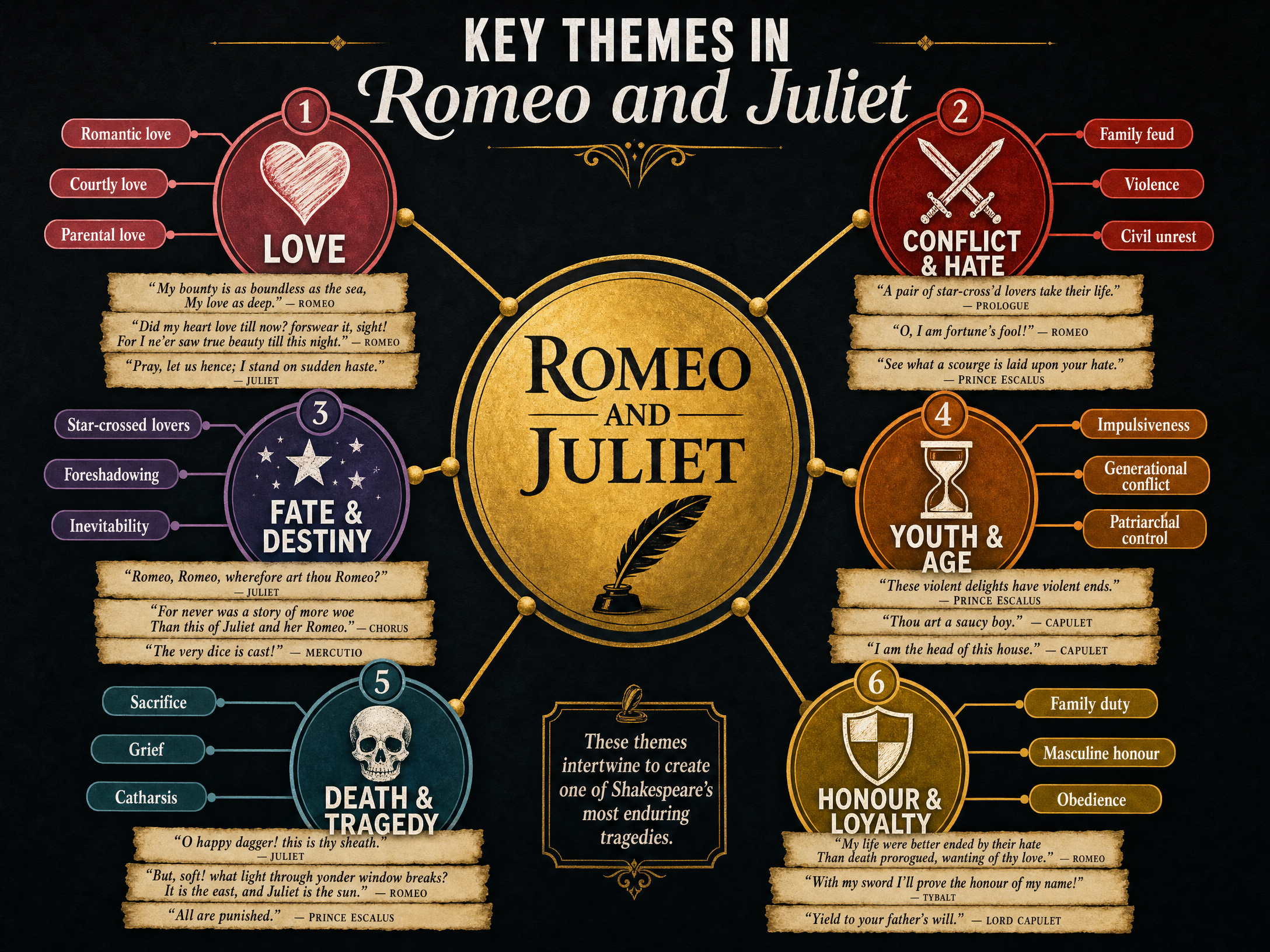
    Key Themes in Romeo and Juliet

    Themes

    Theme 1: Fate and Inevitability

    Shakespeare establishes the dominance of fate immediately in the Prologue, ensuring the audience watches the play through the lens of dramatic irony. The characters' belief in astrology reflects Elizabethan views on destiny. Every impulsive decision and unfortunate coincidence tightens the net around the lovers, making their demise feel tragically inescapable.

    Key Quotes:

    • "A pair of star-cross'd lovers take their life." (Prologue) - Analysis: The celestial imagery immediately strips the lovers of agency; their tragic end is predetermined by the cosmos.
    • "O, I am fortune's fool!" (Act 3, Scene 1) - Analysis: Romeo's realization after killing Tybalt highlights his recognition of his own powerlessness against destiny, personifying 'fortune' as a cruel puppet master.
    • "Then I defy you, stars!" (Act 5, Scene 1) - Analysis: Romeo's final, hubristic attempt to assert free will ironically seals his fated doom.

    Theme 2: Love versus Hate

    The play juxtaposes the pure, transcendent love of Romeo and Juliet against the toxic, entrenched hatred of their families. Shakespeare uses language to show how love and violence are dangerously intertwined in Verona's society; passion quickly turns to aggression, and romantic devotion demands ultimate sacrifice.

    Key Quotes:

    • "My only love sprung from my only hate!" (Act 1, Scene 5) - Analysis: Juliet's use of paradox perfectly encapsulates the central conflict of the play; love and hate are inextricably linked.
    • "These violent delights have violent ends." (Act 2, Scene 6) - Analysis: Friar Lawrence's prophetic warning uses repetition to link intense passion directly to destructive outcomes.
    • "What, drawn, and talk of peace? I hate the word, / As I hate hell, all Montagues, and thee." (Act 1, Scene 1) - Analysis: Tybalt's dialogue aligns the Montagues with religious damnation, showing how deeply ingrained and irrational the family hatred is.

    Theme 3: Youth and Age (Generational Conflict)

    The tragedy is driven by the failure of the older generation to guide and protect the young. The ancient grudge of the parents forces the children into deception. The impatience and passion of youth clash fatally with the rigid, patriarchal demands of adulthood.

    Key Quotes:

    • "Hang thee, young baggage! disobedient wretch!" (Act 3, Scene 5) - Analysis: Capulet's violent outburst reduces Juliet to a burdensome object, highlighting the absolute, tyrannical nature of Elizabethan patriarchal authority.
    • "Unwieldy, slow, heavy and pale as lead." (Act 2, Scene 5) - Analysis: Juliet's frustrated description of the Nurse contrasts the urgent, fiery impatience of youth with the sluggishness of the older generation.
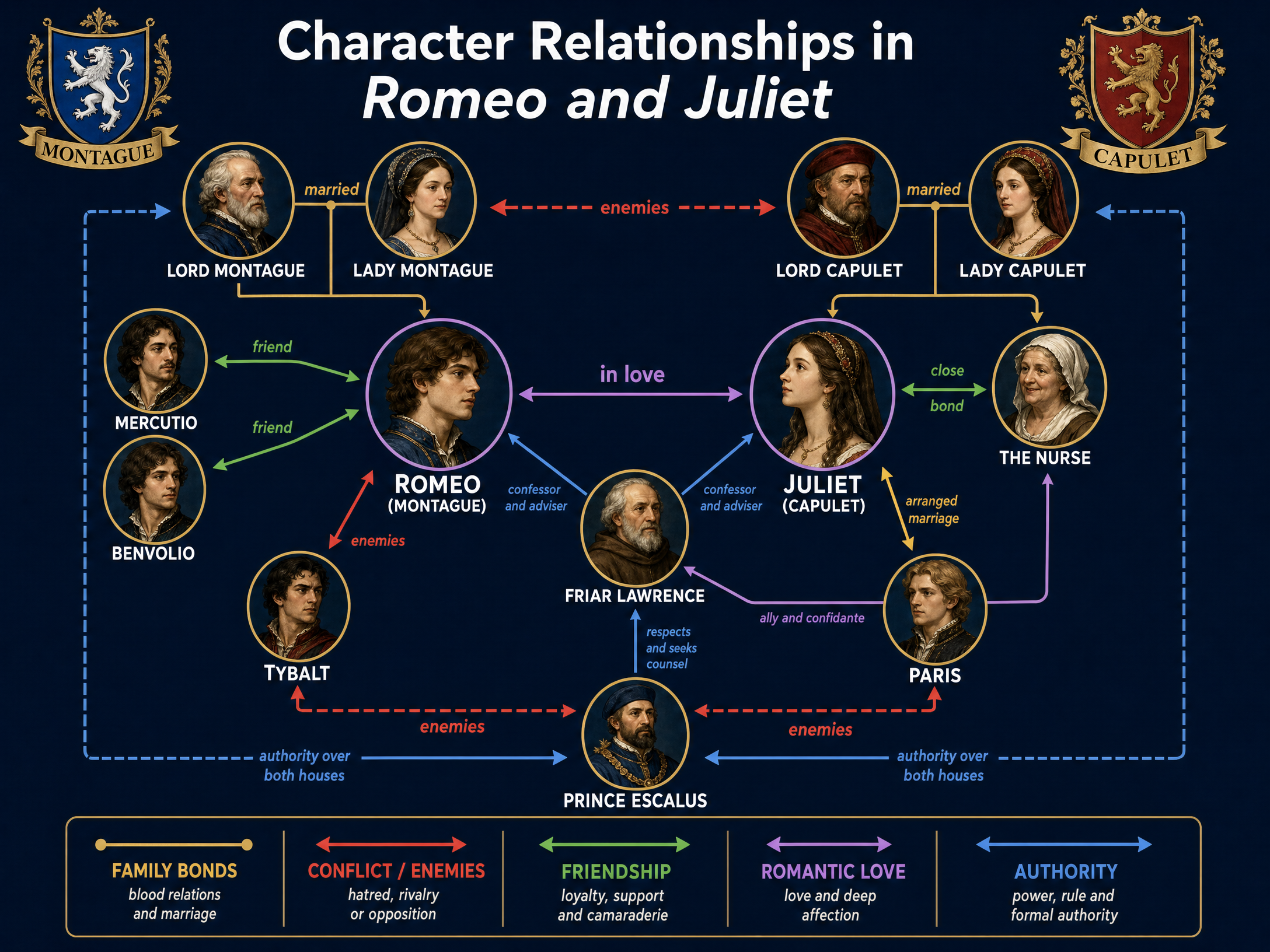
    Character Relationships in Romeo and Juliet

    Character Analysis

    Romeo Montague

    Role: The tragic hero; driven by passion rather than reason.

    Key Traits: Impulsive, romantic, articulate, emotionally volatile.

    Character Arc: Romeo begins as a performative, melancholic Petrarchan lover obsessed with Rosaline. Meeting Juliet matures his language and deepens his capacity for genuine love, but his fatal flaw—his rash impulsivity—ultimately drives him to murder and suicide.

    Essential Quotes:

    • "O brawling love! O loving hate!" (Act 1, Scene 1)
    • "It is the east, and Juliet is the sun." (Act 2, Scene 2)
    • "Fire-eyed fury be my conduct now!" (Act 3, Scene 1)

    Juliet Capulet

    Role: The tragic heroine; the emotional and intellectual anchor of the romance.

    Key Traits: Intelligent, decisive, courageous, pragmatic.

    Character Arc: Juliet transforms rapidly from a naive, obedient child to a fiercely independent young woman. She is more practical than Romeo, questioning the speed of their romance, and shows immense bravery in defying her family and taking the Friar's potion.

    Essential Quotes:

    • "It is too rash, too unadvised, too sudden." (Act 2, Scene 2)
    • "My dismal scene I needs must act alone." (Act 4, Scene 3)
    • "O happy dagger! This is thy sheath." (Act 5, Scene 3)

    Friar Lawrence

    Role: The adult confidant and catalyst for the tragic plot.

    Key Traits: Well-intentioned, philosophical, politically motivated, ultimately cowardly.

    Character Arc: The Friar acts as a surrogate father, marrying the lovers to end the feud. However, his complex schemes and reliance on deception unravel, and his final act of abandoning Juliet in the tomb reveals his fatal lack of courage.

    Essential Quotes:

    • "For this alliance may so happy prove, / To turn your households' rancour to pure love." (Act 2, Scene 3)
    • "Wisely and slow; they stumble that run fast." (Act 2, Scene 3)

    Mercutio

    Role: Romeo's best friend; the play's cynic and source of comic relief.

    Key Traits: Witty, bawdy, volatile, anti-romantic.

    Character Arc: Mercutio serves as a foil to Romeo, mocking courtly love with sexual innuendo. His death in Act 3 marks the structural pivot of the play, destroying the comedic tone and plunging the narrative into irreversible tragedy.

    Essential Quotes:

    • "If love be rough with you, be rough with love." (Act 1, Scene 4)
    • "A plague o' both your houses!" (Act 3, Scene 1)

    Writer's Methods

    Light and Dark Imagery: Shakespeare constantly contrasts light and dark. Romeo compares Juliet to the sun, stars, and torches. Ironically, their love can only exist in the dark (night), while the daylight brings danger, banishment, and reality.

    Form and Metre: The play relies heavily on blank verse (unrhymed iambic pentameter) for noble characters. Crucially, when Romeo and Juliet first meet, their dialogue forms a perfect shared Shakespearean sonnet, symbolising their immediate, perfect harmony and elevating their love to a poetic ideal.

    Dramatic Irony: The audience's foreknowledge of the tragic ending (established in the Prologue) charges every scene with tension. We know Juliet is alive when Romeo buys the poison; this irony makes the climax excruciatingly painful.

    Context

    Patriarchal Society: Elizabethan England was strictly patriarchal. Fathers had absolute legal and moral authority over their daughters. Juliet's refusal to marry Paris would have been shocking to a contemporary audience, making her defiance both courageous and dangerous.

    The Great Chain of Being: The Elizabethans believed in a strict, divinely ordained hierarchy. The feud disrupts this social order, leading to chaos in the streets. Order is only restored through the ultimate sacrifice of the lovers.

    Religion and Suicide: Suicide was considered a mortal sin in Catholic Italy (where the play is set) and Protestant England. The lovers' willingness to commit suicide demonstrates the overwhelming, almost heretical power of their devotion, elevating their love above religious doctrine.


    Audio Revision

    Listen to our 10-minute deep-dive podcast covering the core concepts, themes, and exam strategies for Romeo and Juliet.

    Romeo and Juliet Revision Podcast

    Visual Resources

    2 diagrams and illustrations

    Character Relationships in Romeo and Juliet
    Character Relationships in Romeo and Juliet
    Key Themes in Romeo and Juliet
    Key Themes in Romeo and Juliet

    Interactive Diagrams

    1 interactive diagram to visualise key concepts

    The Dramatic Structure of Romeo and Juliet

    Worked Examples

    2 detailed examples with solutions and examiner commentary

    Practice Questions

    Test your understanding — click to reveal model answers

    Q1

    Starting with this extract (Act 1, Scene 5, Romeo and Juliet's first meeting), explore how Shakespeare presents the power of love. Write about:

    • how love is presented in this extract
    • how love is presented in the play as a whole (30 marks + 4 AO4)
    34 marks
    standard

    Hint: Consider the religious imagery in the extract (pilgrim, saints, shrine) and contrast this pure love with the violent, patriarchal forms of love seen elsewhere in the play.

    Q2

    Explore how Shakespeare presents the character of Lord Capulet in the play. You must refer to the context of the play in your answer. (30 marks + 4 AO4)

    34 marks
    hard

    Hint: Track his changing behaviour: from the seemingly reasonable father in Act 1 to the violent tyrant in Act 3.

    Key Terms

    Essential vocabulary to know