The Merchant of Venice
The Merchant of Venice is a captivating play that balances comic romance with dark, uncomfortable questions about prejudice, justice, and revenge. Studying it rewards candidates who can explore its profound ambiguities, particularly in the complex characters of Shylock and Portia, making it an excellent text for demonstrating perceptive, critical analysis.
Study Notes
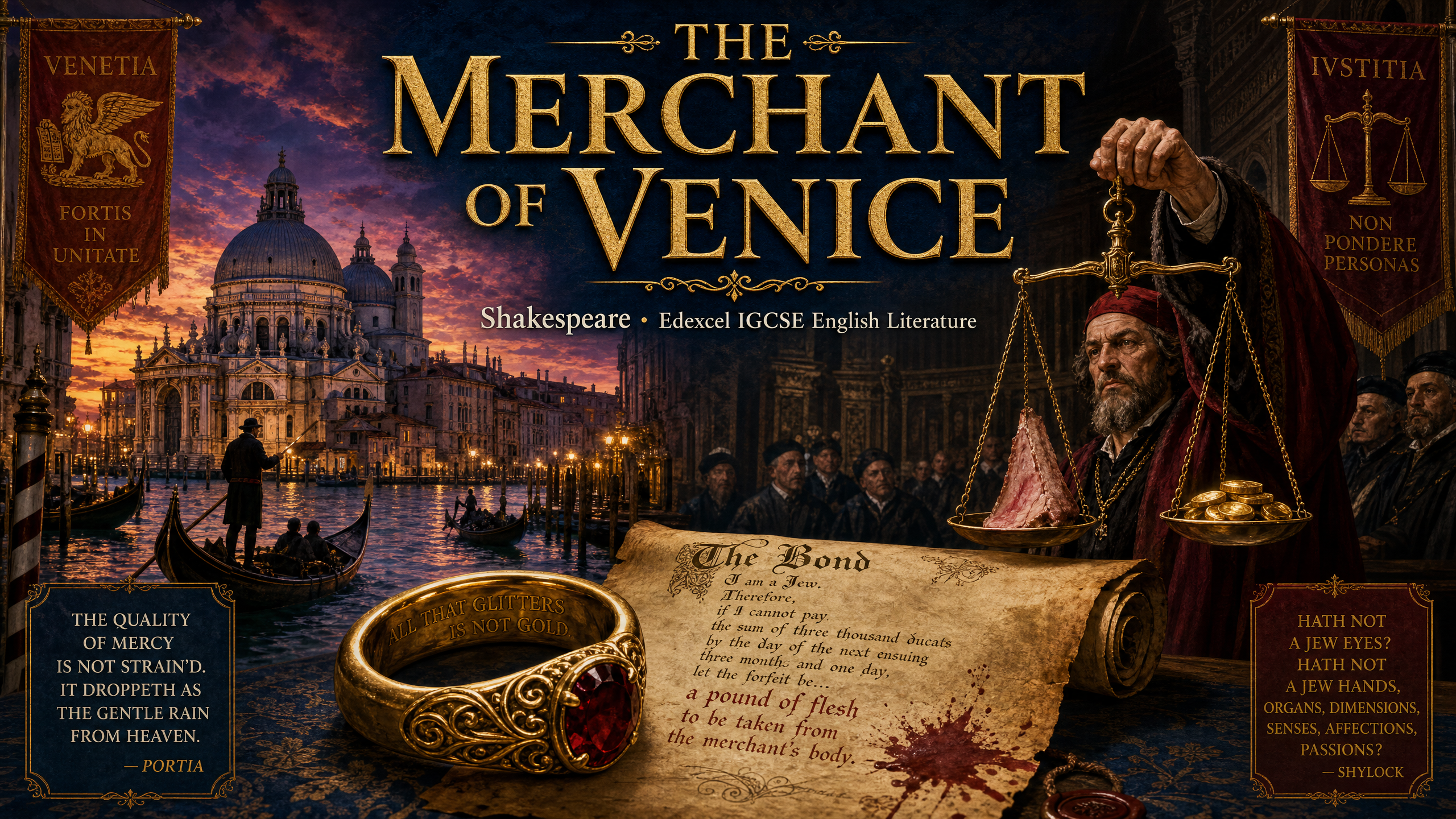
Overview
Shakespeare's The Merchant of Venice is a problem play—ostensibly a comedy ending in marriages, but dominated by the tragic and complex figure of Shylock. For the Edexcel IGCSE Literature exam, examiners are looking for a nuanced understanding of how Shakespeare uses dramatic form and language to explore the tension between justice and mercy, appearance and reality, and the corrosive nature of prejudice. High-scoring candidates will move beyond simple character judgments (e.g., "Shylock is evil") to explore the ambiguities of the text, integrating relevant Elizabethan context about religion, commerce, and gender roles seamlessly into their analysis.
Plot/Content Overview
Act 1: Antonio, a wealthy Venetian merchant, is inexplicably sad. His friend Bassanio needs money to woo the wealthy heiress Portia in Belmont. Antonio's wealth is tied up at sea, so he borrows 3,000 ducats from Shylock, a Jewish moneylender he has previously insulted. Shylock agrees to the loan without interest, but demands a "merry bond": a pound of Antonio's flesh if he defaults.
Act 2: In Belmont, Portia's suitors face her father's casket test (gold, silver, lead). Meanwhile, in Venice, Shylock's daughter Jessica elopes with Lorenzo, a Christian, stealing her father's wealth and jewels. This intensifies Shylock's hatred.
Act 3: Rumours circulate that Antonio's ships are lost. Shylock, grieving his daughter's betrayal, delivers his famous "Hath not a Jew eyes?" speech, vowing revenge. In Belmont, Bassanio correctly chooses the lead casket and wins Portia. News of Antonio's bankruptcy arrives; Portia offers to pay the debt, and Bassanio rushes back to Venice.
Act 4 (The Climax): The courtroom scene. Shylock demands his bond (strict justice). Portia arrives disguised as a young male lawyer, Balthasar. She delivers the "mercy speech," but Shylock refuses. Just as Shylock prepares to cut Antonio, Portia reveals a legal loophole: the bond allows flesh, but no blood. Shylock is defeated, stripped of his wealth, and forced to convert to Christianity.
Act 5: The couples reunite in Belmont. The "ring plot" (where Portia and Nerissa test their husbands' loyalty) is resolved playfully, restoring comic harmony, though the shadow of Shylock's destruction lingers.
Themes
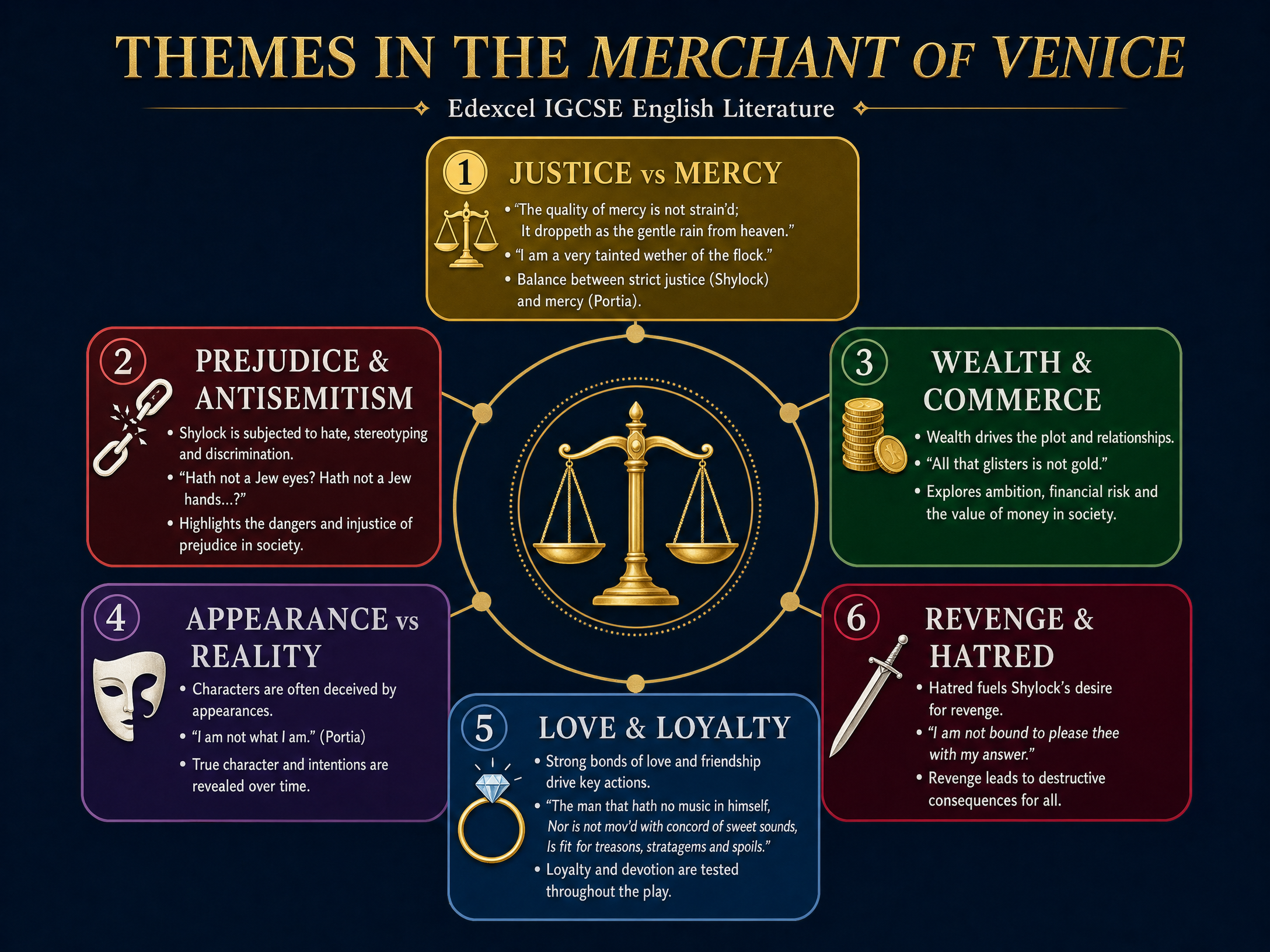
Theme 1: Justice vs Mercy
The central conflict of the play. Shylock demands strict, literal justice (the law of Venice), while Portia advocates for mercy, which she aligns with Christian grace. However, Shakespeare complicates this: Portia's ultimate treatment of Shylock shows very little mercy, forcing the audience to question the hypocrisy of the Venetian Christians.
Key Quotes:
- "The quality of mercy is not strain'd, / It droppeth as the gentle rain from heaven" (Portia, 4.1) - Analysis: The simile presents mercy as natural, divine, and abundant, contrasting with the rigid, artificial nature of Shylock's legal bond.
- "I crave the law, / The penalty and forfeit of my bond." (Shylock, 4.1) - Analysis: The repetition emphasizes his absolute reliance on literal interpretation and strict justice over human compassion.
Theme 2: Prejudice and Antisemitism
Shakespeare presents a deeply prejudiced society. Shylock is subjected to systemic abuse, which fuels his desire for revenge. While an Elizabethan audience might have viewed Shylock purely as a comic villain, Shakespeare gives him profound humanity, exposing the cruelty of the Christian characters.
Key Quotes:
- "You call me misbeliever, cut-throat dog, / And spit upon my Jewish gaberdine" (Shylock, 1.3) - Analysis: The use of animalistic imagery highlights the dehumanizing prejudice Shylock faces daily.
- "Hath not a Jew eyes? hath not a Jew hands, organs, dimensions, senses, affections, passions?" (Shylock, 3.1) - Analysis: The powerful use of anaphora and rhetorical questions forces the audience to acknowledge Shylock's shared humanity.
Theme 3: Appearance vs Reality
Nothing in Venice or Belmont is exactly as it seems. This is literalized in the casket test and Portia's disguise, but it also applies to the hypocrisy of characters who appear virtuous but act cruelly.
Key Quotes:
- "All that glisters is not gold" (Scroll in the gold casket, 2.7) - Analysis: A central maxim of the play, warning against superficial judgments based on outward show.
- "The world is still deceived with ornament." (Bassanio, 3.2) - Analysis: Bassanio's realization before choosing the lead casket, showing his growth in understanding true value.
Character Analysis
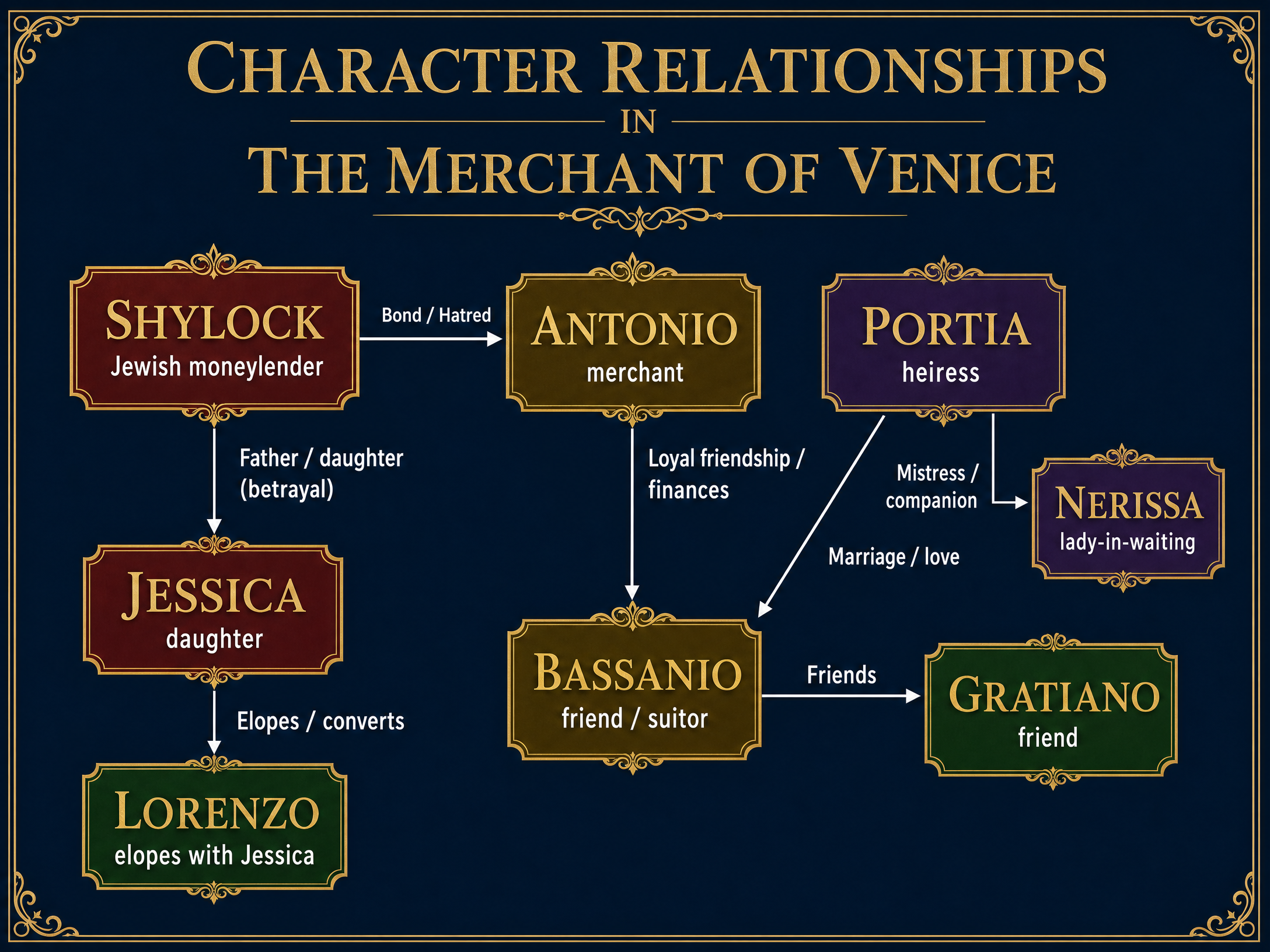
Shylock
Role: The antagonist, a Jewish moneylender in Venice.
Key Traits: Resentful, legalistic, fiercely protective, ultimately broken.
Character Arc: Moves from a marginalized businessman seeking a twisted form of equality through the bond, to a grieving father, to an obsessed avenger, to a broken, forcibly converted man.
Essential Quotes:
- "I will have my bond." (3.3) - The repetition shows his dangerous obsession and isolation.
- "I am not well." (4.1) - His final, broken exit line, contrasting sharply with his earlier rhetorical power.
Portia
Role: Wealthy heiress of Belmont; the intellectual powerhouse of the play.
Key Traits: Intelligent, articulate, constrained by patriarchy but highly manipulative, outwardly merciful but ruthlessly effective.
Character Arc: Begins as a frustrated daughter bound by her dead father's will, but seizes control of her destiny and the lives of the Venetian men through her disguise as Balthasar.
Essential Quotes:
- "So is the will of a living daughter curbed by the will of a dead father." (1.2) - Highlights her initial lack of agency.
- "Tarry a little; there is something else." (4.1) - The turning point of the play, demonstrating her absolute control and sharp intellect.
Antonio
Role: The titular merchant; Bassanio's devoted friend.
Key Traits: Melancholic, generous to friends, deeply prejudiced against Shylock, passive.
Character Arc: Starts as a confident, wealthy merchant, becomes a passive victim awaiting death, and ends saved but somewhat isolated from the married couples.
Essential Quotes:
- "In sooth, I know not why I am so sad" (1.1) - Establishes a tone of melancholy that pervades his character.
- "I am a tainted wether of the flock, / Meetest for death" (4.1) - Shows his passive acceptance of his fate and his self-perception as a sacrificial figure.
Writer's Methods
Form and Structure: Shakespeare uses the dual locations of Venice (a world of commerce, law, and harsh reality) and Belmont (a fairy-tale world of music, love, and riddles) to contrast the play's themes. The climax occurs in Act 4, unusually early, leaving Act 5 to attempt to restore comic harmony, though the tone remains uneasy.
Language: Shakespeare differentiates characters through their speech. Shylock often speaks in harsh, repetitive, and commercial language, or powerful prose when expressing raw emotion. Portia's language is elevated, poetic, and highly rhetorical, showing her education and intellect.
Context
Antisemitism in Elizabethan England: Jews were officially expelled from England in 1290. Shakespeare's audience would have had little to no contact with Jewish people and likely held strong anti-Semitic prejudices, viewing them as usurers (moneylenders who charge interest, a practice forbidden to Christians). Shylock's forced conversion would have been seen by many Elizabethans as an act of saving his soul, whereas modern audiences view it as a horrific violation of identity.
Venice: To an Elizabethan audience, Venice was an exotic, powerful, and wealthy republic. It was famous for its strict laws and its diverse, cosmopolitan population. The necessity of upholding the law to protect international trade is why the Duke cannot simply tear up Shylock's bond.
Patriarchy: Women in Elizabethan society were legally subordinate to men. Portia's need to disguise herself as a man to wield power in the courtroom reflects the societal belief that women were incapable of legal or intellectual authority.
Podcast Revision
Listen to the full revision podcast below:
Visual Resources
2 diagrams and illustrations
Interactive Diagrams
1 interactive diagram to visualise key concepts
Conceptual Flow Outline
Shylock's Tragic Character Arc
Worked Examples
2 detailed examples with solutions and examiner commentary
Practice Questions
Test your understanding — click to reveal model answers
Explore how Shakespeare presents the theme of appearance versus reality in the play. (30 marks + 4 AO4)
Hint: Consider the casket test, Portia's disguise, and the hypocrisy of the Venetian Christians.
How does Shakespeare present the relationship between Antonio and Bassanio? (30 marks + 4 AO4)
Hint: Look at Antonio's willingness to risk his life, and Bassanio's conflicting loyalties between Antonio and Portia.
Starting with this extract (Act 3, Scene 1: 'Hath not a Jew eyes?'), explore how Shakespeare presents prejudice. (30 marks + 4 AO4)
Hint: Analyse the rhetoric in the extract, then look at how prejudice is shown elsewhere in the play.
Explore how Shakespeare presents female characters in The Merchant of Venice. (30 marks + 4 AO4)
Hint: Compare Portia's power and manipulation with Jessica's rebellion.