A Midsummer Night's Dream Revision Notes

    Subject: English Literature | Level: GCSE | Exam Board: OCR

    A Midsummer Night's Dream is a whirlwind of magic, mischief, and mistaken identity. Shakespeare plunges us into an enchanted forest where fairies toy with the hearts of mortal lovers, asking profound questions about the nature of love and reality itself. For an examiner, this play is a goldmine for analysing structure, language, and theme.

    Revision Notes & Key Concepts

    ![Header image for A Midsummer Night's Dream.](https://xnnrgnazirrqvdgfhvou.supabase.co/storage/v1/object/public/study-guide-assets/guide_f85fb042-1bca-41d0-b5f5-5585333fe1c6/header_image.png) ## Overview Welcome to the definitive study guide for *A Midsummer Night's Dream*, tailored for the OCR GCSE (9-1) English Literature specification (J352). This guide will deconstruct the play's core components to help you build a sophisticated, conceptualised response. OCR examiners are not just looking for plot summary; they want to see a candidate who can analyse Shakespeare's dramatic methods (AO2), integrate contextual understanding (AO3), and construct a sustained, critical argument (AO1). This play charts a journey from the rigid, patriarchal laws of Athens to the chaotic, magical freedom of the forest, and finally to a transformed, celebratory resolution. The key to top marks is understanding how these three worlds—the court, the lovers, and the fairies—interact and reflect upon one another, creating a rich tapestry of comedy, romance, and philosophical enquiry. ![Podcast: Unlocking A Midsummer Night's Dream.](https://xnnrgnazirrqvdgfhvou.supabase.co/storage/v1/object/public/study-guide-assets/guide_f85fb042-1bca-41d0-b5f5-5585333fe1c6/a_midsummer_nights_dream_podcast.mp3) ## Plot/Content Overview ![The Five-Act Structure of A Midsummer Night's Dream.](https://xnnrgnazirrqvdgfhvou.supabase.co/storage/v1/object/public/study-guide-assets/guide_f85fb042-1bca-41d0-b5f5-5585333fe1c6/play_structure.png) *A Midsummer Night's Dream* is structured across five acts, moving between the city of Athens and the nearby enchanted forest. * **Act 1: Athens.** The play opens with a conflict of love and law. Hermia is in love with Lysander, but her father, Egeus, commands her to marry Demetrius, who is loved by Helena. Duke Theseus, upholding Athenian law, gives Hermia a stark choice: marry Demetrius, become a nun, or face death. In defiance, Hermia and Lysander plan to elope through the forest. Helena, desperate for Demetrius's affection, reveals their plan to him. Meanwhile, a group of amateur actors, the Mechanicals, rehearse a play for the Duke's wedding. * **Act 2: The Forest.** This is the realm of the fairies. Oberon, the Fairy King, is arguing with his queen, Titania. To punish her, he orders his mischievous servant, Puck, to fetch a magical flower whose juice, when applied to a sleeper's eyelids, makes them fall in love with the first creature they see. Oberon also instructs Puck to use the potion on Demetrius to make him love Helena. However, Puck mistakes Lysander for Demetrius, causing Lysander to fall for Helena. * **Act 3: The Forest.** The chaos escalates. Puck gives Bottom, one of the Mechanicals, the head of a donkey. The now-enchanted Titania awakens, sees Bottom, and falls instantly in love with him. The four lovers' situation descends into a frantic, comical chase, with both Lysander and Demetrius now pursuing Helena, and Hermia left bewildered and furious. * **Act 4: The Forest & Athens.** Oberon, seeing the mayhem, orders Puck to reverse the spell on Lysander. The lovers are reconciled, and Titania is freed from her enchantment. The Duke and his party discover the sleeping lovers in the forest and, seeing their newfound harmony, overrule Egeus's wishes, decreeing they shall be married alongside himself and Hippolyta. * **Act 5: Athens.** The play concludes with a triple wedding. The Mechanicals perform their comically tragic play, *Pyramus and Thisbe*. The play-within-a-play provides a final commentary on the themes of love and illusion. The fairies arrive to bless the sleeping couples, and Puck delivers a final epilogue, suggesting to the audience that if they were offended, they should consider the play as nothing more than a dream. ## Themes ### Theme 1: Love and its Irrationality Shakespeare presents love not as a stable, rational force, but as a powerful, chaotic, and often ridiculous emotion. The symmetrical pattern of the four lovers and the magical intervention of the love potion serve to explore its fickleness. Examiners will award credit for analysing how the play's structure and supernatural elements are used to deconstruct the theme of love. **Key Quotes**: * "The course of true love never did run smooth." (Lysander, 1.1) - This establishes the central conflict from the outset, framing love as an obstacle course rather than a simple path. * "Lord, what fools these mortals be!" (Puck, 3.2) - From his supernatural viewpoint, Puck sees human romantic entanglements as absurd and comical, highlighting the irrationality of their passions. * "Reason and love keep little company together nowadays." (Bottom, 3.1) - Spoken with the profound simple-mindedness of Bottom, this line ironically summarises the entire play's take on love. It’s a key quote for AO1, showing you grasp the central concept. ### Theme 2: Order and Disorder The play is built on the contrast between the world of Athens and the world of the forest. Athens represents daylight, law, reason, and social hierarchy. The forest represents night, magic, passion, and chaos. The journey into the forest is a necessary descent into disorder that ultimately allows for a new, more balanced order to emerge. **Key Quotes**: * "Full of vexation come I, with complaint / Against my child, my daughter Hermia." (Egeus, 1.1) - Egeus embodies the rigid, patriarchal law of Athens, where a father’s will is absolute. This is the order that is challenged. * "Ill met by moonlight, proud Titania." (Oberon, 2.1) - The argument between the fairy rulers has thrown the natural world into chaos ("The seasons alter..."), demonstrating that disorder reigns in the fairy realm and spills over into the mortal world. * "And the country proverb known, / That every man should take his own, / In your waking shall be shown: / Jack shall have Jill; / Nought shall go ill." (Puck, 3.2) - Puck’s spell restores order, but it is a magical, arbitrary order, not one based on reason. This is a great point for higher-level analysis. ### Theme 3: Appearance and Reality (Dream vs. Reality) Shakespeare constantly blurs the line between what is real and what is illusion. The title itself invites us to question the nature of our experience. The play is filled with dreams, visions, and transformations that challenge the characters' (and the audience's) perception of reality. The play-within-a-play is the ultimate exploration of this theme. **Key Quotes**: * "I have had a most rare vision. I have had a dream, past the wit of man to say what dream it was." (Bottom, 4.1) - Bottom’s inability to articulate his experience captures the ineffable nature of the dream-world. He knows something profound has happened, but it defies logical explanation. * "Are you sure / That we are awake? It seems to me / That yet we sleep, we dream." (Demetrius, 4.1) - The lovers emerge from the forest questioning their own senses, unsure of the boundary between their chaotic night and the reality of the morning. * "If we shadows have offended, / Think but this, and all is mended, / That you have but slumbered here / While these visions did appear." (Puck, 5.1) - Puck’s epilogue directly addresses the audience, suggesting the entire theatrical experience might be a dream, breaking the fourth wall and leaving us to ponder the nature of illusion. ## Character Analysis ![Character Relationships and Worlds in A Midsummer Night's Dream.](https://xnnrgnazirrqvdgfhvou.supabase.co/storage/v1/object/public/study-guide-assets/guide_f85fb042-1bca-41d0-b5f5-5585333fe1c6/character_relationships.png) ### Puck (Robin Goodfellow) * **Role**: Oberon's mischievous servant and the play's chief architect of chaos. Puck is not evil; he is an amoral, energetic force of nature who delights in the confusion he creates. * **Key Traits**: Mischievous, quick-witted, loyal to Oberon, and gleefully amoral. * **Character Arc**: Puck does not develop in a traditional sense. He is a catalyst for the transformation of others. His function is to execute Oberon's plans and, in doing so, expose the folly of mortals. * **Essential Quotes**: "I'll put a girdle round about the earth / In forty minutes." (2.1); "Lord, what fools these mortals be!" (3.2) ### Bottom * **Role**: A weaver from the group of Mechanicals and the play's main source of comedy. He is supremely self-confident and completely unaware of his own foolishness. * **Key Traits**: Overconfident, enthusiastic, foolish, yet strangely profound in his simple-mindedness. * **Character Arc**: Bottom undergoes a literal, physical transformation (gaining a donkey's head) and a fantastical experience (being loved by the Fairy Queen). He returns to his world unchanged in personality but possessing the memory of a "most rare vision," a dream that transcends human understanding. * **Essential Quotes**: "Let me play the lion too." (1.2); "I have had a dream, past the wit of man to say what dream it was." (4.1) ### Hermia * **Role**: One of the four young lovers. She is strong-willed and defiant in the face of patriarchal authority. * **Key Traits**: Fierce, determined, loyal, but also prone to jealousy and insecurity when the magical confusion begins. * **Character Arc**: Hermia begins by defying her father for love. In the forest, her confidence is shattered by the inexplicable rejection of both Lysander and Demetrius. Her journey is one of suffering and confusion, leading to a joyful resolution she doesn't understand but accepts. * **Essential Quotes**: "So will I grow, so live, so die, my lord, / Ere I will yield my virgin patent up / Unto his lordship." (1.1); "Though she be but little, she is fierce." (3.2) ### Helena * **Role**: The other female lover, whose unrequited love for Demetrius drives her to desperation. * **Key Traits**: Insecure, self-pitying, but also relentless in her pursuit of Demetrius. * **Character Arc**: Helena’s journey is one of diminishing self-worth. She internalises Demetrius's rejection, believing herself to be ugly and unlovable. The magical reversal, where both men pursue her, is initially perceived as a cruel joke. Her story highlights the painful, obsessive side of love. * **Essential Quotes**: "Love looks not with the eyes, but with the mind; / And therefore is winged Cupid painted blind." (1.1); "We, Hermia, like two artificial gods, / Have with our needles created both one flower." (3.2) ## Writer's Methods Shakespeare uses a range of dramatic and linguistic techniques that you must analyse for AO2. * **Structure**: The three-part structure (Athens-Forest-Athens) is crucial. The forest acts as a "Green World," a space of transformation where the problems of the normal world are resolved through magic and chaos. The play-within-a-play in Act 5 is a key structural device, providing a comic mirror to the main plot's themes of love and tragedy. * **Language**: Shakespeare uses different linguistic styles for different groups of characters. * **Blank Verse (Iambic Pentameter)**: Used by the nobles and lovers. It is formal, poetic, and elevates their speech, but can also show their heightened, often overwrought, emotions. * **Rhyming Couplets**: Used frequently by the fairies, especially Oberon and Puck. This creates a magical, incantatory (spell-like) quality to their speech. Couplets are also used to signal the end of a scene. * **Prose**: Used by the Mechanicals. Their speech is plain, clumsy, and often filled with errors (malapropisms), which is a key source of comedy. * **Imagery**: The play is rich with imagery of the moon, dreams, eyes (and sight/perception), and nature. Tracking how this imagery is used is vital for a high-level response. For example, the moon is associated with changeability, chastity (Diana), and the night-time world of the fairies. * **Dramatic Irony**: The audience often knows more than the characters, which is a key source of both comedy and tension. We know why Titania is in love with a donkey-headed man, and we understand the lovers' confusion is caused by Puck's mistake. This positions us to laugh at their folly, aligning us with Puck's perspective. ## Context For AO3, you must integrate context thoughtfully. Don't just "bolt it on." * **Patriarchy and Marriage**: In Elizabethan England, society was strictly patriarchal. A daughter was legally the property of her father, who had the right to choose her husband. Hermia's defiance of Egeus would have been seen as a shocking act of rebellion. The play ultimately moves towards a more companionate view of marriage, but it begins by affirming the harsh reality of patriarchal law. * **The Supernatural and Superstition**: Belief in fairies, magic, and witchcraft was widespread. The forest in the play is a place of both wonder and fear, reflecting contemporary beliefs about the supernatural. Puck (or Robin Goodfellow) was a well-known figure in English folklore. * **Order and Hierarchy**: The Elizabethan worldview was based on the "Great Chain of Being," the idea that everything in the universe had a specific place in a divine hierarchy. The disruption in the natural world caused by Oberon and Titania's argument reflects the belief that disorder in one part of the chain (the supernatural) could affect all other parts (nature, the mortal world). * **Theatre and Illusion**: Shakespeare’s theatre, The Globe, had minimal scenery. It relied on the audience's imagination. The play-within-a-play and Puck's final epilogue are meta-theatrical moments where Shakespeare seems to be commenting on the art of theatre itself, reminding the audience that they too are part of an illusion. **Alternative Interpretation (Feminist Reading)**: A feminist critic might argue that while the play ends in marriage, it highlights the limited power of its female characters. Hermia’s defiance is ultimately resolved not by her own agency, but by the actions of powerful male figures (Oberon and Theseus). Titania, a powerful queen, is humiliated and controlled by her husband. Helena’s self-worth is entirely dependent on male validation. While the play is a comedy, it can be read as a critique of the patriarchal structures that confine its female characters.

    Revision Podcast Transcript

    # A Midsummer Night's Dream: GCSE English Literature Podcast Script **Episode Title:** Unlocking A Midsummer Night's Dream: Magic, Mayhem, and Maxing Your Marks **Host:** A knowledgeable, enthusiastic female educator **(Intro Music: Upbeat, slightly magical theme, fades into background)** **Host:** (Warm, engaging tone) Hello and welcome to the study guide podcast for Shakespeare’s *A Midsummer Night’s Dream*! I’m your guide, and over the next ten minutes, we’ll delve into the enchanted forest, untangle the lovers' chaotic knots, and most importantly, show you exactly how to secure top marks in your OCR GCSE English Literature exam. This play is a gift for students who can get to grips with its three contrasting worlds: the rigid court of Athens, the chaotic fairy world, and the hilarious world of the Mechanicals. Examiners are looking for candidates who can confidently navigate these shifts. So, let’s get started! **(Transition: Gentle, magical sound effect)** **Host:** Right, let's break down the core concepts. You absolutely **must** be able to discuss the play's key themes. First up is **Love and its Complications**. This isn't just about romance; it's about the irrational, fickle, and often painful nature of love. The four young lovers—Hermia, Helena, Lysander, and Demetrius—are a perfect example. Initially, Hermia loves Lysander, Helena loves Demetrius, but Demetrius loves Hermia. It’s a mess! Shakespeare uses the love potion, squeezed into their eyes by the mischievous Puck, to explore how quickly affections can change. A key quote here is Puck's famous line: "Lord, what fools these mortals be!" (Act 3, Scene 2). This is where you can earn marks for AO2, analysing Shakespeare's methods. Puck's observation highlights the theme of love's irrationality from a supernatural perspective, suggesting mortals are powerless and slightly ridiculous in its grip. Next, we have **Order versus Disorder**. Athens, ruled by Duke Theseus, represents law, reason, and patriarchal order. Egeus tries to use this law to force his daughter Hermia to marry Demetrius. The forest, by contrast, is a space of chaos, magic, and unpredictability, ruled by the feuding fairy king and queen, Oberon and Titania. When the lovers escape to the forest, they leave the world of human law and enter a world of supernatural disorder. Credit is always given for analysing this structural contrast. For example, you could analyse how the formal, blank verse of the Athenian court contrasts with the rhyming couplets of the fairies, which often signal spell-casting or a sense of otherworldliness. The Mechanicals' clumsy prose provides yet another layer of contrast. Finally, let's touch on **Appearance versus Reality**. Nothing is quite what it seems in this play. The love potion makes characters fall in love with the wrong person, Titania falls for Bottom who has been given the head of a donkey, and the Mechanicals' play, *Pyramus and Thisbe*, is a play-within-a-play that constantly draws attention to the nature of theatre and illusion itself. When Bottom wakes up, he says, "I have had a most rare vision. I have had a dream, past the wit of man to say what dream it was" (Act 4, Scene 1). This is a fantastic quote for exploring how the lines between dream and reality are blurred. High-level responses will connect this to Puck's final speech, where he suggests the entire play might have been a dream for the audience. **(Transition: Sound of a pen scratching on paper)** **Host:** Now for the crucial exam tips. The OCR paper for this text will give you an extract of about 30 lines and ask you to explore a theme or character, starting with the extract and then linking to the play as a whole. The biggest mistake candidates make is analysing the extract in isolation. You **must** create a seamless argument that moves between the extract and the wider text. A good strategy is to spend the first 5-10 minutes annotating the extract and planning your links. For every point you make about the extract, think: where else in the play do we see this idea? For instance, if the extract shows Hermia defying her father, you could link this to her later defiance in the forest, or contrast it with Helena's more submissive attitude. Another common pitfall is 'context-bolting'. Don't just drop in a random fact about Queen Elizabeth I. Make it relevant. For example, when discussing Egeus's control over Hermia, you can link this to the patriarchal context of Elizabethan England, where a daughter was considered her father's property. This shows the examiner you are integrating AO3, contextual understanding, to illuminate the text. And remember those 4 marks for AO4 – Spelling, Punctuation, and Grammar. Clear, accurate writing is essential. Use formal, academic language. Instead of 'Shakespeare shows us', try 'Shakespeare presents...' or 'Shakespeare explores...'. **(Transition: Upbeat, quiz-show style jingle)** **Host:** Time for a quick-fire recall quiz! I'll give you a prompt, you pause and try to answer. Ready? 1. Who says, "The course of true love never did run smooth"? (Pause) ... That's Lysander in Act 1, Scene 1. A perfect quote for any essay on love. 2. What are the three groups of characters in the play? (Pause) ... The Athenian nobles, the lovers, and the Mechanicals... and of course, the fairies! 3. What is the name of the play the Mechanicals perform? (Pause) ... *The Most Lamentable Comedy, and Most Cruel Death of Pyramus and Thisbe*. 4. Why are Oberon and Titania arguing? (Pause) ... Over a changeling boy. This argument is the source of the natural world's disruption. How did you do? If you struggled, make a note to revise those key details. **(Transition: Gentle, reflective music starts)** **Host:** So, to summarise. *A Midsummer Night's Dream* is a play about the chaotic, magical, and often confusing nature of love. To succeed in the exam, you must analyse the interplay between the different worlds of the play, explore the key themes of Love, Order vs. Disorder, and Appearance vs. Reality, and seamlessly link your analysis of the given extract to the wider text. Always integrate your contextual knowledge purposefully, and never forget the importance of clear, accurate expression. Thank you for listening. Keep practising, keep revising, and you'll be well on your way to achieving those top marks. **(Outro Music: Upbeat, magical theme swells and fades out)**

    Key Terms & Definitions

    Blank Verse
    Poetry written in unrhymed iambic pentameter. An iamb is a metrical foot of one unstressed syllable followed by a stressed syllable (da-DUM). Pentameter means there are five of these feet per line.
    Prose
    Written or spoken language in its ordinary form, without metrical structure.
    Rhyming Couplet
    Two consecutive lines of poetry that rhyme.
    Dramatic Irony
    A literary device where the audience's or reader's understanding of events or individuals in a work surpasses that of its characters.
    Malapropism
    The mistaken use of a word in place of a similar-sounding one, often with unintentionally amusing effect.
    Soliloquy
    An act of speaking one's thoughts aloud when by oneself or regardless of any hearers, especially by a character in a play.
    Aside
    A remark or passage in a play that is intended to be heard by the audience but unheard by the other characters in the play.
    Meta-theatre
    Theatre that draws attention to its own nature as a performance. This can be done through devices like a play-within-a-play or direct address to the audience.

    Worked Examples

    Practice Questions

    A Midsummer Night's Dream

    A Midsummer Night's Dream is a whirlwind of magic, mischief, and mistaken identity. Shakespeare plunges us into an enchanted forest where fairies toy with the hearts of mortal lovers, asking profound questions about the nature of love and reality itself. For an examiner, this play is a goldmine for analysing structure, language, and theme.

    12
    Min Read
    2
    Examples
    4
    Questions
    8
    Key Terms
    🎙 Podcast Episode
    A Midsummer Night's Dream
    0:00-0:00

    Study Notes

    Header image for A Midsummer Night's Dream.

    Overview

    Welcome to the definitive study guide for A Midsummer Night's Dream, tailored for the OCR GCSE (9-1) English Literature specification (J352). This guide will deconstruct the play's core components to help you build a sophisticated, conceptualised response. OCR examiners are not just looking for plot summary; they want to see a candidate who can analyse Shakespeare's dramatic methods (AO2), integrate contextual understanding (AO3), and construct a sustained, critical argument (AO1). This play charts a journey from the rigid, patriarchal laws of Athens to the chaotic, magical freedom of the forest, and finally to a transformed, celebratory resolution. The key to top marks is understanding how these three worlds—the court, the lovers, and the fairies—interact and reflect upon one another, creating a rich tapestry of comedy, romance, and philosophical enquiry.

    Podcast: Unlocking A Midsummer Night's Dream.

    Plot/Content Overview

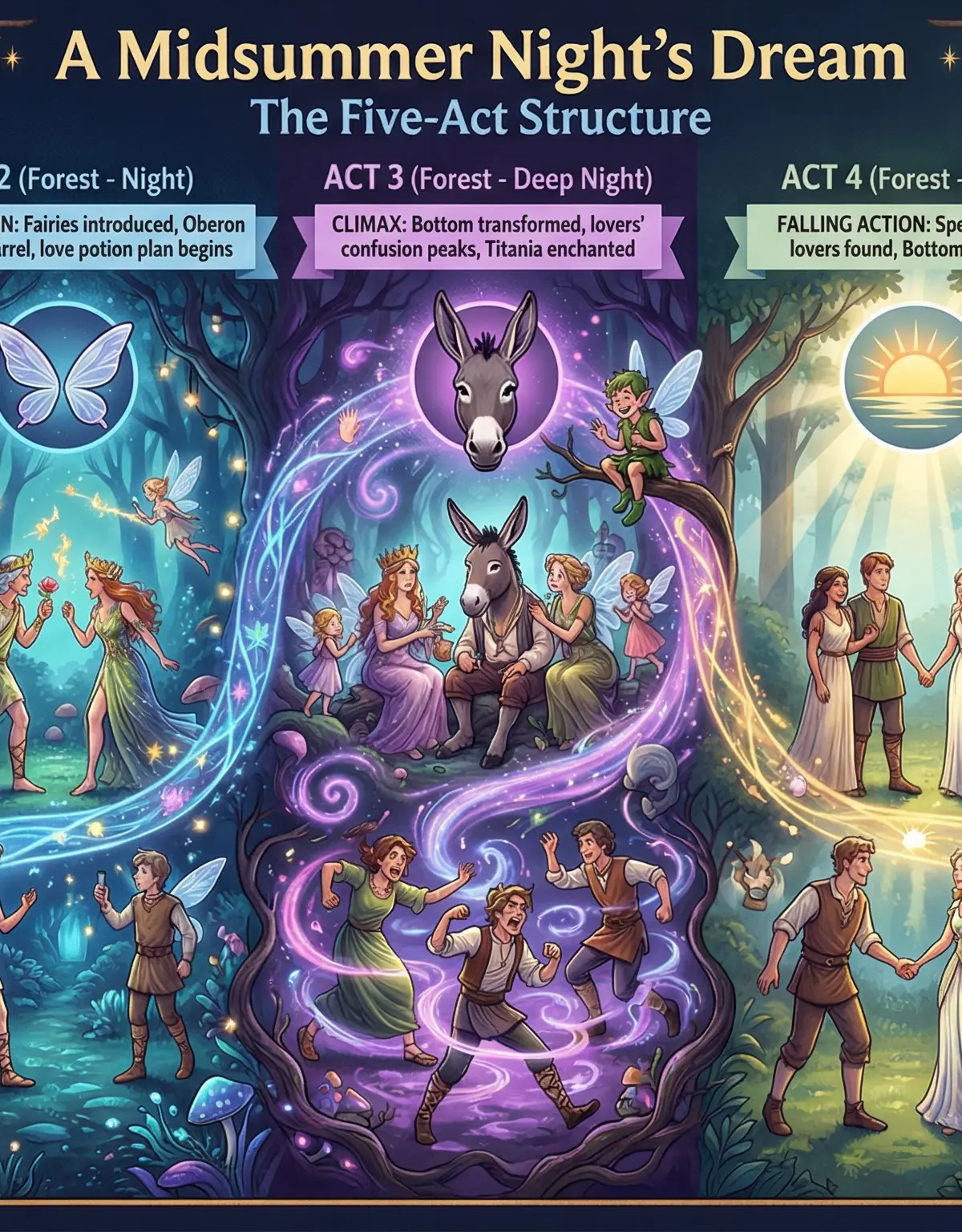
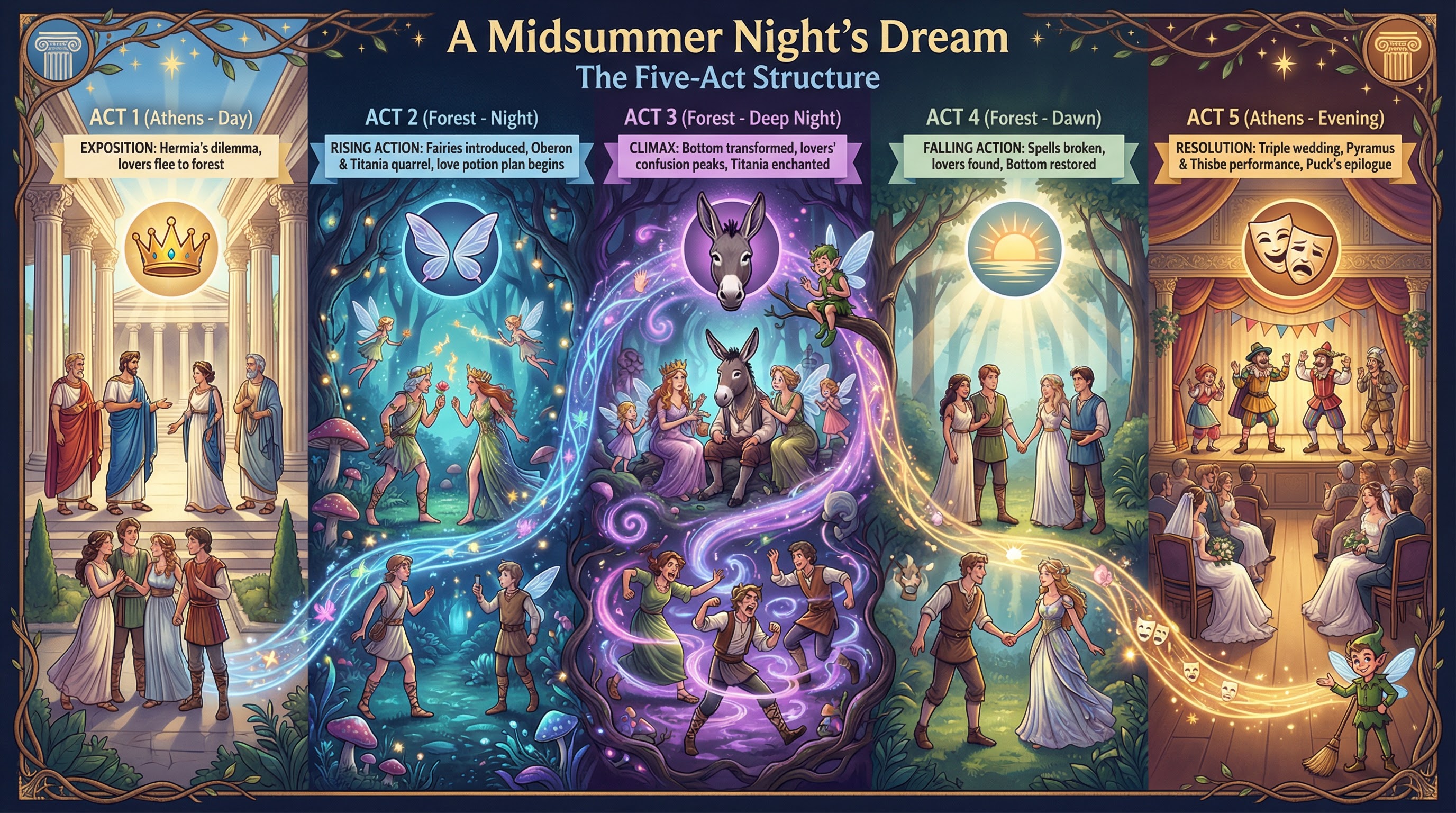
    The Five-Act Structure of A Midsummer Night's Dream.

    A Midsummer Night's Dream is structured across five acts, moving between the city of Athens and the nearby enchanted forest.

    • Act 1: Athens. The play opens with a conflict of love and law. Hermia is in love with Lysander, but her father, Egeus, commands her to marry Demetrius, who is loved by Helena. Duke Theseus, upholding Athenian law, gives Hermia a stark choice: marry Demetrius, become a nun, or face death. In defiance, Hermia and Lysander plan to elope through the forest. Helena, desperate for Demetrius's affection, reveals their plan to him. Meanwhile, a group of amateur actors, the Mechanicals, rehearse a play for the Duke's wedding.
    • Act 2: The Forest. This is the realm of the fairies. Oberon, the Fairy King, is arguing with his queen, Titania. To punish her, he orders his mischievous servant, Puck, to fetch a magical flower whose juice, when applied to a sleeper's eyelids, makes them fall in love with the first creature they see. Oberon also instructs Puck to use the potion on Demetrius to make him love Helena. However, Puck mistakes Lysander for Demetrius, causing Lysander to fall for Helena.
    • Act 3: The Forest. The chaos escalates. Puck gives Bottom, one of the Mechanicals, the head of a donkey. The now-enchanted Titania awakens, sees Bottom, and falls instantly in love with him. The four lovers' situation descends into a frantic, comical chase, with both Lysander and Demetrius now pursuing Helena, and Hermia left bewildered and furious.
    • Act 4: The Forest & Athens. Oberon, seeing the mayhem, orders Puck to reverse the spell on Lysander. The lovers are reconciled, and Titania is freed from her enchantment. The Duke and his party discover the sleeping lovers in the forest and, seeing their newfound harmony, overrule Egeus's wishes, decreeing they shall be married alongside himself and Hippolyta.
    • Act 5: Athens. The play concludes with a triple wedding. The Mechanicals perform their comically tragic play, Pyramus and Thisbe. The play-within-a-play provides a final commentary on the themes of love and illusion. The fairies arrive to bless the sleeping couples, and Puck delivers a final epilogue, suggesting to the audience that if they were offended, they should consider the play as nothing more than a dream.

    Themes

    Theme 1: Love and its Irrationality

    Shakespeare presents love not as a stable, rational force, but as a powerful, chaotic, and often ridiculous emotion. The symmetrical pattern of the four lovers and the magical intervention of the love potion serve to explore its fickleness. Examiners will award credit for analysing how the play's structure and supernatural elements are used to deconstruct the theme of love.

    Key Quotes:

    • "The course of true love never did run smooth." (Lysander, 1.1) - This establishes the central conflict from the outset, framing love as an obstacle course rather than a simple path.
    • "Lord, what fools these mortals be!" (Puck, 3.2) - From his supernatural viewpoint, Puck sees human romantic entanglements as absurd and comical, highlighting the irrationality of their passions.
    • "Reason and love keep little company together nowadays." (Bottom, 3.1) - Spoken with the profound simple-mindedness of Bottom, this line ironically summarises the entire play's take on love. It’s a key quote for AO1, showing you grasp the central concept.

    Theme 2: Order and Disorder

    The play is built on the contrast between the world of Athens and the world of the forest. Athens represents daylight, law, reason, and social hierarchy. The forest represents night, magic, passion, and chaos. The journey into the forest is a necessary descent into disorder that ultimately allows for a new, more balanced order to emerge.

    Key Quotes:

    • "Full of vexation come I, with complaint / Against my child, my daughter Hermia." (Egeus, 1.1) - Egeus embodies the rigid, patriarchal law of Athens, where a father’s will is absolute. This is the order that is challenged.
    • "Ill met by moonlight, proud Titania." (Oberon, 2.1) - The argument between the fairy rulers has thrown the natural world into chaos ("The seasons alter..."), demonstrating that disorder reigns in the fairy realm and spills over into the mortal world.
    • "And the country proverb known, / That every man should take his own, / In your waking shall be shown: / Jack shall have Jill; / Nought shall go ill." (Puck, 3.2) - Puck’s spell restores order, but it is a magical, arbitrary order, not one based on reason. This is a great point for higher-level analysis.

    Theme 3: Appearance and Reality (Dream vs. Reality)

    Shakespeare constantly blurs the line between what is real and what is illusion. The title itself invites us to question the nature of our experience. The play is filled with dreams, visions, and transformations that challenge the characters' (and the audience's) perception of reality. The play-within-a-play is the ultimate exploration of this theme.

    Key Quotes:

    • "I have had a most rare vision. I have had a dream, past the wit of man to say what dream it was." (Bottom, 4.1) - Bottom’s inability to articulate his experience captures the ineffable nature of the dream-world. He knows something profound has happened, but it defies logical explanation.
    • "Are you sure / That we are awake? It seems to me / That yet we sleep, we dream." (Demetrius, 4.1) - The lovers emerge from the forest questioning their own senses, unsure of the boundary between their chaotic night and the reality of the morning.
    • "If we shadows have offended, / Think but this, and all is mended, / That you have but slumbered here / While these visions did appear." (Puck, 5.1) - Puck’s epilogue directly addresses the audience, suggesting the entire theatrical experience might be a dream, breaking the fourth wall and leaving us to ponder the nature of illusion.

    Character Analysis
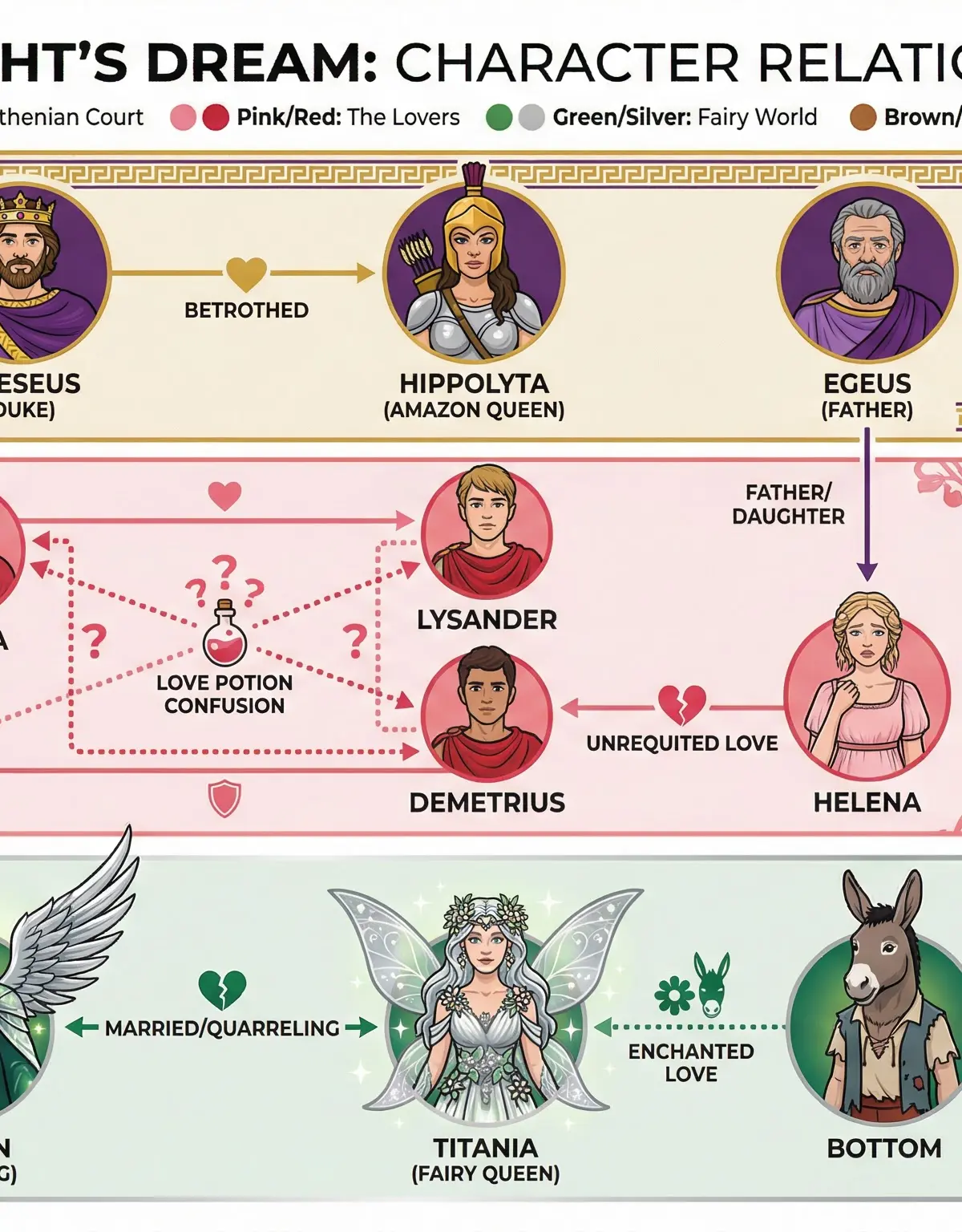
    Character Relationships and Worlds in A Midsummer Night's Dream.

    Puck (Robin Goodfellow)

    • Role: Oberon's mischievous servant and the play's chief architect of chaos. Puck is not evil; he is an amoral, energetic force of nature who delights in the confusion he creates.
    • Key Traits: Mischievous, quick-witted, loyal to Oberon, and gleefully amoral.
    • Character Arc: Puck does not develop in a traditional sense. He is a catalyst for the transformation of others. His function is to execute Oberon's plans and, in doing so, expose the folly of mortals.
    • Essential Quotes: "I'll put a girdle round about the earth / In forty minutes." (2.1); "Lord, what fools these mortals be!" (3.2)

    Bottom

    • Role: A weaver from the group of Mechanicals and the play's main source of comedy. He is supremely self-confident and completely unaware of his own foolishness.
    • Key Traits: Overconfident, enthusiastic, foolish, yet strangely profound in his simple-mindedness.
    • Character Arc: Bottom undergoes a literal, physical transformation (gaining a donkey's head) and a fantastical experience (being loved by the Fairy Queen). He returns to his world unchanged in personality but possessing the memory of a "most rare vision," a dream that transcends human understanding.
    • Essential Quotes: "Let me play the lion too." (1.2); "I have had a dream, past the wit of man to say what dream it was." (4.1)

    Hermia

    • Role: One of the four young lovers. She is strong-willed and defiant in the face of patriarchal authority.
    • Key Traits: Fierce, determined, loyal, but also prone to jealousy and insecurity when the magical confusion begins.
    • Character Arc: Hermia begins by defying her father for love. In the forest, her confidence is shattered by the inexplicable rejection of both Lysander and Demetrius. Her journey is one of suffering and confusion, leading to a joyful resolution she doesn't understand but accepts.
    • Essential Quotes: "So will I grow, so live, so die, my lord, / Ere I will yield my virgin patent up / Unto his lordship." (1.1); "Though she be but little, she is fierce." (3.2)

    Helena

    • Role: The other female lover, whose unrequited love for Demetrius drives her to desperation.
    • Key Traits: Insecure, self-pitying, but also relentless in her pursuit of Demetrius.
    • Character Arc: Helena’s journey is one of diminishing self-worth. She internalises Demetrius's rejection, believing herself to be ugly and unlovable. The magical reversal, where both men pursue her, is initially perceived as a cruel joke. Her story highlights the painful, obsessive side of love.
    • Essential Quotes: "Love looks not with the eyes, but with the mind; / And therefore is winged Cupid painted blind." (1.1); "We, Hermia, like two artificial gods, / Have with our needles created both one flower." (3.2)

    Writer's Methods

    Shakespeare uses a range of dramatic and linguistic techniques that you must analyse for AO2.

    • Structure: The three-part structure (Athens-Forest-Athens) is crucial. The forest acts as a "Green World," a space of transformation where the problems of the normal world are resolved through magic and chaos. The play-within-a-play in Act 5 is a key structural device, providing a comic mirror to the main plot's themes of love and tragedy.
    • Language: Shakespeare uses different linguistic styles for different groups of characters.
      • Blank Verse (Iambic Pentameter): Used by the nobles and lovers. It is formal, poetic, and elevates their speech, but can also show their heightened, often overwrought, emotions.
      • Rhyming Couplets: Used frequently by the fairies, especially Oberon and Puck. This creates a magical, incantatory (spell-like) quality to their speech. Couplets are also used to signal the end of a scene.
      • Prose: Used by the Mechanicals. Their speech is plain, clumsy, and often filled with errors (malapropisms), which is a key source of comedy.
    • Imagery: The play is rich with imagery of the moon, dreams, eyes (and sight/perception), and nature. Tracking how this imagery is used is vital for a high-level response. For example, the moon is associated with changeability, chastity (Diana), and the night-time world of the fairies.
    • Dramatic Irony: The audience often knows more than the characters, which is a key source of both comedy and tension. We know why Titania is in love with a donkey-headed man, and we understand the lovers' confusion is caused by Puck's mistake. This positions us to laugh at their folly, aligning us with Puck's perspective.

    Context

    For AO3, you must integrate context thoughtfully. Don't just "bolt it on."

    • Patriarchy and Marriage: In Elizabethan England, society was strictly patriarchal. A daughter was legally the property of her father, who had the right to choose her husband. Hermia's defiance of Egeus would have been seen as a shocking act of rebellion. The play ultimately moves towards a more companionate view of marriage, but it begins by affirming the harsh reality of patriarchal law.
    • The Supernatural and Superstition: Belief in fairies, magic, and witchcraft was widespread. The forest in the play is a place of both wonder and fear, reflecting contemporary beliefs about the supernatural. Puck (or Robin Goodfellow) was a well-known figure in English folklore.
    • Order and Hierarchy: The Elizabethan worldview was based on the "Great Chain of Being," the idea that everything in the universe had a specific place in a divine hierarchy. The disruption in the natural world caused by Oberon and Titania's argument reflects the belief that disorder in one part of the chain (the supernatural) could affect all other parts (nature, the mortal world).
    • Theatre and Illusion: Shakespeare’s theatre, The Globe, had minimal scenery. It relied on the audience's imagination. The play-within-a-play and Puck's final epilogue are meta-theatrical moments where Shakespeare seems to be commenting on the art of theatre itself, reminding the audience that they too are part of an illusion.

    Alternative Interpretation (Feminist Reading): A feminist critic might argue that while the play ends in marriage, it highlights the limited power of its female characters. Hermia’s defiance is ultimately resolved not by her own agency, but by the actions of powerful male figures (Oberon and Theseus). Titania, a powerful queen, is humiliated and controlled by her husband. Helena’s self-worth is entirely dependent on male validation. While the play is a comedy, it can be read as a critique of the patriarchal structures that confine its female characters.

    Visual Resources

    2 diagrams and illustrations
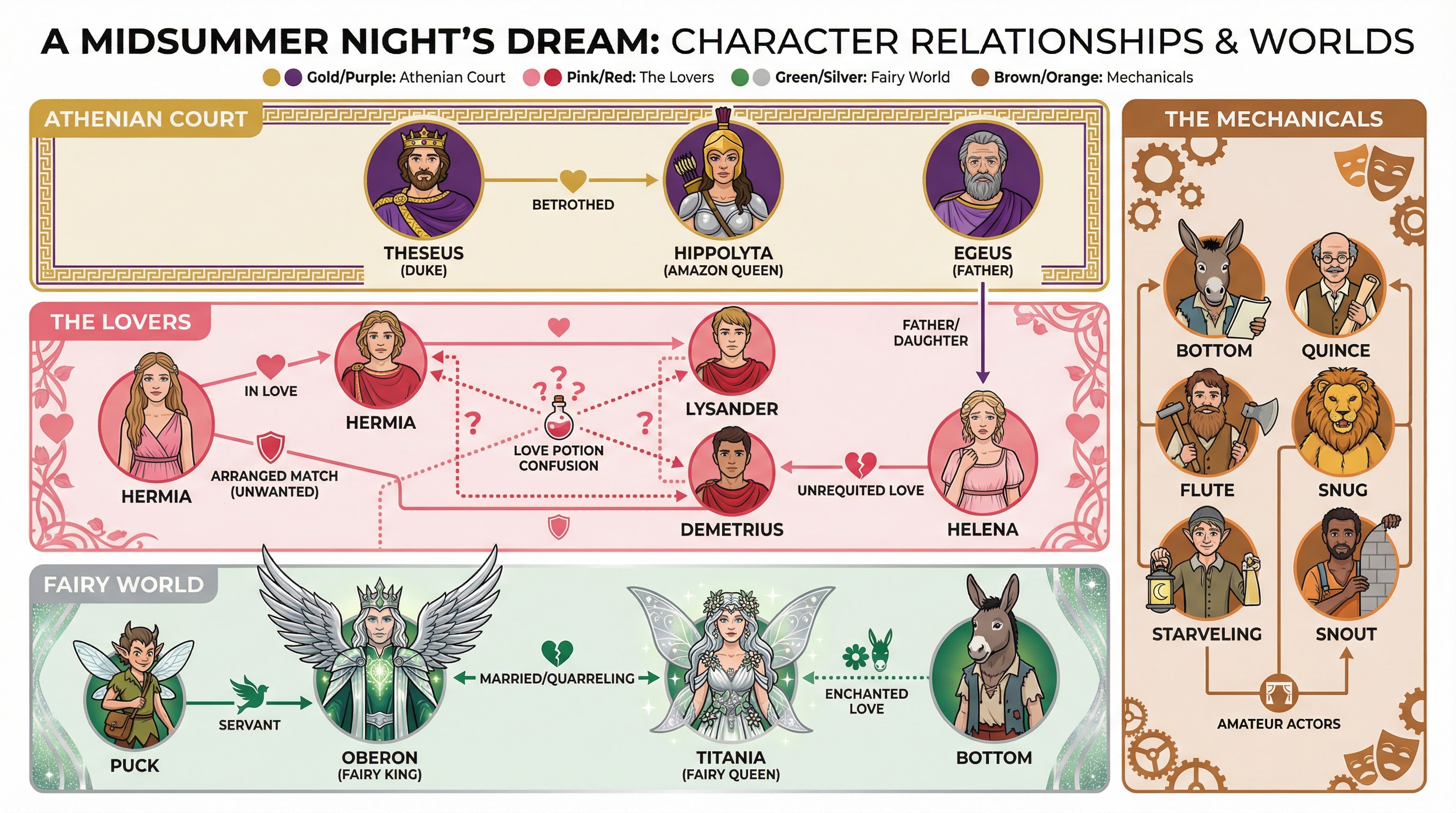
    Character Relationships and Worlds in A Midsummer Night's Dream.
    Character Relationships and Worlds in A Midsummer Night's Dream.
    The Five-Act Structure of A Midsummer Night's Dream.
    The Five-Act Structure of A Midsummer Night's Dream.

    Interactive Diagrams

    2 interactive diagrams to visualise key concepts

    The structural journey of the play from order to chaos and back to a new, transformed order.

    A diagram showing the initial state of the lovers' affections and the chaos caused by Puck's magical intervention.

    Worked Examples

    2 detailed examples with solutions and examiner commentary

    Practice Questions

    Test your understanding — click to reveal model answers

    Q1

    Starting with this extract, explore how Shakespeare presents the character of Puck.

    30 marks
    standard

    Hint: Consider Puck's role as both a servant and a mischievous agent of chaos. How does his language set him apart from the mortals?

    Q2

    Explore the importance of the Mechanicals in the play.

    30 marks
    standard

    Hint: Think about their function beyond just comic relief. How do they relate to the theme of appearance vs. reality?

    Q3

    ‘In A Midsummer Night’s Dream, the forest is a place of dangerous chaos, not magical freedom.’ To what extent do you agree?

    30 marks
    challenging

    Hint: This is an evaluative question. You need to argue both sides. Is the chaos purely negative, or is it necessary for the final resolution?

    Q4

    Explore how Shakespeare presents the relationship between Helena and Hermia.

    30 marks
    standard

    Hint: Trace their relationship from the beginning of the play to the end. How does the magical intervention in the forest test their friendship?

    Key Terms

    Essential vocabulary to know