OCR · GCSE · English Literature
Animal Farm
This guide provides a comprehensive, exam-focused breakdown of George Orwell's 'Animal Farm' for the OCR GCSE Paper 2.4. It is designed to help you master the key themes, characters, and writer's methods to achieve top marks, focusing exclusively on the assessment objectives for this specific exam."
- 10 min read
- 2 worked examples
- 4 practice questions
Study Notes
Overview
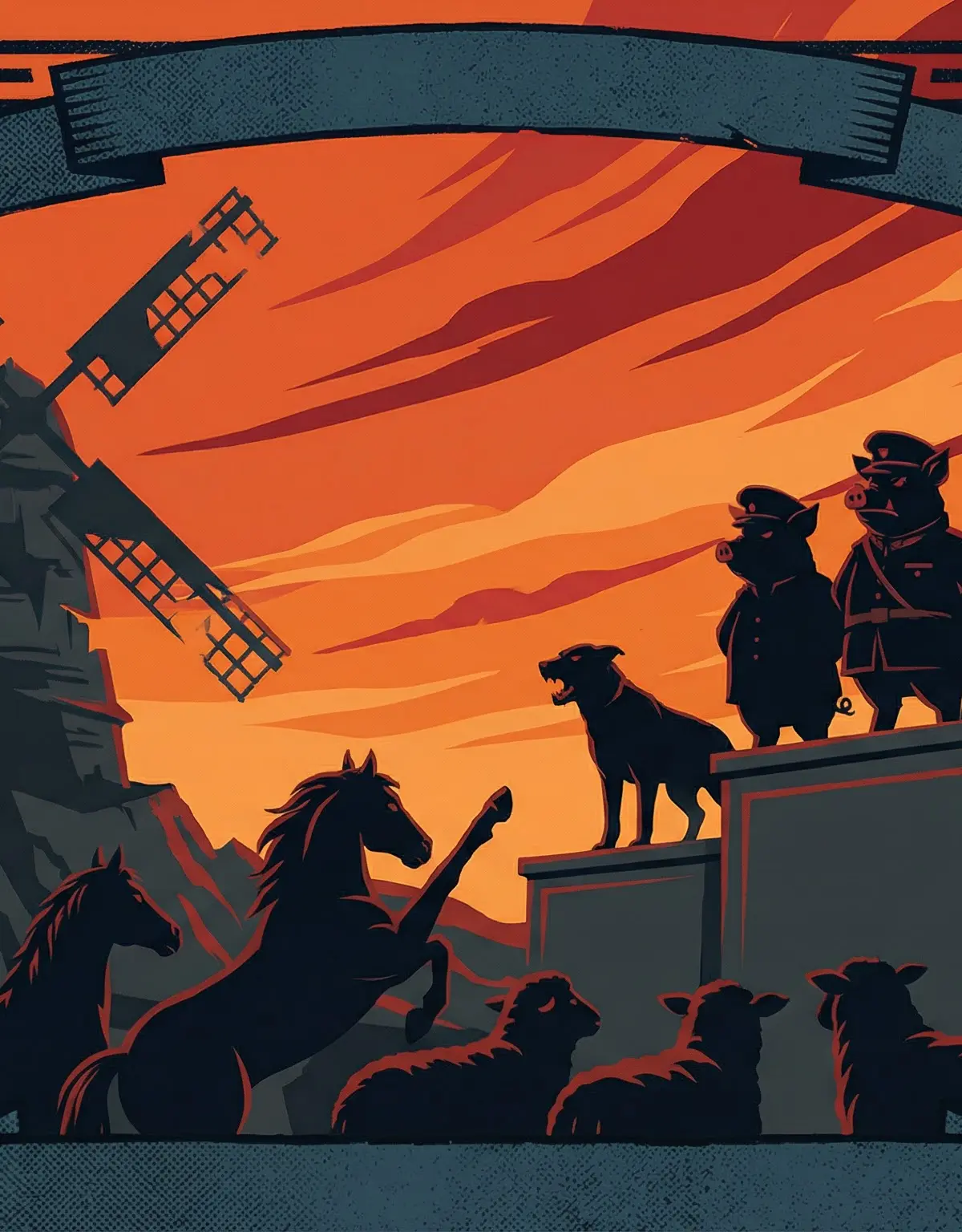
George Orwell's 'Animal Farm' is a powerful allegorical novella that uses a seemingly simple story of farm animals rebelling against their human master to explore the corrupting nature of power, the manipulation of language, and the betrayal of revolutionary ideals. For the OCR J352 Component 01 exam, candidates are not assessed on historical context (AO3), so your focus must be entirely on Orwell's narrative construction and linguistic choices (AO1 and AO2). Examiners are looking for a conceptualized argument that analyzes how Orwell crafts his message through characterization, structural devices like the cyclical narrative, and the manipulation of the Seven Commandments. Credit is given for a forensic analysis of language and a sustained, convincing argument that avoids simply retelling the plot or making superficial links to the Russian Revolution.
Plot/Content Overview
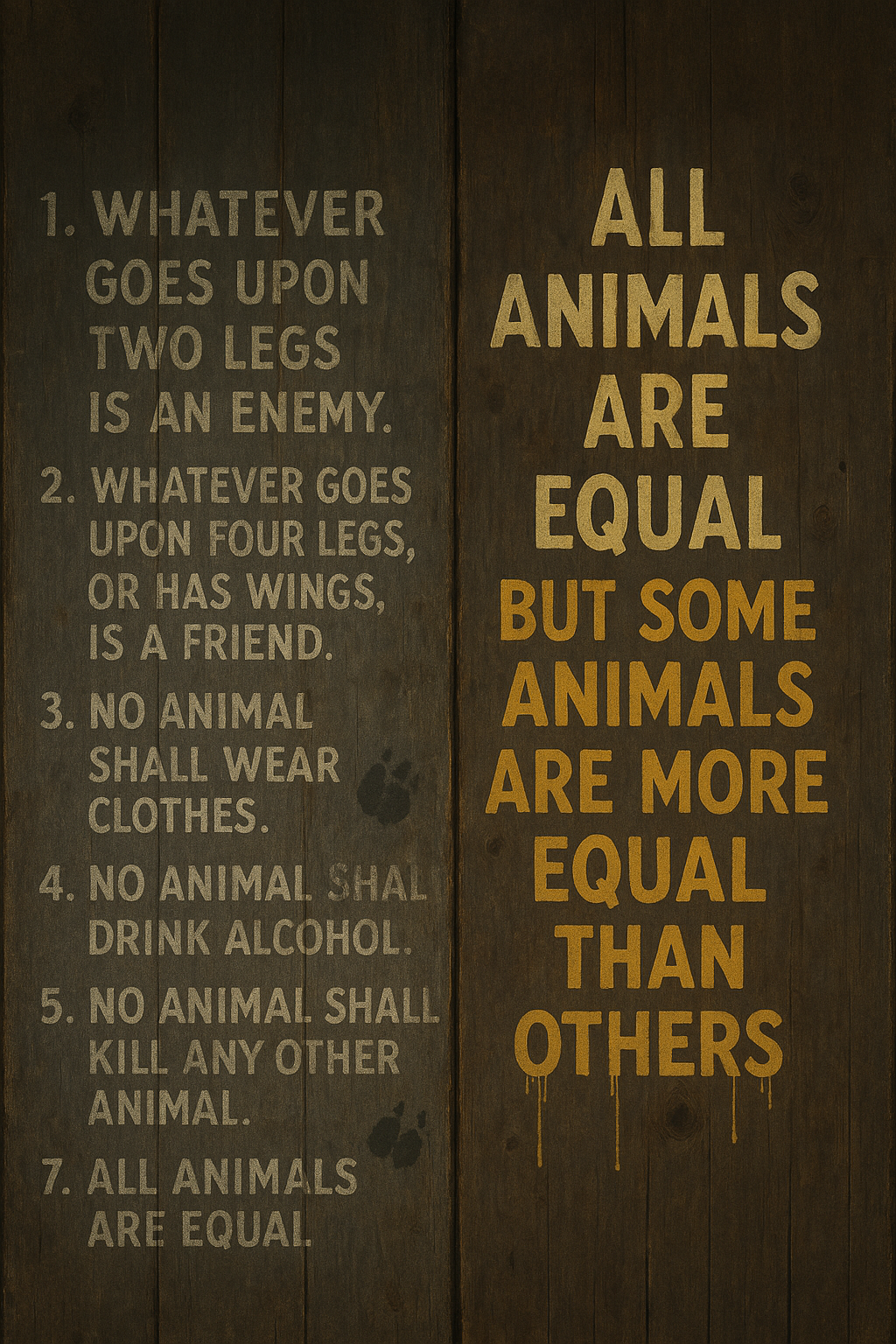
The novella begins on Manor Farm, where the animals are suffering under the neglectful farmer, Mr. Jones. Old Major, a prize-winning boar, gathers the animals and inspires them with a vision of a utopian society free from human oppression. After his death, the animals, led by the pigs Snowball and Napoleon, successfully overthrow Jones in a rebellion. They rename the farm 'Animal Farm' and establish the Seven Commandments of Animalism, the most important of which is: "All animals are equal."
Initially, the farm prospers. Snowball, a brilliant strategist, proposes building a windmill to modernize the farm. However, Napoleon, driven by a lust for power, opposes the plan. In a decisive move, Napoleon unleashes nine ferocious dogs he has secretly trained, chasing Snowball off the farm and seizing absolute control. He then declares the windmill project his own idea.
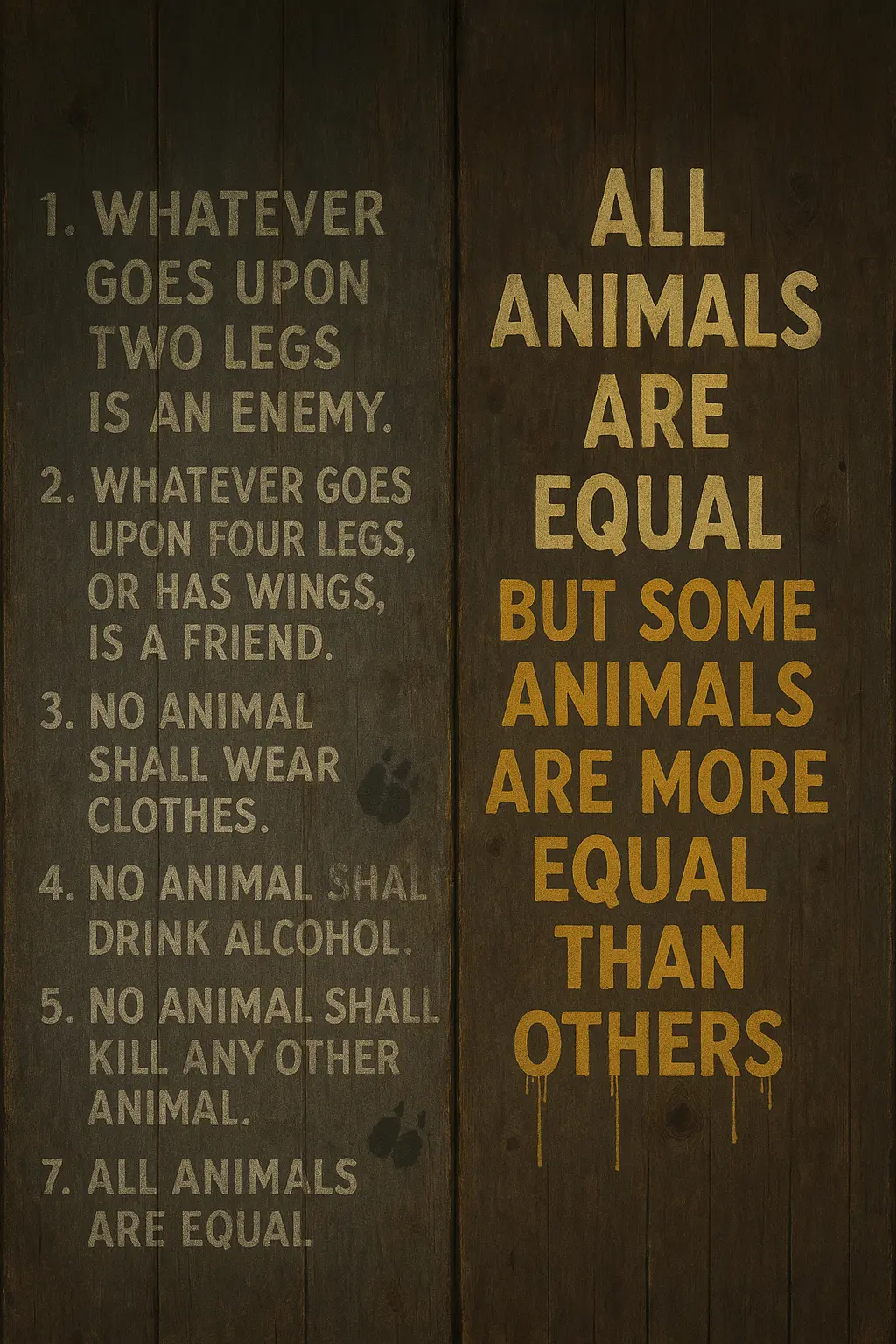
Life on the farm deteriorates under Napoleon's dictatorship. The pigs begin to adopt human habits, moving into the farmhouse, sleeping in beds, and drinking alcohol. Squealer, a masterful propagandist, continually manipulates the other animals, altering the Seven Commandments to justify the pigs' actions. The most loyal and hardworking animal, Boxer the cart-horse, is worked to death and then sold to a knacker to be turned into glue. The novella culminates in the pigs walking on two legs and hosting a dinner party for human farmers, with the final, corrupted commandment reading: "All animals are equal, but some animals are more equal than others." The other animals, looking in through the window, can no longer tell the difference between the pigs and the men, completing the cyclical narrative.
Themes
The Corruption of Power
This is the central theme of the novella. Orwell demonstrates how revolutionary ideals can be subverted by those who seek power for its own sake. Napoleon's gradual transformation from a revolutionary leader to a ruthless dictator mirrors the trajectory of many historical tyrants. The pigs' increasing indulgence in human vices—sleeping in beds, drinking alcohol, and engaging in trade—highlights their moral decay. The ultimate symbol of this corruption is the final commandment, which enshrines inequality as the new law of the farm.
Key Quotes:
- "The creatures outside looked from pig to man, and from man to pig, and from pig to man again; but already it was impossible to say which was which." (Chapter 10) - This final line encapsulates the complete betrayal of the revolution, showing how the oppressors and the new ruling class have become indistinguishable.
- "ALL ANIMALS ARE EQUAL BUT SOME ANIMALS ARE MORE EQUAL THAN OTHERS." (Chapter 10) - This paradoxical statement is the ultimate act of propaganda, twisting the original egalitarian principle into a justification for tyranny.
Propaganda and Deception
Orwell explores how language can be used as an instrument of control. Squealer is the embodiment of this theme, using sophisticated rhetoric, false statistics, and fear-mongering to manipulate the less intelligent animals. He is able to convince them that their memories are faulty and that the pigs' actions are always in their best interest. The constant alteration of the Seven Commandments is a powerful structural device that shows this deception in action.
Key Quotes:
- "He could turn black into white." (Chapter 2) - This description of Squealer immediately establishes his role as a master manipulator of language.
- "Surely, comrades, you do not want Jones back?" (Chapter 3) - Squealer repeatedly uses this rhetorical question to quell any dissent, playing on the animals' fear of their former oppressor.
Apathy and Complicity
While the pigs are the active agents of corruption, the other animals are complicit in their own oppression through their passivity, ignorance, and blind loyalty. Boxer's unthinking devotion, summed up in his mottos "I will work harder" and "Napoleon is always right," allows the pigs to exploit him mercilessly. Benjamin, the cynical donkey, understands what is happening but chooses not to intervene until it is too late, representing the dangers of intellectual apathy.
Key Quotes:
- "Napoleon is always right." (Boxer, Chapter 5) - This motto demonstrates Boxer's complete and unquestioning faith in his leader, a trait that ultimately leads to his demise.
- "Donkeys live a long time. None of you has ever seen a dead donkey." (Benjamin, Chapter 3) - Benjamin's cynical detachment and belief that life will always be hard prevents him from taking action to prevent the pigs' rise to power.
Character Analysis
Napoleon
Role: The primary antagonist and dictator of Animal Farm.
Key Traits: Cunning, ruthless, ambitious, and power-hungry. He is not a great speaker but possesses a talent for manipulation and strategy.
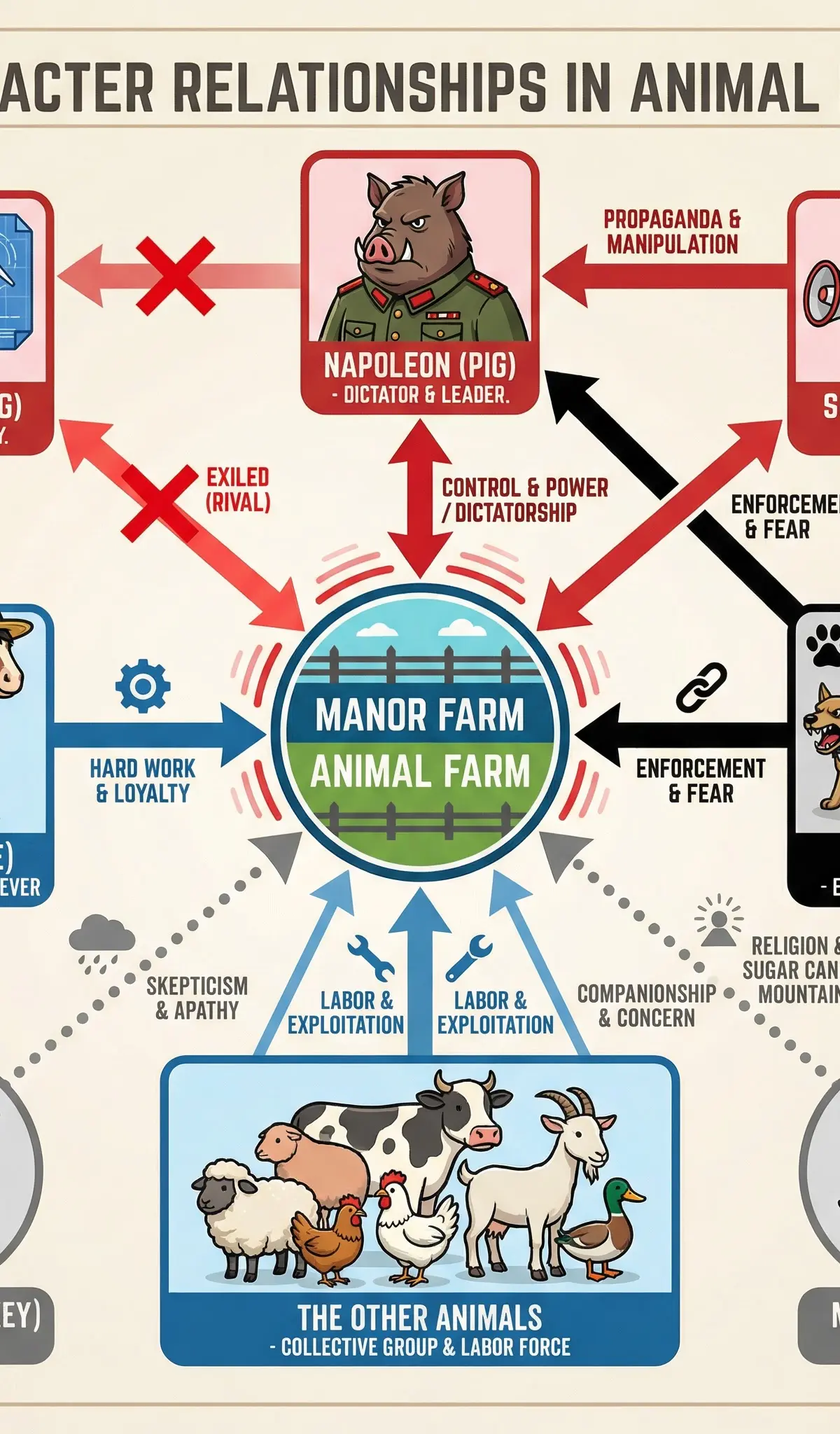
Character Arc: Napoleon begins as one of the leaders of the revolution but quickly consolidates power. He uses fear (the dogs) and propaganda (Squealer) to eliminate his rival, Snowball, and establish a totalitarian regime. His arc is one of complete moral corruption, ending with him becoming indistinguishable from the human oppressors he once fought against.
Essential Quotes:
- "a large, rather fierce-looking Berkshire boar, the only Berkshire on the farm, not much of a talker, but with a reputation for getting his own way." (Chapter 2)
- "He announced that from now on the Sunday-morning Meetings would come to an end. They were unnecessary, he said, and wasted time." (Chapter 5)
Snowball
Role: Napoleon's main rival and a key architect of the revolution.
Key Traits: Intelligent, eloquent, and idealistic. He is a brilliant strategist and a passionate believer in the principles of Animalism.
Character Arc: Snowball is a true revolutionary who genuinely wants to improve the lives of the other animals. His proposal for the windmill is a symbol of his forward-thinking vision. However, he is outmaneuvered by Napoleon's brute force and is exiled from the farm. He becomes a scapegoat for all the farm's problems, a convenient enemy used by Napoleon to maintain control.
Essential Quotes:
- "He was a more vivacious pig than Napoleon, quicker in speech and more inventive, but was not considered to have the same depth of character." (Chapter 2)
- "The pellets scored bloody streaks along Snowball's back... he was running as only a pig can run, but the dogs were close on his heels." (Chapter 5)
Squealer
Role: Napoleon's chief propagandist and second-in-command.
Key Traits: Persuasive, manipulative, and cynical. He is a brilliant speaker who can justify any action taken by the pigs.
Character Arc: Squealer's role remains consistent throughout the novella: to be the mouthpiece of the regime. He represents the power of language to distort truth and maintain control. His character does not develop; rather, his manipulative tactics become more audacious as the pigs' power grows.
Essential Quotes:
- "The others said of Squealer that he could turn black into white." (Chapter 2)
- "He was a brilliant talker, and when he was arguing some difficult point he had a way of skipping from side to side and whisking his tail which was somehow very persuasive." (Chapter 2)
Boxer
Role: The loyal and hardworking cart-horse who represents the exploited working class.
Key Traits: Strong, diligent, and naive. He is completely devoted to the ideals of the revolution and to Napoleon.
Character Arc: Boxer is the tragic hero of the novella. His unwavering belief in the revolution and his leader is exploited by the pigs. Despite his immense contributions to the farm, he is betrayed and sold to a knacker when he is no longer useful. His arc is a powerful indictment of how totalitarian regimes exploit and discard the very people who support them.
Essential Quotes:
- "I will work harder." (Chapter 3)
- "Napoleon is always right." (Chapter 5)
Writer's Methods
Orwell uses a variety of methods to convey his message. The most important is allegory, where the entire story operates on a symbolic level. The farm, the animals, and the events all represent real-world political figures, groups, and events. However, for this exam, you must treat allegory as a structural device (AO2), not as historical context (AO3). The cyclical structure, which begins and ends with the animals in a state of oppression, is another key method. It reinforces the theme that power corrupts and that revolutions can fail. The Seven Commandments serve as a powerful structural and visual motif, with their gradual alteration providing a clear and damning record of the pigs' betrayal. Orwell's use of a third-person narrator who reports events in a simple, factual tone creates a sense of irony, as the reader can see the injustice that the animals themselves cannot.
Context
While AO3 is not assessed in this component, understanding the novella as a critique of totalitarianism in general is useful for a deeper analysis of Orwell's purpose. Orwell wrote 'Animal Farm' during World War II as a warning against the dangers of Stalinism and the betrayal of socialist ideals. The characters and events are direct parallels to the Russian Revolution and its aftermath. However, you must be careful to frame this as part of your analysis of Orwell's methods and intentions, rather than as a separate historical discussion. For example, you could argue that Orwell uses the character of Napoleon as a narrative device to explore the archetype of the modern dictator, rather than simply stating that Napoleon represents Stalin.
"
Worked Examples
2 worked examples — open one to explore the question and available guidance.
Practice Questions
Test your understanding — click to reveal model answers
How does Orwell present the theme of propaganda in 'Animal Farm'?
Hint: Focus on the character of Squealer and the changing of the Seven Commandments. Analyze specific linguistic techniques.
Explore the importance of the windmill in 'Animal Farm'.
Hint: Consider the windmill's symbolic meaning as well as its role in the plot. Think about how it is used by both Snowball and Napoleon.
‘Boxer is a heroic figure, but he is also a foolish one.’ To what extent do you agree?
Hint: This is a 'to what extent' question, so you need to explore both sides of the argument. Acknowledge his heroic qualities (strength, loyalty) but also his fatal flaws (naivety, blind faith).
How does Orwell use the final chapter of 'Animal Farm' to convey his message about power?
Hint: Focus on the cyclical structure of the novella. Analyze the final image of the pigs and men together and the significance of the final commandment.
Test your understanding of Animal Farm
Active recall beats re-reading. Take an instant quiz now to test what you’ve learned and lock it into long-term memory.
7 days Premium · Then free forever · No card, no charge