Study Notes
Overview
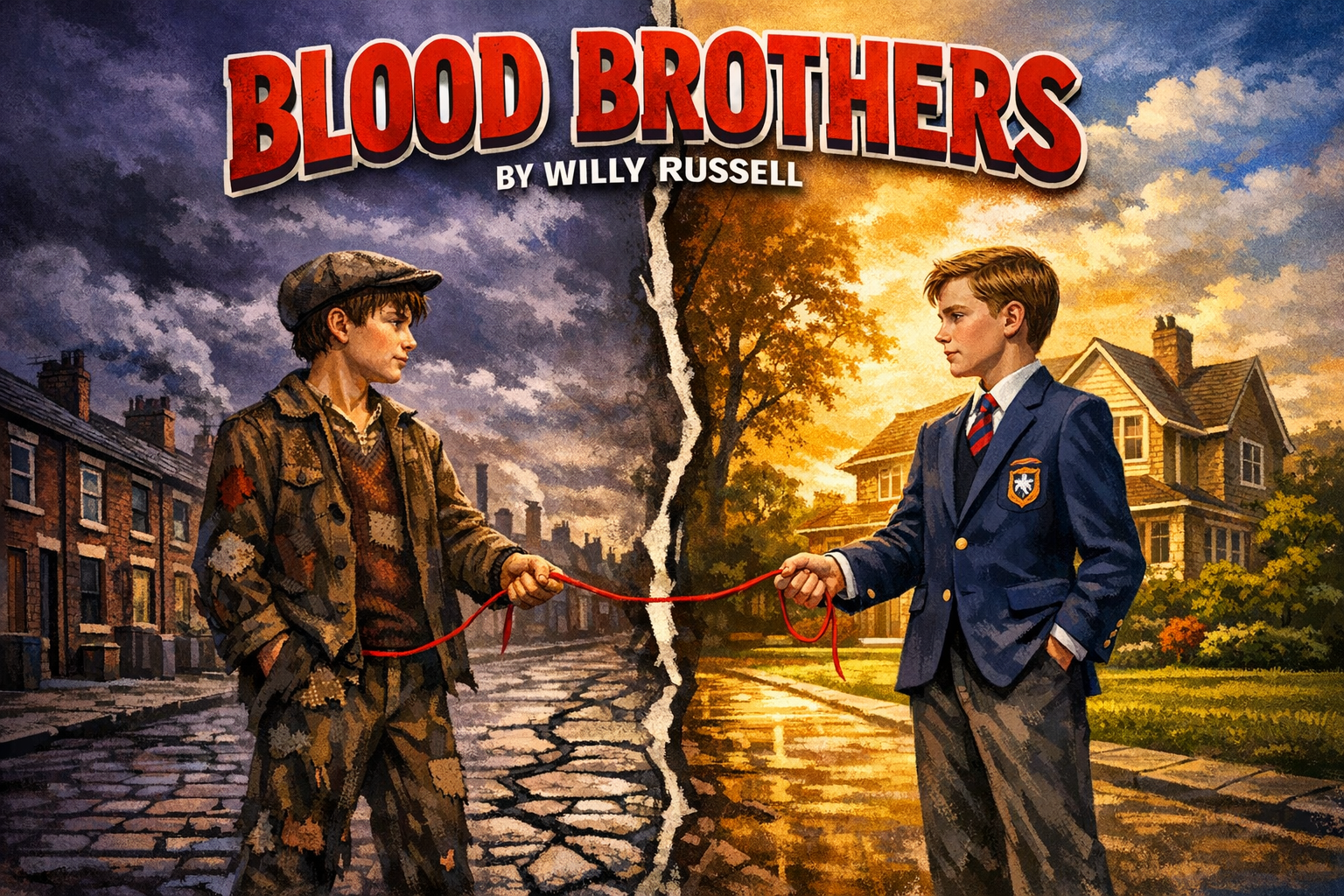
Willy Russell's 'Blood Brothers' is a modern tragedy that uses the lives of twin brothers to deliver a devastating critique of the British class system. Set in Liverpool, the play spans from the 1960s to the 1980s, exploring the 'nature versus nurture' debate through Mickey and Edward, twins separated at birth. Examiners reward candidates who recognise that this is a play, not a novel. High marks are awarded to those who can analyse Russell's dramatic methods — the cyclical structure, the use of the Narrator, musical motifs, and stage directions — to show how the tragedy is inevitable from the very beginning. Context is crucial: the mass unemployment and social division of Thatcher's Britain are the engine driving the characters' fates.
Listen to our revision podcast here:
Plot/Content Overview
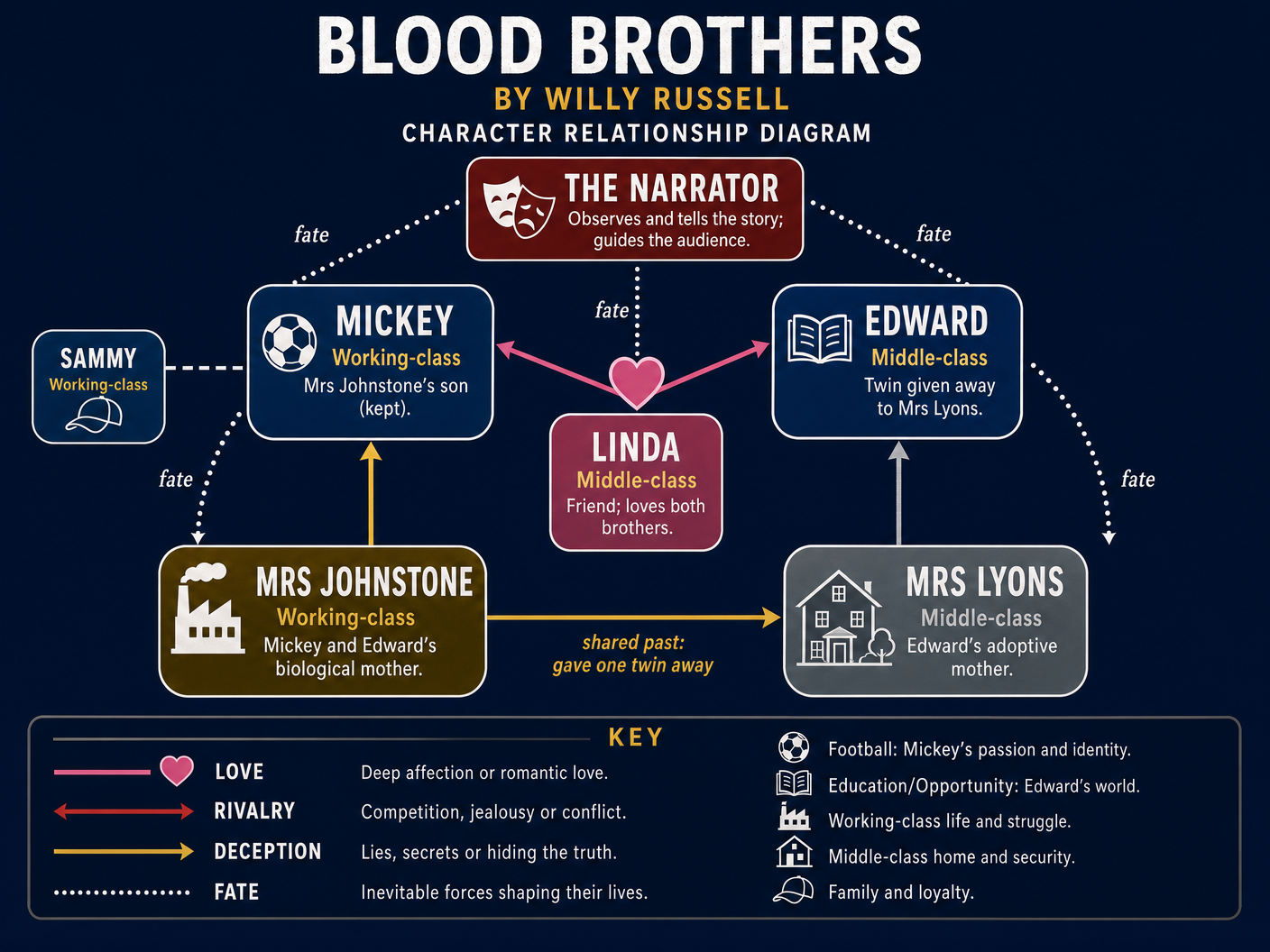
Act 1: ChildhoodThe play opens with a prologue showing the twins dead. We then flash back to see Mrs Johnstone, a struggling working-class mother, persuaded by her wealthy employer, Mrs Lyons, to give away one of her unborn twins (Edward). Mrs Lyons uses superstition to ensure Mrs Johnstone's silence. Aged seven, Mickey and Edward meet by chance and, unaware of their relation, swear a blood oath to be 'blood brothers'. When the mothers discover this, they force the boys apart, and the Lyons family moves away to the country. The Johnstones are eventually rehoused nearby.
Act 2: Adolescence to AdulthoodThe boys reunite as teenagers. Edward is privately educated and confident; Mickey attends a local comprehensive and struggles. Both fall in love with their childhood friend, Linda. As adults, the class divide shatters their bond. Edward goes to university and becomes a successful councillor. Mickey is made redundant, gets involved in a robbery with his brother Sammy, and is sent to prison where he becomes addicted to antidepressants. Upon release, Mickey discovers Linda is having an affair with Edward. Armed with a gun, Mickey confronts Edward at the town hall. Mrs Johnstone rushes in and reveals they are twins. In the shock, the gun goes off, killing Edward, and the police immediately shoot Mickey. The play ends as it began.
Themes
Theme 1: Social Class and Inequality
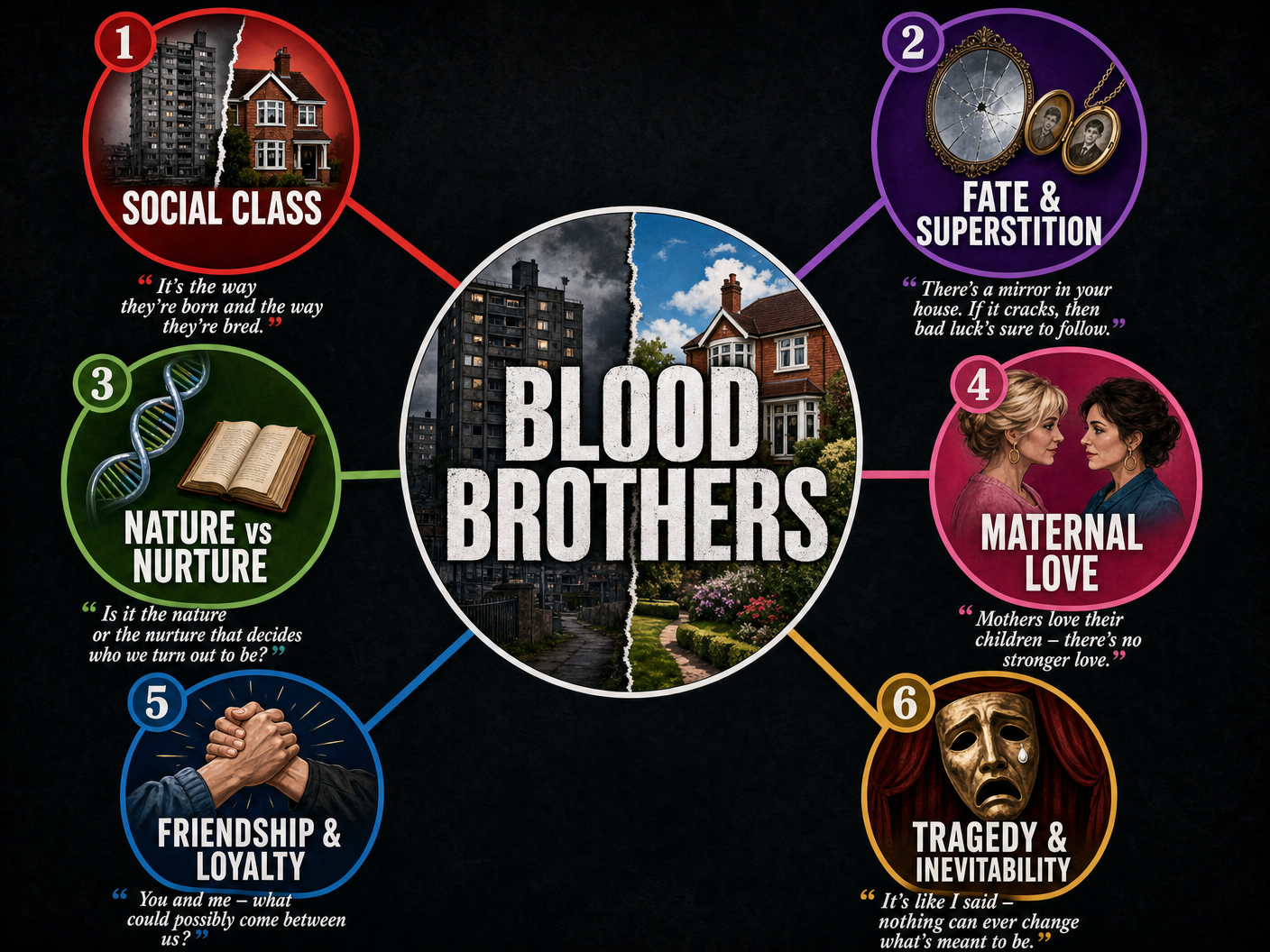
Social class is the central thematic engine of the play. Russell argues that class, not genetics, determines a person's life chances. This is the 'nurture' side of the debate. Mickey and Edward share the same DNA, but their vastly different upbringings lead to vastly different outcomes. Russell uses the contrast between the boys' education, language, and opportunities to highlight the injustice of the class system. The tragedy is that Mickey's downfall is not due to a personal flaw, but a systemic one.
Key Quotes:
- "It's the way they're born and the way they're bred." (Narrator) - Highlights the nature vs nurture debate and the inescapable influence of environment.
- "I could have been him!" (Mickey, Act 2) - The devastating climax where Mickey realises his life was stolen by class disparity, not fate.
- "By the time I was nineteen, I had nothing." (Mickey, Act 2) - Contrasts starkly with Edward's university life, showing the reality of working-class youth unemployment.
Theme 2: Fate and Determinism
Russell uses the concept of fate to show how the working classes are trapped. The Narrator acts as a constant reminder of the inescapable tragedy, functioning like a Greek Chorus. The cyclical structure (starting and ending with the deaths) means the audience knows the boys are doomed. However, Russell suggests that 'fate' is actually just the inevitable consequence of a divided society. Superstition is used by the middle class (Mrs Lyons) to control the working class (Mrs Johnstone).
Key Quotes:
- "There's a girl inside the woman, staring out at you." (Narrator) - Suggests that the past cannot be escaped and fate is always watching.
- "You know the devil's got your number." (Narrator) - A recurring musical motif that builds tension and reinforces the inevitability of the tragic end.
- "If either twin learns that he once was a pair, they shall both immediately die." (Mrs Lyons, Act 1) - A fabricated superstition that becomes a self-fulfilling prophecy.
Theme 3: Nature versus Nurture
The play constantly asks whether our identities are innate (nature) or shaped by our environment (nurture). As children, Mickey and Edward are remarkably similar — both are playful, curious, and drawn to each other. However, as they grow, their environments mould them. Edward's middle-class nurture gives him articulacy and opportunity, while Mickey's working-class nurture leaves him defeated. Russell firmly sides with nurture.
Key Quotes:
- "Do you want to be my blood brother?" (Mickey, Act 1) - Shows their natural affinity before society teaches them they are different.
- "Why didn't you give me away?" (Mickey, Act 2) - Mickey's tragic realisation that nurture, not nature, dictated his miserable life.
Character Analysis
Mickey Johnstone
Role: The tragic working-class protagonist.
Key Traits: Energetic, loyal, vulnerable, eventually defeated by society.
Character Arc: Mickey transitions from a lively, imaginative seven-year-old to an awkward teenager, and finally to a broken, depressed adult. His arc represents the crushing weight of working-class reality in the 1980s.
Essential Quotes:
- "I'm older than you. I'm nearly eight!" (Act 1) - Shows his early innocence and desire for status.
- "That was kids' stuff, Eddie. Didn't anyone tell y'?" (Act 2) - Marks the moment the class divide becomes unbridgeable; Mickey is forced to grow up while Edward remains sheltered.
Edward Lyons
Role: The privileged twin, representing middle-class opportunity.
Key Traits: Sheltered, articulate, generous, naive.
Character Arc: Edward grows from a sheltered child to a successful, albeit slightly naive, adult. His lack of understanding of Mickey's struggles highlights the insulation of the middle class.
Essential Quotes:
- "Why... why is a job so important?" (Act 2) - Demonstrates his complete lack of understanding of economic necessity.
- "I've got money, plenty of it." (Act 2) - His attempt to help Mickey is well-meaning but patronising, showing the gulf between them.
Mrs Johnstone
Role: The biological mother, representing working-class struggle and maternal love.
Key Traits: Warm, superstitious, trapped by poverty, loving.
Character Arc: She is a victim of her circumstances, forced into an impossible choice. Despite her poverty, she is shown to be a far warmer and more loving mother than Mrs Lyons.
Essential Quotes:
- "Living on the never-never." (Act 1) - A motif highlighting the constant debt and precariousness of working-class life.
- "Mothers love their children — there's no stronger love." (Act 1) - Emphasises that her decision to give Edward away was born of love, not coldness.
The Narrator
Role: The voice of fate, judgment, and society.
Key Traits: Omniscient, menacing, objective.
Character Arc: He does not develop but remains a constant, looming presence, guiding the audience's response and breaking the fourth wall.
Essential Quotes:
- "And do we blame superstition for what came to pass? Or could it be what we, the English, have come to know as class?" (Act 2) - The final lines of the play, explicitly stating Russell's political message.
Writer's Methods
Russell employs several key dramatic methods that candidates must analyse (AO2):
- Cyclical Structure: The play begins with the ending (the dead twins). This creates profound dramatic irony and ensures the audience views the entire childhood sequence through a lens of impending tragedy.
- The Narrator: Functions as a Brechtian device to prevent the audience from becoming too emotionally absorbed, forcing them to judge the social issues. He also acts as a Greek Chorus, representing fate.
- Musical Motifs: Recurring songs like 'Marilyn Monroe' map Mrs Johnstone's decline (from glamour to tragedy) and the 'Shoes upon the table' motif tracks the theme of superstition and inescapable fate.
- Contrasting Dialect: Russell uses language to signify class. Mickey uses colloquialisms and expletives ("gis a sweet"), while Edward uses Standard English and elevated vocabulary ("You're a fuckoff!").
- Symbolism: The locket represents the unbreakable bond of blood and Mrs Johnstone's enduring love. The childhood game of 'Cowboys and Indians' foreshadows the real gun violence at the end.
Context
To achieve high marks in AO3, context must be integrated into your analysis of character and theme. Willy Russell wrote the play in 1983, during Margaret Thatcher's Conservative government.
- Deindustrialisation: Liverpool suffered massive job losses in manufacturing. Mickey's redundancy reflects the reality of millions of working-class men whose livelihoods were destroyed, leading to a crisis of masculinity and mental health.
- The Class Divide: The 1980s saw a widening gap between the rich and the poor. Edward's smooth path to university and local politics contrasts with Mickey's descent into crime, illustrating the systemic inequality Russell was critiquing.
- Patriarchy and Single Motherhood: Mrs Johnstone's struggle highlights the lack of support for single mothers and the vulnerability of working-class women to exploitation (by her husband, the catalogue men, and Mrs Lyons).
Visual Resources
2 diagrams and illustrations
Interactive Diagrams
1 interactive diagram to visualise key concepts
Conceptual Flow Outline
The Cyclical and Inevitable Structure of Blood Brothers
Worked Examples
2 detailed examples with solutions and examiner commentary
Practice Questions
Test your understanding — click to reveal model answers
How does Russell use the characters of Mrs Johnstone and Mrs Lyons to explore ideas about motherhood and social class? (30 marks + 4 AO4)
Hint: Contrast their financial security with their emotional warmth. Look at how they use or are used by superstition.
Explore how Russell presents the theme of childhood and growing up in Blood Brothers. (30 marks + 4 AO4)
Hint: Focus on the transition from Act 1 to Act 2. How does the 'real world' intrude on their games?
How is the theme of violence presented in the play? (30 marks + 4 AO4)
Hint: Track violence from childhood games to Sammy's real crimes, to the final tragic climax.
Starting with the final scene (from Mickey entering with the gun to the end), explore how Russell presents the idea of inevitability. (30 marks + 4 AO4)
Hint: Look at the Narrator's final lines, the cyclical structure, and Mickey's realisation.