OCR · GCSE · English Literature
Great Expectations
Unlock top marks in your OCR GCSE English Literature exam with this comprehensive guide to *Great Expectations*. This guide provides a deep dive into Dickens' classic novel, focusing on the key themes, characters, and literary methods you need to know to impress the examiners. It is packed with worked examples, memory hooks, and exam-style questions to help you revise effectively and write with confidence."
- 6 min read
- 2 worked examples
- 4 practice questions
Study Notes
Overview
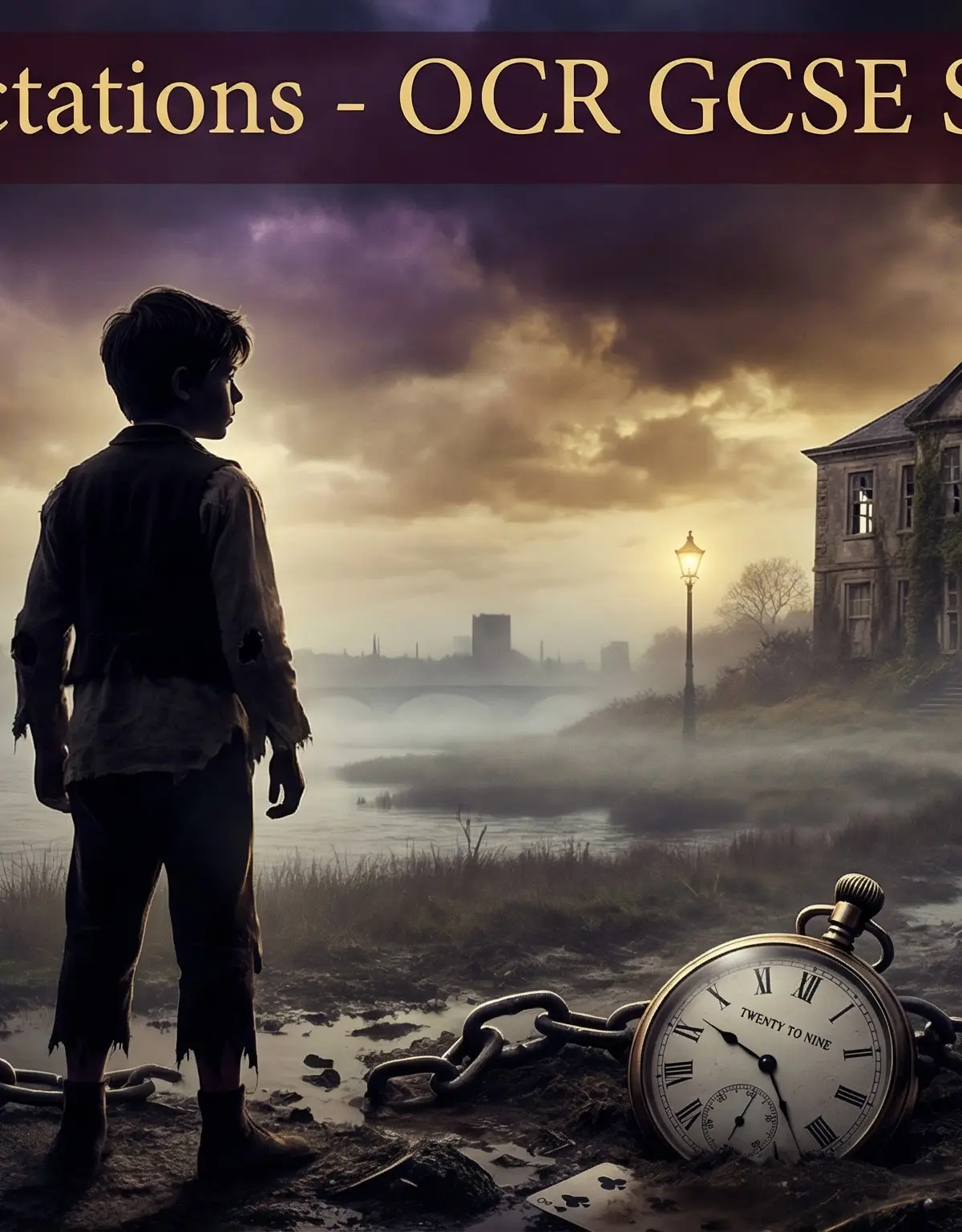
Great Expectations is a novel that has captivated readers for over 150 years. It is a classic example of a Bildungsroman, a story that traces the moral and psychological growth of its protagonist, Pip. The novel is set in Victorian England and offers a powerful critique of the social class system, the nature of gentility, and the justice system. For the OCR GCSE exam, candidates are expected to demonstrate a sophisticated understanding of the novel's themes, characters, and literary techniques. Examiners look for a well-structured argument that is supported by textual evidence and informed by the historical context of the novel. A successful response will move beyond a simple summary of the plot and offer a critical analysis of Dickens' authorial choices.
Plot/Content Overview
The novel is divided into three stages of Pip's expectations. In the first stage, Pip is a young orphan living with his abusive sister and her kind husband, Joe Gargery. His life takes an unexpected turn when he encounters an escaped convict, Magwitch, in a churchyard and is later summoned to Satis House, the home of the eccentric Miss Havisham and her adopted daughter, Estella. These encounters ignite Pip's ambition to become a gentleman. In the second stage, Pip receives a mysterious fortune and moves to London to pursue his education and social advancement. He becomes increasingly snobbish and ashamed of his humble origins. The third stage of the novel sees Pip's great expectations shattered when he discovers the true source of his wealth. This revelation forces him to confront his own moral failings and re-evaluate his values. The novel ends with Pip a humbler and more compassionate man, reconciled with his past.
Themes
Theme 1: Social Class and Ambition
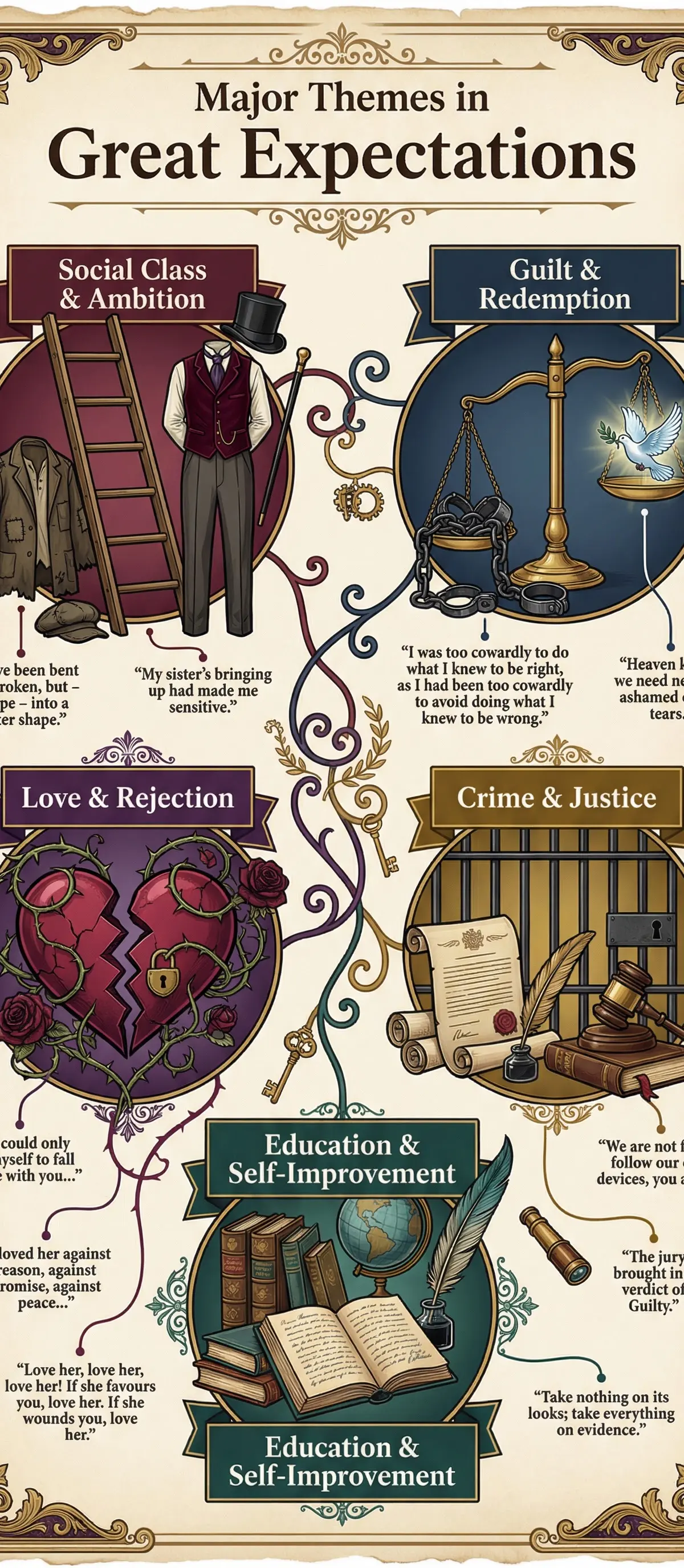
Dickens uses Pip's journey to expose the arbitrary and often cruel nature of the Victorian class system. Pip's desperate ambition to become a gentleman is fuelled by his encounters with the upper-class world of Miss Havisham and Estella. He comes to believe that social status is the ultimate measure of a person's worth, a belief that leads him to betray his true friends and values.
Key Quotes:
- "I have been bent and broken, but - I hope - into a better shape." (Chapter 59) - This quote, spoken by Pip at the end of the novel, reflects his hard-won self-awareness and his rejection of his earlier, superficial ambitions.
- "My sister's bringing up had made me sensitive." (Chapter 8) - Pip's early experiences of cruelty and injustice fuel his desire to escape his social circumstances.
Theme 2: Guilt and Redemption
Guilt is a powerful and recurring emotion in the novel. Pip is haunted by his association with Magwitch and his own acts of snobbery and unkindness. The novel suggests that true redemption can only be achieved through self-awareness, compassion, and a willingness to atone for one's past mistakes.
Key Quotes:
- "I was too cowardly to do what I knew to be right, as I had been too cowardly to avoid doing what I knew to be wrong." (Chapter 6) - This quote reveals Pip's early moral struggles and his awareness of his own cowardice.
- "Heaven knows we need never be ashamed of our tears." (Chapter 19) - This quote, spoken by Pip, suggests that emotional vulnerability is a necessary part of the human experience and a key to redemption.
Character Analysis
Pip
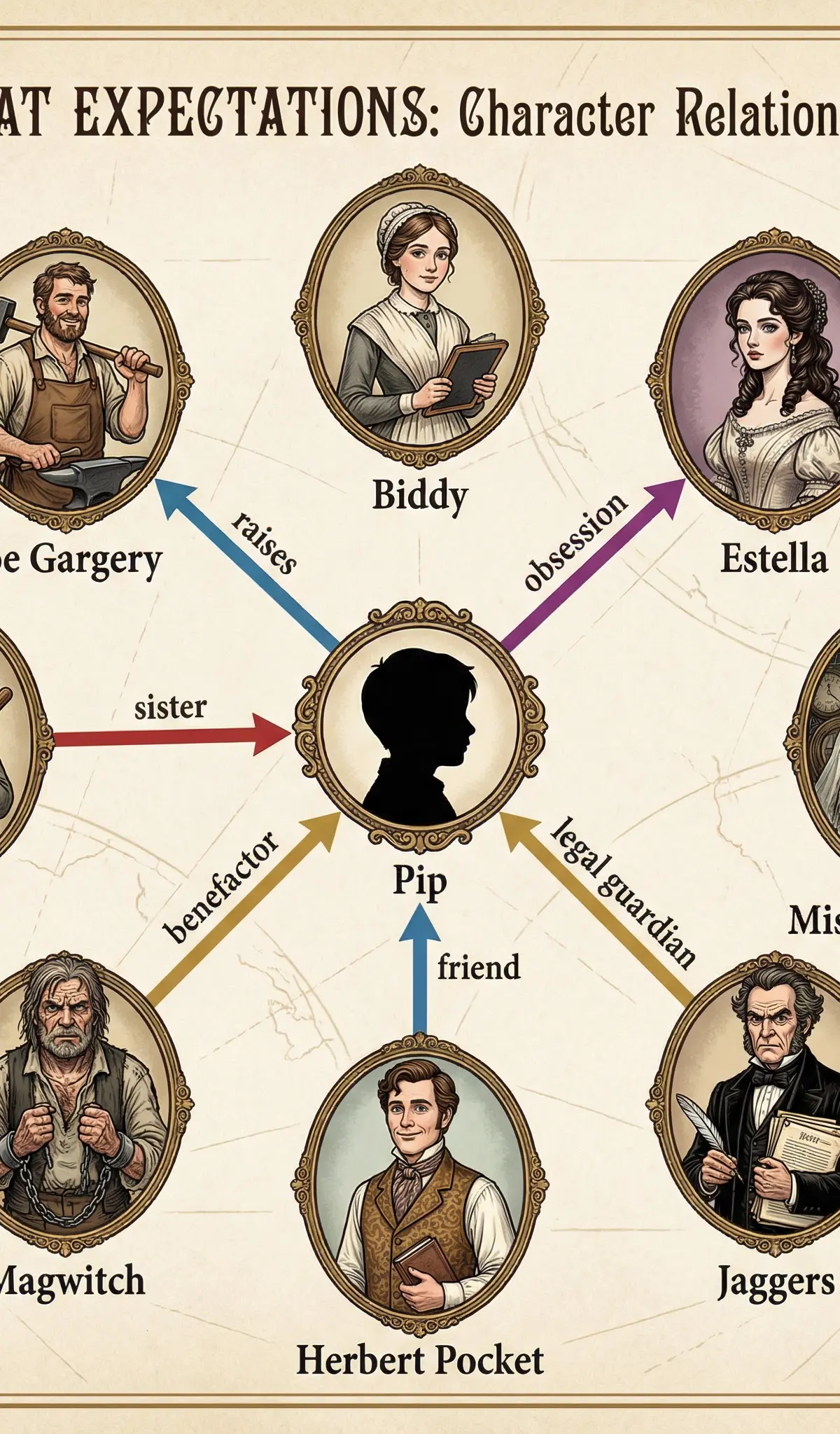
Role: Protagonist and narrator
Key Traits: Ambitious, sensitive, snobbish, and ultimately, compassionate.
Character Arc: Pip undergoes a profound transformation throughout the novel, moving from a state of innocence to a state of moral awareness. He learns that true worth is not determined by social class but by one's character and actions.
Essential Quotes:
- "I wished Joe had been rather more genteelly brought up, and then I should have been so too." (Chapter 8)
- "For now my repugnance to him had all melted away, and in the hunted, wounded, shackled creature who held my hand in his, I only saw a man who had meant to be my benefactor, and who had felt affectionately, gratefully, and generously, towards me with great constancy through a series of years. I only saw in him a much better man than I had been to Joe." (Chapter 54)
Miss Havisham
Role: A wealthy and eccentric spinster who was jilted on her wedding day.
Key Traits: Bitter, manipulative, and vengeful.
Character Arc: Miss Havisham is a static character for much of the novel, trapped in a self-imposed prison of the past. However, she does experience a moment of remorse and self-awareness towards the end of the novel, begging Pip for his forgiveness.
Essential Quotes:
- “I have a sick fancy that I want to see some play at being loved.” (Chapter 29)
- “What have I done! What have I done!” (Chapter 49)
Writer's Methods
Dickens is a master of literary technique, and his writing is rich with symbolism, irony, and vivid imagery. He uses the first-person narrative to create a sense of intimacy and immediacy, allowing the reader to experience events through Pip's eyes. The dual perspective of the narrator, with the older Pip reflecting on his younger self, creates a powerful sense of irony and allows for a more nuanced and critical exploration of the novel's themes. Dickens also uses setting to great effect, with the bleak and misty marshes reflecting Pip's sense of isolation and fear, and the decaying grandeur of Satis House symbolizing the corrupting influence of wealth and social status.
Context
Great Expectations was published in 1861, a time of great social and economic change in Victorian England. The Industrial Revolution had created a new wealthy class, and the traditional social hierarchies were beginning to break down. This is the world that Pip is born into, a world of great opportunity but also great inequality. The novel reflects many of the anxieties and concerns of the Victorian era, including the rigid class system, the brutal justice system, and the changing definition of what it meant to be a gentleman. To achieve top marks, candidates must be able to connect these contextual factors to their analysis of the novel.
"
Worked Examples
2 worked examples — open one to explore the question and available guidance.
Practice Questions
Test your understanding — click to reveal model answers
How does Dickens present the theme of crime and justice in Great Expectations?
Hint: Consider the characters of Magwitch and Jaggers, and the role of the legal system in the novel.
Explore the significance of Satis House in Great Expectations.
Hint: Consider the symbolic meaning of the house and its inhabitants, and how it affects Pip's development.
How does Dickens use the relationship between Pip and Estella to explore the theme of love?
Hint: Consider the nature of Pip's love for Estella, and how it changes and develops throughout the novel.
‘The minor characters in Great Expectations are more memorable than the main characters.’ To what extent do you agree?
Hint: Consider the role of characters such as Joe, Jaggers, Wemmick, and Pumblechook.
Test your understanding of Great Expectations
Active recall beats re-reading. Take an instant quiz now to test what you’ve learned and lock it into long-term memory.
7 days Premium · Then free forever · No card, no charge