OCR · GCSE · English Literature
Lord of the Flies
William Golding's *Lord of the Flies* is a stark, allegorical tale of schoolboys stranded on a desert island, a descent into savagery that ruthlessly examines the dark heart of human nature. For OCR candidates, mastering this text is about understanding how Golding uses character, symbolism, and structure to question the very foundations of society.
- 11 min read
- 2 worked examples
- 4 practice questions
- 8 key terms
Study Notes
Overview
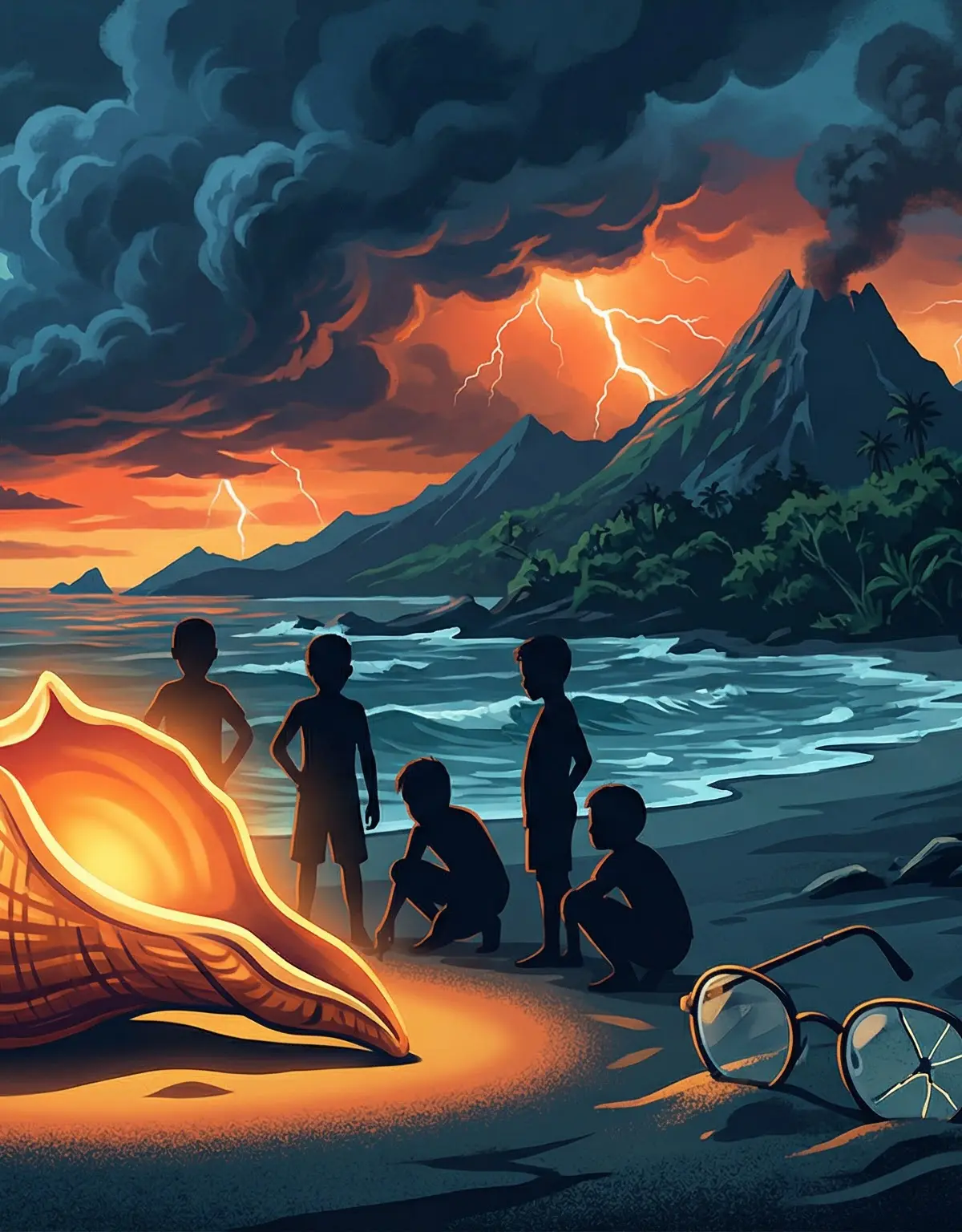
Lord of the Flies is a novel that operates on multiple levels. On the surface, it is a gripping adventure story. Beneath this, it is a profound political and psychological allegory. William Golding, writing in the shadow of World War II and the atomic bomb, challenges the romantic notion of innate human goodness. Examiners expect candidates to move beyond simple plot summary and engage with the text as a deliberately crafted argument. Credit is given for analysing how Golding’s stylistic choices—from the oppressive heat of the island to the chillingly detached narrative voice—serve his thematic purpose. A top-band response will demonstrate a clear understanding of the novel as a microcosm of society, where the struggle between Ralph and Jack represents the eternal conflict between civilisation and primal instinct.
Plot/Content Overview
- Chapter 1: The Sound of the Shell: Following a plane crash, English schoolboys gather on a desert island. Ralph meets Piggy, and they use a conch shell to summon the others. Ralph is elected chief, much to the annoyance of Jack Merridew, the head of the choir.
- Chapter 2: Fire on the Mountain: Ralph establishes rules and the importance of a signal fire. Jack’s focus is on hunting. The first mention of a ‘beastie’ emerges from the younger boys (‘littluns’), sowing seeds of fear.
- Chapter 3: Huts on the Beach: The division between Ralph and Jack deepens. Ralph and Simon struggle to build shelters while Jack becomes obsessed with hunting, his frustration growing.
- Chapter 4: Painted Faces and Long Hair: The boys’ appearance deteriorates. Roger shows early signs of cruelty. Jack paints his face, creating a mask that liberates his savagery. A passing ship is missed because Jack’s hunters let the signal fire go out.
- Chapter 5: Beast from Water: An assembly collapses into chaos as fear of the beast intensifies. Jack openly challenges Ralph’s authority and leads his followers away.
- Chapter 6: Beast from Air: A dead parachutist lands on the mountain, his form mistaken by Sam and Eric for the beast. The boys, armed, set off to hunt it.
- Chapter 7: Shadows and Tall Trees: The hunt for the beast leads to a pig-hunt, where Ralph gets his first taste of bloodlust. The boys re-enact the hunt, with Robert as the pig, in a disturbingly violent ritual. Ralph, Jack, and Roger climb the mountain and see the ‘beast’.
- Chapter 8: Gift for the Darkness: Jack fails to overthrow Ralph and forms his own tribe. They kill a sow and leave its head on a stick as an offering to the beast. Simon has a terrifying, hallucinatory conversation with the ‘Lord of the Flies’.
- Chapter 9: A View to a Death: Simon discovers the truth about the dead parachutist. He stumbles down the mountain to tell the others but is mistaken for the beast and brutally killed in a frenzied tribal dance.
- Chapter 10: The Shell and the Glasses: Ralph and Piggy are left with only a few followers. Jack’s tribe, now established at Castle Rock, raids Ralph’s camp and steals Piggy’s glasses—the power to make fire.
- Chapter 11: Castle Rock: Ralph, Piggy, Sam, and Eric go to Castle Rock to confront Jack. Roger, from above, releases a huge boulder which kills Piggy and shatters the conch. Sam and Eric are captured and tortured.
- Chapter 12: Cry of the Hunters: Ralph is hunted like an animal. The island is set on fire to smoke him out. As he collapses on the beach, a Naval officer appears. The boys are rescued, but their innocence is gone forever. Ralph weeps ‘for the end of innocence, the darkness of man’s heart’.
Themes
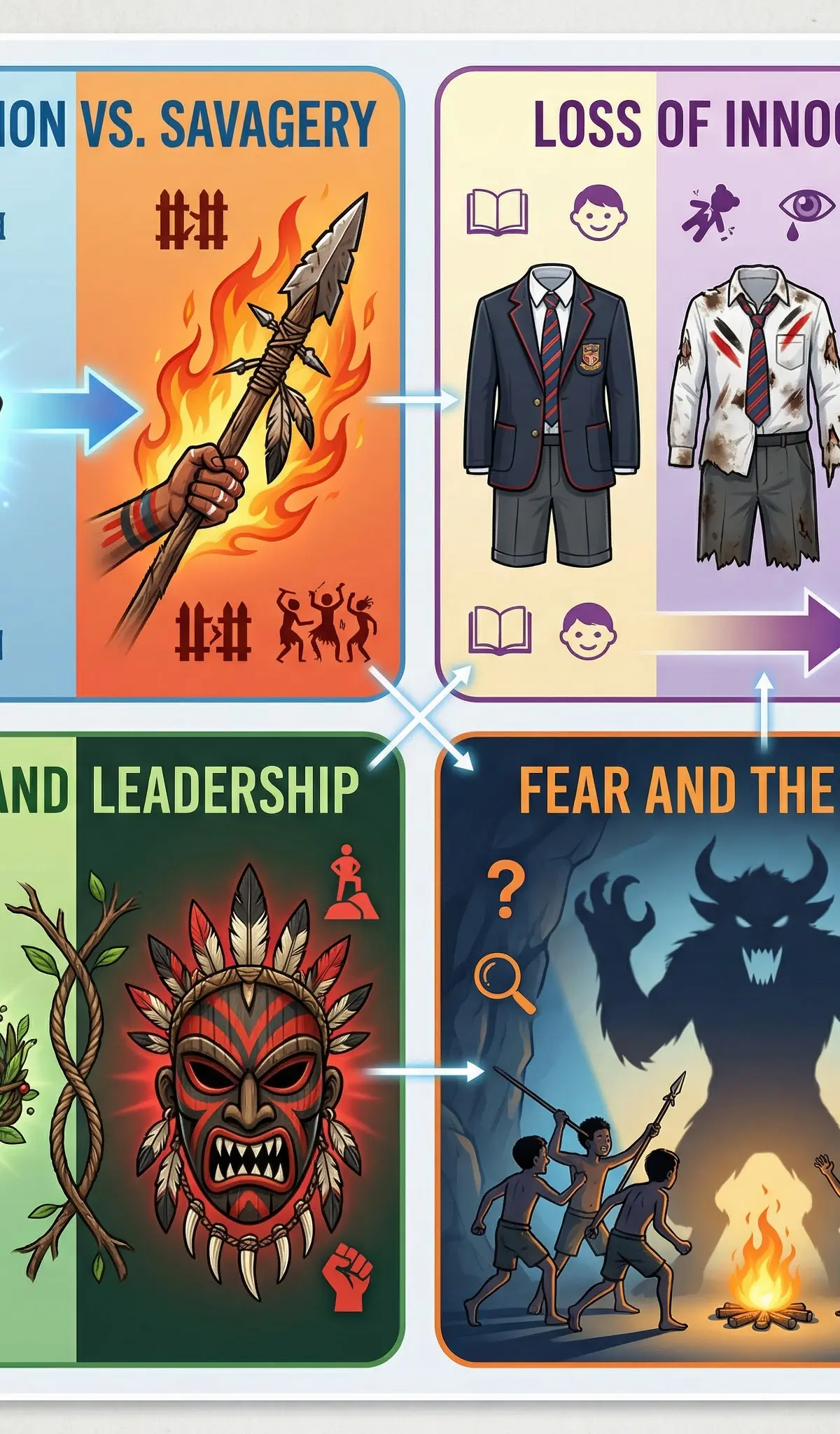
Theme 1: Civilisation vs. Savagery
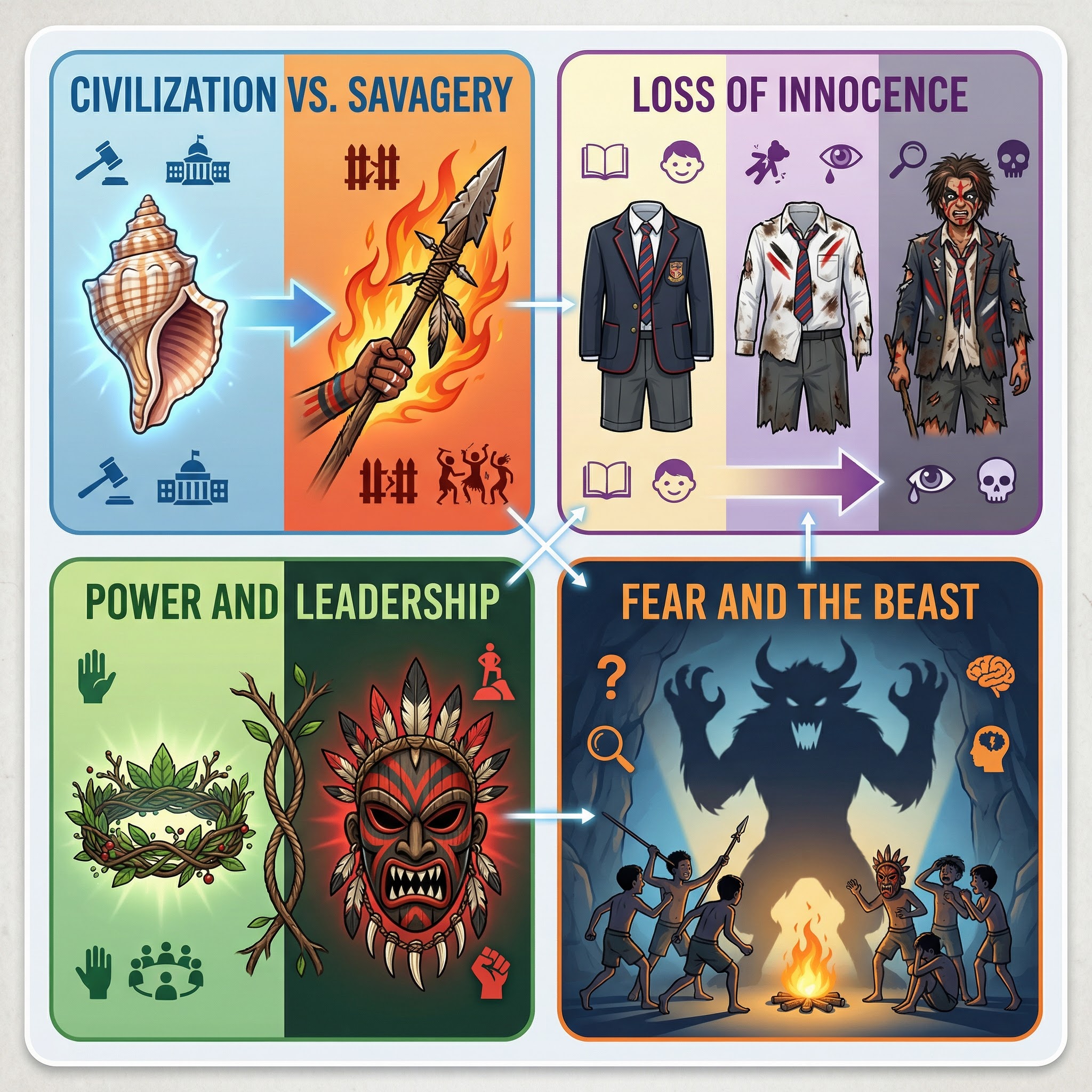
This is the central conflict of the novel. Golding uses the boys’ descent to argue that the instincts of savagery are inherent and that the structures of civilisation are a fragile veneer. The conch and the signal fire represent the forces of order, while Jack’s choir, transformed into hunters with painted faces, represents the allure of primal savagery.
Key Quotes:
- ‘We’ve got to have rules and obey them. After all, we’re not savages.’ (Chapter 2) - Jack’s ironic declaration at the start, which he later completely abandons. Credit is given for analysing the dramatic irony here.
- ‘The mask was a thing on its own, behind which Jack hid, liberated from shame and self-consciousness.’ (Chapter 4) - Analysis of the mask as a tool of liberation into savagery is a high-level point.
- ‘Which is better—to have rules and agree, or to hunt and kill?’ (Chapter 11) - Piggy’s desperate, final plea for reason before his murder.
Theme 2: The Loss of Innocence
Golding systematically strips the boys of their innocence. They arrive as well-behaved schoolboys but leave as murderers. This is shown through their increasing comfort with violence, the ritualistic nature of their hunts and dances, and their ultimate participation in the deaths of Simon and Piggy. The final scene, where the Naval officer sees them as ‘a pack of little boys’, is deeply ironic.
Key Quotes:
- ‘Ralph wept for the end of innocence, the darkness of man’s heart, and the fall through the air of the true, wise friend called Piggy.’ (Chapter 12) - The novel’s conclusion explicitly states this theme.
- ‘Kill the pig. Cut her throat. Spill her blood.’ (Chapter 4) - This chant starts as a hunting cry but becomes a murderous mantra, showing their desensitisation to violence.
Theme 3: Power and Leadership
Golding explores different models of leadership. Ralph’s is democratic and focused on the common good (rescue). Jack’s is autocratic, based on fear, and appeals to the boys’ baser instincts (hunting, feasting). The novel suggests that in the absence of established authority, the charismatic but dangerous leader can triumph over the rational one.
Key Quotes:
- ‘He’s like Piggy. He says things like Piggy. He isn’t a proper chief.’ (Chapter 8) - Jack’s criticism of Ralph reveals his different values for leadership—strength over intellect.
- ‘The chief has spoken.’ (Chapter 10) - The statement from Roger and Robert highlights the absolute, unquestioning obedience Jack now commands.
Character Analysis
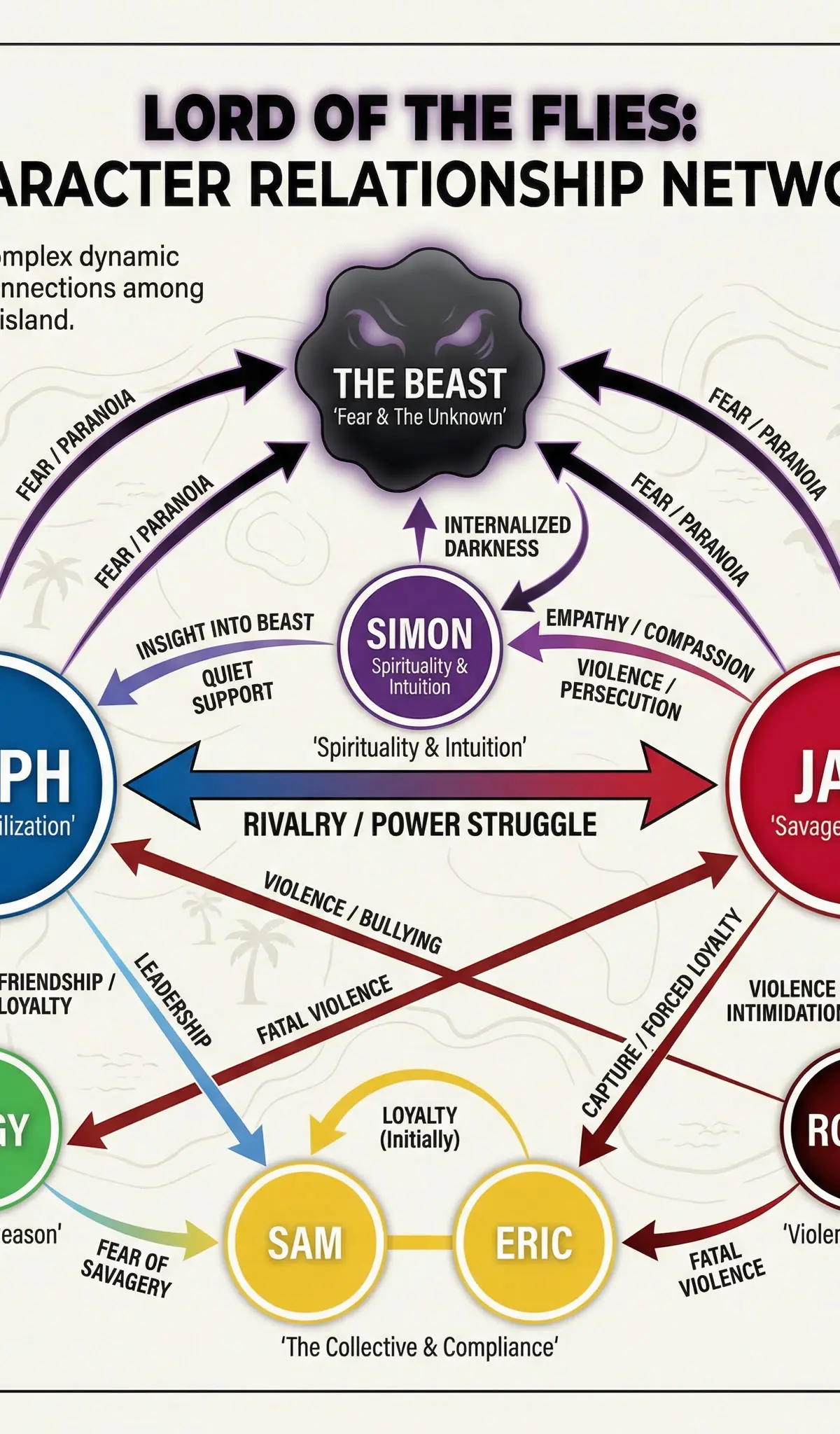
Ralph
Role: The protagonist and elected leader. He represents democracy, order, and the struggle to maintain civilisation.
Key Traits: Responsible, fair-minded, but increasingly overwhelmed by the savagery of the other boys. He has a ‘stillness’ about him that suggests leadership potential.
Character Arc: Ralph begins as a confident leader but gradually loses his authority as Jack’s influence grows. He is hunted and almost killed, and his final realisation about the ‘darkness of man’s heart’ marks his complete loss of innocence.
Essential Quotes:
- ‘There was a mildness about his mouth and eyes that proclaimed no devil.’ (Chapter 1)
- ‘Things are breaking up. I don’t understand why.’ (Chapter 5)
- ‘No, I’m not. I was, but I’m not now.’ (Chapter 12) - His response when the officer asks if he is the leader.
Jack
Role: The antagonist. He represents savagery, dictatorship, and the primal instincts that lie beneath the surface of civilisation.
Key Traits: Charismatic, arrogant, and obsessed with hunting and power. He is quick to anger and uses fear to control his tribe.
Character Arc: Jack begins as the frustrated leader of the choir, bound by rules. He quickly sheds these constraints, becoming a tribal chief who revels in violence and ritual. He is the driving force behind the island’s descent into chaos.
Essential Quotes:
- ‘I ought to be chief... because I’m chapter chorister and head boy.’ (Chapter 1)
- ‘Bollocks to the rules! We’re strong—we hunt!’ (Chapter 5)
- ‘A little boy who wore the remains of an extraordinary black cap on his red hair and who carried the remains of a pair of spectacles at his waist.’ (Chapter 12) - The final description of him, stripped of his power.
Piggy
Role: The intellectual and Ralph’s loyal advisor. He represents science, reason, and the vulnerability of intellect in the face of brute force.
Key Traits: Intelligent, articulate, but physically weak and socially awkward. He is an outsider who is constantly ridiculed.
Character Arc: Piggy remains consistent in his values throughout the novel. He never loses faith in rules and reason. His murder, and the simultaneous destruction of the conch, symbolises the final triumph of savagery over civilisation.
Essential Quotes:
- ‘What are we? Humans? Or animals? Or savages?’ (Chapter 5)
- ‘It was an accident... that’s what it was. An accident.’ (Chapter 10) - His desperate attempt to rationalize Simon’s murder.
- ‘The rock struck Piggy a glancing blow from chin to knee; the conch exploded into a thousand white fragments and ceased to exist.’ (Chapter 11)
Simon
Role: A visionary or prophet. He represents innate goodness and a spiritual understanding of the world.
Key Traits: Shy, thoughtful, and epileptic. He is connected to nature and is the only one who understands the true nature of the beast.
Character Arc: Simon is a static character who represents a moral constant. He does not change, but his understanding deepens. His murder is a pivotal moment, a sacrifice of truth and goodness. He is often interpreted as a Christ-figure.
Essential Quotes:
- ‘Maybe... maybe there is a beast... What I mean is... maybe it’s only us.’ (Chapter 5)
- ‘You knew, didn’t you? I’m part of you? Close, close, close! I’m the reason why it’s no go? Why things are what they are?’ (Chapter 8) - The Lord of the Flies speaking to Simon.
- ‘The water rose farther and dressed Simon’s coarse hair with brightness. The line of his cheek silvered and the turn of his shoulder became sculptured marble.’ (Chapter 9) - The description of his body being taken by the sea.
Writer's Methods
- Allegory: The entire novel is an allegory for human society. The island is a microcosm, and the boys’ actions represent larger political and social conflicts.
- Symbolism: Golding uses a range of powerful symbols. The conch (democracy), Piggy’s glasses (intellect/technology), the signal fire (hope/rescue/destruction), the beast (internal evil), and the Lord of the Flies (the devil/innate evil) are all crucial. Candidates must analyse, not just list, these symbols.
- Foreshadowing: The novel is filled with hints of the violence to come. Roger throwing stones ‘to miss’ in Chapter 4 foreshadows his later, deliberate murder of Piggy. The mock pig-hunt with Robert foreshadows the real violence against Simon.
- Imagery: Golding uses vivid sensory imagery. The oppressive heat, the ‘witch-like’ cry of birds, and the descriptions of the jungle create a claustrophobic and threatening atmosphere. The contrast between the beautiful, idyllic island and the horrific events is a key technique.
- Narrative Voice: The third-person narrative voice is often detached and clinical, especially during moments of extreme violence. This makes the events seem even more shocking and objective, as if Golding is presenting a scientific observation of human nature.
Context
- Post-WWII: Golding served in the Royal Navy in WWII. His experiences shattered his belief in the inherent goodness of humanity. The novel is a direct response to the horrors he witnessed, a counter-argument to the idea that evil is something external rather than a part of us all.
- The Cold War: Published in 1954, the novel reflects the anxieties of the Cold War era. The fear of atomic warfare hangs over the story (the boys are being evacuated from a war zone). The island can be seen as a world in miniature, facing its own form of mutually assured destruction as the boys’ conflict escalates.
- R.M. Ballantyne’s The Coral Island: Golding’s novel is a deliberate inversion of this Victorian adventure story, in which three British boys named Ralph, Jack, and Peterkin are shipwrecked and behave impeccably. Golding borrows the names Ralph and Jack to highlight his contrasting, pessimistic vision.
- Freudian Psychology: A Freudian reading sees the characters as representing different parts of the human psyche. Ralph can be seen as the Ego (rational self), Jack as the Id (primal desires), and Piggy as the Superego (internalised societal rules). Simon represents a higher consciousness or spirituality.
Visual Resources
2 diagrams and illustrations
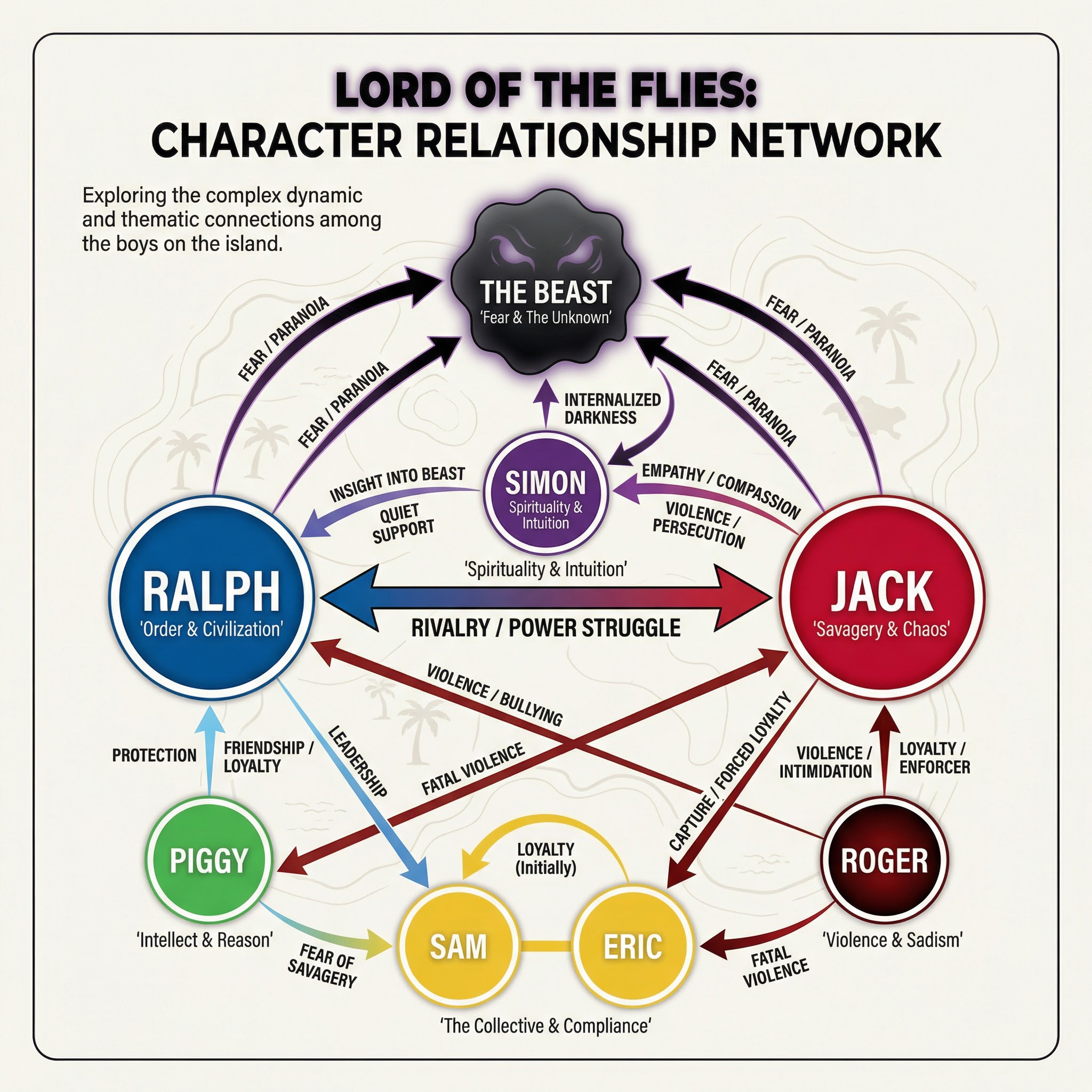
Interactive Diagrams
2 interactive diagrams to visualise key concepts
Conceptual Flow Outline
Thematic development of Civilisation vs. Savagery across the novel's key plot points.
Conceptual Flow Outline
A simplified map of the key character relationships and conflicts.
Worked Examples
2 worked examples — open one to explore the question and available guidance.
Practice Questions
Test your understanding — click to reveal model answers
How does Golding use the character of Piggy to explore ideas about civilisation and savagery?
Hint: Consider Piggy's symbolic function (his name, his glasses, his asthma) and his relationship with Ralph and Jack. How does his treatment by the other boys reflect the novel's central themes?
Explore the significance of the island setting in Lord of the Flies.
Hint: Think about the island as more than just a location. How does Golding describe it? How does it change? How does it affect the boys?
How does Golding present Simon as a significant character in the novel?
Hint: Focus on Simon's unique insight, his connection to nature, and his symbolic role as a prophet or Christ-figure. Why is his death so important?
Starting with the extract from Chapter 2 where the boys light the first fire, explore how Golding uses fire as a symbol throughout the novel.
Hint: Consider the dual nature of fire. It represents both hope and destruction. Trace its use from the first signal fire to the final inferno.
Test your understanding of Lord of the Flies
Active recall beats re-reading. Take an instant quiz now to test what you’ve learned and lock it into long-term memory.
7 days Premium · Then free forever · No card, no charge