Study Notes
Overview
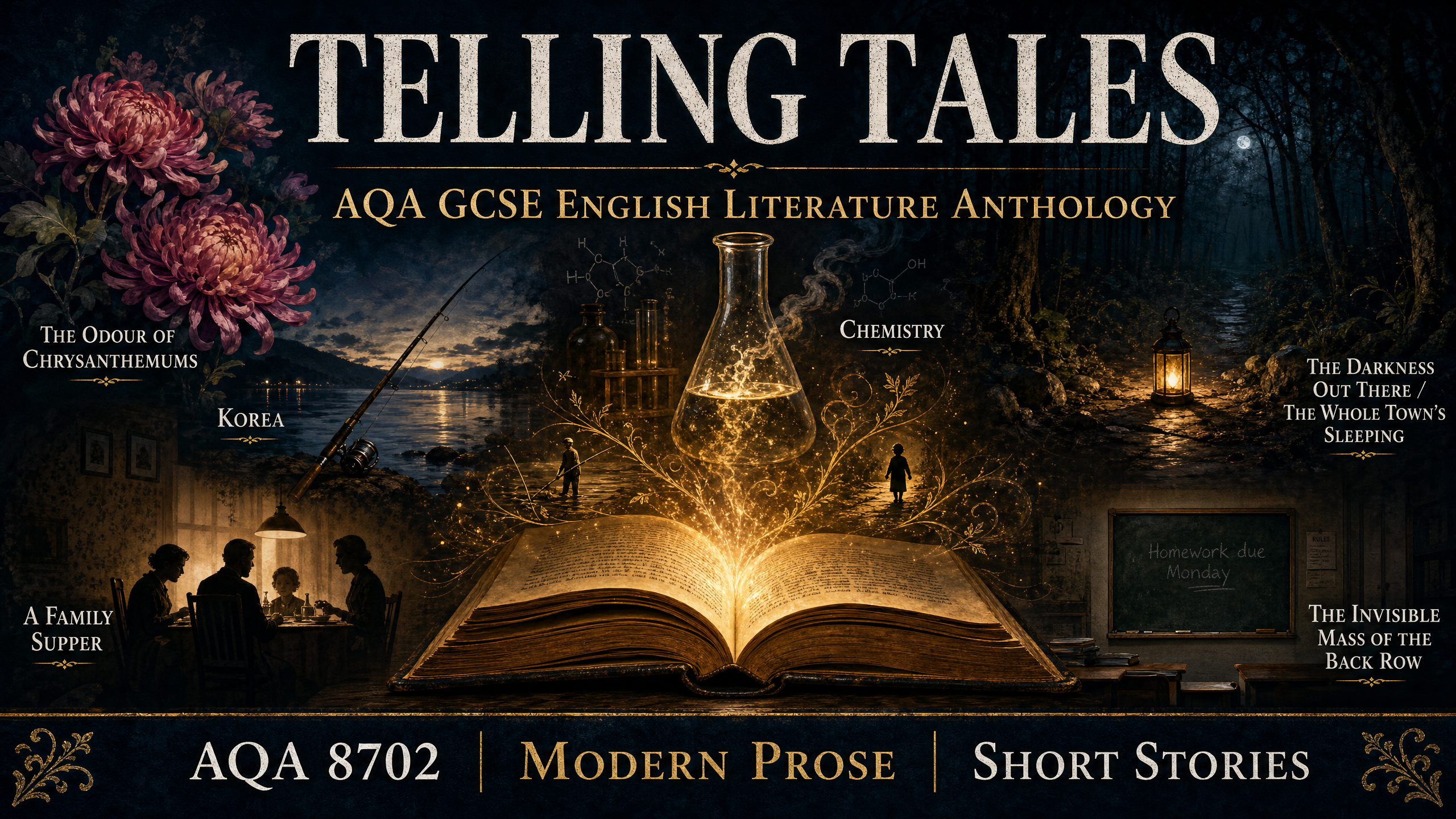
The AQA 'Telling Tales' anthology is a collection of seven modern short stories, studied as part of AQA GCSE English Literature Paper 2 (Component 2). The anthology spans the 19th, 20th, and 21st centuries, offering a rich diversity of narrative voices, cultural contexts, and thematic concerns. Examiners are looking for candidates who can move beyond simple plot summaries to critically analyse how writers use language, form, and structure to create meaning. Top-band responses will explore the nuanced themes connecting these stories — such as the tension between appearance and reality, the loss of innocence, and the profound effects of isolation — while integrating relevant contextual understanding seamlessly into their analysis. Candidates should note that the short story form demands that every word is deliberate; this compact intensity is precisely what makes these texts so rich for examination.
Plot/Content Overview
Chemistry (Graham Swift): A young boy observes the changing dynamics in his home as his mother's new boyfriend, Ralph, disrupts the bond between the boy, his mother, and his grandfather. The grandfather's eventual death (possibly suicide) leaves the boy isolated and the family irrevocably changed.
Odour of Chrysanthemums (D.H. Lawrence): Set in a grim mining community, Elizabeth Bates waits angrily, then anxiously, for her husband. When his dead body is brought home following a pit accident, she realises with devastating clarity how little they truly knew each other.
My Polish Teacher's Tie (Helen Dunmore): Carla, a part-time school caterer who feels invisible, begins a pen-pal relationship with a Polish teacher, Stefan. When he visits the school, she reclaims her Polish heritage and finds a long-suppressed sense of identity and belonging.
The Darkness Out There (Penelope Lively): Teenagers Sandra and Kerry help an elderly woman, Mrs Hutter. Sandra discovers that the seemingly sweet old lady was complicit in a horrific wartime act of cruelty, shattering Sandra's naive worldview.
The Whole Town's Sleeping (Ray Bradbury): Francine walks home alone at night while a serial killer, the 'Lonely One', is on the loose. The story builds immense psychological terror through atmosphere and the power of imagination, ending on a terrifying cliffhanger.
A Family Supper (Kazuo Ishiguro): A son returns to Japan to dine with his strict father and sister following his mother's death (caused by eating poisonous fugu fish). The meal is fraught with unspoken tension and the lingering symbolic threat of death.
Korea (John McGahern): A young Irish boy discovers his father's plan to send him to America, suspecting the father hopes he will be drafted into the Korean War so the father can claim the insurance money if he dies.
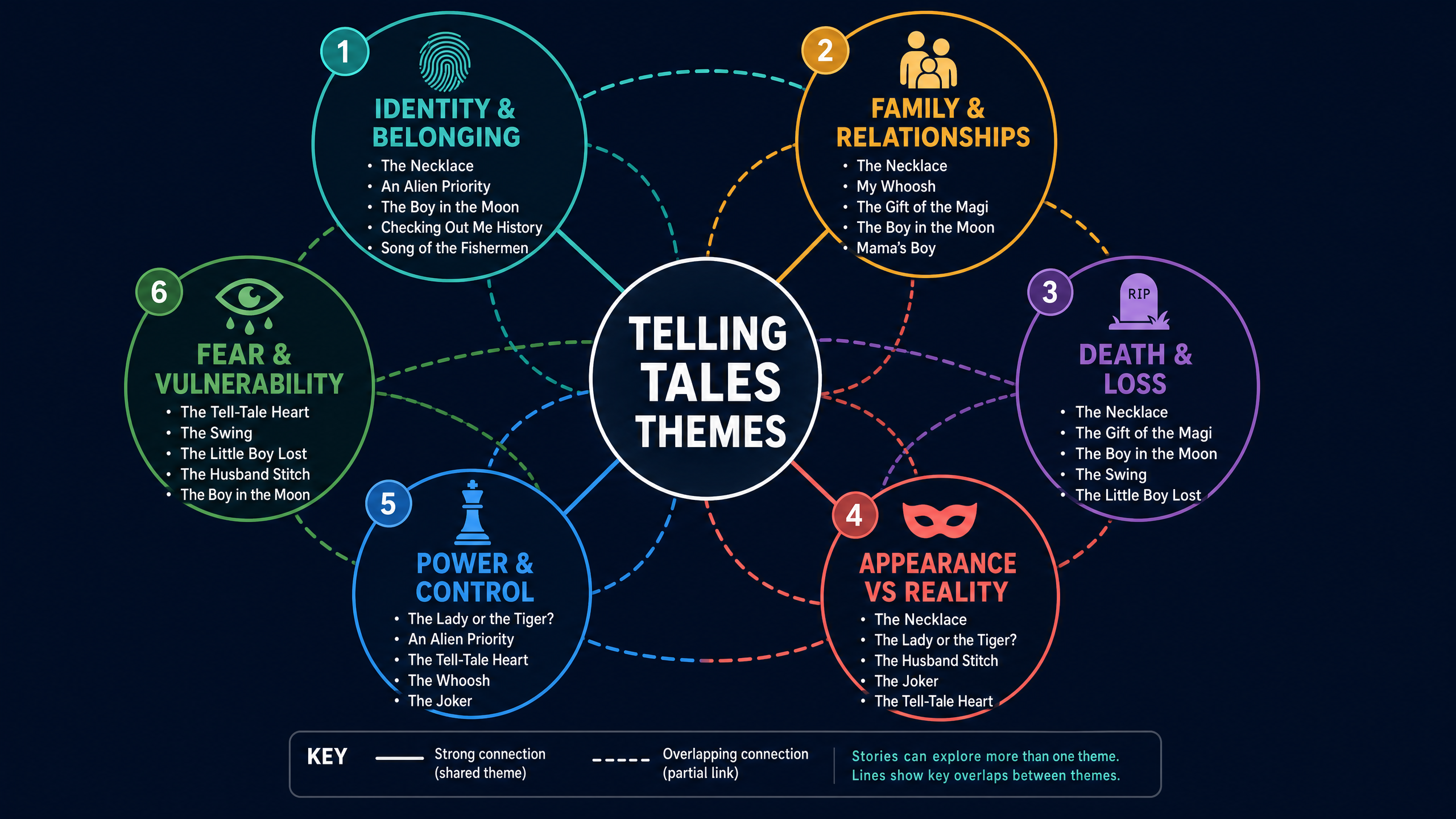
Themes
Theme 1: Appearance vs. Reality
This is arguably the most pervasive theme in the anthology, exploring how people, places, and relationships are rarely what they appear on the surface. Penelope Lively's 'The Darkness Out There' is its most direct exploration: the 'darkness' Sandra fears is not in Packer's End, the dark woods, but inside the seemingly kind Mrs Hutter. Lively deliberately uses warm, cosy language to describe Mrs Hutter's cottage — "a dear old thing" — before subverting these expectations with the horrific wartime revelation. This structural contrast is a key technique examiners reward when candidates analyse it as a deliberate authorial choice.
Key Quotes:
- "She was a good woman, Mrs Hutter. A dear old thing." (The Darkness Out There) — Sandra's naive initial perception, presented in free indirect discourse to implicate the reader in the same mistake.
- "He was a stranger to me." (Odour of Chrysanthemums) — Elizabeth's devastating epiphany that her marriage was an illusion of intimacy.
Theme 2: Family Conflict and Betrayal
The stories frequently examine the breakdown of family units and the unspoken resentments that divide them. In 'Chemistry', the introduction of Ralph into the family unit acts as a chemical catalyst, destabilising the existing bonds. In 'Korea', the betrayal is even more profound: a father who would sacrifice his son for financial gain. McGahern presents this through the boy's gradual dawning realisation, making the horror all the more effective.
Key Quotes:
- "We ate in silence." (A Family Supper) — The physical silence represents the massive emotional distance and unresolved grief between the family members.
- "He was making a calculation." (Korea) — The chilling moment the son realises his father values money over his life.
Theme 3: Identity and Belonging
Several stories explore characters who feel displaced or invisible within their own social contexts. Carla in 'My Polish Teacher's Tie' is literally rendered invisible by her uniform as a school caterer. Her journey to reclaim her Polish heritage is a journey to reclaim her identity. Dunmore uses the motif of the tie — a physical object connecting two people across national boundaries — to symbolise the power of cultural heritage.
Key Quotes:
- "Half-Polish, half-invisible." (My Polish Teacher's Tie) — Carla's self-description that encapsulates her sense of social erasure.
- "I am a Polish teacher." (My Polish Teacher's Tie) — Stefan's simple declaration that carries enormous weight for Carla.
Character Analysis
Elizabeth Bates (Odour of Chrysanthemums)
Role: Protagonist whose worldview is shattered by tragedy.
Key Traits: Resentful, trapped, emotionally distant, ultimately capable of profound self-awareness.
Character Arc: Moves from bitter anger about her husband's presumed drinking, through anxiety, to a profound existential shock upon seeing his dead body. She realises the ultimate isolation of the human soul.
Essential Quotes:
- "She knew she submitted to life, which was her immediate master."
- "There had been nothing between them, and yet they had come together."
- "He was a stranger to me."
The Grandfather (Chemistry)
Role: The stabilising force for the young narrator, representing the old order and genuine emotional connection.
Key Traits: Quiet, scientific, marginalised, deeply loving.
Character Arc: He is slowly pushed out of the family dynamic by Ralph, retreating to his shed before ultimately succumbing to despair. His death represents the final destruction of the boy's safe world.
Essential Quotes:
- "He offered me a sanctuary."
- "He was a man who lived by invisible laws."
Mrs Hutter (The Darkness Out There)
Role: The story's central subversive figure; the embodiment of the theme of appearance vs. reality.
Key Traits: Superficially warm and helpless, but concealing a capacity for calculated cruelty.
Character Arc: She does not change — the revelation changes Sandra and the reader's perception of her.
Essential Quotes:
- "Oh, he was a long time dying, I can tell you."
Writer's Methods
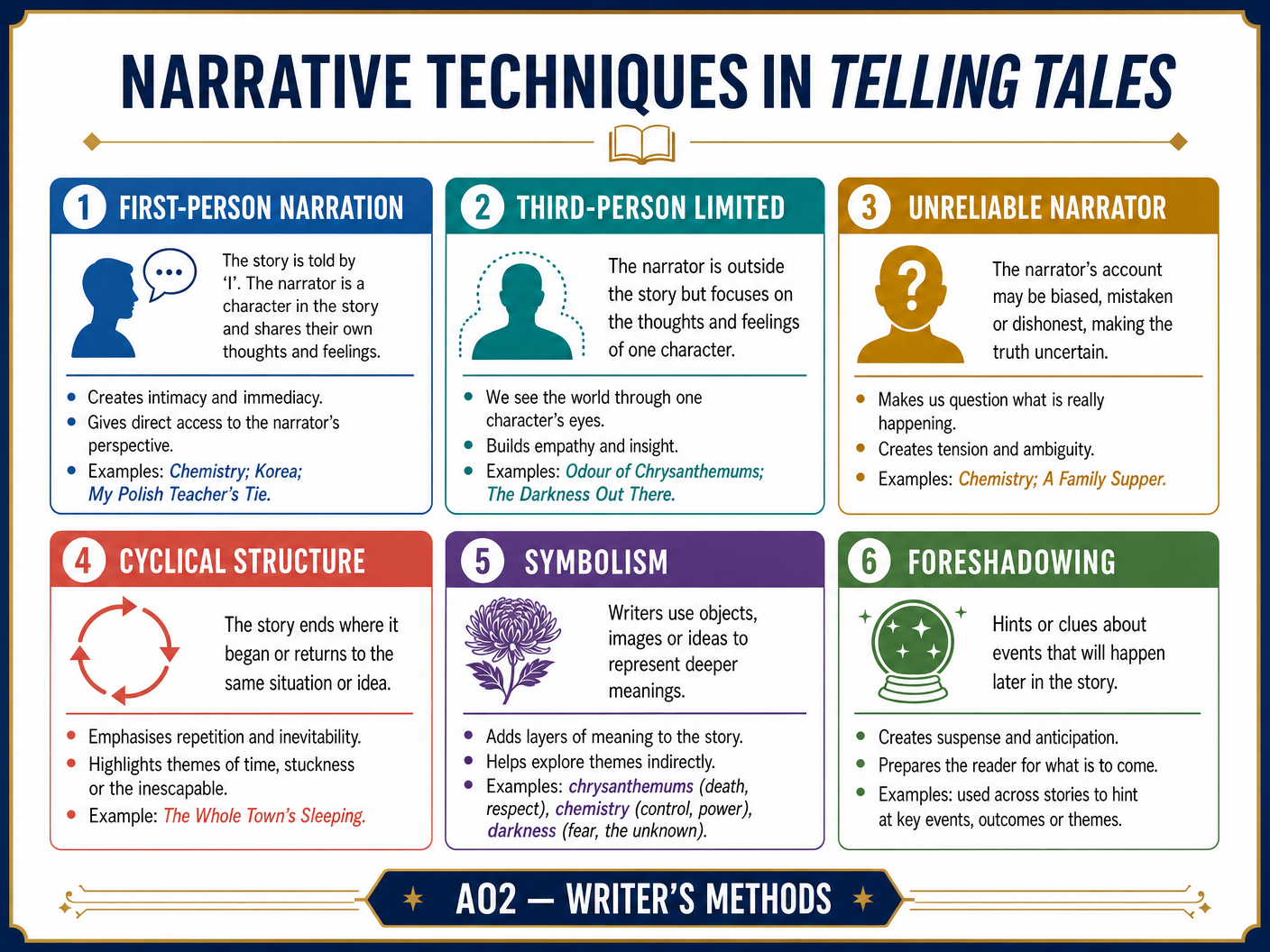
Examiners heavily reward the analysis of narrative voice. Swift (Chemistry) and McGahern (Korea) use first-person narrators to create intimacy, but also to demonstrate the limitations of a child's understanding. The reader often understands more than the narrator does, creating dramatic irony. In contrast, Lawrence (Odour of Chrysanthemums) uses a third-person limited perspective focused on Elizabeth to trap the reader in her claustrophobic mindset, making her epiphany feel like our own.
Symbolism is pervasive and examiners expect candidates to analyse it at word level. The fugu fish in A Family Supper symbolises the ever-present threat of death and the toxic nature of the family's past. The chrysanthemums in Lawrence's story chart the progression from life and marriage to death and decay — they appear at the wedding, and they are the last thing Elizabeth notices before the body is brought in. The tie in My Polish Teacher's Tie is a physical manifestation of cultural connection and identity.
Structure is equally important. The cyclical structure of The Whole Town's Sleeping — ending exactly where it began, with Francine alone in the dark — creates a sense of inescapable fate. The abrupt, unresolved endings of A Family Supper and Korea leave the reader in a state of deliberate unease, mirroring the unresolved tensions within the families themselves.
Context
Understanding context (AO3) is crucial, but it must be integrated into analysis rather than presented as a separate historical essay. For Odour of Chrysanthemums, examiners expect candidates to understand the brutal reality of early 20th-century mining communities and the rigid gender roles that trapped women like Elizabeth in lives of drudgery and emotional isolation. For My Polish Teacher's Tie, the context of post-war immigration and the search for identity in modern multicultural Britain is key to understanding Carla's sense of invisibility. For The Darkness Out There, the Second World War context is essential — Mrs Hutter's act occurred during a period of extreme moral complexity, and Lively forces the reader to confront the uncomfortable truth that ordinary people are capable of extraordinary cruelty.
Visual Resources
2 diagrams and illustrations
Interactive Diagrams
2 interactive diagrams to visualise key concepts
Conceptual Flow Outline
The typical narrative arc found across the Telling Tales anthology. The climax (epiphany) is the key moment examiners expect you to analyse.
Conceptual Flow Outline
Thematic connections between the seven stories — use these links for comparison questions.
Worked Examples
2 detailed examples with solutions and examiner commentary
Practice Questions
Test your understanding — click to reveal model answers
Explore how writers present the theme of childhood and growing up in 'Chemistry' and one other story from the anthology.
Hint: Consider pairing 'Chemistry' with 'Korea'. Both feature young male narrators dealing with difficult father/grandfather figures and the harsh realities of the adult world. Focus on HOW the writers use narrative perspective to show the child's limited understanding.
How does Penelope Lively create a sense of shock and horror in 'The Darkness Out There'?
Hint: Focus on the contrast between the idyllic setting and sweet old lady versus the horrific revelation at the end. Think about how Lively deliberately misleads the reader.
Explore how Helen Dunmore presents the importance of heritage and identity in 'My Polish Teacher's Tie'.
Hint: Look at Carla's journey from feeling invisible to proudly claiming her Polish roots. Focus on the symbolism of the tie and the uniform.
How does Kazuo Ishiguro build tension in 'A Family Supper'?
Hint: Focus on what is NOT said. The silence and ambiguity are just as important as the dialogue. Think about the fugu fish as a structural device.