Study Notes
Overview
The 19th-century prose component is a cornerstone of GCSE English Literature. Examiners are looking for your ability to critically evaluate a text, understanding not just the plot, but how the writer has crafted the narrative to convey deeper meanings. Whether you are studying A Christmas Carol, The Strange Case of Dr Jekyll and Mr Hyde, or Frankenstein, success relies on your ability to analyse language, form, and structure (AO2), and to seamlessly integrate relevant social and historical context (AO3). This guide provides the tools to move beyond simple narrative summary into the perceptive, critical analysis required for Level 5 and 6 responses.
Listen to our comprehensive revision podcast for a deep dive into the core concepts:
Plot/Content Overview
While the specific plot depends on your set text, all 19th-century prose texts share common structural features. They often involve a protagonist undergoing a profound transformation or facing a moral crisis. For example, Scrooge's journey from misanthropy to redemption, Jekyll's tragic experiment with his own duality, or Victor Frankenstein's disastrous creation. Understanding the chronological sequence of events is vital, but examiners reward candidates who can explain why events occur in a specific order and how this structure shapes the reader's response.
Themes
Theme 1: Social Class and Inequality
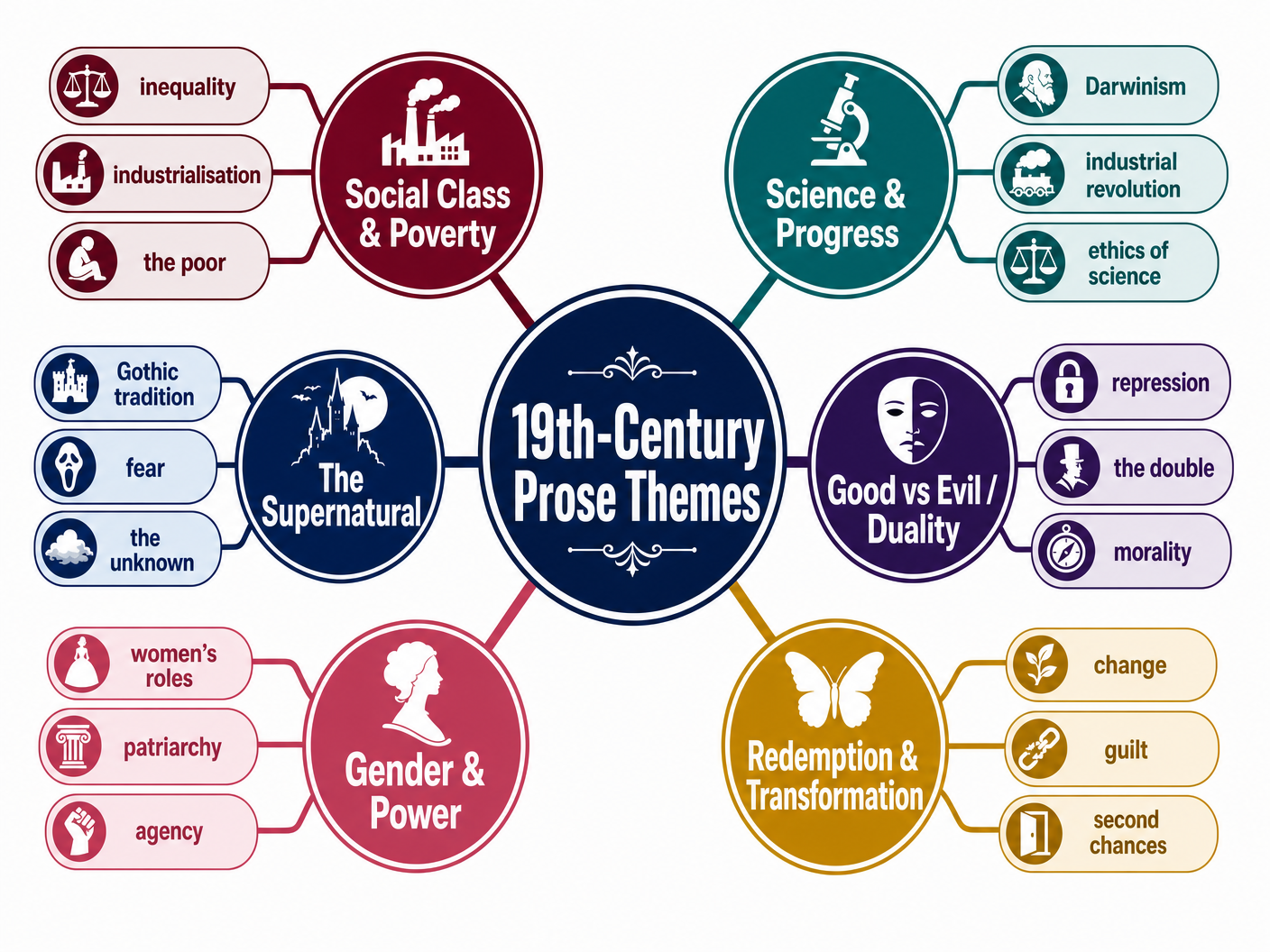
19th-century writers frequently used their novels to critique the stark social divisions of their time. In A Christmas Carol, Dickens exposes the brutal reality of poverty and challenges the Malthusian view that the poor were a surplus population.
Key Quotes:
- "Are there no prisons?" (Stave 1) - Scrooge echoing the harsh utilitarian views of the era.
- "This boy is Ignorance. This girl is Want." (Stave 3) - Dickens allegorising the destructive consequences of societal neglect.
Theme 2: Duality and the Divided Self
The tension between outward respectability and inner desires is a hallmark of Victorian literature, most explicitly explored in Jekyll and Hyde.
Key Quotes:
- "Man is not truly one, but truly two." (Chapter 10) - Jekyll's thesis on human nature.
- "My devil had been long caged, he came out roaring." (Chapter 10) - The violent consequence of repression.
Theme 3: Science, Ambition, and Ethics
Texts like Frankenstein interrogate the limits of human knowledge and the moral responsibilities of the creator.
Key Quotes:
- "I will pioneer a new way, explore unknown powers..." (Chapter 3) - Victor's hubristic ambition.
- "You are my creator, but I am your master; obey!" (Chapter 20) - The inversion of power.
Character Analysis
The Protagonist in Crisis
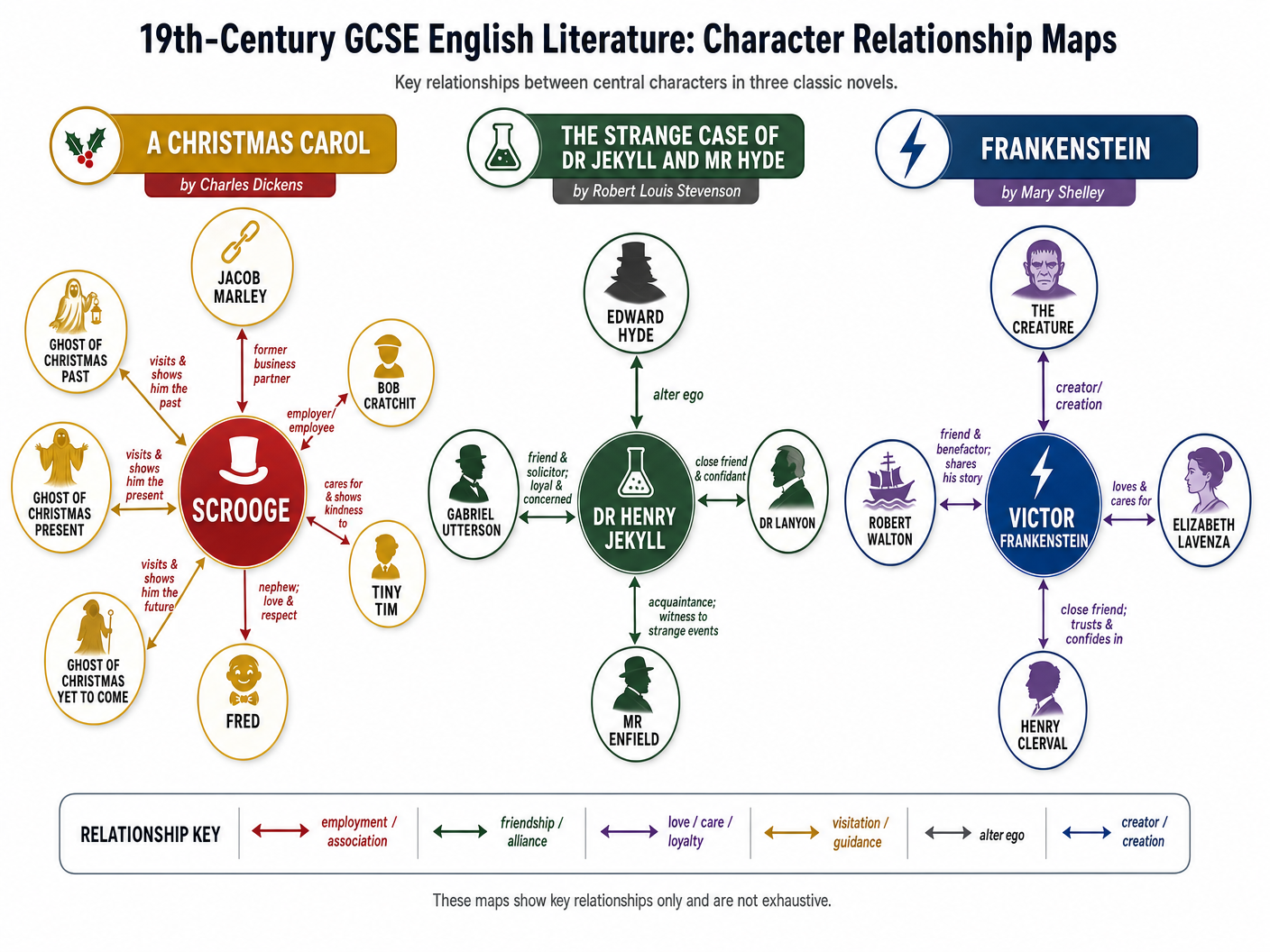
Role: Central figure whose internal conflict drives the narrative.
Key Traits: Often isolated, ambitious, or deeply flawed at the outset.
Character Arc: Experiences a profound disruption to their worldview, leading to either redemption (Scrooge) or destruction (Jekyll, Frankenstein).
Essential Quotes:
- "Hard and sharp as flint..." (Scrooge)
- "A large, well-made, smooth-faced man of fifty..." (Jekyll)
Writer's Methods
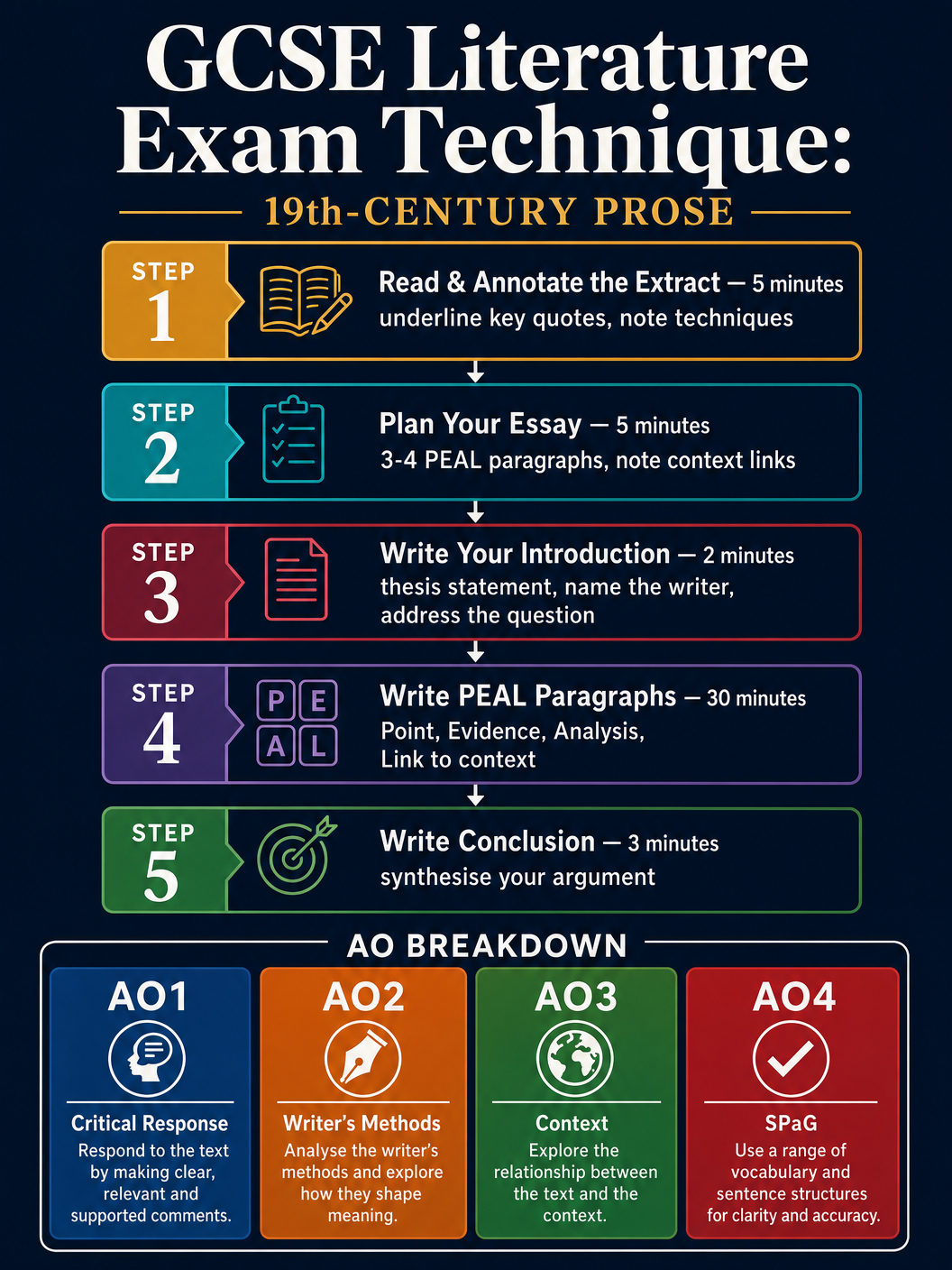
Examiners heavily reward the analysis of methods (AO2). This includes:
- Language: Word choice, imagery, and semantic fields. (e.g., Dickens's use of cold/ice imagery to describe Scrooge's emotional state).
- Form: The type of text. (e.g., The epistolary elements in Frankenstein or the fragmented narrative of Jekyll and Hyde).
- Structure: How the story is built. (e.g., The circular structure of A Christmas Carol ending where it began but with a transformed protagonist).
Context
Context (AO3) must be integrated, not bolted on. It involves understanding the societal anxieties of the time: the impact of the Industrial Revolution, fears surrounding scientific advancement (galvanism, Darwinism), the strict moral codes of Victorian society, and the stark realities of urban poverty. A strong response links a specific textual detail to a relevant contextual factor to illuminate the writer's intention.
Visual Resources
3 diagrams and illustrations
Interactive Diagrams
1 interactive diagram to visualise key concepts
Conceptual Flow Outline
Common Narrative Arc in 19th-Century Prose
Worked Examples
2 detailed examples with solutions and examiner commentary
Practice Questions
Test your understanding — click to reveal model answers
Starting with this extract, explore how the writer presents the influence of setting on the characters. (30 marks + 4 AO4)
Hint: Consider how the physical environment reflects the psychological or moral state of the characters.
How does the writer present the theme of responsibility in the novel? (30 marks + 4 AO4)
Hint: Think about personal responsibility versus social responsibility.
Explore how the writer presents the relationship between [Character A] and [Character B]. (30 marks + 4 AO4)
Hint: Look at power dynamics and how they shift throughout the narrative.
How is the concept of fear presented in the text? (30 marks + 4 AO4)
Hint: Consider both physical fear and psychological/moral terror.