OCR · GCSE · English Literature
The Merchant of Venice
This guide explores Shakespeare's The Merchant of Venice, a play that masterfully blends romantic comedy with profound questions of justice, mercy, and prejudice. It is designed to equip OCR GCSE candidates with the analytical tools and contextual knowledge needed to excel in their closed-book exam.
- 10 min read
- 2 worked examples
- 4 practice questions
- 8 key terms
Study Notes

Overview
William Shakespeare's The Merchant of Venice is a 'problem play' that continues to provoke debate and divide audiences. For the OCR J352/02 exam, candidates must navigate its complex tonal shifts, moving from the romantic courtship in Belmont to the tense legal drama in Venice. A successful essay will demonstrate a sustained, critical argument that engages with the play's central conflicts, particularly the tension between its comedic structure and the tragic implications of its treatment of Shylock. Examiners award high marks for the seamless integration of AO3 context, using knowledge of Elizabethan anti-Semitism, the laws surrounding usury, and the status of women to illuminate the text. Credit is given for a detailed analysis of Shakespeare's dramatic methods (AO2), such as the structural contrast between Venice and Belmont, the use of prose and verse, and the powerful imagery of bonds, flesh, and gold.
Plot/Content Overview
Act 1: The play opens in Venice with Antonio, a wealthy merchant, in a melancholic mood. His friend Bassanio asks for a loan of 3,000 ducats to woo the wealthy heiress Portia in Belmont. Antonio's money is tied up in sea ventures, so he agrees to act as guarantor for a loan from Shylock, a Jewish moneylender. Shylock, citing his mistreatment by Antonio, agrees to the loan but on a sinister condition: if Antonio defaults, Shylock is entitled to a pound of his flesh. In Belmont, Portia complains to her maid Nerissa about the terms of her father's will, which forces her suitors to choose one of three caskets—gold, silver, or lead—to win her hand.
Act 2: The Princes of Morocco and Arragon arrive in Belmont and both choose the wrong caskets (gold and silver, respectively). In Venice, Shylock's daughter, Jessica, elopes with the Christian Lorenzo, taking a significant amount of her father's wealth. Shylock is enraged by his daughter's betrayal and the loss of his ducats.
Act 3: Bassanio arrives in Belmont. He correctly chooses the lead casket, winning Portia's hand. Their joy is short-lived as news arrives that Antonio's ships have been lost at sea, and he has forfeited the bond. Shylock, fueled by grief and a desire for revenge, insists on the penalty. Portia and Nerissa, disguised as a male lawyer (Balthazar) and his clerk, travel to Venice to intervene.
Act 4: The trial scene. The Duke of Venice presides over the case. Portia, as Balthazar, delivers a powerful speech on the 'quality of mercy,' but Shylock is unmoved. Just as he is about to cut the flesh, Portia cleverly turns the law against him: the bond allows for flesh, but not a single drop of blood. Furthermore, as an 'alien' who has conspired against the life of a Venetian citizen, Shylock's life and fortune are forfeit. Antonio shows a form of 'mercy': Shylock must give half his wealth to the state and half to Jessica and Lorenzo, and he must convert to Christianity.
Act 5: The final act returns to Belmont. The couples are reunited, but a light-hearted argument ensues over the rings that Portia and Nerissa (in disguise) had tricked their husbands into giving away. Portia reveals her and Nerissa's deception, and news arrives that some of Antonio's ships have returned safely. The play ends on a note of romantic harmony, though the audience is left to contemplate the dark events of the trial.
Themes
Justice and Mercy
This is the central theme of the play, crystallised in the trial scene. The play contrasts the rigid, legalistic justice demanded by Shylock with the Christian ideal of mercy. Portia's famous speech, "The quality of mercy is not strained, / It droppeth as the gentle rain from heaven," argues that mercy is a divine attribute that should temper justice. However, the mercy shown to Shylock is arguably cruel and serves to reinforce the Christian characters' power. Examiners expect candidates to explore this hypocrisy.
Key Quotes:
- "The pound of flesh, which I demand of him, / Is dearly bought; 'tis mine and I will have it." (Act 4, Scene 1) - Shylock's insistence on the letter of the law.
- "It is an attribute to God himself; / And earthly power doth then show likest God's / When mercy seasons justice." (Act 4, Scene 1) - Portia's eloquent plea for mercy.
Prejudice and Intolerance
The play depicts a society rife with anti-Semitism. Shylock is repeatedly insulted and dehumanised, referred to as "the dog Jew." His desire for revenge is born from the constant prejudice he faces. While an Elizabethan audience might have viewed him as a stock villain, modern audiences are more likely to see him as a tragic figure. Credit is given for analysing the nuance in his character.
Key Quotes:
- "Hath not a Jew eyes? Hath not a Jew hands, organs, dimensions, senses, affections, passions?" (Act 3, Scene 1) - Shylock's powerful speech asserting his shared humanity.
- "I hate him for he is a Christian" (Act 1, Scene 3) - Shylock's initial expression of his animosity towards Antonio.
Appearance vs. Reality
Characters and situations are rarely as they seem. The casket plot is a literal test of this theme: suitors fail by choosing the ornate gold and silver caskets, while Bassanio succeeds by choosing the humble lead casket. Portia and Nerissa disguise themselves as men to save Antonio, subverting gender expectations. Venice appears as a lawful city, but its justice is flawed. Belmont appears idyllic, but its happiness is built on a fortune that enables Bassanio to court Portia.
Key Quotes:
- "All that glisters is not gold" (Act 2, Scene 7) - The message inside the gold casket, a direct statement of the theme.
- "So may the outward shows be least themselves: / The world is still deceived with ornament." (Act 3, Scene 2) - Bassanio's reasoning for choosing the lead casket.
Character Analysis
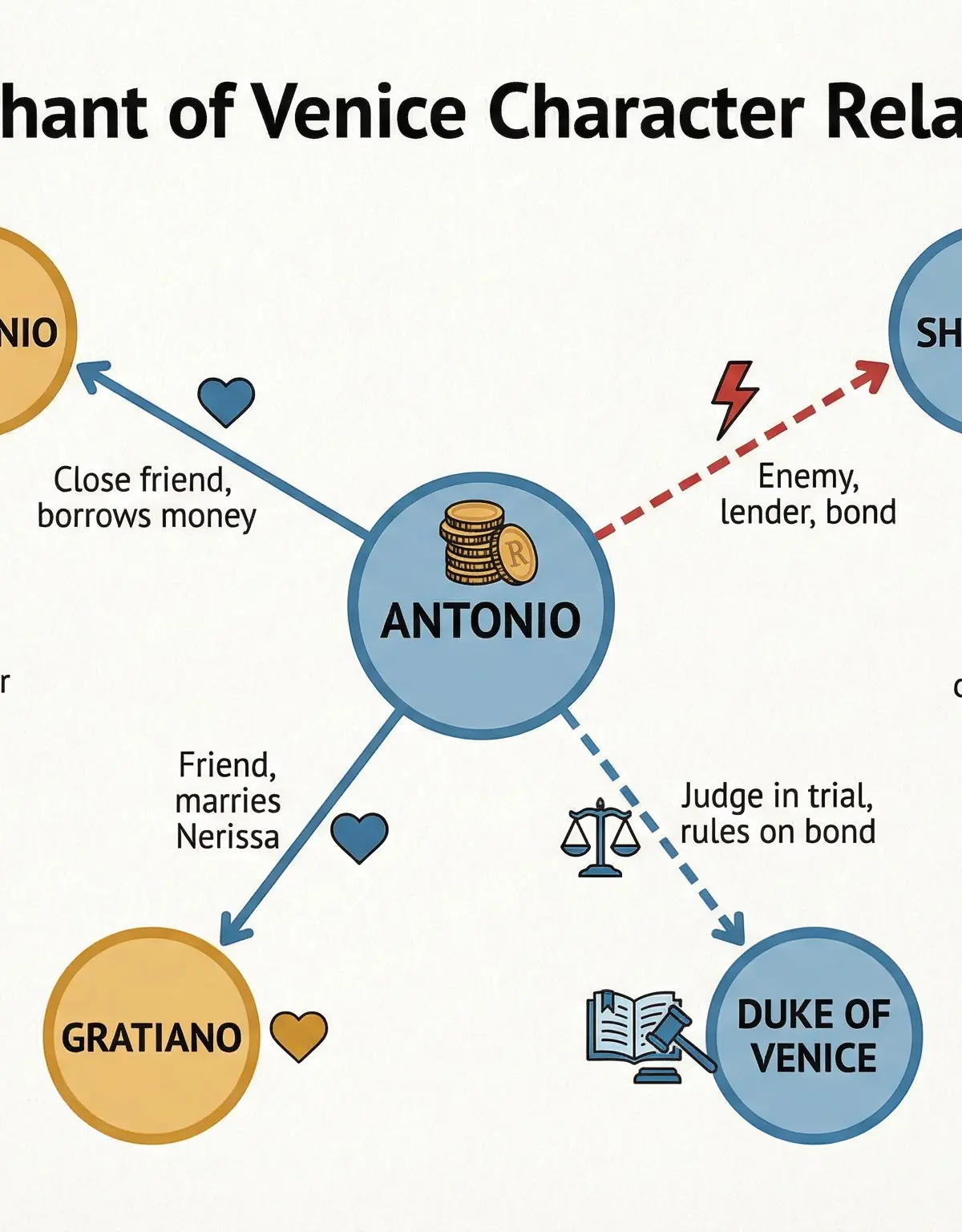
Shylock
Role: The antagonist, a Jewish moneylender, and the play's most complex character.
Key Traits: Vengeful, proud, intelligent, but also deeply wronged and humanised by his suffering.
Character Arc: Shylock begins as a scorned outsider. The loss of his daughter and his wealth, combined with years of abuse, fuels his desire for a terrible revenge. His defeat in the trial scene, where he is stripped of his property, his religion, and his dignity, is one of the most powerful and disturbing moments in Shakespeare.
Essential Quotes:
- "If you prick us, do we not bleed? If you tickle us, do we not laugh? If you poison us, do we not die? And if you wrong us, shall we not revenge?" (Act 3, Scene 1)
- "I am a Jew. Hath not a Jew eyes?" (Act 3, Scene 1)
Portia
Role: The romantic heroine, heiress of Belmont, and a pivotal figure in the trial.
Key Traits: Intelligent, witty, resourceful, and bound by the rules of her father's will but ultimately subverts them.
Character Arc: Portia begins as a seemingly passive figure, her fate controlled by the casket test. However, she demonstrates immense agency and intellect by disguising herself as the lawyer Balthazar and saving Antonio's life. She embodies the theme of appearance vs. reality and challenges the patriarchal norms of her society.
Essential Quotes:
- "The quality of mercy is not strained..." (Act 4, Scene 1)
- "In Belmont is a lady richly left; / And she is fair, and, fairer than that word, / Of wondrous virtues." (Act 1, Scene 1) - Bassanio's description of her.
Antonio
Role: The titular merchant of Venice, whose wealth is the catalyst for the plot.
Key Traits: Melancholic, loyal, generous to his friends, but also casually cruel and anti-Semitic towards Shylock.
Character Arc: Antonio's arc is one of suffering and passivity. He begins in a state of unexplained sadness and ends as a spectator to the romantic happiness of others. He is prepared to die for his friend Bassanio, showing extreme loyalty, but his character also reveals the casual prejudice at the heart of Venetian society.
Essential Quotes:
- "In sooth, I know not why I am so sad." (Act 1, Scene 1)
- "I am a tainted wether of the flock, / Meetest for death." (Act 4, Scene 1)
Writer's Methods
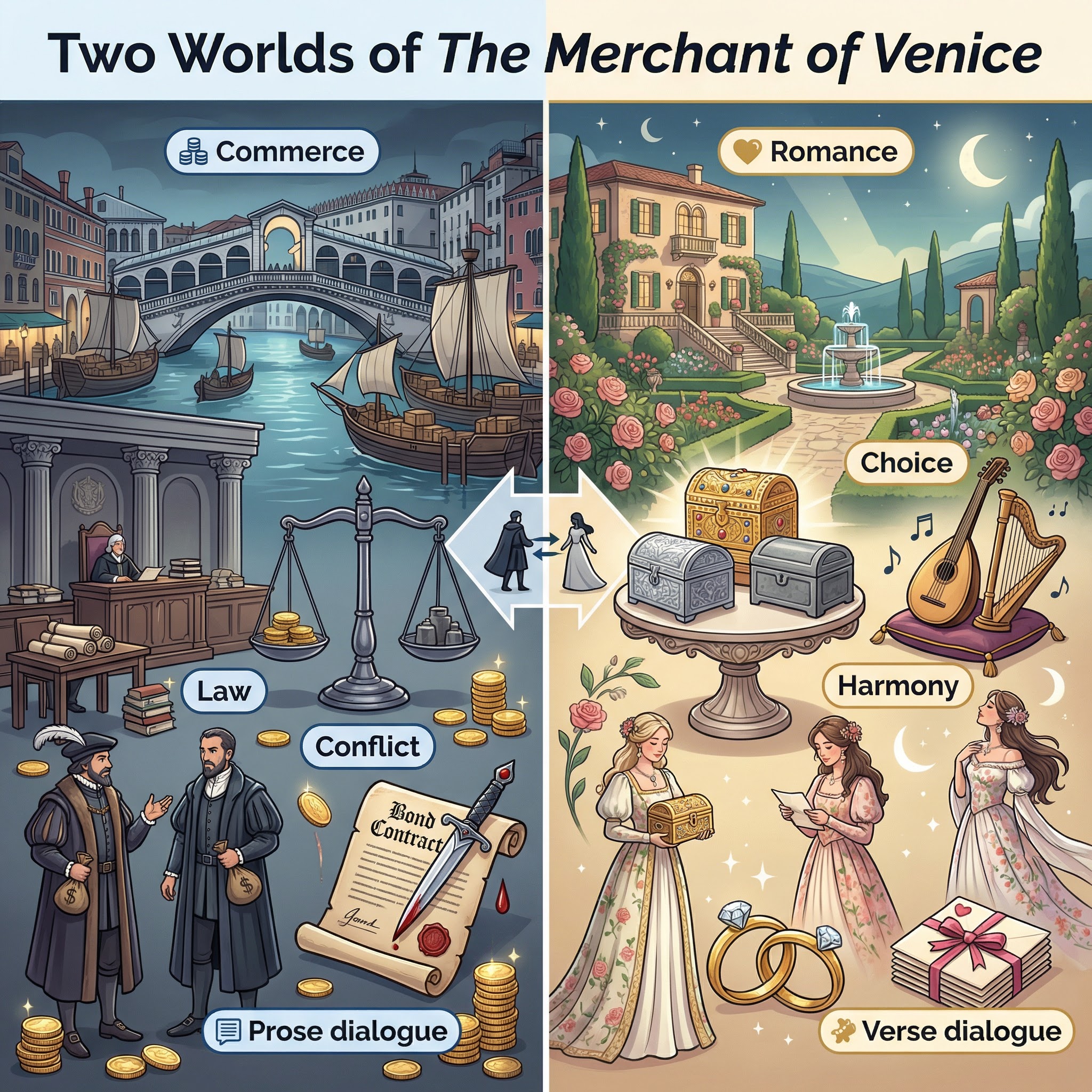
Structure: The play's structure is built on the contrast between two distinct worlds: Venice and Belmont. Shakespeare uses cross-cutting to move between the tense business of Venice and the romantic escapism of Belmont, creating dramatic tension and highlighting thematic contrasts. The play follows a comedic structure, ending with multiple marriages, but the dark undercurrents of the trial scene trouble this resolution.
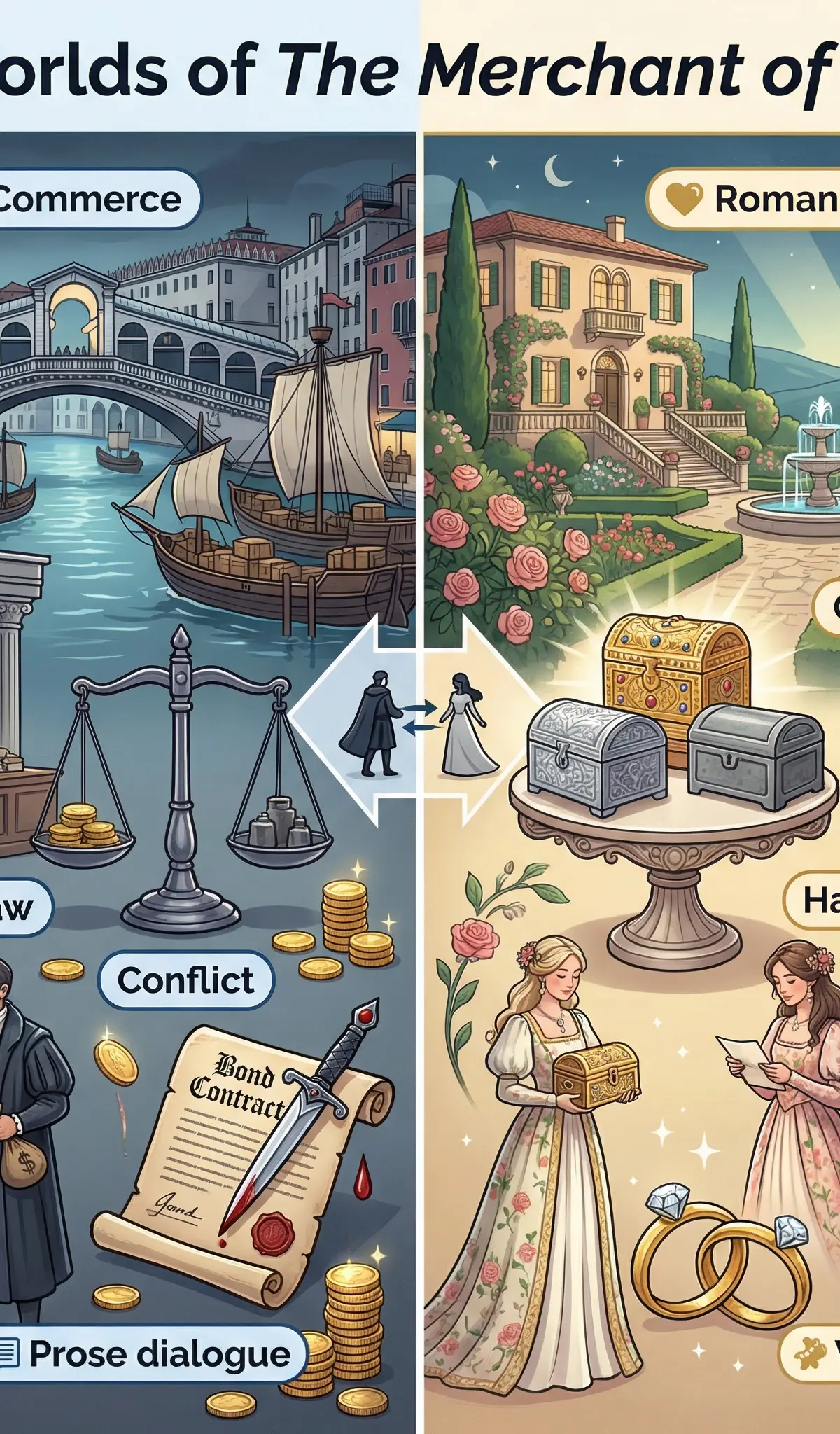
Language: Shakespeare uses prose for the scenes set in Venice, reflecting the world of commerce and law. The language is often direct and functional. In contrast, the scenes in Belmont are written in verse, which is more poetic and romantic. Shylock's language is powerful and often biblical, while Portia's is eloquent and persuasive.
Imagery: Key patterns of imagery are used to develop themes. Gold and silver are associated with greed and false value (the caskets). Bonds and flesh represent the literal and metaphorical contracts between characters. Music and moonlight in the final act symbolise the restoration of harmony.
Context
To achieve high marks for AO3, candidates must integrate contextual knowledge. Key areas include:
- Anti-Semitism in Elizabethan England: Jews had been expelled from England in 1290. The few who remained had to practice their faith in secret. Elizabethan audiences would have been familiar with negative stereotypes of Jews from plays like Marlowe's The Jew of Malta. Shakespeare both plays into and subverts these stereotypes with the character of Shylock.
- Usury: The practice of lending money at interest was forbidden for Christians but was one of the few professions open to Jews. This created significant social and religious tension, which is central to the conflict between Antonio and Shylock.
- The Role of Women: Women had limited legal rights and were expected to be subservient to their fathers and husbands. Portia, though wealthy, is initially bound by her father's will. Her disguise as a man allows her to enter the male-dominated world of law and exercise an authority she would otherwise be denied. This provides a feminist reading of the play.
Visual Resources
2 diagrams and illustrations
Interactive Diagrams
2 interactive diagrams to visualise key concepts
Conceptual Flow Outline
The tragic arc of Shylock, from a wronged outsider to a broken man.
Conceptual Flow Outline
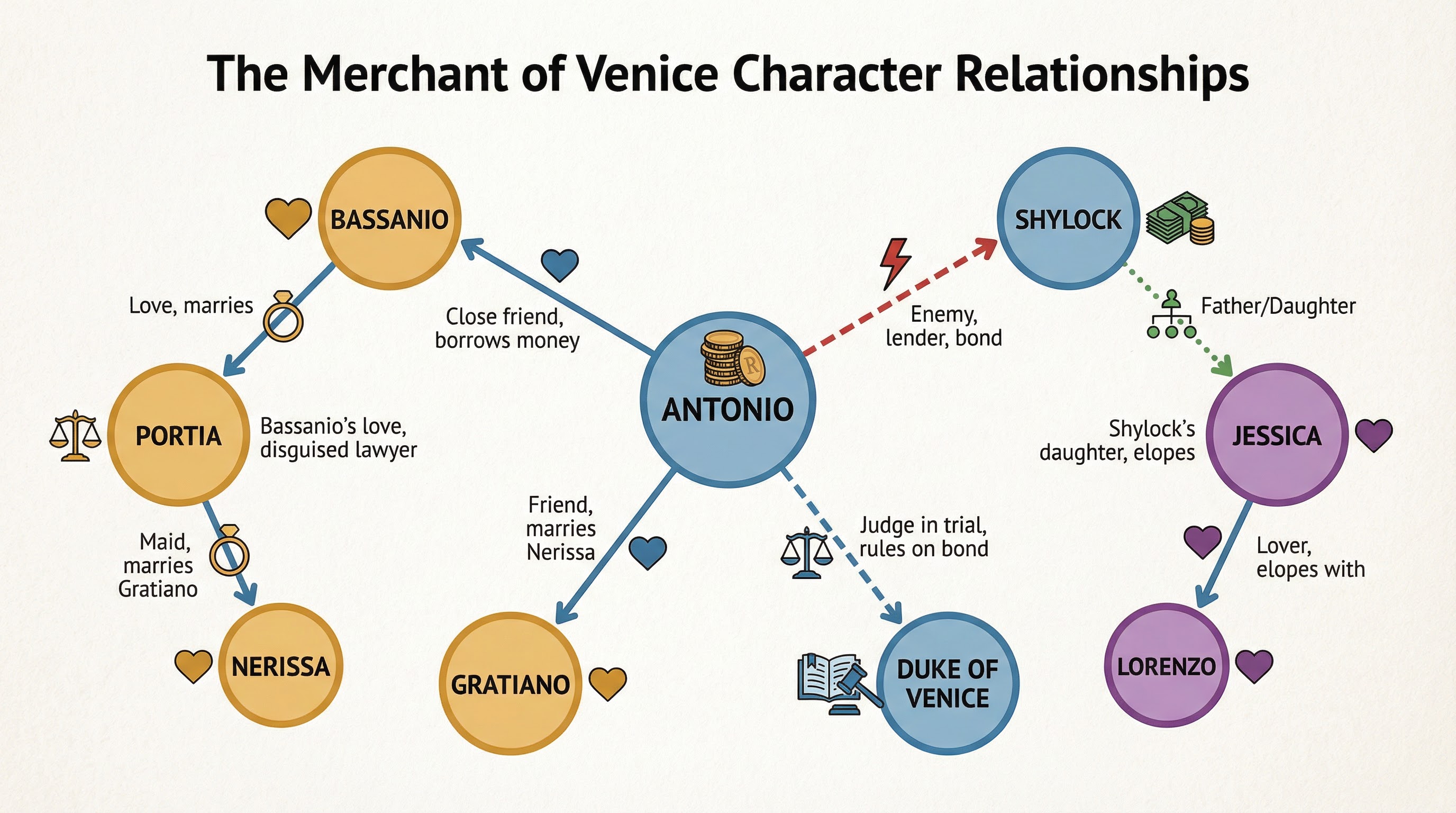
A simplified plot diagram showing the key relationships and movements between Venice and Belmont.
Worked Examples
2 worked examples — open one to explore the question and available guidance.
Practice Questions
Test your understanding — click to reveal model answers
Explore how Shakespeare presents Portia as a powerful female character.
Hint: Consider her intelligence in the casket plot, her agency in the trial scene, and her control in the final act. How does she challenge Elizabethan gender roles?
To what extent do you think the ending of The Merchant of Venice is a happy one?
Hint: Weigh the comedic elements (marriages, music, restored fortunes) against the tragic elements (Shylock's fate, Antonio's isolation).
Explore the significance of money and wealth in the play.
Hint: Think about how money drives the plot (the loan), defines relationships (Antonio/Bassanio), and conflicts with love (Jessica's dowry, Portia's inheritance).
How does Shakespeare use the contrast between Venice and Belmont in the play?
Hint: Use the V.I.L.L.A.I.N. memory hook. Think about the settings, the language (prose/verse), the values, and the characters associated with each location.
Test your understanding of The Merchant of Venice
Active recall beats re-reading. Take an instant quiz now to test what you’ve learned and lock it into long-term memory.
7 days Premium · Then free forever · No card, no charge