OCR · GCSE · English Literature
The War of the Worlds
Unlock top marks for H.G. Wells' *The War of the Worlds* with this exam-focused guide. We'll dissect Wells' critique of Victorian imperialism and show you how to analyse the 'scientific romance' form to impress examiners."
- 11 min read
- 2 worked examples
- 4 practice questions
Study Notes
Overview
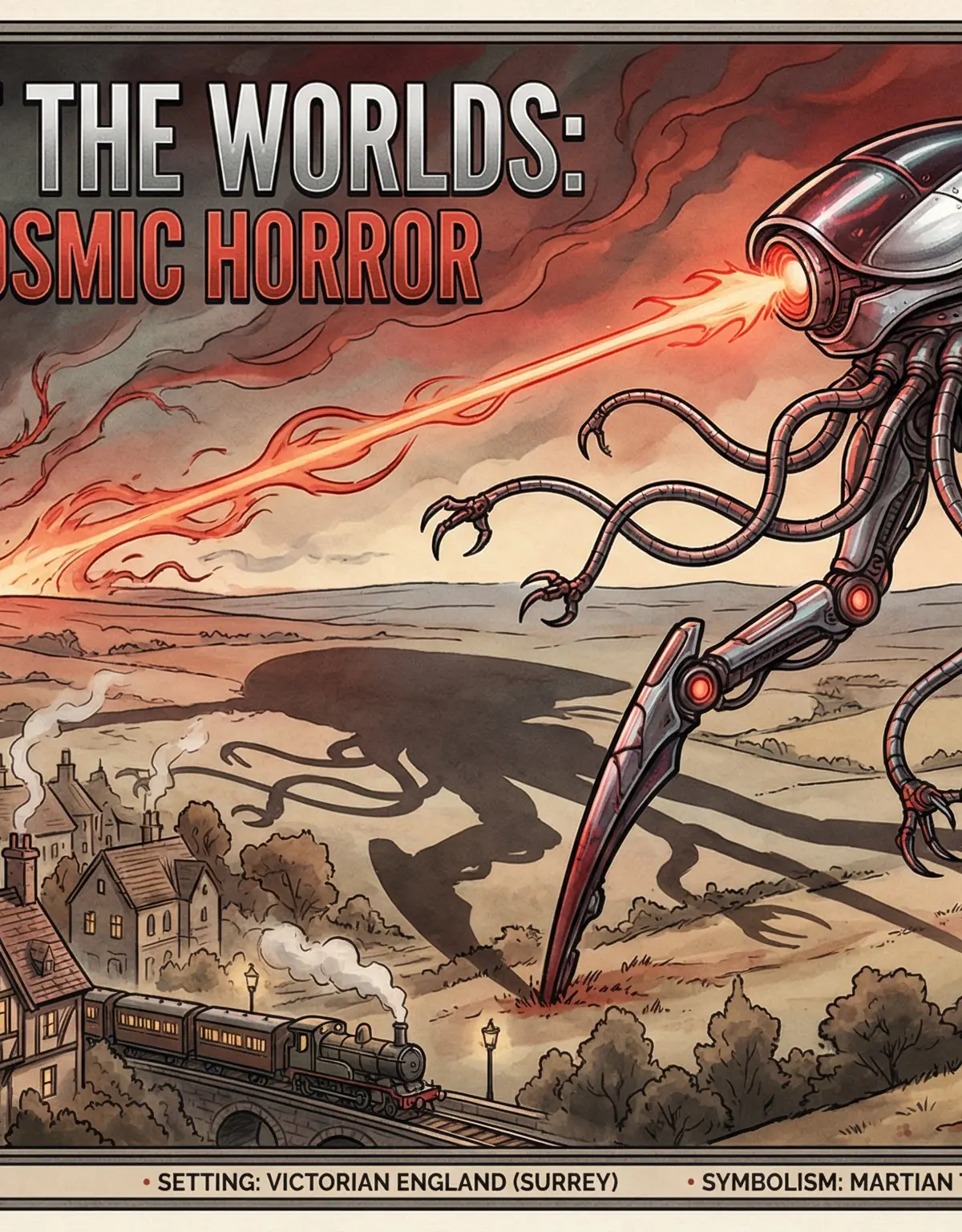
The War of the Worlds, first published in 1898, is a seminal work of science fiction by H.G. Wells. For the OCR GCSE (J352), it is a text ripe for analysis, offering a sharp critique of Victorian society, imperialism, and humanity's faith in its own dominance. Examiners are looking for candidates who can move beyond a simple plot summary to engage with the novel's complex themes and historical context. A successful response must demonstrate an understanding of the text as a 'scientific romance,' a genre that blends meticulous scientific detail with fantastical, often terrifying, concepts. The key to high marks is to analyse how Wells subverts the confidence of the British Empire by showing its most powerful nation brought to its knees, not by a superior army, but by a technologically advanced, utterly indifferent alien force. You must integrate analysis of Wells's narrative choices—the retrospective, philosophical narrator, the juxtaposition of mundane English settings with cosmic horror—with a firm grasp of the contextual anxieties of the fin de siècle, such as Social Darwinism and fears of reverse-colonisation.
Plot/Content Overview
The War of the Worlds is divided into two books: 'The Coming of the Martians' and 'The Earth Under the Martians.'
Book One: The Coming of the Martians
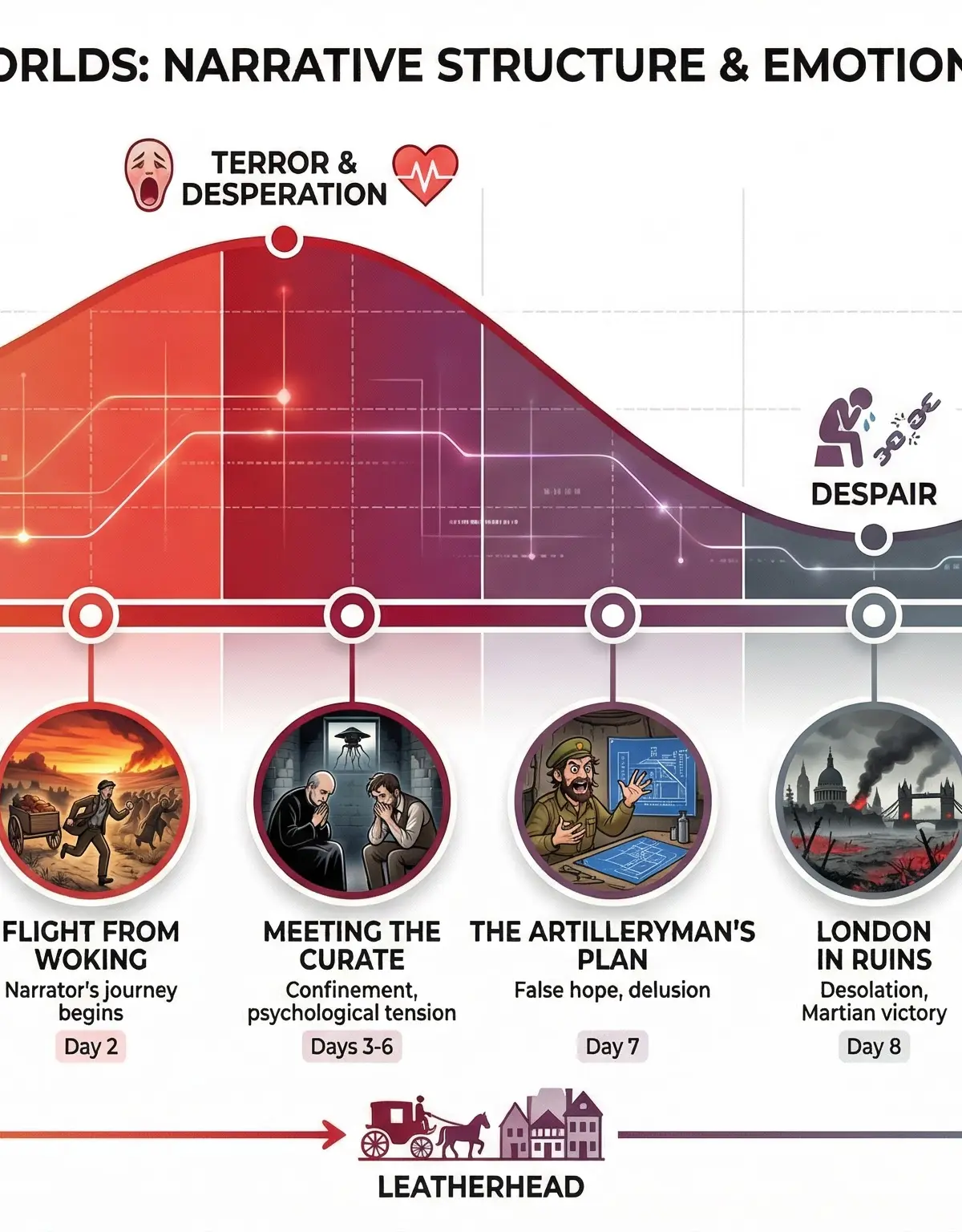
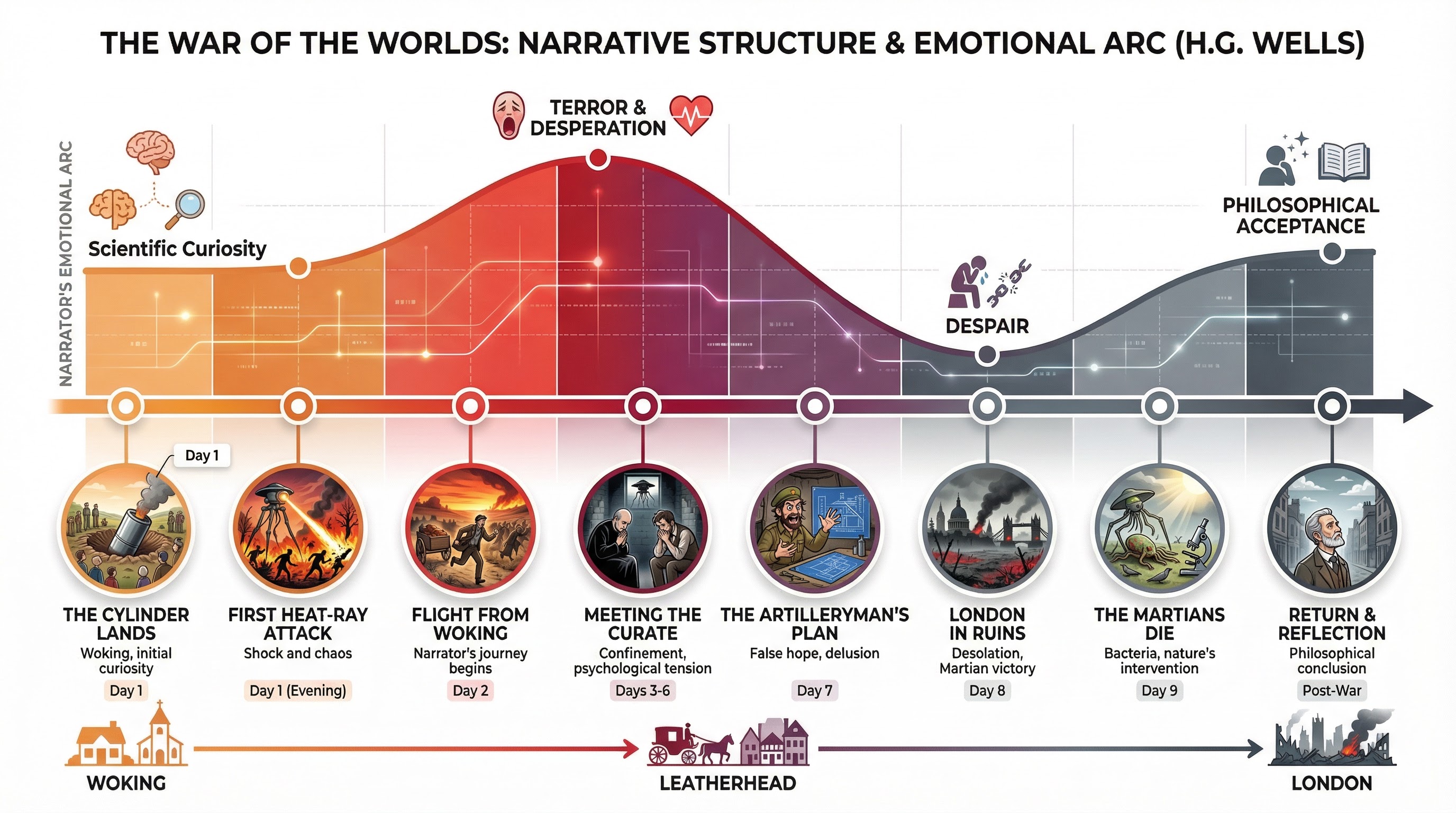
- Chapters 1-5: The novel opens with the narrator, a philosophical writer, observing strange explosions on Mars. A cylindrical object lands on Horsell Common near his home in Woking, Surrey. Initially, it is a curiosity, drawing crowds.
- Chapters 6-11: The Martians emerge—large, greyish creatures with tentacles. They construct their iconic three-legged fighting machines (tripods) and unleash a devastating Heat-Ray, massacring the onlookers. The narrator flees, witnessing the destruction of towns and the military's futile response.
- Chapters 12-17: The narrator secures his wife on a train to Leatherhead before returning to find his home destroyed. He encounters a fleeing artilleryman and later, in the ruins of a house, a hysterical curate. The invasion spreads, with the Martians using a toxic 'Black Smoke' and capturing humans.
Book Two: The Earth Under the Martians
- Chapters 1-4: The narrator and the curate are trapped in a ruined house in Sheen for 15 days, observing the Martians. The curate's loud behaviour forces the narrator to silence him, and the curate is eventually discovered and killed by a Martian. The narrator barely escapes.
- Chapters 5-7: He emerges into a desolate, red-weed-choked landscape. He meets the artilleryman again, who has grandiose but ultimately delusional plans for an underground resistance. The narrator leaves him, disillusioned.
- Chapters 8-9: The narrator travels through a silent, dead London. He confronts a Martian tripod, only to discover the Martians are dead or dying. He realises they have been killed by terrestrial bacteria, to which they had no immunity.
- Chapter 10: The narrator has a mental breakdown but is nursed back to health. He is eventually reunited with his wife. The novel concludes with his philosophical reflections on the experience, humanity's narrow escape, and the humbling realisation that we are not alone or supreme in the universe.
Themes
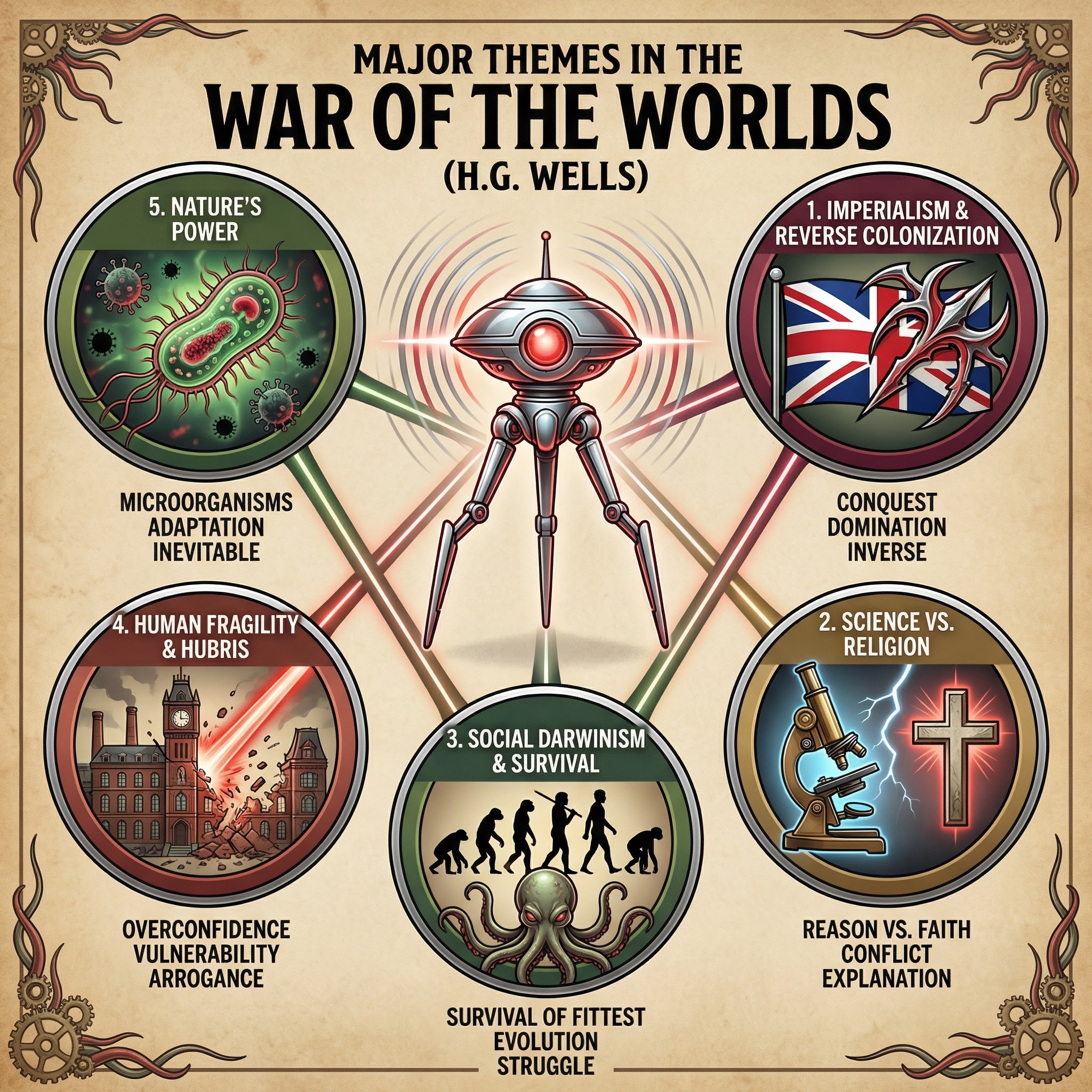
Theme 1: Imperialism and Reverse Colonisation
Wells uses the Martian invasion as a direct allegory for European, and specifically British, imperialism. By placing the technologically superior British in the position of the colonised, he forces his readers to confront the brutality of their own empire. Examiners award high marks for recognising and exploring this central theme.
Key Quotes:
- "And before we judge of them too harshly we must remember what ruthless and utter destruction our own species has wrought, not only upon animals, such as the vanished bison and the dodo, but upon its own inferior races. The Tasmanians, in spite of their human likeness, were entirely swept out of existence in a war of extermination waged by European immigrants, in the space of fifty years. Are we such apostles of mercy as to complain if the Martians warred in the same spirit?" (Book 1, Chapter 1) - This is a direct, damning comparison that sets up the novel's core argument. You MUST use this quote to discuss AO3 context.
- "The secular cooling that must someday overtake our planet has already gone far indeed with our neighbour. Its physical condition is still largely a mystery, but we know now that even in its equatorial region the midday temperature barely approaches that of our coldest winter." (Book 1, Chapter 1) - This establishes the Martians' motive: they are not inherently evil, but desperate, driven by the slow death of their own world—a parallel to the resource-driven motives of empire.
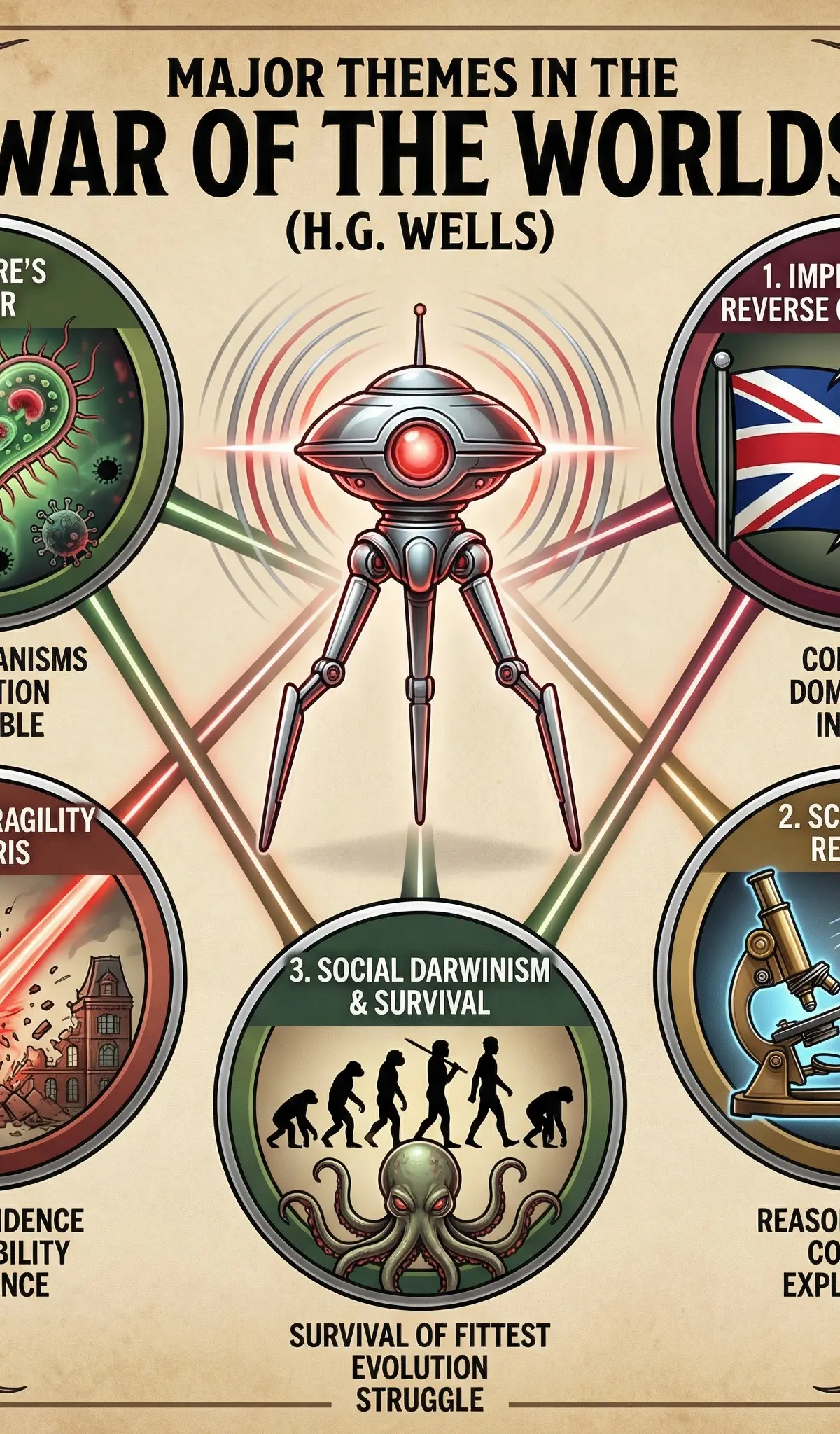
Theme 2: Science vs. Religion
Wells, a student of T.H. Huxley (known as 'Darwin's Bulldog'), champions a scientific, rational worldview, while critiquing the inadequacy of religious faith in the face of existential crisis. The narrator, a man of science and philosophy, survives, while the curate, representing organised religion, perishes.
Key Quotes:
- "It is a curious thing, that I felt angry with him for telling me that. I would have preferred to believe that the thud and the jar had been the fall of a Martian, and that the Martian had been killed." (Book 2, Chapter 3) - The narrator's frustration with the curate's reliance on prayer and divine interpretation over practical observation and survival.
- "For a time I believed that mankind had been swept out of existence, and that I stood alone, the last man on earth." (Book 2, Chapter 8) - The narrator confronts a godless, empty world, a state of existential dread that faith cannot soothe. His survival depends on his own resilience and intellect, not divine intervention.
Theme 3: Social Darwinism and Human Hubris
Victorian society was built on the confidence of its own superiority. Wells uses the theories of Social Darwinism—the idea of 'survival of the fittest' applied to human society—to dismantle this arrogance. The Martians, physically more evolved and technologically advanced, initially appear to be the 'fitter' species, but are ultimately undone by the smallest of creatures.
Key Quotes:
- "We must be hardened. We have to be hardened. There is no other way to it. It is a case of the survival of the fittest." (Book 2, Chapter 7) - The artilleryman’s distorted view of Social Darwinism, which he uses to justify his selfish and ultimately futile plans.
- "Slain by the putrefactive and disease bacteria against which their systems were unprepared... slain, after all man’s devices had failed, by the humblest things that God, in his wisdom, has put upon this earth." (Book 2, Chapter 8) - The ultimate irony. Human technology and intellect fail, but nature, in the form of bacteria, prevails. This is a powerful critique of the idea that might and intelligence alone determine survival.
Character Analysis
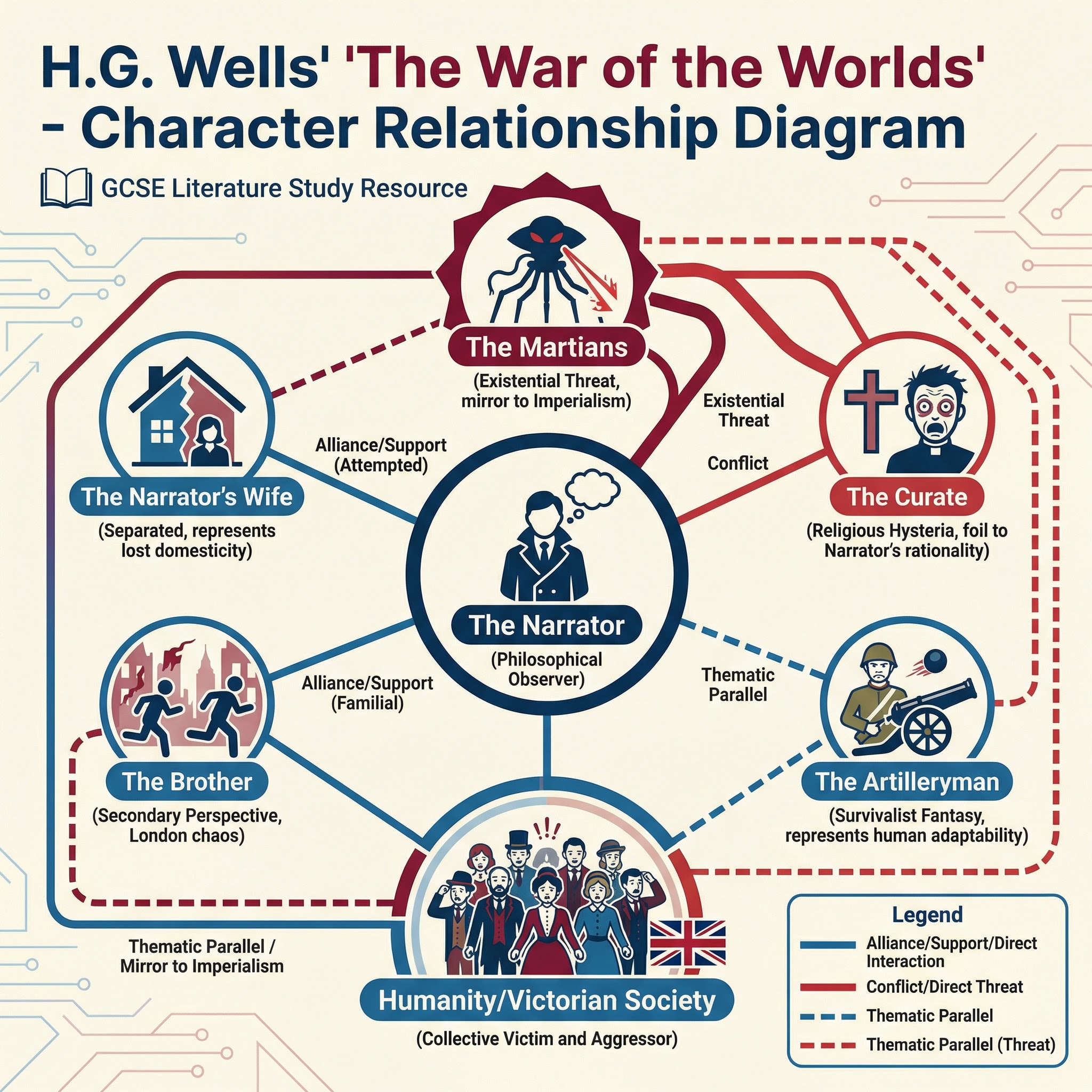
The Narrator
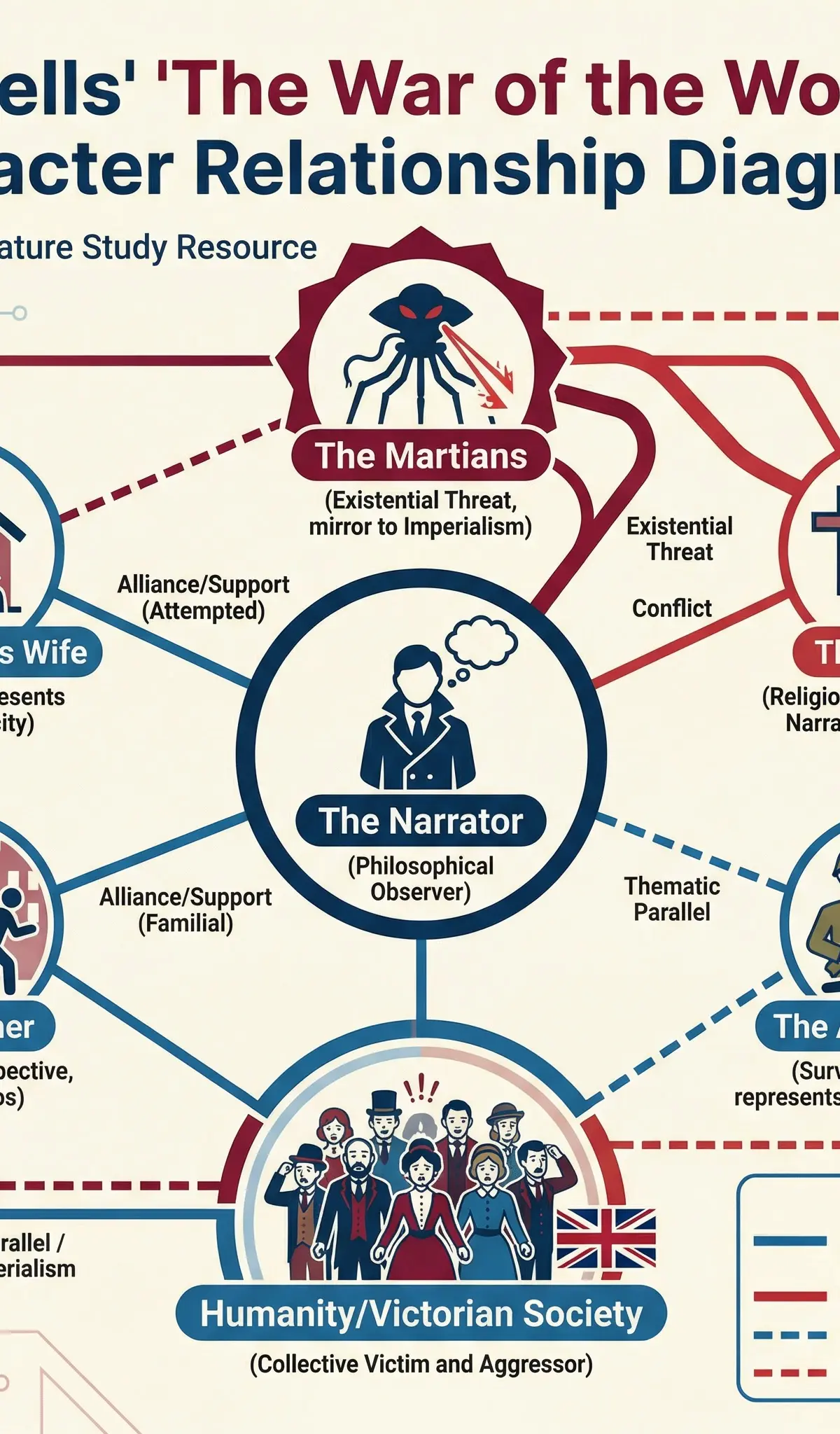
Role: The protagonist and our window into the catastrophic events. He is a philosophical writer, and his observations are framed by a scientific and reflective mindset.
Key Traits: Intelligent, observant, rational, but also prone to moments of terror and despair. He represents the voice of reason trying to make sense of chaos.
Character Arc: He begins as a detached observer, confident in the order of his world. The invasion shatters this, forcing him into a desperate struggle for survival that strips away his civilised veneer. He ends the novel a changed man, humbled and with a profound new perspective on humanity's place in the universe.
Essential Quotes:
- "I was a battleground of fear and curiosity." (Book 1, Chapter 4)
- "By the toll of a billion deaths man has bought his birthright of the earth, and it is his against all comers." (Book 2, Chapter 10)
The Curate
Role: A foil to the narrator. He represents the failure of organised religion and blind faith in the face of a crisis that cannot be explained by scripture.
Key Traits: Hysterical, selfish, irrational. He is unable to adapt and his faith provides no comfort or practical guidance.
Character Arc: He has no positive development. He descends from panic into a state of complete mental collapse, becoming a liability and a symbol of a worldview that is no longer fit for purpose.
Essential Quotes:
- "'It is the end!' he said. 'The great and terrible day of the Lord!'" (Book 1, Chapter 13)
- "He was weeping, but I did not heed him." (Book 2, Chapter 4)
The Artilleryman
Role: Represents an alternative response to the invasion: a vision of humanity adapting and fighting back, based on a crude interpretation of Social Darwinism.
Key Traits: Charismatic, visionary, but also lazy, delusional, and self-important. His grand plans are a form of escapism.
Character Arc: He initially appears as a pragmatic survivor, but his second appearance reveals his ideas to be a hollow fantasy. He talks a good game but lacks the discipline to act, preferring the comfort of his dreams to the harsh reality of rebuilding civilisation.
Essential Quotes:
- "Life is real again, and the useless and cumbersome and mischievous have to die. They ought to die. They will be killed off, they will be killed off. There's no escape for them." (Book 2, Chapter 7)
- "I saw that his work lay in a pile of dirt in the corner of the kitchen." (Book 2, Chapter 7)
Writer's Methods
- Scientific Realism: Wells grounds his fantastical story in precise, scientific-sounding detail. He names specific towns (Woking, Leatherhead), uses astronomical and physical terminology, and describes the Martian technology with a journalist's eye. This makes the impossible seem terrifyingly plausible. Credit is given for analysing how this verisimilitude creates horror.
- First-Person Retrospective Narration: The story is told by the narrator looking back on events. This allows Wells to blend immediate, visceral description of the horror with later, philosophical reflection on its meaning. This dual perspective is crucial. For example, he can describe the terror of the Heat-Ray and then, in the next paragraph, reflect on what it taught him about humanity.
- Juxtaposition: A key technique. Wells constantly juxtaposes the mundane with the monstrous: a Martian cylinder on a peaceful common; a tripod striding through a suburban garden. This contrast is a primary source of the novel's horror and a key point for AO2 analysis.
- Symbolism: The Martians themselves, their tripods, the Heat-Ray, the Black Smoke, and the Red Weed are all powerful symbols. The tripods represent the unfeeling, industrialised nature of the invasion. The Red Weed symbolises the alien terraforming of Earth, a visual metaphor for colonisation.
Context
- Fin de Siècle Anxiety: The late 19th century was a time of great change and anxiety. Fears about the decline of the British Empire, the rise of other powers (like Germany), urban decay, and racial degeneration were common. The novel taps into these fears.
- Imperialism: As discussed, this is the central context. Knowledge of the British Empire, its methods, and contemporary critiques of it (like the Tasmanian genocide reference) is essential for AO3.
- Scientific Advancement: Wells was writing at a time of rapid scientific discovery. Darwin's theory of evolution had shaken religious belief, and new technologies were changing the world. The novel explores both the promise and the potential terror of scientific progress.
- Invasion Literature: A popular genre in Victorian Britain, which often featured foreign powers (usually French or German) invading England. Wells took this genre and gave it a cosmic twist, using it to critique his own society rather than to fuel jingoistic patriotism.
"
Worked Examples
2 worked examples — open one to explore the question and available guidance.
Practice Questions
Test your understanding — click to reveal model answers
How does Wells use the setting of suburban London and Surrey to create horror?
Hint: Think about the contrast between the mundane and the monstrous. How does the destruction of familiar places affect the reader?
Explore the idea that the narrator is not a hero.
Hint: Consider his actions and motivations. Does he act for the greater good, or for his own survival? Compare him to a traditional literary hero.
Starting with the narrator's time trapped in the house with the curate, explore how Wells presents psychological horror.
Hint: Focus on the internal as well as the external threats. How does the confinement and the curate's behaviour affect the narrator?
To what extent does Wells suggest that the Martian invasion was ultimately beneficial for humanity?
Hint: This requires you to evaluate the novel's ending and the narrator's final reflections. Is the immense suffering justified by the lessons learned?
Test your understanding of The War of the Worlds
Active recall beats re-reading. Take an instant quiz now to test what you’ve learned and lock it into long-term memory.
7 days Premium · Then free forever · No card, no charge