Unseen Poetry: Analysis and Comparison Revision Notes
Subject: English Literature | Level: GCSE | Exam Board: OCR
This guide provides a comprehensive, exam-focused toolkit for mastering OCR GCSE Unseen Poetry. It demystifies the analysis process, focusing on the precise skills required to earn top marks by deconstructing language, form, and structure while avoiding common pitfalls.
Revision Notes & Key Concepts
Revision Podcast Transcript
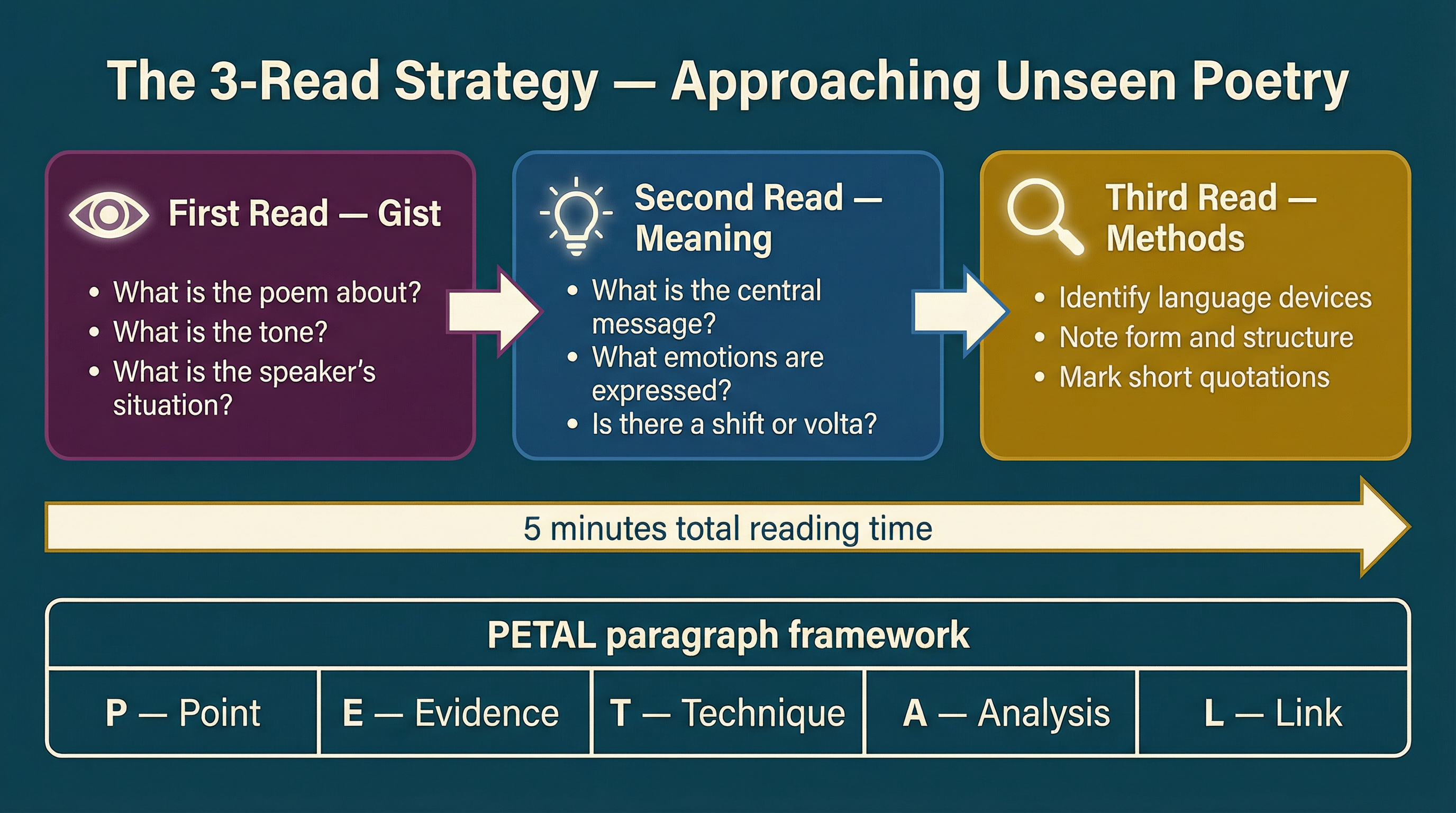
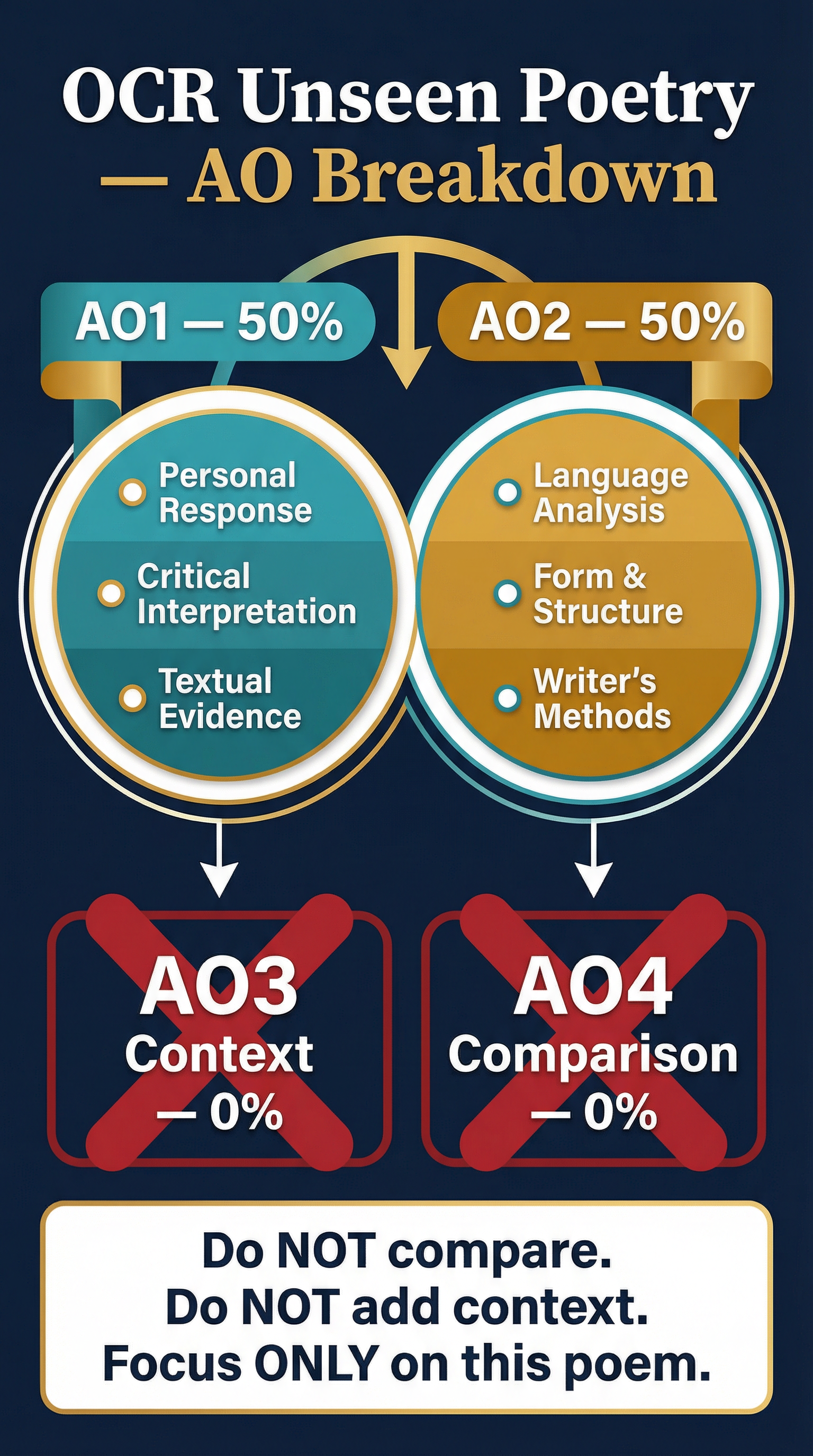
OCR GCSE English Literature — Unseen Poetry: Analysis and Comparison Podcast Episode Script — Approx. 10 Minutes Speaker: Warm, enthusiastic female educator / tutor --- [INTRO — 1 minute] Hello and welcome back! I'm so glad you've pressed play today, because we're diving into one of the most exciting — and honestly, one of the most manageable — parts of your OCR GCSE English Literature exam: Unseen Poetry. Now, I know what some of you might be thinking. "Unseen? That sounds terrifying." But here's the thing — and I want you to hold onto this — the unseen poem is actually your greatest opportunity in the whole paper. Why? Because every single student in that exam hall is in exactly the same position as you. Nobody has seen it before. Nobody has a pre-prepared essay. The playing field is completely level, and the students who do best are simply the ones who have the best toolkit. And that's exactly what we're going to build today. Over the next ten minutes, we're going to cover the core concepts you need, the exam techniques that unlock top marks, the most common mistakes to avoid, and we'll finish with a quick-fire recall quiz to lock it all in. Let's go. --- [CORE CONCEPTS — 5 minutes] Let's start with the basics. In OCR J352, the Unseen Poetry question appears in Component 02, Section A, Part B. It's worth a significant chunk of marks, and here's the crucial thing that makes OCR different from other exam boards: you are only assessed on TWO Assessment Objectives. AO1 and AO2. That's it. AO1 is your personal, critical response — your interpretation of what the poem means, what it's doing, and how it makes you feel as a reader. AO2 is your analysis of the writer's methods — the language, the form, and the structure. Each of these is worth exactly fifty percent of the marks. Now here is the single most important thing I will say in this entire podcast: AO3 — context — is worth zero marks. AO4 — comparison — is worth zero marks. If you spend time writing about the historical background of the poem, or comparing it to another poem you've studied, you are wasting precious minutes and gaining zero credit. OCR is very clear on this. Focus entirely on the poem in front of you. So, how do you approach a poem you've never seen before? I want you to use what I call the Three-Read Strategy, and I want you to give yourself a full five minutes to do it properly. Your first read is for gist. Just read the poem through, as you would read a text message or a short story. Don't annotate yet. Just ask yourself: what is this poem about? What is the situation? Who is the speaker? What is the general mood or tone? Your second read is for meaning. Now you're going deeper. What is the central message or idea? What emotions does the speaker express? Is there a shift in tone — what we call a volta — somewhere in the poem? Where does the poem change direction? Your third read is for methods. This is where you pick up your pen and start annotating. Look at the language choices — the specific words the poet has selected and why. Look at the form — is it a sonnet? A free verse poem? Does it have a regular rhyme scheme or is the rhyme irregular? And look at the structure — how are the stanzas organised? Does the poem use enjambment, where lines run on without a pause? Does it use caesura — that deliberate pause in the middle of a line — to create a particular effect? Now, when you come to write your response, I want you to think about structure. The best responses track the development of the poem — they move through it from beginning to middle to end, rather than jumping around by technique. Examiners call this a "sustained" response, and it's one of the hallmarks of the highest level answers. Let me give you a model sentence to show you what a high-level analytical point looks like. Imagine the poem contains the line: "the silence grew teeth." A weak response might say: "The poet uses a metaphor here." That's feature-spotting — identifying a technique without explaining its effect. A strong response would say: "The poet's striking metaphor 'the silence grew teeth' transforms an absence of sound into something predatory and threatening, suggesting that the speaker's isolation has become actively dangerous rather than merely uncomfortable. The verb 'grew' implies a gradual, organic development, as though the silence has been feeding on the speaker's fear over time." Do you see the difference? The strong response names the technique, embeds the quotation, analyses the specific word choices within it, and explores the effect on the reader. That is what earns marks at the top levels. Let me also talk about form and structure, because this is where many candidates lose marks. Form and structure are not just decorative features — they carry meaning. If a poem is written in a tightly controlled sonnet form with a regular rhyme scheme, that control might reflect the speaker's attempt to impose order on chaotic emotions. If the poem breaks into irregular stanzas or uses enjambment to push lines forward without pause, that might mirror the speaker's sense of urgency, breathlessness, or loss of control. Always ask yourself: why has the poet made this formal choice, and what does it contribute to the poem's meaning? One more key concept: the difference between the speaker and the poet. The speaker of the poem — the "I" or the voice we hear — is not automatically the same person as the poet who wrote it. Examiners award credit to candidates who maintain this distinction. Say "the speaker" or "the poet presents a speaker who..." rather than assuming the poem is autobiographical. --- [EXAM TIPS AND COMMON MISTAKES — 2 minutes] Right, let's talk about the mistakes that cost students marks — and how to avoid every single one of them. Mistake number one: feature-spotting. This is the most common error at GCSE level. Identifying a technique — "there is alliteration here" — without explaining what it does is worth very little. Every technique you name must be followed by an explanation of its effect on meaning and on the reader. Mistake number two: narrative retelling. Some candidates spend their response summarising what happens in the poem — "in the first stanza, the speaker describes a garden, and then in the second stanza..." This is not analysis. Examiners want to see you engaging with how the poem works, not what it says. Mistake number three: neglecting form and structure. Many students focus entirely on imagery and language devices and completely ignore the poem's shape. Remember: form and structure are worth just as many marks as language analysis under AO2. Mistake number four — and this is the big one for OCR — attempting to compare the poem to another text, or adding biographical or historical context. I cannot stress this enough. OCR does not assess AO3 or AO4 in this question. Any time you spend on comparison or context is time wasted. Now for the positive tips. Use short, embedded quotations — that means weaving the quotation into your sentence rather than dropping it in as a separate block. Short quotations allow you to zoom in on individual words and phrases, which is exactly what examiners want to see. Structure your response to track the poem's development. Begin with the opening lines, move through the middle, and address the ending. This shows the examiner that you understand the poem as a whole, unified piece of writing. And always — always — link your analysis back to the poem's overall effect or central idea. Every paragraph should end with a sentence that connects your point to the bigger picture of what the poem is doing. --- [QUICK-FIRE RECALL QUIZ — 1 minute] Okay, quiz time! I'll ask the question, give you three seconds to think, then I'll give you the answer. Question one: What two Assessment Objectives are assessed in the OCR Unseen Poetry question? ... That's right — AO1 and AO2, each worth fifty percent. Question two: What is the Three-Read Strategy? ... First read for gist, second read for meaning, third read for methods. Question three: What is feature-spotting, and why does it lose marks? ... Feature-spotting is naming a technique without explaining its effect. It loses marks because it shows no analytical depth. Question four: What is a volta? ... A volta is a turn or shift in the poem — a change in tone, perspective, or argument, often found in sonnets but present in many poems. Question five: Should you include biographical context about the poet in your OCR Unseen response? ... No! AO3 is worth zero marks in this question. --- [SUMMARY AND SIGN-OFF — 1 minute] Let's bring it all together. The OCR Unseen Poetry question is your chance to shine as an independent, analytical reader. You have everything you need: the Three-Read Strategy to approach the poem, the PETAL paragraph framework to structure your analysis, and the knowledge that AO1 and AO2 are your only focus. Remember: track the poem's development, embed short quotations, analyse specific word choices, and always explain the effect on the reader. Avoid feature-spotting, avoid retelling, avoid comparison, and avoid context. The students who do best in this question are not the ones who know the most poems — they're the ones who read most carefully and think most deeply about the poem in front of them. And you can absolutely do that. Thank you so much for listening. Good luck in your exam — I'm rooting for you. Now go and practise with some unseen poems, and remember: every poem is a puzzle waiting to be solved. See you next time! --- [END OF SCRIPT]
Key Terms & Definitions
- Volta
- A turn or shift in the argument or tone of a poem. In a sonnet, this typically occurs around line 9, but voltas can appear in any poem.
- Enjambment
- The continuation of a sentence or clause across a line break without a pause. The line runs on to the next.
- Caesura
- A pause or break within a line of poetry, usually marked by punctuation (a comma, full stop, dash, etc.).
- Free Verse
- Poetry that does not have a regular rhyme scheme or metrical pattern. It mimics the rhythms of natural speech.
- Speaker
- The narrative voice of the poem. The speaker is a persona created by the poet and should not be automatically assumed to be the poet themselves.
- Diction
- The specific word choices made by a writer. Analysis of diction involves examining the connotations and effects of individual words.
- Connotation
- The associated ideas or feelings that a word invokes, beyond its literal dictionary definition (denotation).
- Half-rhyme
- Also known as slant rhyme or near rhyme, where the final consonants of words are the same but the vowel sounds are different (e.g., 'shape' and 'keep').
Worked Examples
Worked Example
Question: Explore how the poet presents the power of nature in the poem below. (24 marks)
Solution: **Introduction**: The poet presents nature as an overwhelmingly powerful and indifferent force, using a combination of violent imagery and structural choices to dwarf the human speaker and emphasise their vulnerability. The poem tracks a journey from initial awe to a final, terrifying realisation of nature's absolute dominance. **Paragraph 1 (Opening)**: From the outset, the poet establishes nature's power through personification. The mountain is described as having a 'stone shoulder' that 'shrugged off the wind'. The verb 'shrugged' gives the mountain a sense of casual, effortless strength, as if the wind—itself a powerful natural force—is a minor irritation. This immediately establishes a hierarchy of power, placing the mountain at the apex. Credit would be given for analysing how this positions the human speaker as insignificant from the very first stanza. **Paragraph 2 (Development)**: As the poem develops, the poet uses increasingly violent imagery to convey nature's threat. The sea is described not as waves, but as 'liquid fists' that 'pummelled the shore'. The metaphor transforms the water into an aggressive, purposeful attacker. The plosive alliteration in 'pummelled' mimics the brutal, repetitive impact of the waves, creating an auditory effect that reinforces the visual image of violence. A candidate would be rewarded for explaining how this shifts the reader's perception from awe to fear. **Paragraph 3 (Structure)**: The poet's structural choices reinforce this sense of being overwhelmed. The poem is written as a single, unbroken stanza, with frequent use of enjambment that pulls the reader relentlessly forward, mirroring the speaker's inability to find a resting place or escape the onslaught of nature. The lack of a regular rhyme scheme adds to the sense of chaos and unpredictability. This structural wildness is a direct reflection of the wildness of the natural world being described. **Conclusion**: Ultimately, the poet presents the power of nature as absolute and terrifying. By moving from the casual strength of the mountain to the active violence of the sea, and by using a chaotic structure that mirrors the subject, the poem leaves the reader with a profound sense of human fragility in the face of a world that is not just powerful, but actively hostile.
Worked Example
Question: How does the poet present the speaker's feelings of loss in this poem? (24 marks)
Solution: **Introduction**: The poet powerfully conveys the speaker's profound sense of loss through a combination of sensory imagery that emphasises absence, and a fragmented structure that mirrors a broken state of mind. The poem suggests that loss is not a single event, but a persistent, haunting presence. **Paragraph 1 (Sensory Absence)**: In the opening stanza, the poet presents loss as an absence that has a physical presence. The speaker notes 'the hollow in the air where your voice used to be'. This synaesthetic metaphor gives a physical shape to something that is gone, suggesting the speaker's grief is so intense it has become a tangible part of their environment. The word 'hollow' suggests an emptiness that is both deep and resonant, implying the loss has carved out a part of the speaker's world. Marks are awarded for exploring how this moves beyond simple sadness to a more complex, physical experience of grief. **Paragraph 2 (Fragmented Memory)**: The poet uses fragmented syntax and caesura to reflect the speaker's fractured memory. The line 'I remember your hands. The way they held a cup. Still.' is broken into three distinct parts. The caesurae force the reader to pause, mimicking the way a memory can surface in incomplete, disjointed flashes. The final, single-word sentence, 'Still.', is deeply ambiguous. It could mean the memory is still vivid, or it could refer to the stillness of the hands in death. This ambiguity captures the unsettling nature of grief, where memories are both a comfort and a source of pain. **Paragraph 3 (Form and Rhyme)**: The poem's form contributes significantly to the feeling of loss. It is written in couplets, but the rhymes are often half-rhymes or eye-rhymes (e.g., 'love' and 'remove'). This creates a feeling of being 'nearly' complete but ultimately disconnected, structurally mirroring the speaker's relationship with the lost person. The 'almost-but-not-quite' nature of the rhymes is a subtle yet powerful way to convey that something is fundamentally broken and cannot be perfectly restored. This is a sophisticated point that would gain significant AO2 credit. **Conclusion**: In conclusion, the poet presents loss as a disorienting and all-encompassing experience. The use of sensory absence makes the loss tangible, while the fragmented structure and broken rhyme scheme create a powerful sense of a mind and a world that have been shattered by grief, leaving only echoes and incomplete pairs.
Practice Questions
Question: Explore how the poet presents the experience of memory in the poem below. (24 marks)
Answer:
Question: How does the poet present the speaker's attitude towards the city? (24 marks)
Answer:
Question: Explore how the poet presents a moment of change. (24 marks)
Answer:
Question: How does the poet make the everyday object seem strange or unfamiliar? (24 marks)
Answer: