OCR · GCSE · English Literature
Course version: J352 · Version from Sept 2017
Unseen Poetry: Analysis and Comparison
This guide provides a comprehensive, exam-focused toolkit for mastering OCR GCSE Unseen Poetry. It demystifies the analysis process, focusing on the precise skills required to earn top marks by deconstructing language, form, and structure while avoiding common pitfalls.
- 5 min read
- 2 worked examples
- 4 practice questions
- 8 key terms
Check what you remember
Read the wording for your board, then hide it and explain Volta in your own words. Rough notes are fine. This is a self-check, with no mark or grade.
Reference: OCR
A turn or shift in the argument or tone of a poem. In a sonnet, this typically occurs around line 9, but voltas can appear in any poem.
Study Notes

Overview
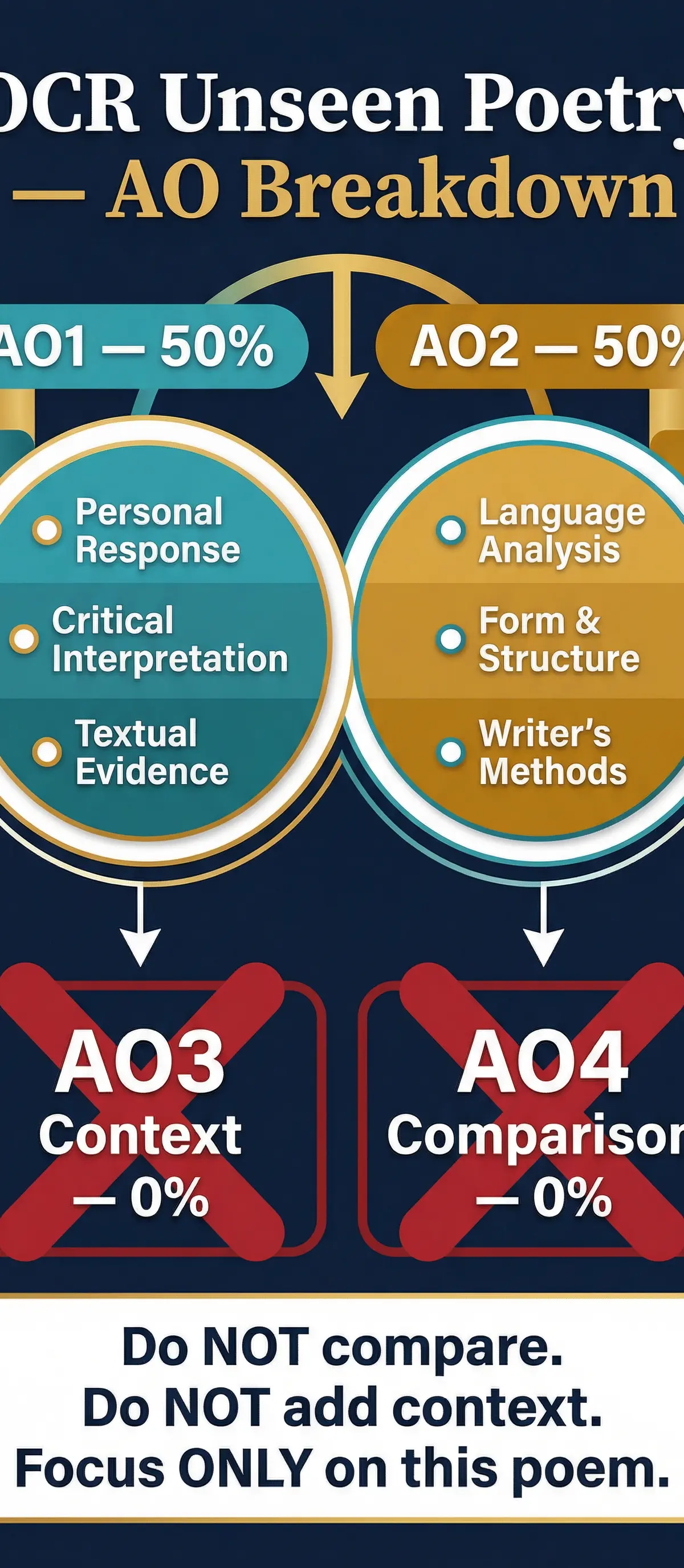
The Unseen Poetry component of the OCR GCSE English Literature exam (J352, Component 02) is a unique challenge that tests pure analytical skill. Unlike other sections, it requires candidates to engage with a poem they have never encountered before, making it a true measure of their ability to think critically under pressure. Examiners are looking for a sustained, informed personal response (AO1) supported by detailed analysis of the writer's methods (AO2). This section is worth 50% of the paper's marks, split equally between these two objectives. Success here is not about prior knowledge of the poem, but about the rigorous application of an analytical toolkit. Candidates who can dissect language, form, and structure with precision, while avoiding the common traps of comparison (AO4) and context (AO3), will find this a rewarding opportunity to demonstrate their literary expertise. This guide will equip you with the strategies to do just that.
The Analytical Process: A Step-by-Step Guide
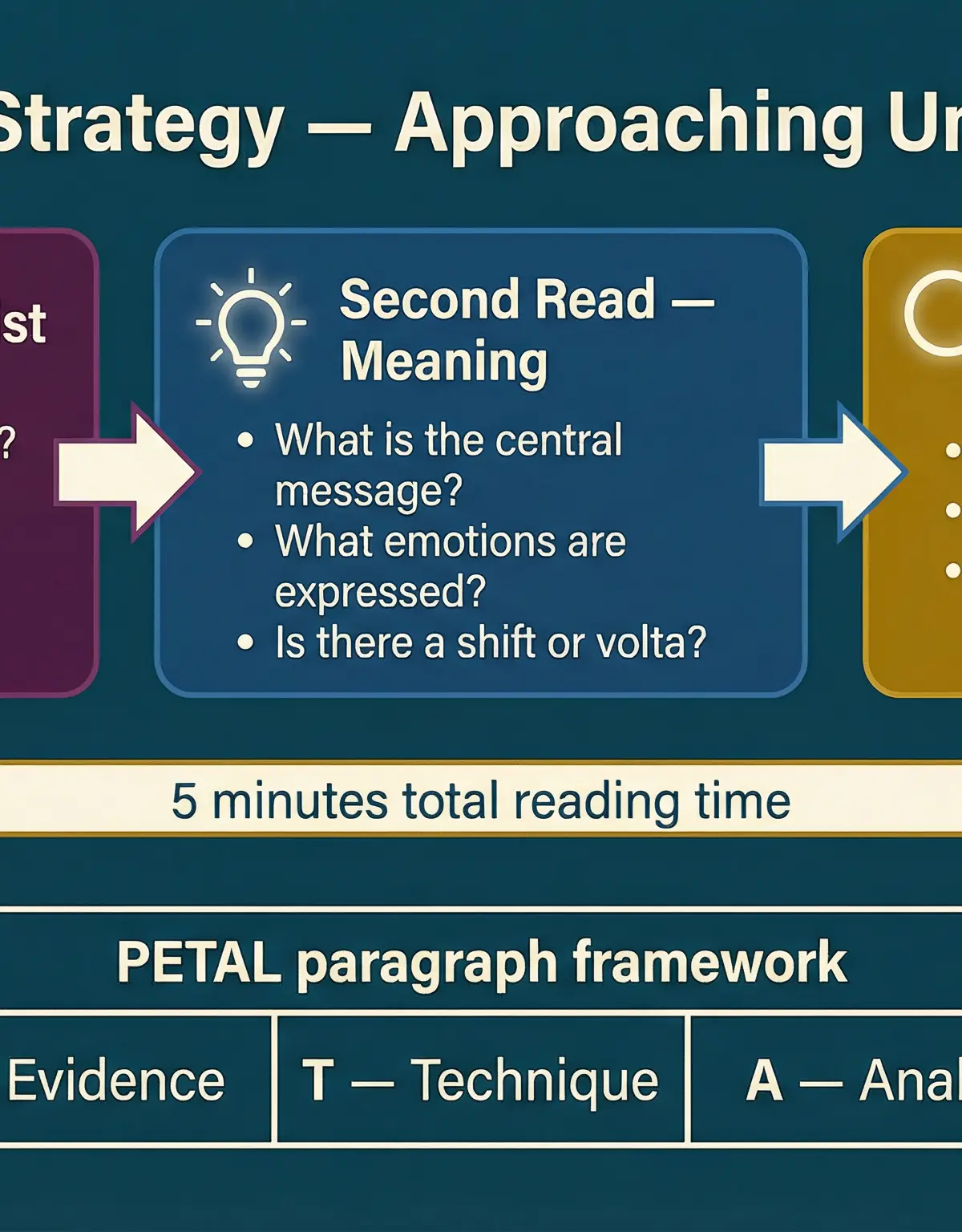
Approaching an unseen poem requires a methodical process to ensure no marks are left behind. The most effective strategy is the 'Three-Read' method, which allows for a layered understanding of the poem's complexities.
-
First Read: The Gist (1 minute): Read the poem from top to bottom without making any notes. The goal is to get a general sense of the poem's subject matter and tone. Ask yourself: What is the situation? Who is the speaker? What is the overall mood?
-
Second Read: The Meaning (2 minutes): Read the poem again, this time focusing on the deeper message. What is the central idea or argument? What emotions are being explored? Is there a 'volta' or a turn in the poem where the argument or tone shifts?
-
Third Read: The Methods (2 minutes): This is your annotation read. With a pen in hand, actively mark the poem, identifying the specific techniques the poet is using to create meaning. Look for patterns in imagery, interesting word choices, structural features like enjambment or caesura, and the poem's overall form.
Writer's Methods: The Core of AO2
Your ability to analyse the writer's methods is the cornerstone of a high-level response. This goes beyond simply 'feature-spotting'. For every technique you identify, you must explore its specific effect on the reader and its contribution to the poem's overall meaning.
Language
Language analysis involves looking at the poet's specific word choices (diction), imagery (metaphors, similes, personification), and sound devices (alliteration, assonance, onomatopoeia).
- Diction: Why has the poet chosen this specific word? What are its connotations? For example, describing a house as 'imposing' versus 'welcoming' creates entirely different effects.
- Imagery: How does the imagery create a sensory experience for the reader? A metaphor doesn't just create a comparison; it transfers the qualities of one thing onto another, deepening our understanding.
- Sound Devices: How does the sound of the poem contribute to its tone? Harsh alliterative 'k' or 't' sounds might create a sense of aggression, while soft 's' sounds (sibilance) could suggest secrecy or intimacy.
Form
Form refers to the overall shape and type of the poem. Is it a sonnet, with its traditional 14 lines and strict rhyme scheme? Is it a ballad, telling a story in regular quatrains? Or is it written in free verse, with no set rules?
- Sonnets: Often used for themes of love or intense emotion. The strict form can suggest a speaker trying to control their feelings.
- Free Verse: The lack of a set structure can mirror a speaker's feelings of freedom, chaos, or confusion.
- Stanza Length: Regular stanza lengths (e.g., quatrains) can create a sense of order and predictability, while irregular stanzas might reflect an unsettled state of mind.
Structure
Structure refers to how the poem is organised and how it unfolds for the reader. This includes elements like rhyme scheme, rhythm, enjambment, and caesura.
- Rhyme Scheme: A regular rhyme scheme (e.g., AABB) can create a simple, song-like quality. An irregular or broken rhyme scheme might create a sense of unease or fragmentation.
- Rhythm (Metre): A regular rhythm, like the iambic pentameter, can create a sense of control or formality. A broken rhythm can feel jarring and disruptive.
- Enjambment: When a line of poetry runs onto the next line without a pause, it can create a sense of urgency, breathlessness, or overflowing emotion.
- Caesura: A pause within a line of poetry, created by punctuation. It can force the reader to slow down and reflect on a particular word or idea, or it can create a sense of fragmentation and broken thought.
Visual Resources
2 diagrams and illustrations
Interactive Diagrams
1 interactive diagram to visualise key concepts
Conceptual Flow Outline
A workflow diagram showing the process from initial reading to final written response for Unseen Poetry.
Worked Examples
2 worked examples — open one to explore the question and available guidance.
Practice Questions
Try the question, then reveal an answer plan or example response
Explore how the poet presents the experience of memory in the poem below. (24 marks)
Hint: Consider how the poet uses sensory details and structure to show how memory feels to the speaker. Is it comforting or painful?
How does the poet present the speaker's attitude towards the city? (24 marks)
Hint: Track the speaker's feelings from the beginning to the end of the poem. Do they change? Look for contrasting imagery.
Explore how the poet presents a moment of change. (24 marks)
Hint: Locate the 'volta' or turning point in the poem. How do the language and structure before this point differ from the language and structure after it?
How does the poet make the everyday object seem strange or unfamiliar? (24 marks)
Hint: This is a question about 'defamiliarization'. How does the poet use unusual metaphors, similes, or perspectives to make you see something common in a new light?
Exam technique
How to turn what you know into marks
How to approach the question
1. Read the question carefully and underline the key focus (e.g., 'power of nature', 'speaker's feelings'). 2. Apply the Three-Read Strategy to the poem, annotating with the question focus in mind. 3. Create a brief plan, outlining the point for each paragraph, tracking the poem from beginning to end.
How to structure your answer
Use PETAL paragraphs: Point (make a clear statement linked to the question), Evidence (embed a short, relevant quote), Technique (name the literary device), Analysis (explain the effect of the technique and specific words), Link (connect back to the overall argument and the question).
Timing
For a 24-mark question, you should spend approximately 30-35 minutes. This includes 5 minutes for reading and planning, and 25-30 minutes for writing.
Common pitfalls
- Feature-spotting without analysing the effect on meaning.
- Retelling the story of the poem instead of analysing the writer's methods.
- Ignoring form and structure in favour of only language devices.
- Including context (AO3) or comparison (AO4), which gain zero marks for OCR.
What the command words want
- Explore
- This invites a wide-ranging analysis. You should consider language, form, and structure, and track the development of the theme or feeling throughout the poem.
- Evaluate
- This is not a common command word in this specific OCR question, but if encountered, it requires you to make a judgement on the effectiveness of the poet's methods.
- How does... present
- This is a direct instruction to focus on the writer's methods (AO2). Your answer should be built around the techniques the poet uses to create meaning.
- Starting with this extract
- This command word is not used for the OCR Unseen Poetry question, as there is no extract. The question will always be about the single, whole poem provided.
Watch or listen (optional)
Test your understanding of Unseen Poetry: Analysis and Comparison
Active recall beats re-reading. Take an instant quiz now to test what you’ve learned and lock it into long-term memory.
A week of Premium from your first lesson · Then the free plan continues · No card, no charge