A Christmas Carol
Master Charles Dickens' classic novella with this comprehensive study guide. We break down Scrooge's transformation, the profound social context, and the writer's methods to help you secure top marks in your GCSE English Literature exam.
Study Notes
Overview
A Christmas Carol is not merely a festive ghost story; it is a profound moral allegory and a fierce critique of Victorian capitalism. Dickens uses the transformation of Ebenezer Scrooge to argue that greed is a learned behaviour and that society has a collective responsibility to care for its most vulnerable members. For the GCSE exam, candidates are rewarded for moving beyond plot summary to analyse Dickens' authorial methods—his use of structure (staves), rich imagery, and allegorical figures like the ghosts and the children Ignorance and Want. A perceptive response will seamlessly integrate contextual knowledge, such as the 1834 Poor Law and the horrific conditions of workhouses, showing how Dickens uses fiction as a vehicle for social change.
Audio Revision
Listen to our comprehensive revision podcast covering core concepts, exam tips, and a quick-fire recall quiz:
Plot/Content Overview
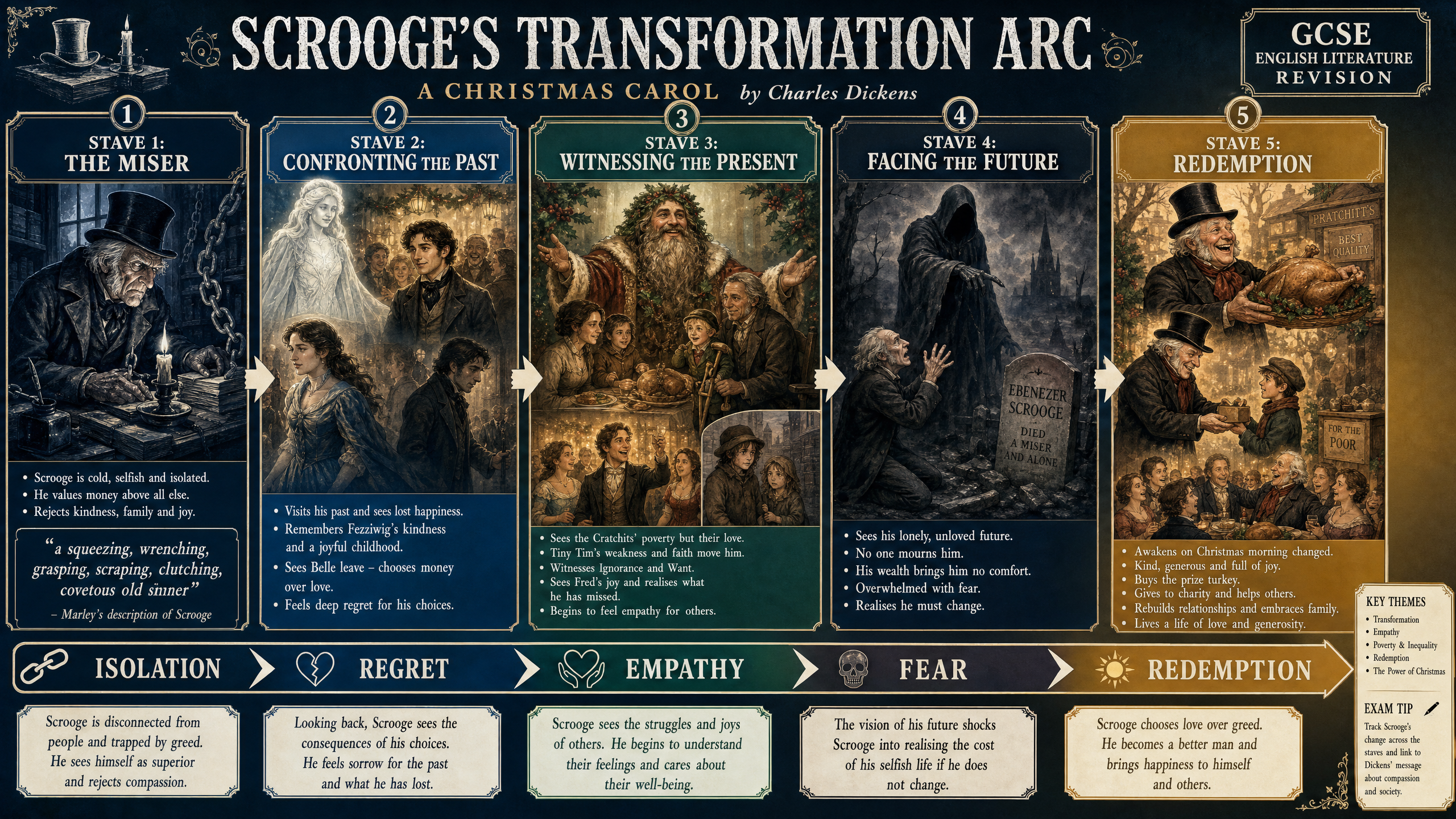
Stave 1: Marley's GhostScrooge is introduced as a misanthropic, greedy moneylender who despises Christmas. He rejects his nephew Fred's invitation, refuses to give to charity, and begrudges his clerk, Bob Cratchit, a day off. That night, the ghost of his former partner, Jacob Marley, visits him wrapped in heavy chains, warning Scrooge to change his ways or face a worse fate. Marley announces the arrival of three spirits.
Stave 2: The First of the Three SpiritsThe Ghost of Christmas Past shows Scrooge his lonely childhood, his apprenticeship with the generous Fezziwig, and his broken engagement to Belle, who left him because he loved money more than her. Scrooge begins to feel deep regret.
Stave 3: The Second of the Three SpiritsThe Ghost of Christmas Present takes Scrooge through London to see how others celebrate. He witnesses the warmth of the Cratchit family despite their poverty and the fragile health of Tiny Tim. He also sees Fred's joyful party. The ghost reveals two starving children, Ignorance and Want, warning Scrooge of the doom they represent.
Stave 4: The Last of the SpiritsThe silent Ghost of Christmas Yet to Come shows Scrooge a bleak future: businessmen casually discussing a dead man, thieves stealing his belongings, the Cratchit family mourning Tiny Tim, and finally, Scrooge's own neglected gravestone. Terrified, Scrooge begs for the chance to alter his fate.
Stave 5: The End of ItScrooge awakens on Christmas morning a changed man. He sends a prize turkey to the Cratchits, donates generously to charity, and joins Fred's party. He becomes a second father to Tiny Tim and embodies the Christmas spirit for the rest of his life.
Themes
Theme 1: Redemption
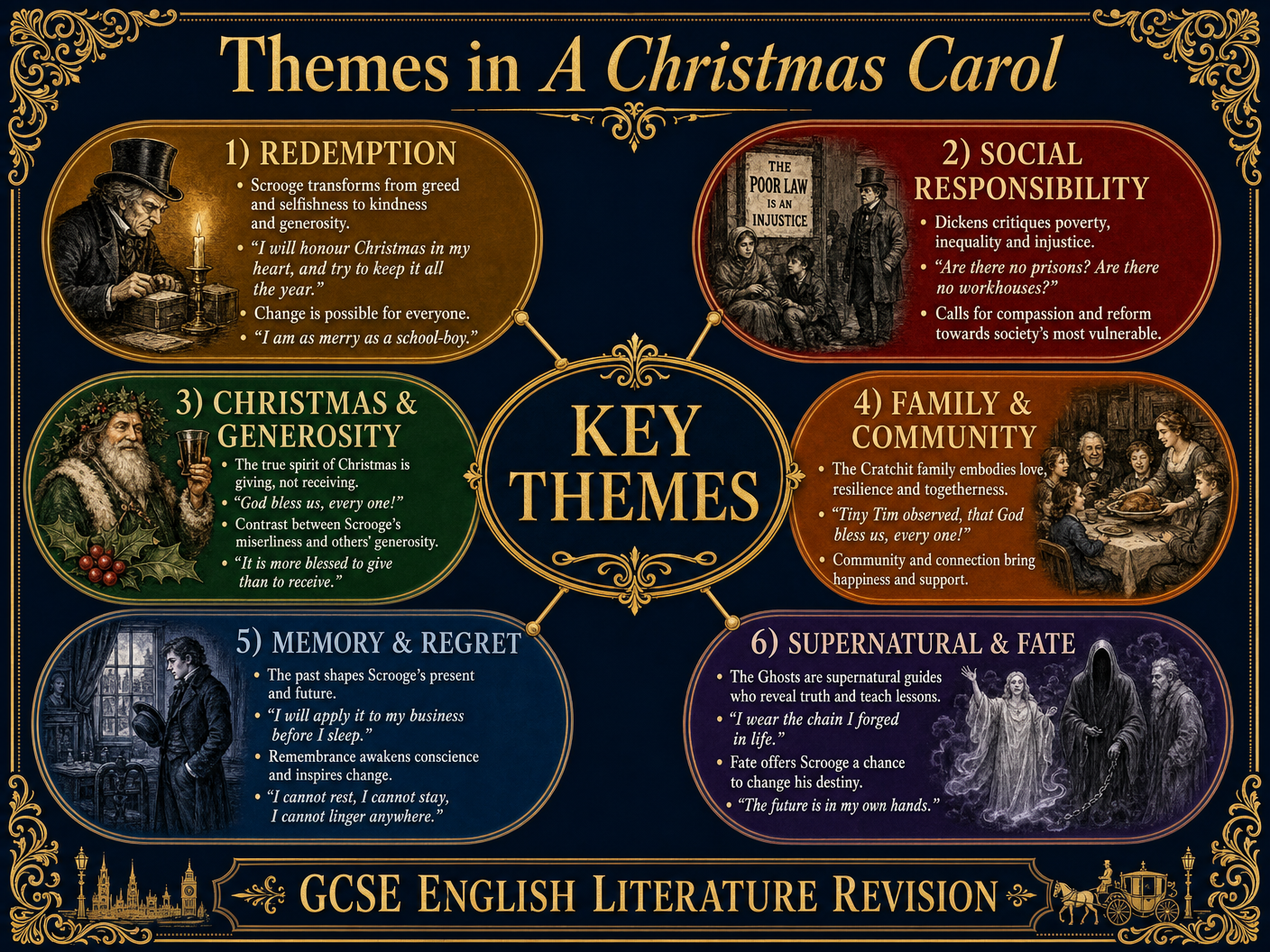
Redemption is the structural and moral core of the novella. Dickens structures the narrative to show that change is possible for anyone, no matter how entrenched in sin. Scrooge's journey from a "covetous old sinner" to a man who "knew how to keep Christmas well" is a message of hope.
Key Quotes:
- "Hard and sharp as flint, from which no steel had ever struck out generous fire." (Stave 1) - Dickens uses the simile of flint to suggest Scrooge's hard exterior, but also hints at the potential for "fire" or warmth hidden within.
- "I am as light as a feather, I am as happy as an angel, I am as merry as a school-boy." (Stave 5) - The use of multiple joyful similes contrasts directly with the heavy, cold imagery of Stave 1, showing a complete spiritual rebirth.
Theme 2: Social Responsibility and Poverty
Dickens wrote the novella partly as a response to a parliamentary report on child poverty. He uses the text to challenge the Malthusian economic theories of the time, which suggested the poor should be left to die to decrease the "surplus population."
Key Quotes:
- "Are there no prisons? ... And the Union workhouses?" (Stave 1) - Scrooge echoes the callous attitudes of the Victorian ruling class, relying on harsh institutions rather than personal charity.
- "This boy is Ignorance. This girl is Want. Beware them both..." (Stave 3) - The personification of social ills as horrific children serves as a stark warning to Victorian society about the consequences of neglecting the poor.
Theme 3: Christmas and Generosity
Christmas in the novella is less about religion and more about community, charity, and human connection. Characters like Fred and Fezziwig demonstrate that wealth is only valuable when used to bring joy to others.
Key Quotes:
- "A good time: a kind, forgiving, charitable, pleasant time." (Stave 1) - Fred's definition of Christmas establishes the moral benchmark against which Scrooge is judged.
- "He has the power to render us happy or unhappy; to make our service light or burdensome." (Stave 2) - Scrooge's realization about Fezziwig highlights the responsibility employers have toward their workers.
Character Analysis
Ebenezer Scrooge
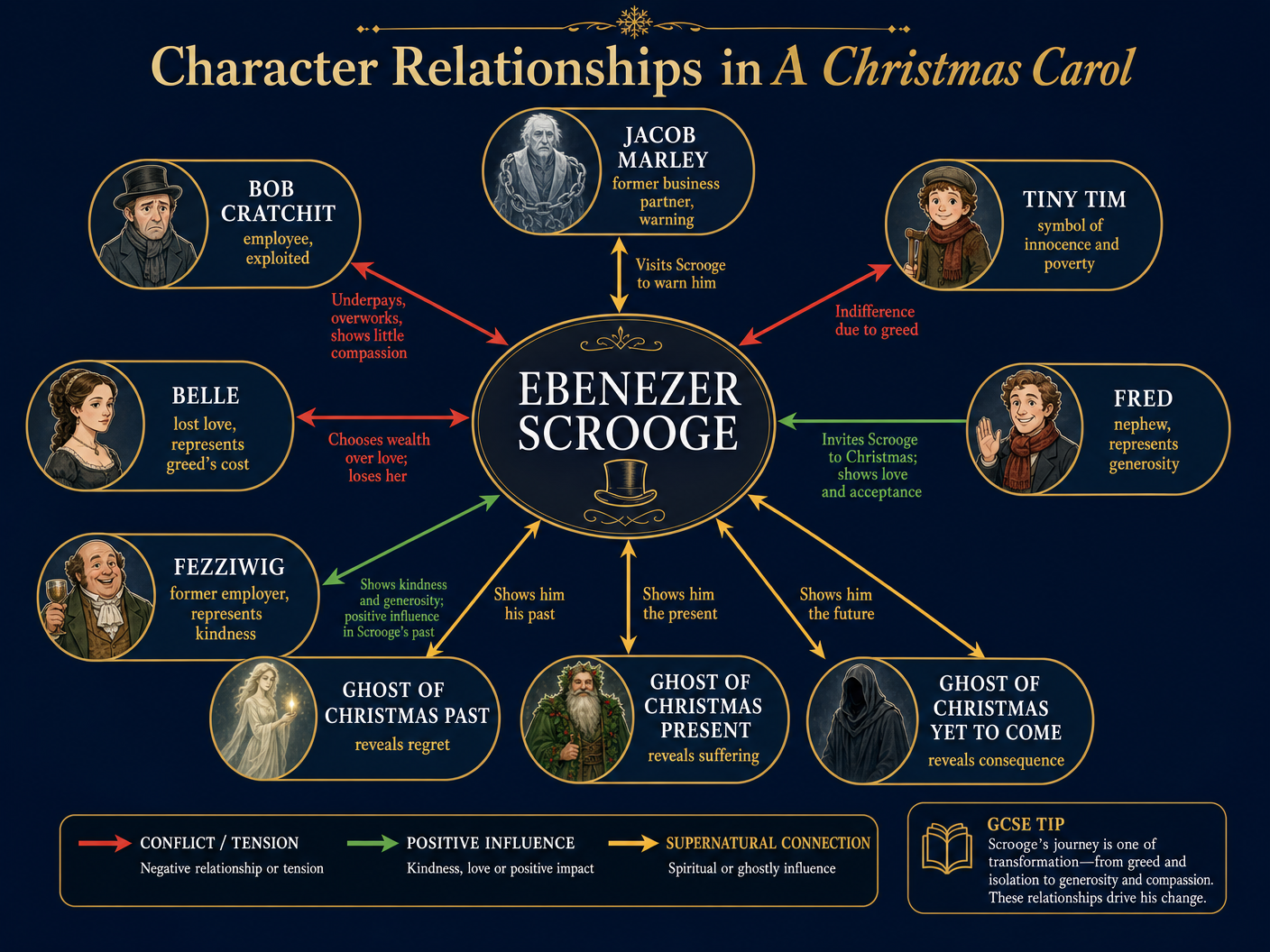
Role: The protagonist whose transformation drives the narrative and delivers Dickens' moral message.
Key Traits: Miserly, isolated, misanthropic (initially); repentant, joyful, generous (finally).
Character Arc: Moves from total isolation and greed to integration within the community and profound generosity.
Essential Quotes:
- "a squeezing, wrenching, grasping, scraping, clutching, covetous, old sinner!"
- "I will honour Christmas in my heart, and try to keep it all the year."
The Cratchit Family (especially Bob and Tiny Tim)
Role: They humanize the abstract concept of poverty for Scrooge and the reader.
Key Traits: Loving, resilient, grateful despite immense hardship.
Character Arc: They remain morally constant, but their material fate is altered by Scrooge's transformation.
Essential Quotes:
- "God bless us every one!" (Tiny Tim)
- "I'll give you Mr. Scrooge, the Founder of the Feast!" (Bob Cratchit)
The Three Spirits
Role: Supernatural agents of Scrooge's redemption; they force him to confront truth.
Key Traits:
- Past: Ethereal, illuminating (forces reflection).
- Present: Abundant, joyful, yet stern (forces awareness of current suffering).
- Yet to Come: Silent, dark, terrifying (forces realization of consequences).
Essential Quotes:
- "I wear the chain I forged in life." (Marley)
- "Are these the shadows of the things that Will be, or are they shadows of things that May be, only?" (Scrooge to the final spirit)
Writer's Methods
- Structure (The Carol): Dickens divides the book into five "Staves" rather than chapters, framing the story as a song to be shared. The narrative follows a strict chronological structure of past, present, and future, creating a clear trajectory of moral education.
- Narrative Voice: The omniscient narrator is intrusive, conversational, and highly opinionated, guiding the reader's moral judgment of Scrooge.
- Motifs and Imagery: Dickens uses contrasting imagery of cold/darkness (Scrooge) versus warmth/light (Fred, the Cratchits, the Ghost of Christmas Past) to represent emotional states.
- Allegory and Personification: The ghosts and the children Ignorance and Want are allegorical figures representing abstract concepts (memory, charity, poverty, doom).
Context
- The Poor Law (1834): Established the workhouse system, designed to be so harsh that only the truly desperate would seek help. Scrooge supports this system initially.
- Thomas Malthus: An economist who argued that famine and poverty were natural checks on overpopulation. Scrooge's comment about decreasing the "surplus population" is a direct attack on Malthusian theory.
- Dickens' Own Life: Dickens' father was imprisoned for debt, and 12-year-old Charles was forced to work in a blacking factory. This trauma fueled his lifelong advocacy for the poor and children.
- The Victorian Christmas: The novella helped popularize and shape the modern idea of Christmas as a family-centered festival of generosity and goodwill.
Visual Resources
3 diagrams and illustrations
Interactive Diagrams
1 interactive diagram to visualise key concepts
Conceptual Flow Outline
Scrooge's structural journey to redemption
Worked Examples
2 detailed examples with solutions and examiner commentary
Practice Questions
Test your understanding — click to reveal model answers
How does Dickens present the importance of family in A Christmas Carol? (30 marks)
Hint: Contrast Scrooge's isolation with the warmth of the Cratchit family and Fred's household. Consider why Dickens positions family as the antidote to greed.
Starting with this extract (the description of Ignorance and Want in Stave 3), explore how Dickens presents the suffering of the poor. (30 marks)
Hint: Look closely at the animalistic imagery used to describe the children. Link this to the wider text, specifically the Cratchits and the workhouses.
How does Dickens use the settings of the novella to reflect the characters and themes? (30 marks)
Hint: Think about the contrast between cold/dark settings (Scrooge's office) and warm/bright settings (Fezziwig's warehouse, the Cratchits' hearth).
Explore the significance of the Ghost of Christmas Yet to Come in Scrooge's redemption. (30 marks)
Hint: Focus on the ghost's silence, its resemblance to the Grim Reaper, and how it forces Scrooge to draw his own conclusions.