A Taste of Honey
Shelagh Delaney's 'A Taste of Honey' is a groundbreaking 1958 play that shatters 1950s theatrical conventions by placing working-class, marginalized characters centre stage. It offers students a rich opportunity to explore themes of gender, class, and unconventional family structures through sharp, naturalistic dialogue.
Study Notes
Overview

Shelagh Delaney's A Taste of Honey (1958) is a seminal work of post-war British theatre. Written when Delaney was just 18, it challenged the middle-class dominance of the stage by presenting the gritty reality of working-class Salford life. Examiners look for candidates who can analyze how Delaney uses naturalistic dialogue, minimal stage directions, and Brechtian musical interludes to explore complex themes of gender, poverty, and marginalization. A strong response will move beyond plot summary to evaluate how Delaney's characters—particularly Jo and Helen—challenge the traditional expectations of 1950s society.
Plot/Content Overview
Act One: The play opens with Jo (15) and her mother Helen moving into a dilapidated, damp flat in Salford. Their relationship is volatile and neglectful. Helen quickly becomes involved with Peter, a younger, wealthy, and arrogant man. Meanwhile, Jo begins a brief romance with Jimmy, a Black sailor who is stationed nearby. Jimmy proposes to Jo, giving her a ring, but soon leaves with his ship. Helen marries Peter and leaves Jo alone in the flat.
Act Two: Months later, Jo is heavily pregnant and living with Geoffrey, a gay art student who has moved in to care for her. Geoffrey takes on a maternal, domestic role, cleaning the flat and preparing for the baby. He even proposes to Jo to give the baby a 'traditional' family, which she rejects. Helen returns after her marriage to Peter breaks down. She drives Geoffrey away and takes control, but upon learning the baby will be Black, she reacts with horror. The play ends ambiguously with Jo alone in the flat, singing a nursery rhyme.
Themes

Theme 1: Gender Roles and Female Independence
Delaney presents a world where traditional gender roles are both enforced and subverted. Helen relies on men (Peter) for financial security, conforming to the expectation that a woman needs a husband to survive. Jo, however, fiercely rejects this dependency, refusing to marry Geoffrey despite her vulnerable position as an unmarried pregnant teenager.
Key Quotes:
- "I don't need anything from anybody." (Act Two) - Highlights Jo's desperate desire for independence and her rejection of traditional support structures.
- "It's not a man's work, this." (Helen, Act Two) - Helen's dismissal of Geoffrey's domesticity highlights the rigid gender norms of the 1950s, which Geoffrey subverts.
Theme 2: Class and Poverty
Set in a cramped Salford flat, the play uses its setting as a symbol of the inescapable cycle of working-class poverty in post-war Britain. The physical decay of the flat mirrors the limited opportunities available to the characters.
Key Quotes:
- "It's got no real privacy." (Stage directions, Act One) - Delaney immediately establishes the claustrophobic, restrictive nature of their environment.
- "We share the same bed." (Jo, Act One) - Emphasizes the extreme poverty and lack of personal space, contributing to the tension between mother and daughter.
Theme 3: Race and Otherness
The inclusion of Jimmy (a Black sailor) and Geoffrey (a gay man) places marginalized identities at the forefront. Delaney exposes the casual racism and homophobia of 1950s society, primarily through Helen's reactions.
Key Quotes:
- "It's a wonder you didn't find yourself a Chinese." (Helen, Act Two) - Exposes the casual, deeply ingrained racism of the period when Helen learns the baby's father is Black.
- "You're just like a big sister to me." (Jo to Geoffrey, Act Two) - Jo accepts Geoffrey's non-traditional masculinity, contrasting with the wider society's prejudice.
Character Analysis
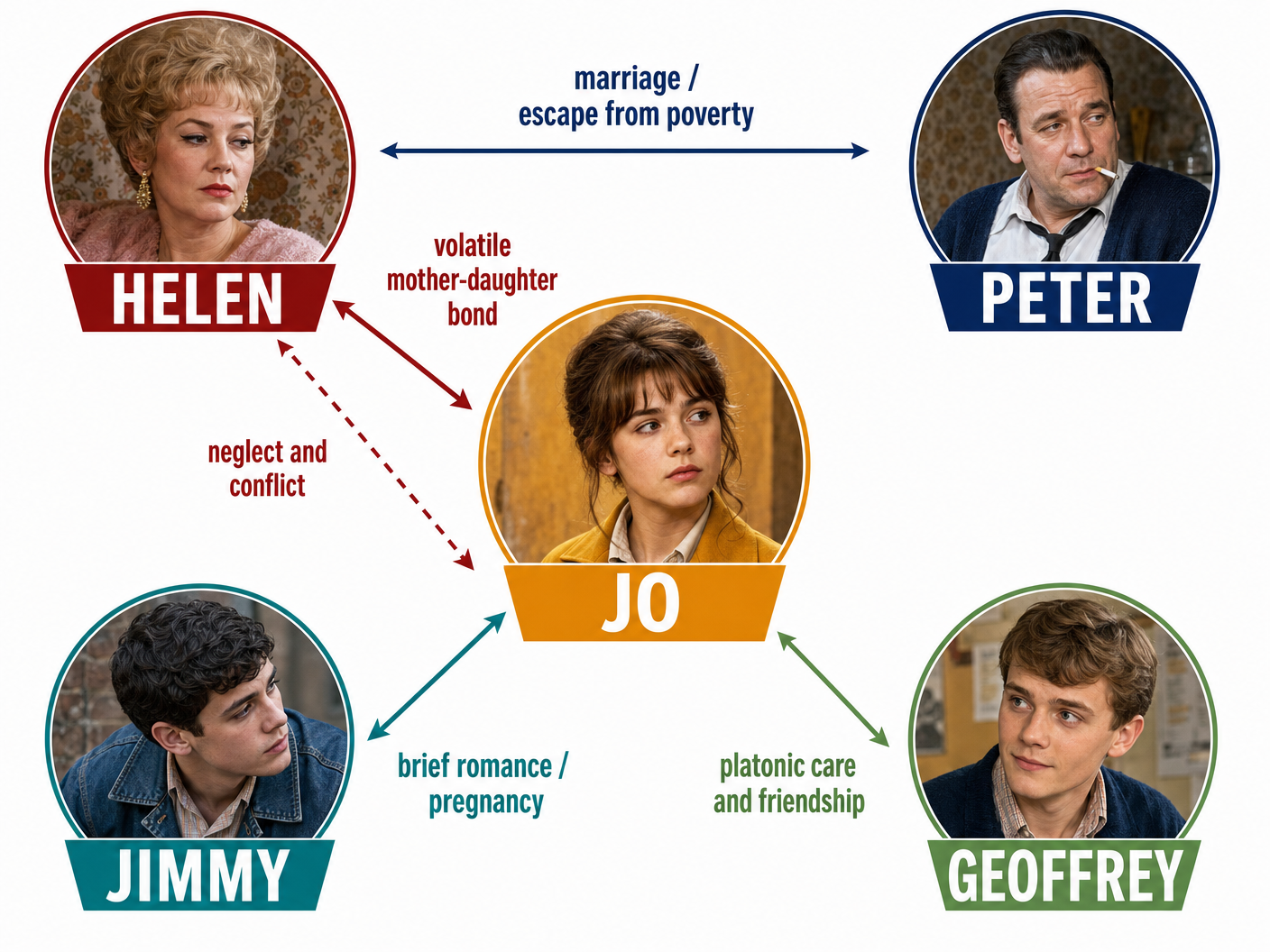
Jo
Role: The protagonist; a teenage girl navigating poverty, pregnancy, and a lack of parental care.
Key Traits: Cynical, vulnerable, fiercely independent, creative.
Character Arc: Jo moves from a dependent, argumentative daughter to an expectant mother trying to forge her own path, ultimately ending up isolated but resolute.
Essential Quotes:
- "I'm not getting married like you did."
- "I don't want to be a mother. I don't want to be a woman."
Helen
Role: Jo's mother; a "semi-whore" who prioritizes her own survival and pleasure over her daughter.
Key Traits: Selfish, pragmatic, vital, neglectful.
Character Arc: Helen abandons Jo for Peter's wealth, only to return when her marriage fails, attempting to reassert control but ultimately failing to provide genuine maternal care.
Essential Quotes:
- "I used to try to love you."
- "Have I ever laid claim to being a proper mother?"
Geoffrey
Role: Jo's friend and caretaker; a gay art student who provides the only genuine domestic stability in the play.
Key Traits: Nurturing, sensitive, marginalized, loyal.
Character Arc: Geoffrey finds purpose in caring for Jo but is ultimately forced out by Helen's aggressive re-entry, highlighting the vulnerability of marginalized individuals.
Essential Quotes:
- "You need somebody to love you."
- "I'd rather be dead than be like you." (To Helen)
Writer's Methods
- Naturalistic Dialogue: Delaney uses authentic, colloquial Northern dialect, which grounds the play in realism and contrasts with the polished accents typical of 1950s theatre.
- Brechtian Elements: The use of jazz music between scenes and characters occasionally addressing the audience directly breaks the "fourth wall," encouraging the audience to think critically about the social issues presented.
- Setting as Symbol: The "comfortless" flat is a constant visual reminder of entrapment and poverty.
- Cyclical Structure: The play begins and ends with Jo and Helen in the flat, suggesting the inescapable nature of their social class and circumstances.
Context
- Post-War Austerity: Despite the introduction of the Welfare State in 1948, many working-class families in the industrial North (like Salford) remained in deep poverty.
- The "Kitchen Sink" Drama: A Taste of Honey is a prime example of this movement, which focused on the gritty reality of working-class life rather than middle-class drawing rooms.
- 1950s Social Attitudes: Homosexuality was illegal in the UK until 1967, and interracial relationships faced severe prejudice. Delaney's sympathetic portrayal of Geoffrey and Jimmy was highly radical.
- Feminism: The play predates the second-wave feminist movement but deals heavily with female autonomy, marriage as an economic transaction, and the burden of motherhood.
Podcast
Listen to our comprehensive 10-minute revision podcast covering themes, context, and exam technique:
Visual Resources
2 diagrams and illustrations
Interactive Diagrams
1 interactive diagram to visualise key concepts
Conceptual Flow Outline
Jo's Character Arc and the Cyclical Structure of Entrapment
Worked Examples
2 detailed examples with solutions and examiner commentary
Practice Questions
Test your understanding — click to reveal model answers
How does Delaney present the character of Geoffrey in A Taste of Honey? (30 marks)
Hint: Consider his role as a surrogate mother, his marginalized status as a gay man in the 1950s, and how he acts as a foil to the other male characters.
Explore the significance of the setting in A Taste of Honey. (30 marks)
Hint: Don't just describe the flat. Explain what it symbolizes about class, poverty, and entrapment.
Starting with this extract (Act 1, Jimmy's proposal), explore how Delaney presents romantic relationships. (30 marks)
Hint: Contrast Jo's brief, naive romance with Jimmy against Helen's pragmatic, transactional marriage to Peter.
How does Delaney explore the theme of prejudice and marginalization? (30 marks)
Hint: Look at how society (often voiced through Helen) treats Jimmy (race) and Geoffrey (sexuality).