Eduqas · GCSE · English Literature
Course version: WJEC-GCSE-English-Literature · Version from Mar 2026
A Wife in London
Thomas Hardy's 'A Wife in London' is a quietly devastating exploration of the Boer War's impact on those left behind. Through a masterful two-part structure and haunting pathetic fallacy, it exposes the cruel irony of fate and the impersonal nature of modern warfare, making it a highly rewarding text for AO2 and AO3 analysis.
- 6 min read
- 1 worked example
- 4 practice questions
- 8 key terms
Check what you remember
Read the wording for your board, then hide it and explain Pathetic Fallacy in your own words. Rough notes are fine. This is a self-check, with no mark or grade.
Reference: Eduqas
When the weather or environment reflects the mood of the characters.
Study Notes
Overview
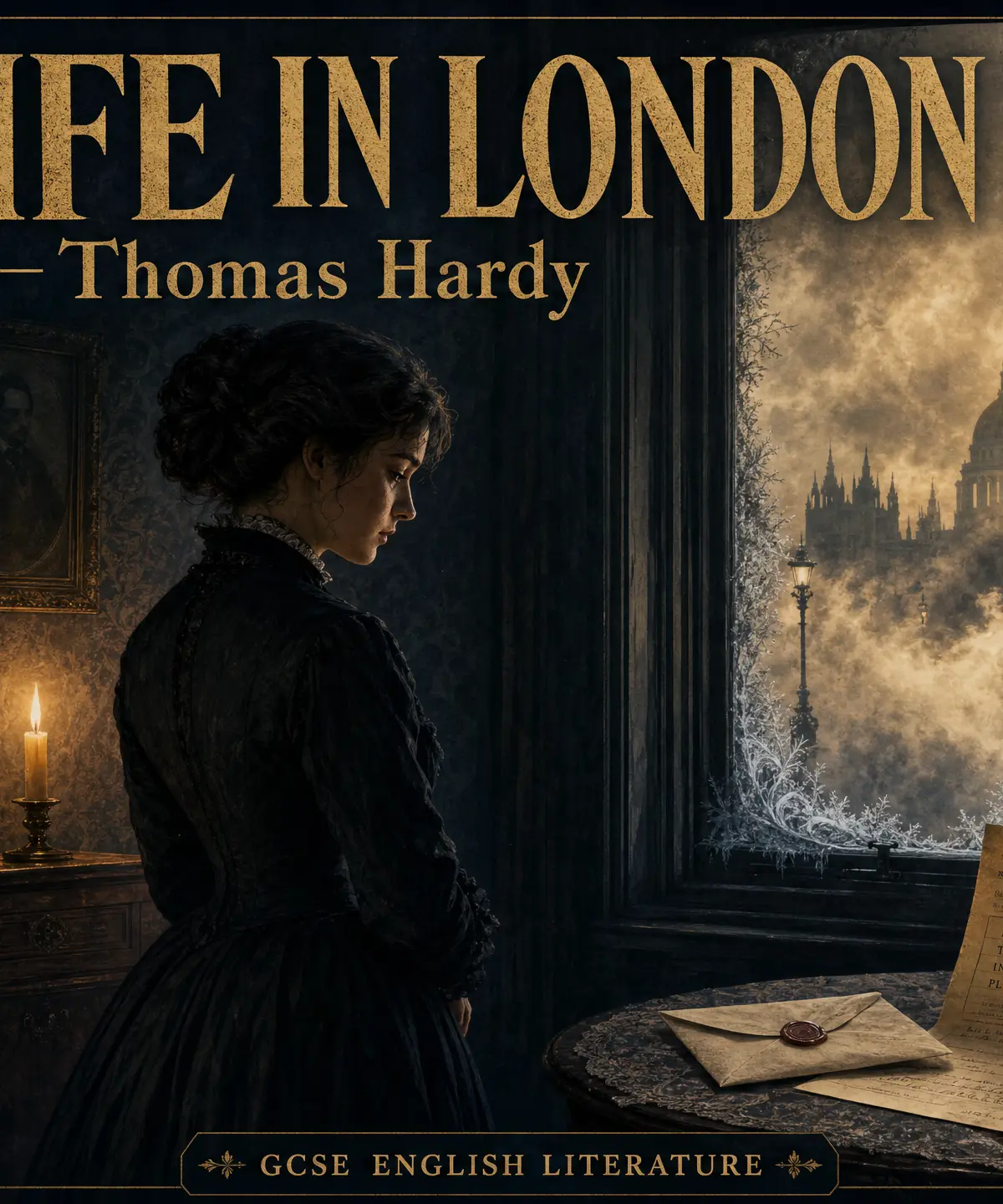
Thomas Hardy's 'A Wife in London' (1899) is a poignant monologue that captures the quiet devastation of the Boer War. Written at a time when the British public was deeply ambivalent about the conflict in South Africa, the poem focuses not on the battlefield, but on the domestic tragedy of a wife receiving news of her husband's death. Examiners consistently reward candidates who can perceptive analyse Hardy's use of pathetic fallacy (the 'tawny vapour'), his controlled, regular rhyme scheme which contrasts with the chaotic subject matter, and the tragic irony created by the poem's two-part structure. A top-tier response will seamlessly integrate the context of the Boer War, particularly the cruel gap between the speed of official telegrams and the slowness of personal letters.
Listen to our comprehensive revision podcast for an in-depth breakdown of the poem:
Plot/Content Overview
Part I: The TragedyA wife sits alone in her London home, surrounded by a thick, yellowish fog. A messenger arrives and hands her a telegram. The message is brief and impersonal: her husband has been killed in action in the Boer War.
Part II: The IronyThe following morning, the fog remains. The postman arrives and delivers a letter. It is from her husband, written before his death. The letter is full of hope, detailing his plans for their future and his anticipated return. The wife reads the hopeful words of a man she knows is already dead.
Themes
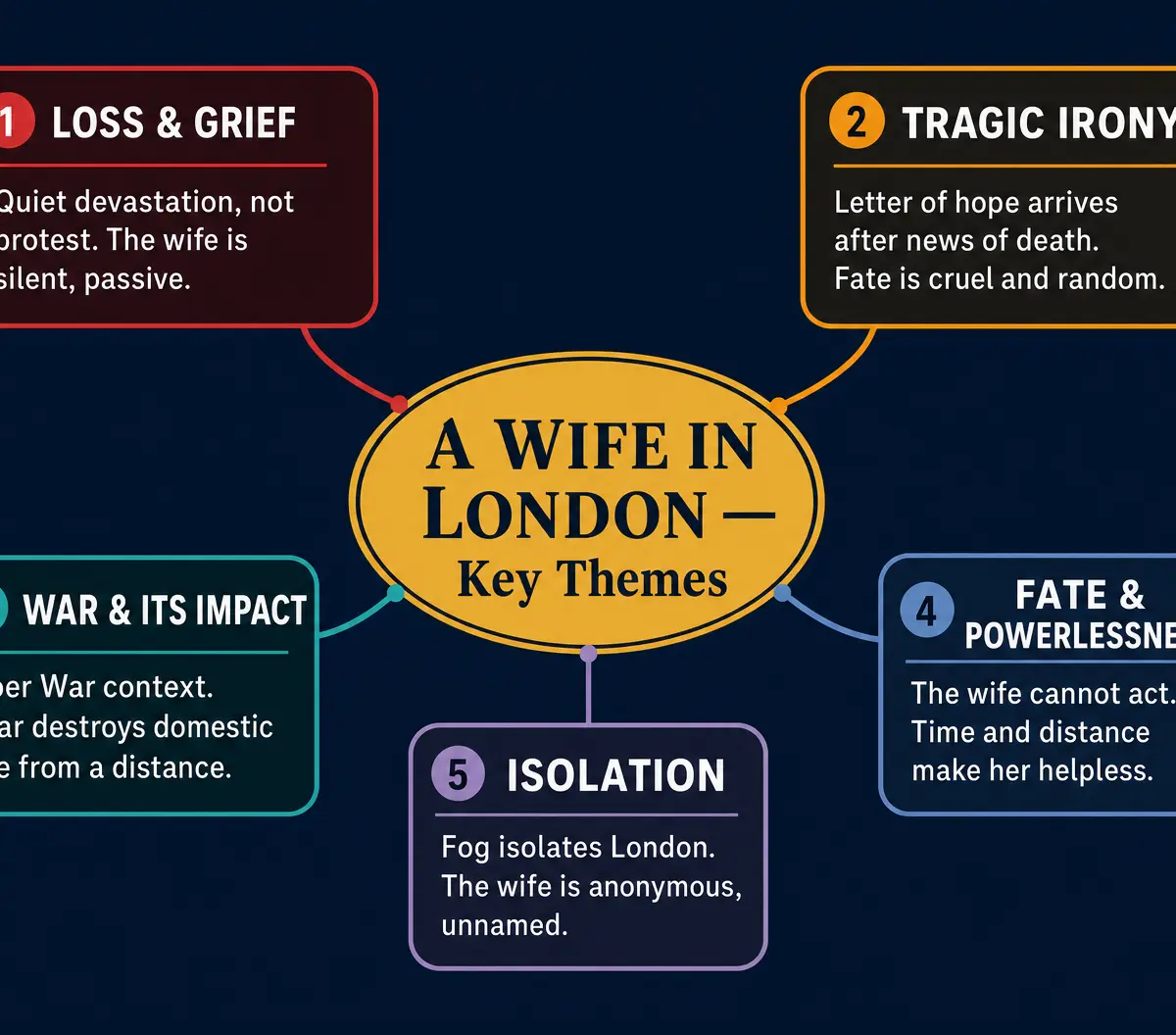
Theme 1: Tragic Irony and Fate
Hardy constructs the poem around a central, devastating irony: the arrival of hope after the certainty of death. The poem highlights the cruel randomness of fate and the powerlessness of individuals caught in the machinery of war.
Key Quotes:
- "He--has fallen--in the far South Land..." (Part I) - The fragmented syntax reflects the sudden, shocking nature of the news.
- "His hand, whom the worm now knows" (Part II) - A chilling juxtaposition. The physical hand that wrote the hopeful letter is now decaying, emphasizing the absolute finality of death against the enduring nature of his written words.
- "Page-full of his hoped return, / And of home-planned jaunts" (Part II) - The compound adjectives emphasize the shared, domestic future that has been abruptly cancelled by fate.
Theme 2: Isolation and Grief
The poem focuses on the quiet, isolating nature of grief. The wife's sorrow is not public or dramatic; it is domestic, silent, and deeply lonely.
Key Quotes:
- "She sits in the tawny vapour" (Part I) - The fog physically isolates her from the rest of London, acting as a metaphor for the obscuring, isolating nature of grief.
- "The street-lamp glimmers cold" (Part I) - Even the light offers no warmth or comfort, reflecting the cold reality of her situation.
- "A messenger's knock cracks smartly" (Part I) - The sharp, violent sound of the knock shatters the quiet isolation, bringing the outside world (and war) violently into the domestic space.
Theme 3: The Impersonal Nature of War
Hardy contrasts the vast, impersonal machinery of the state (represented by the telegram) with the intimate, human reality of the individuals involved (represented by the letter).
Key Quotes:
- "Flashes news is in her hand" (Part I) - The telegram is fast, modern, and utterly devoid of emotion. It reduces a human life to a brief 'flash' of information.
- "In the mild newest ink" (Part II) - The letter, in contrast, is described with sensory, almost tender language. It is a human artifact, arriving too late.
Character Analysis
The Wife
Role: The protagonist and focal point of the poem's emotional impact.
Key Traits: Passive, isolated, anonymous. She is defined entirely by her relationship to her husband and her reaction to the news.
Character Arc: She moves from isolated waiting (Part I) to sudden, shocking grief (Part I), to a state of profound, ironic devastation (Part II).
Essential Quotes:
- "She sits in the tawny vapour" - Establishes her passivity and isolation.
- "A Wife in London" (Title) - Her anonymity makes her a universal figure representing all grieving women.
Writer's Methods
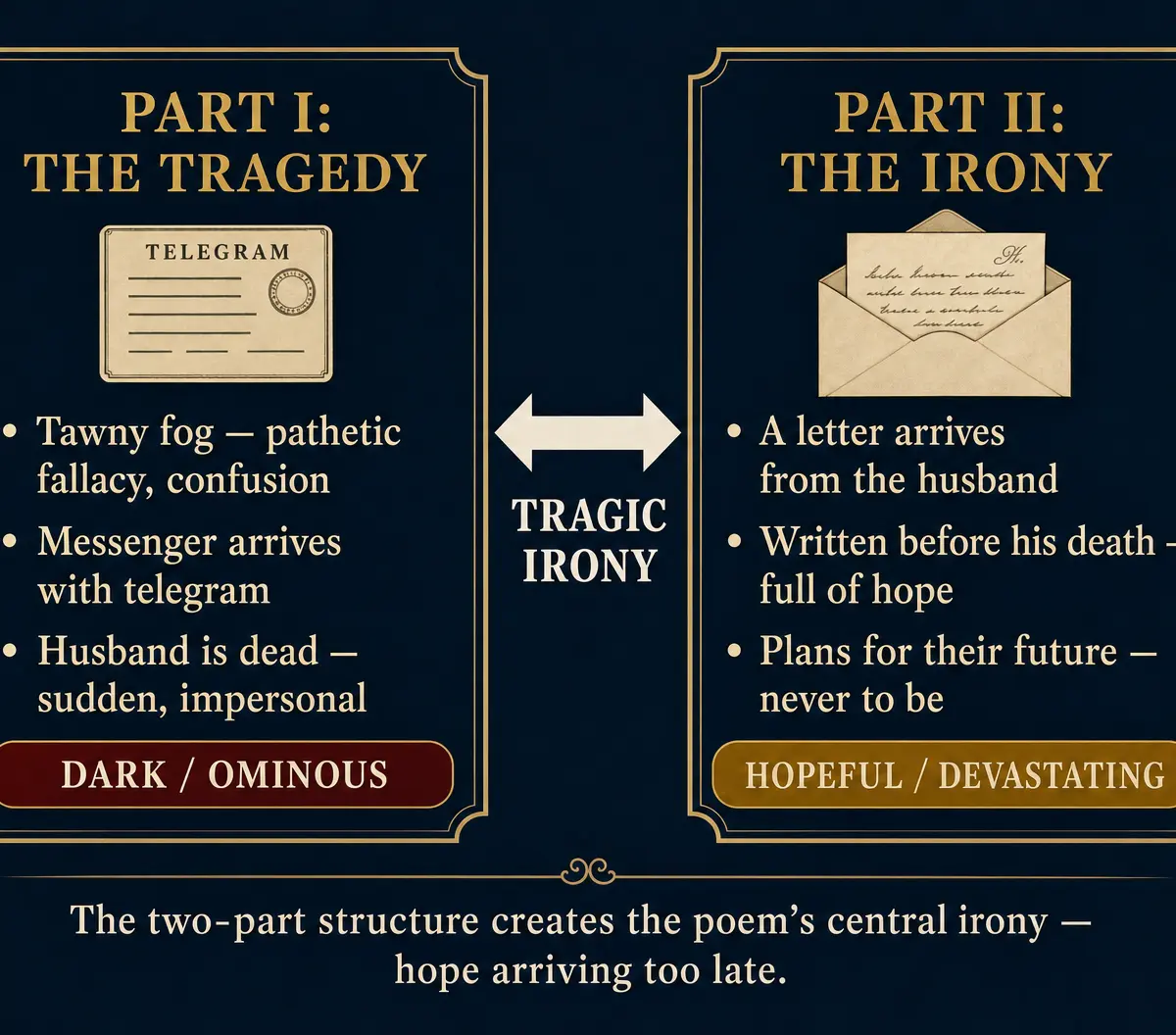
Structure: The poem is divided into two distinct halves: 'The Tragedy' and 'The Irony'. This structural division is the engine of the poem's meaning, creating the agonizing contrast between the arrival of the death notice and the arrival of the hopeful letter.
Form: Hardy uses a regular ABAB rhyme scheme and a consistent metre. This formal regularity is deeply ironic; it creates a sense of order and control that starkly contrasts with the chaotic, life-shattering news the wife receives. It mirrors her quiet, restrained grief.
Imagery (Pathetic Fallacy): The 'tawny vapour' (London fog) is used extensively in Part I. It is not just setting the scene; it reflects the wife's confusion, the obscuring of her future, and the general gloom of a nation at war.
Context
The Boer War (1899-1902): Fought in South Africa, this war was controversial in Britain. It was the first war where the telegraph played a major role in reporting casualties, meaning families often found out about deaths before receiving final letters. This technological gap is the literal foundation of the poem's irony.
Victorian Mourning: The poem taps into the strict, often isolating conventions of Victorian mourning, emphasizing the wife's solitary suffering.
Hardy's View of War: Hardy was deeply critical of the Boer War, viewing it as a tragic waste of human life. The poem reflects his belief in a cruel, indifferent universe where human hopes are easily crushed by fate.
Visual Resources
2 diagrams and illustrations
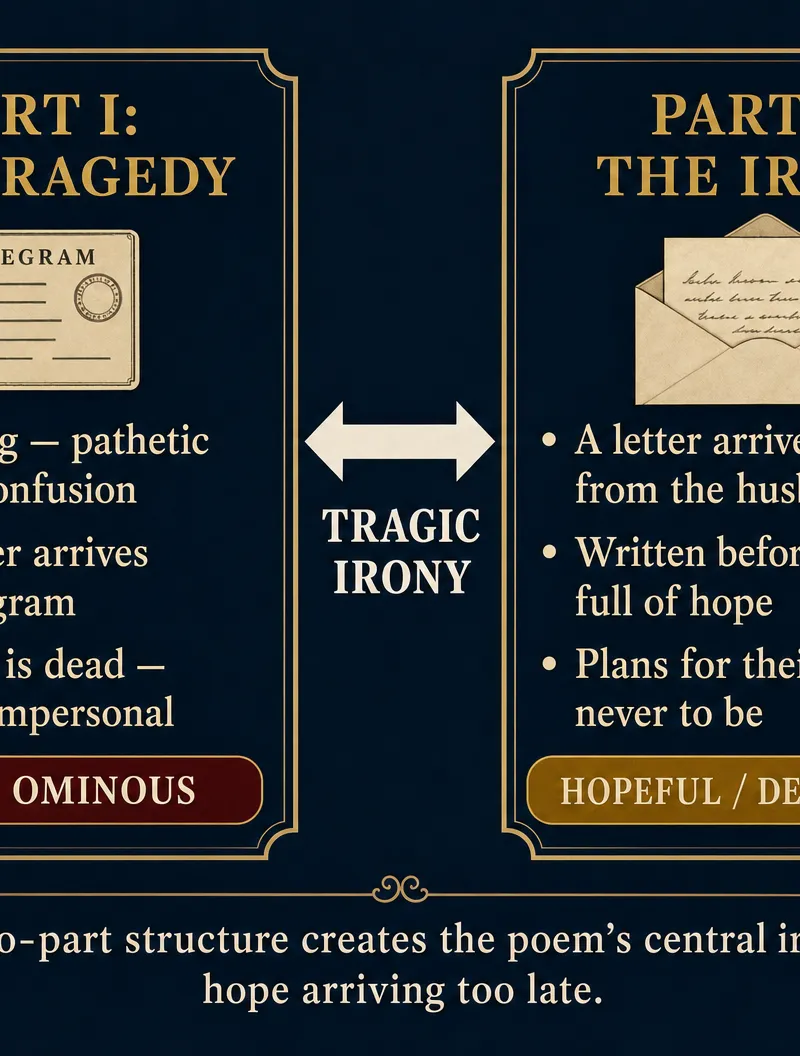
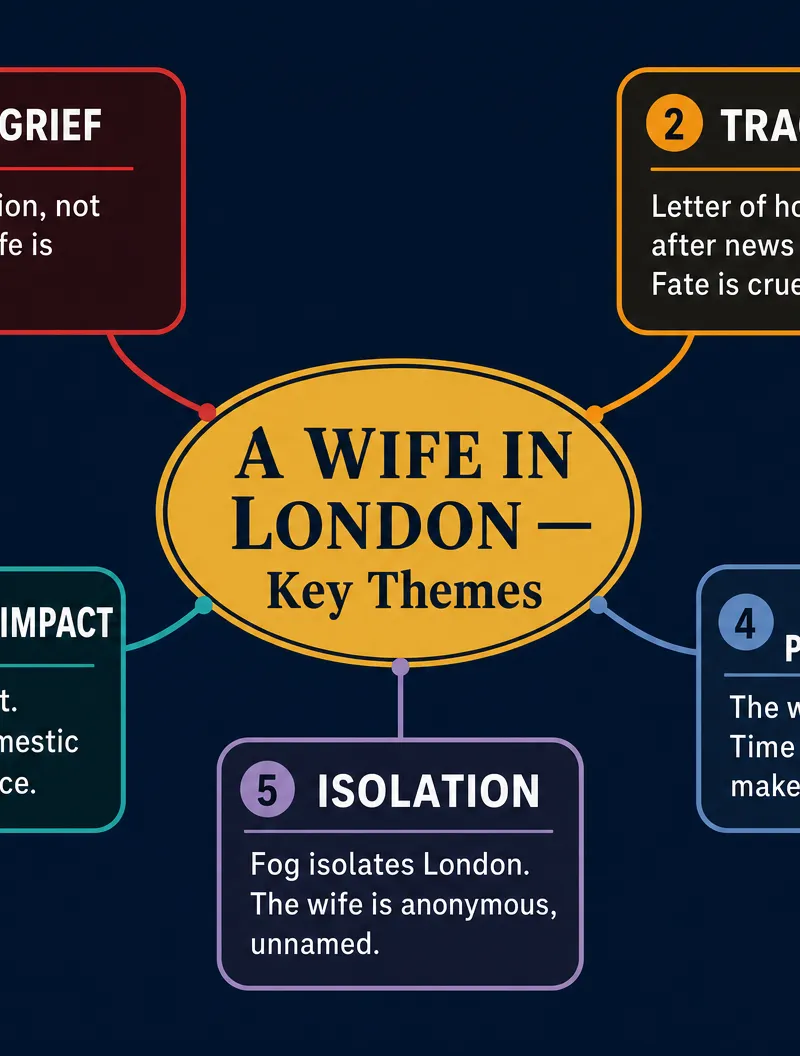
Interactive Diagrams
1 interactive diagram to visualise key concepts
Conceptual Flow Outline
The narrative structure and development of tragic irony in 'A Wife in London'
Worked Examples
1 worked example — open one to explore the question and available guidance.
Practice Questions
Try the question, then reveal an answer plan or example response
Explore how Hardy presents the theme of isolation in 'A Wife in London'. (30 marks)
Hint: Consider physical isolation (the fog, the domestic setting) and emotional isolation (the impersonal telegram, the anonymity of the wife).
Compare how poets present the reality of conflict in 'A Wife in London' and one other poem from your anthology. (30 marks)
Hint: Focus on the 'reality'—is it the physical reality of the battlefield, or the psychological reality of the home front?
How does Hardy use structure to create impact in 'A Wife in London'? (15 marks)
Hint: You must discuss the division into Part I and Part II, and the timing of the letter's arrival.
Explore the significance of the poem's title, 'A Wife in London'. (15 marks)
Hint: Think about the words 'A' (indefinite article) and 'Wife' (defined by relationship).
Exam technique
How to turn what you know into marks
How to approach the question
Deconstruct the prompt: Identify the theme (e.g., 'loss'). Choose your second poem carefully—ensure you have strong comparative points on both theme AND methods (form/structure).
How to structure your answer
Use integrated comparative paragraphs. Do not write an essay on Poem A, then an essay on Poem B. Instead: Point about theme -> Evidence/Analysis Poem A -> Comparative Link -> Evidence/Analysis Poem B -> Context integration.
Timing
For a 30-mark poetry comparison, spend 5-7 minutes planning your comparative points, and 40 minutes writing.
Common pitfalls
- Getting the sequence of events wrong (thinking the letter arrived first).
- Treating it as a generic war poem and ignoring the specific Boer War context (telegrams vs. letters).
- Feature-spotting the rhyme scheme without explaining that it reflects restrained grief.
What the command words want
- Compare
- Use comparative connectives constantly ('Similarly', 'Conversely', 'While Hardy uses X, Weir employs Y').
- Explore the significance
- Look for deeper meanings. Why is she unnamed? Why is the fog 'tawny'? Go beyond literal interpretation.
- How does the poet present
- Focus heavily on AO2—writer's methods. Every paragraph must discuss a language, form, or structural choice.
Test your understanding of A Wife in London
Active recall beats re-reading. Take an instant quiz now to test what you’ve learned and lock it into long-term memory.
A week of Premium from your first lesson · Then the free plan continues · No card, no charge