Eduqas · GCSE · English Literature
Course version: WJEC-GCSE-English-Literature · Version from Mar 2026
An Inspector Calls
J.B. Priestley's 'An Inspector Calls' is a gripping, suspenseful morality play that unpeels the dark secrets of a wealthy Edwardian family. Beyond the thrilling detective narrative, it offers a blistering critique of class, privilege, and the necessity of social responsibility—making it an incredibly rewarding text for higher-level exam analysis.
- 6 min read
- 2 worked examples
- 4 practice questions
- 8 key terms
Check what you remember
Read the wording for your board, then hide it and explain Didactic in your own words. Rough notes are fine. This is a self-check, with no mark or grade.
Reference: Eduqas
Intended to teach, particularly in having moral instruction as an ulterior motive.
Study Notes
Overview
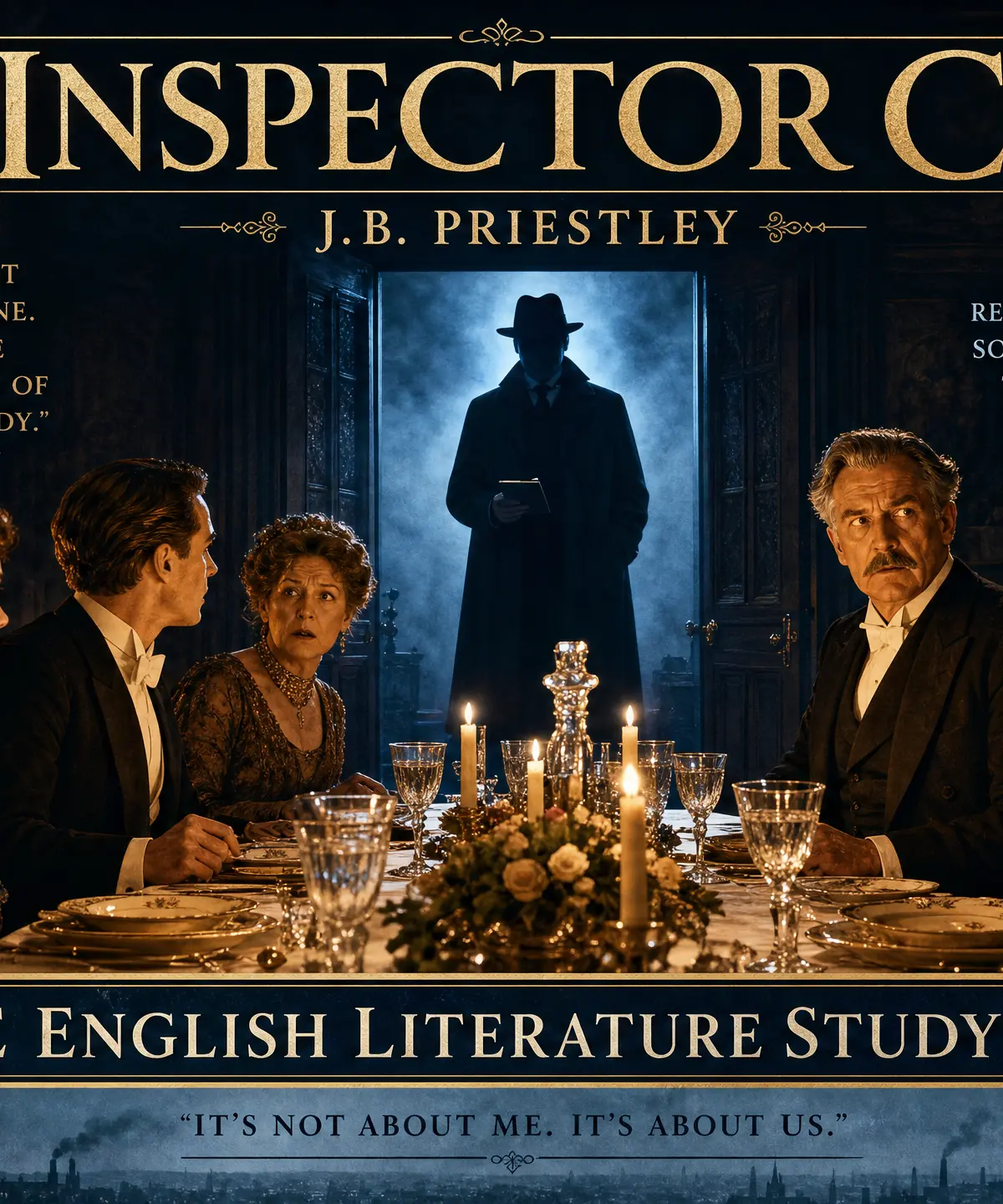
J.B. Priestley's An Inspector Calls is a staple of GCSE English Literature because it perfectly balances a compelling narrative with profound social critique. Set in 1912 but written in 1945, the play uses this dual time-frame to create powerful dramatic irony. Examiners are looking for candidates who can look beyond the surface-level 'whodunit' plot to understand the play as a didactic vehicle for Priestley's socialist ideology. Top-band responses consistently explore how Priestley manipulates the audience's understanding of time, responsibility, and guilt to argue that 'we are all members of one body'.
Plot/Content Overview
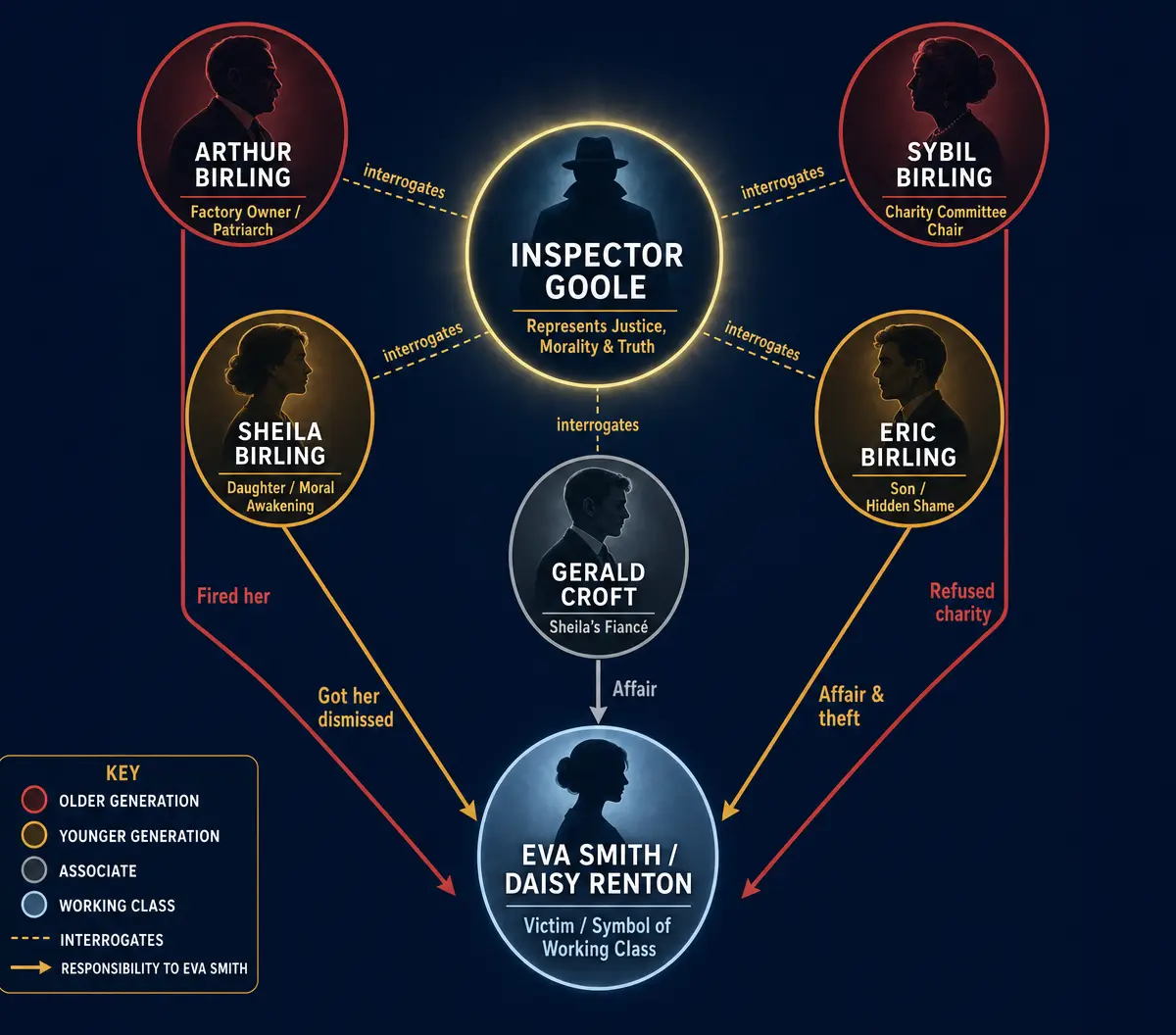
Act 1: The Birling family is celebrating the engagement of Sheila Birling to Gerald Croft. Arthur Birling delivers pompous speeches about capitalist individualism and the impossibility of war. The mood is shattered by the arrival of Inspector Goole, who announces that a young woman, Eva Smith, has died by suicide. The Inspector interrogates Arthur, who admits to firing Eva for leading a strike, and Sheila, who admits to having her fired from a shop out of jealousy.
Act 2: The interrogation continues. Gerald confesses to having an affair with Eva (under the name Daisy Renton) and abandoning her. Sybil Birling is then questioned; as chair of a charity committee, she coldly refused help to the pregnant and destitute Eva. Sybil arrogantly shifts all blame to the father of the child, unknowingly condemning her own son.
Act 3: Eric confesses that he forced himself on Eva, got her pregnant, and stole money from his father's business to support her. The family is fractured. The Inspector delivers a final, damning speech on social responsibility before leaving. Gerald returns with evidence that Goole is not a real police officer, and there is no dead girl at the infirmary. The older generation celebrates this 'hoax', while Eric and Sheila remain traumatised. Suddenly, the phone rings: a girl has just died on her way to the infirmary, and a real police inspector is on his way.
Themes
Theme 1: Social Responsibility
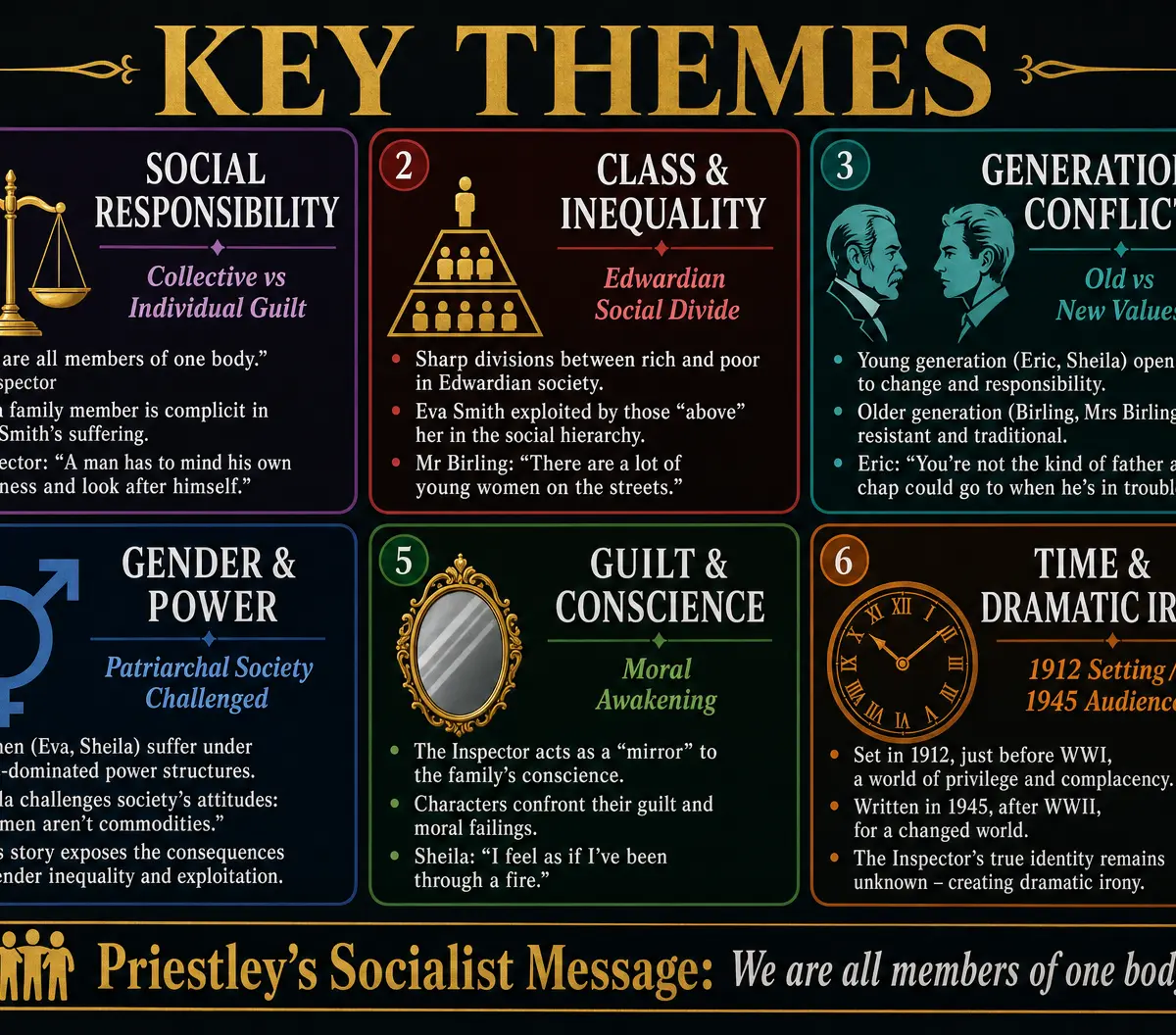
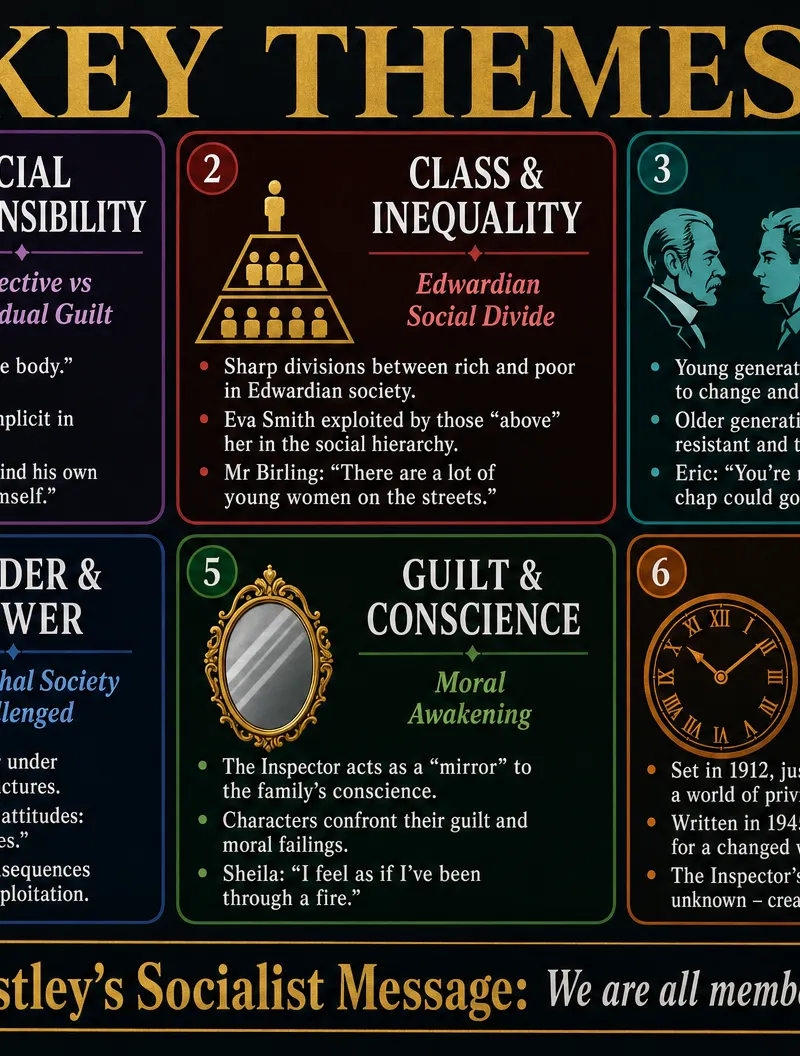
This is the core message of the play. Priestley uses the Birling family to represent the selfish individualism of capitalism, contrasting it with the Inspector's socialist message of collective responsibility. The play suggests that ignoring our duty to others leads to societal collapse (symbolised by the World Wars).
Key Quotes:
- "a man has to mind his own business and look after himself and his own" (Act 1) - Birling's capitalist philosophy, which Priestley actively undermines.
- "We are members of one body. We are responsible for each other." (Act 3) - The Inspector's final speech, acting as a mouthpiece for Priestley's own socialist views.
Theme 2: Generational Conflict
The play explores the divide between the older, inflexible generation (Arthur and Sybil) who refuse to change, and the younger generation (Sheila and Eric) who are capable of moral awakening. This reflects Priestley's hope that post-war youth could build a fairer society.
Key Quotes:
- "the famous younger generation who know it all. And they can't even take a joke-" (Act 3) - Birling's dismissal of his children, interrupted ironically by the final phone call.
- "I feel as if I've been through a fire." (Act 3) - Sheila's metaphor of purification, showing her permanent transformation.
Theme 3: Class and Inequality
Priestley exposes the rigid class system of Edwardian England, showing how the wealthy exploit the working class with impunity. Eva Smith is a symbol for the entire oppressed working class.
Key Quotes:
- "If you don't come down sharply on some of these people, they'd soon be asking for the earth." (Act 1) - Birling's view of the working class as a threat to be managed.
- "But these girls aren't cheap labour - they're people." (Act 1) - Sheila's early recognition of humanity beyond class labels.
Character Analysis
Inspector Goole
Role: The catalyst for the play's events; a moral conscience; Priestley's mouthpiece.
Key Traits: Omniscient, commanding, relentless, immune to class intimidation.
Character Arc: He does not change; rather, he forces change in others. He acts as a mirror to the Birlings' guilt.
Essential Quotes:
- "He creates at once an impression of massiveness, solidity and purposefulness."
- "If men will not learn that lesson, then they will be taught it in fire and blood and anguish."
Arthur Birling
Role: The embodiment of capitalist greed and Edwardian complacency.
Key Traits: Pompous, self-centred, obsessed with status and public image.
Character Arc: He remains static, learning nothing from the Inspector's visit, caring only about avoiding a "public scandal".
Essential Quotes:
- "unsinkable, absolutely unsinkable"
- "I can't accept any responsibility."
Sheila Birling
Role: Represents the hope for the future and the capacity for moral growth.
Key Traits: Initially superficial and materialistic, but becomes perceptive, empathetic, and courageous.
Character Arc: Moves from naive complicity to profound moral awakening, ultimately aligning with the Inspector.
Essential Quotes:
- "Oh - how horrible! Was it an accident?"
- "It frightens me the way you talk."
Writer's Methods
Dramatic Irony: Priestley relies heavily on dramatic irony, particularly in Birling's Act 1 speeches. The 1945 audience knows that the Titanic sank and WWI occurred, immediately establishing Birling as an unreliable, foolish figure.
The Unseen Character: Eva Smith never appears on stage. This absence is a powerful structural device; it reflects how the working class are rendered invisible and voiceless by the wealthy.
Cyclical Structure: The play ends exactly where it began—with the prospect of an Inspector arriving to investigate a suicide. This structure implies that until society learns its lesson, history will repeat itself (a warning to the 1945 audience).
Context
1912 vs 1945: Set just before WWI (1912), when society was strictly divided by class and gender. Written just after WWII (1945), when the rigid class system had been broken down by the war effort, and the Labour party had just won a landslide victory on a platform of social welfare. Priestley uses the play to urge his 1945 audience not to return to the selfish individualism of 1912.
Audio Revision
Listen to our comprehensive 10-minute revision podcast covering all key themes, characters, and exam strategies:
Visual Resources
2 diagrams and illustrations
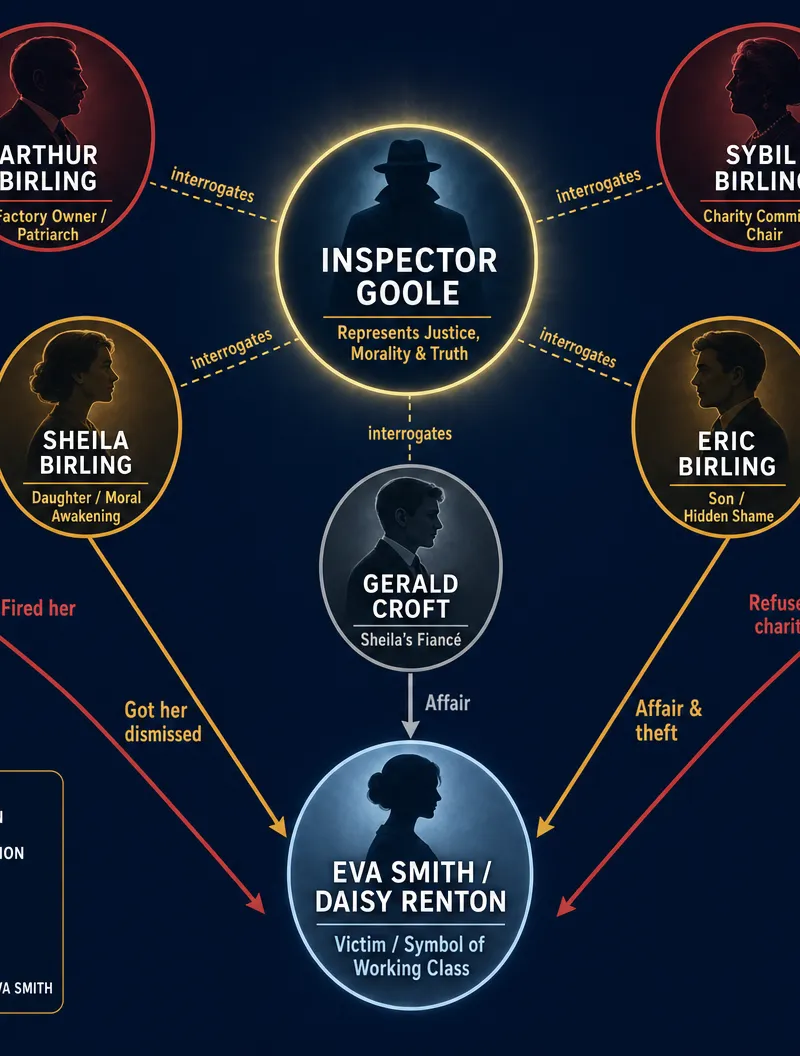
Interactive Diagrams
1 interactive diagram to visualise key concepts
Conceptual Flow Outline
The dramatic structure of An Inspector Calls, building tension through a series of false climaxes.
Worked Examples
2 worked examples — open one to explore the question and available guidance.
Practice Questions
Try the question, then reveal an answer plan or example response
How does Priestley present the differences between the older and younger generations in An Inspector Calls? (30 marks + 4 AO4)
Hint: Contrast Arthur/Sybil's refusal to change with Sheila/Eric's moral awakening. Link this to Priestley's hope for the post-war 1945 audience.
Explore the function of the Inspector in the play. (30 marks + 4 AO4)
Hint: Do not treat him as a real policeman. Discuss him as a dramatic device, a moral conscience, and Priestley's mouthpiece.
How does Priestley use the character of Eva Smith to explore ideas about society? (30 marks + 4 AO4)
Hint: Remember she never appears on stage. She is a symbol of the exploited working class and the vulnerability of women in 1912.
How is the theme of guilt presented in An Inspector Calls? (30 marks + 4 AO4)
Hint: Look at who accepts guilt (Sheila, Eric) and who deflects it (Arthur, Sybil, Gerald).
Exam technique
How to turn what you know into marks
How to approach the question
Deconstruct the question: Identify the focus (character or theme) and the command word (usually 'How'). Plan 3-4 thematic points that track the character/theme from the beginning, middle, to the end of the play.
How to structure your answer
Conceptualised Topic Sentence → Embedded Evidence → Method Analysis (AO2) → Contextual Link (AO3) → Link back to question.
Timing
For a 30+4 mark question, spend 5 minutes planning, 40 minutes writing, and 5 minutes proofreading for SPaG.
Common pitfalls
- Treating the Inspector as a real police officer instead of a dramatic device/symbol.
- Telling the story chronologically instead of arguing a thematic point.
- Adding historical context at the end of a paragraph that doesn't link to the quote you just analysed.
What the command words want
- Explore
- Look at multiple facets. If exploring a character, look at their flaws, their growth, and their symbolic function.
- How does... present
- Focus heavily on AO2 (methods). Write about 'Priestley constructs', 'Priestley uses', 'Through the character of X, Priestley highlights...'
- Starting with this extract
- Spend about 1/3 of your essay closely analysing the language in the extract, then 2/3 linking those ideas to the rest of the play.
Watch or listen (optional)
Test your understanding of An Inspector Calls
Active recall beats re-reading. Take an instant quiz now to test what you’ve learned and lock it into long-term memory.
7 days Premium · Then the free plan continues · No card, no charge