Hawk Roosting
'Hawk Roosting' is a chilling dramatic monologue offering a stark, unsentimental glimpse into the mind of an apex predator. It is highly rewarding to study because Hughes’s masterful use of form and language allows for sophisticated, multi-layered interpretations—from literal observations of nature to powerful allegories of human tyranny.
Study Notes
Overview
'Hawk Roosting' by Ted Hughes is a key text in the GCSE English Literature poetry anthology. Written as a dramatic monologue, the poem places the reader directly inside the mind of a hawk resting at the top of a wood. However, this is not a romanticised view of nature. Hughes presents a creature of absolute arrogance, convinced of its own perfection and divine right to kill. Examiners highly reward candidates who can move beyond a literal summary to analyse how Hughes uses language, structure, and form to construct this chilling persona. Furthermore, top-tier responses often explore alternative interpretations, such as reading the hawk as a metaphor for human hubris, dictatorship, or the amoral forces of the natural world.
Listen to the comprehensive podcast guide below for a deep dive into the poem:
Plot/Content Overview
- Stanza 1: The hawk sits at the top of the wood, its eyes closed, resting. It declares that it is not plagued by falsifying dreams; even in sleep, it rehearses perfect kills.
- Stanza 2: The hawk praises its own physical perfection, claiming that the entirety of Creation was required to produce its "hooked head and hooked feet."
- Stanza 3: The hawk asserts its dominance over its environment. It views the high trees, the air's buoyancy, and the sun's rays as existing solely for its convenience.
- Stanza 4: The hawk describes its absolute authority. It flies up and revolves the world slowly, claiming ownership over everything it sees: "I kill where I please because it is all mine."
- Stanza 5: The hawk discusses its method of killing with chilling detachment. It rejects sophisticated arguments, stating simply: "My manners are tearing off heads."
- Stanza 6: The poem concludes with a declaration of permanence. The hawk states that nothing has changed since it began, and it intends to "keep things like this."
Themes
Theme 1: Power and Dominance
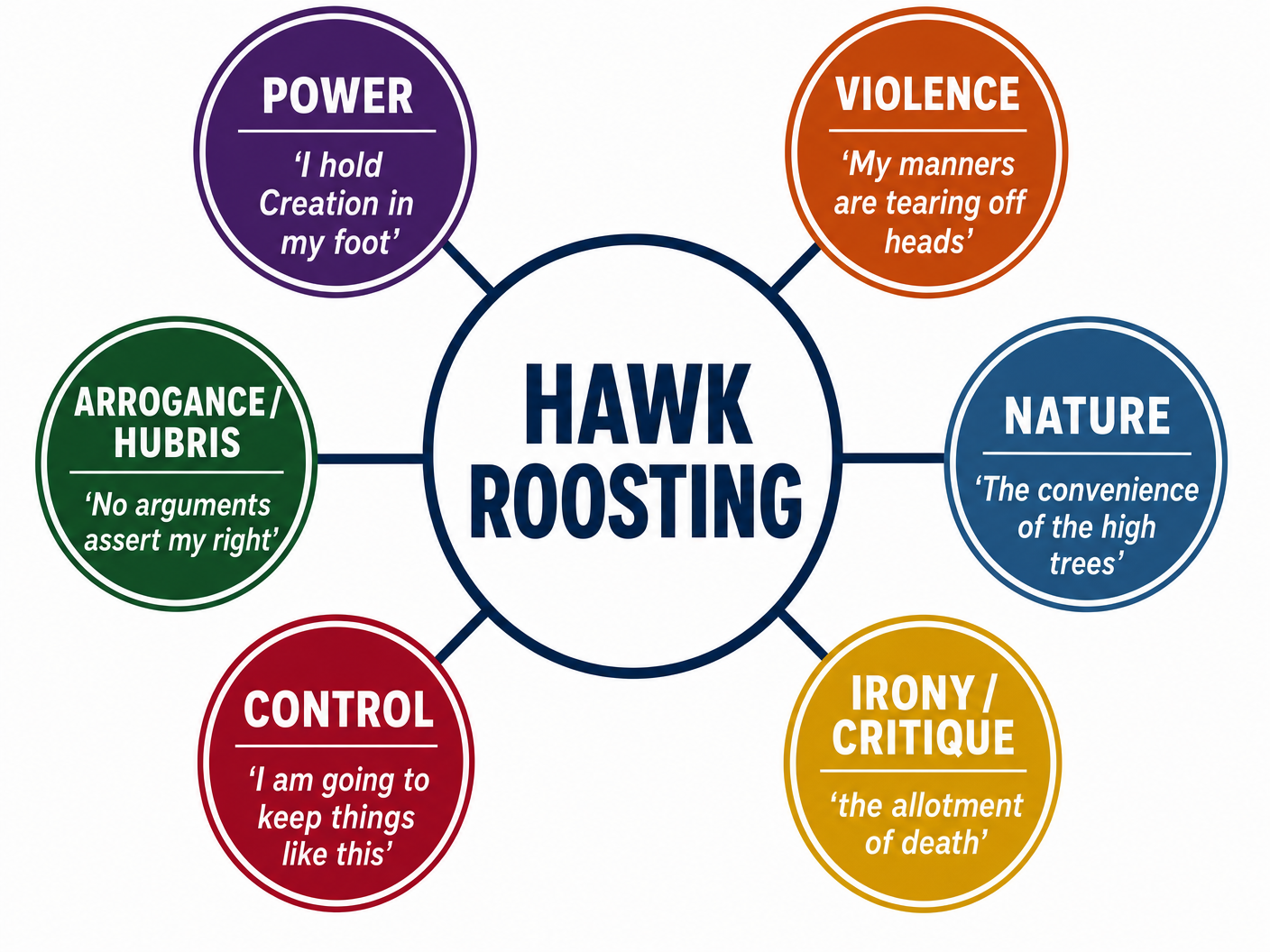
The most prominent theme is the hawk's absolute, unyielding power. The hawk views itself as the apex of existence, holding power not just over other animals, but over the universe itself.
Key Quotes:
- "I hold Creation in my foot" (Stanza 2) - The capitalisation of 'Creation' elevates the hawk's power to a god-like status. The physical act of gripping the branch becomes a metaphor for controlling the universe.
- "the earth's face upward for my inspection" (Stanza 3) - Personification of the earth. The earth is subjugated, looking up to the hawk as a subordinate would to a ruler.
Theme 2: Violence and Death
Hughes presents violence not as a passionate or chaotic act, but as a cold, calculated, and necessary function of the hawk's existence.
Key Quotes:
- "the allotment of death" (Stanza 5) - The noun 'allotment' suggests distribution, measurement, and administration. The hawk views killing as a routine, almost bureaucratic task.
- "My manners are tearing off heads" (Stanza 5) - A dark juxtaposition. 'Manners' implies civilised, polite society, which is violently contrasted with the brutal reality of decapitation.
Theme 3: Arrogance and Hubris
The hawk possesses a terrifying self-belief. It requires no justification for its actions and recognises no higher authority.
Key Quotes:
- "It took the whole of Creation / To produce my foot, my each feather" (Stanza 2) - The ultimate expression of ego. The hawk believes the universe's sole purpose was its own evolution.
- "No arguments assert my right" (Stanza 5) - The hawk rejects human concepts of morality, philosophy, or legal justification. Its power is its right.
Character Analysis
The Hawk (The Persona)
Role: The sole speaker and subject of the dramatic monologue.
Key Traits:
- Arrogant: Believes it is the pinnacle of creation.
- Unsentimental: Views the world purely in terms of its own survival and dominance.
- Authoritarian: Rejects any questioning of its authority.
Essential Quotes:
- "I sit in the top of the wood, my eyes closed."
- "I kill where I please because it is all mine."
- "I am going to keep things like this."
Writer's Methods
Form (Dramatic Monologue):
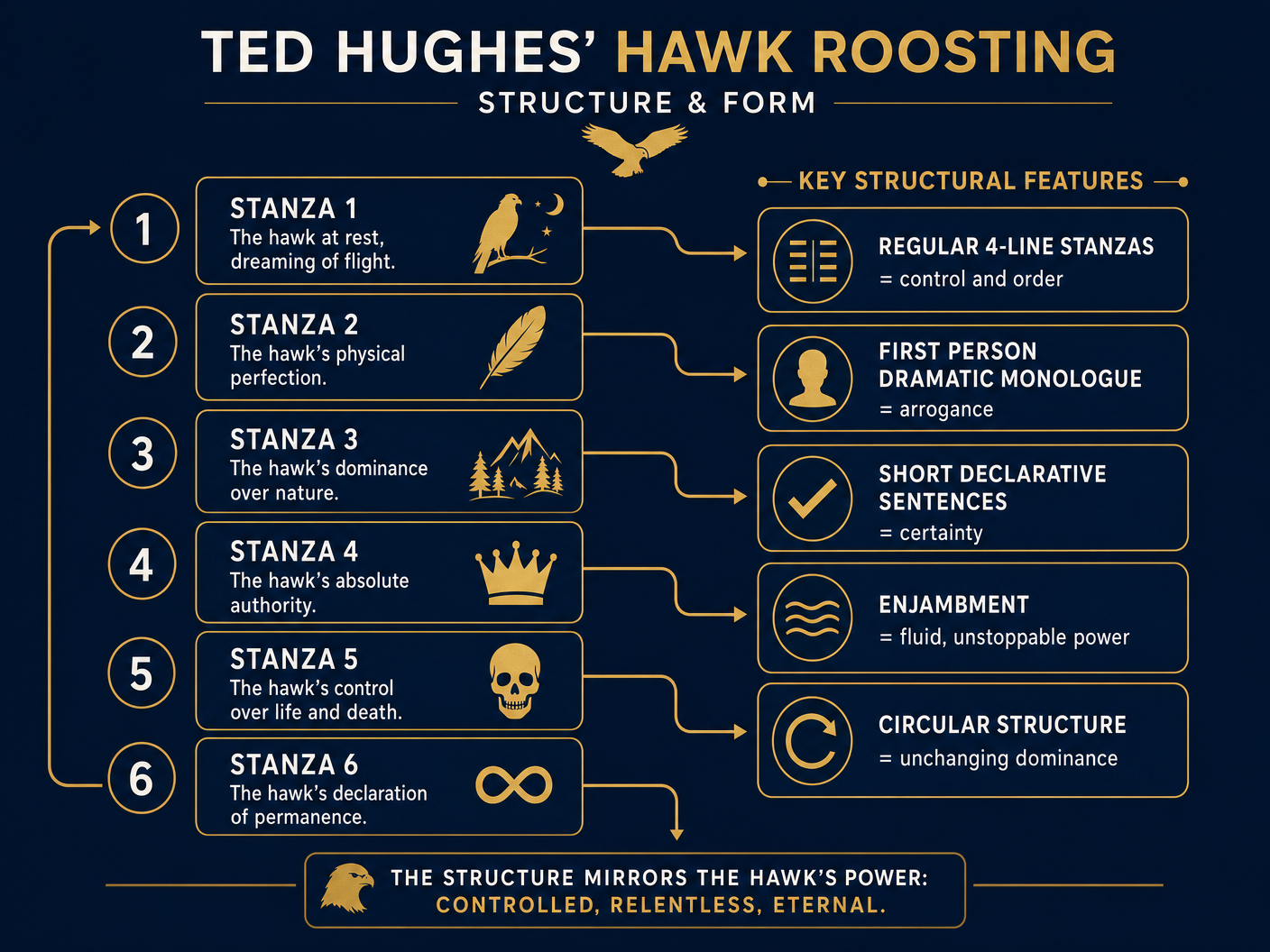
By writing in the first person ("I sit", "my eyes"), Hughes forces the reader to inhabit the hawk's mindset. This creates an uncomfortable intimacy with a predator. The monologue form allows the hawk's arrogance to go unchallenged within the text itself.
Structure (Regular Stanzas):
The poem consists of six regular, four-line stanzas. This visual and structural rigidity on the page mirrors the hawk's desire for control and its belief in a fixed, unchanging world order. The circularity of the poem—starting with the hawk resting and ending with its declaration of permanence—reinforces this sense of inescapable control.
Language (Declarative Sentences & Enjambment):
Hughes uses short, declarative sentences ("It is all mine.", "Nothing has changed since I began.") to convey the hawk's absolute certainty. There is no room for doubt. However, he frequently uses enjambment (lines flowing into the next without punctuation), which creates a sense of continuous, unstoppable movement, much like the hawk's power.
Context
Ted Hughes and Nature:
Hughes grew up in rural Yorkshire and had a lifelong fascination with animals and the natural world. Unlike romantic poets (like Wordsworth or Keats) who often saw nature as a source of moral guidance or spiritual comfort, Hughes often depicted nature as a space of raw, amoral, primal energy—"nature, red in tooth and claw."
Alternative Interpretations (Human Tyranny):
While Hughes himself often insisted the poem was simply about a hawk, many critics read it as an allegory for human dictatorship. Written in 1959, in the aftermath of WWII and the rise of totalitarian regimes, the hawk's rhetoric—rejecting arguments, claiming absolute right, controlling life and death—bears a chilling resemblance to fascist ideology. Examiners highly reward candidates who can explore this dual interpretation.
Worked Examples
2 detailed examples with solutions and examiner commentary
Practice Questions
Test your understanding — click to reveal model answers
Compare how poets present ideas about power in 'Hawk Roosting' and one other poem from your anthology.
Hint: Consider 'Ozymandias' (power of nature vs human power), 'My Last Duchess' (arrogance and control), or 'London' (institutional power).
Explore how Hughes presents the hawk as an arrogant character. Support your ideas with details from the poem.
Hint: Look closely at Stanza 2 (Creation) and Stanza 5 (arguments). Focus on the use of pronouns.
How does the structure and form of 'Hawk Roosting' contribute to its meaning?
Hint: This is a pure AO2 question. You must talk about the stanzas, the sentences, the enjambment, and the dramatic monologue.
To what extent can 'Hawk Roosting' be read as a political poem about human dictators?
Hint: Focus on the vocabulary the hawk uses that seems unnatural for a bird ('arguments', 'allotment', 'manners').