Henry V
Henry V is a thrilling exploration of leadership, war, and the performance of power. It challenges students to look beyond patriotic heroism and analyse the moral complexities of a king who uses brilliant rhetoric to unite a nation while making ruthless decisions on the battlefield.
Study Notes
Overview
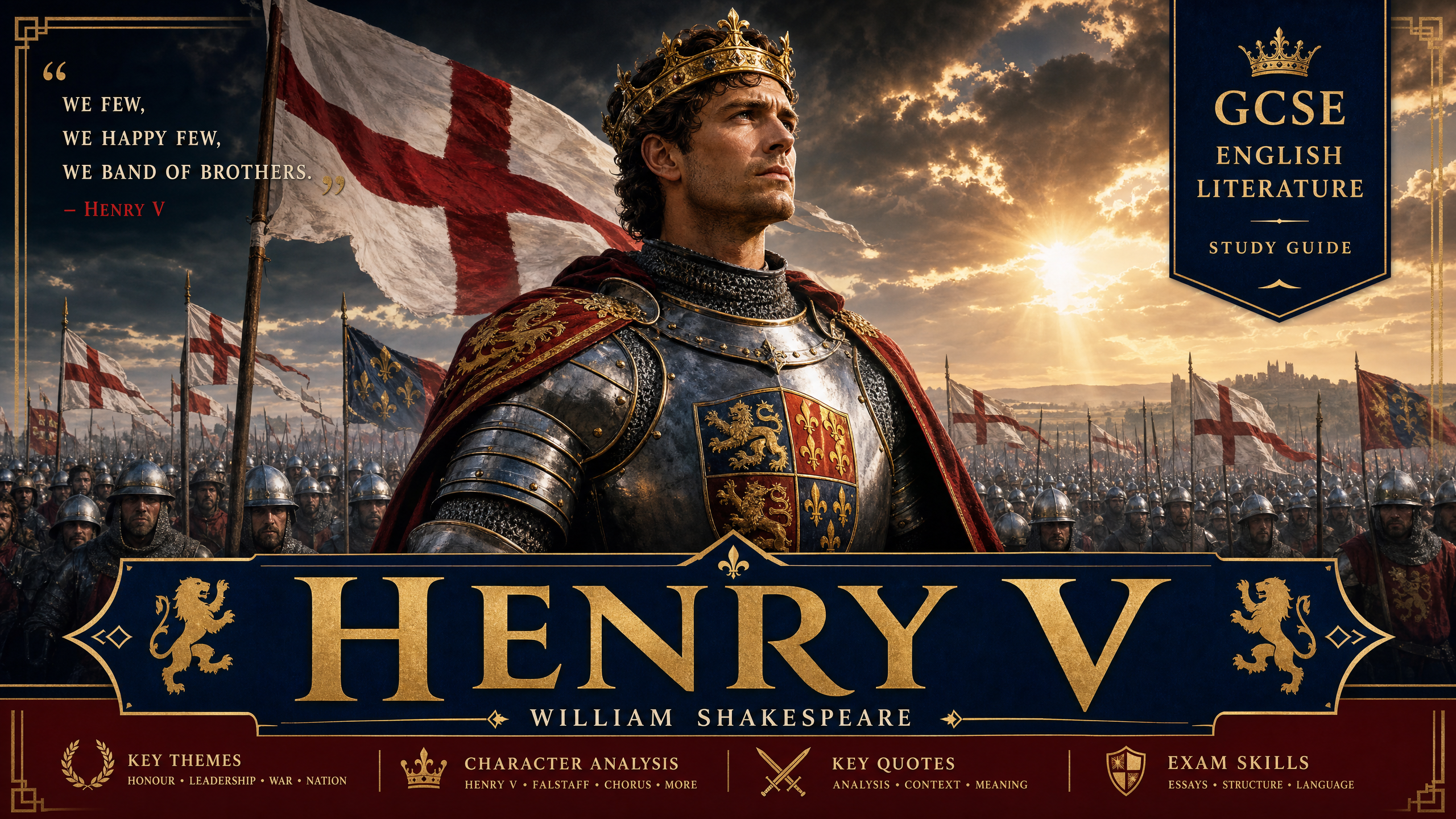
Shakespeare's Henry V (c. 1599) is the final play in his second tetralogy, chronicling the transformation of a wayward prince into a charismatic, yet morally ambiguous, warrior-king. For GCSE candidates, the key to top marks lies in recognising that this is not a simple patriotic celebration. Examiners reward students who can analyse how Shakespeare presents Henry as a masterful performer of kingship—a leader who uses brilliant rhetoric to inspire his men, while also displaying a ruthless Machiavellian pragmatism. The play's metatheatrical Chorus, the contrasting use of blank verse and prose, and the interplay between the noble main plot and the comic subplot all provide rich opportunities for AO2 analysis.
Listen to our comprehensive revision podcast for a deep dive into the play's themes and exam strategies:
Plot/Content Overview
Act 1: The Archbishop of Canterbury and the Bishop of Ely plot to distract King Henry from passing a bill that would tax the Church. They encourage his claim to the French throne. The French Dauphin insults Henry by sending him tennis balls, prompting Henry to declare war.
Act 2: The Chorus describes England's preparation for war. Henry discovers a plot against his life by three traitors (Cambridge, Scroop, and Grey) and sentences them to death. In the comic subplot, we learn of the death of Falstaff, Henry's former tavern companion. Henry's army sets sail for France.
Act 3: The English lay siege to Harfleur. Henry delivers his famous "Once more unto the breach" speech, followed by a brutal ultimatum threatening the town's destruction, forcing their surrender. The French King and his nobles express contempt for the English, while Princess Katherine takes an English language lesson.
Act 4: The night before the Battle of Agincourt, the English are outnumbered and exhausted. Henry walks among his men in disguise, debating the morality of war with a soldier named Williams. The next morning, Henry delivers the rousing St. Crispin's Day speech. The English win a miraculous victory, though Henry controversially orders the killing of French prisoners during the battle.
Act 5: Five years later, Henry and the French King negotiate the Treaty of Troyes. Henry woos Princess Katherine in a comic, awkward exchange, securing her hand in marriage and his position as heir to the French throne. The Epilogue reminds the audience that Henry's son will eventually lose all that was gained.
Themes
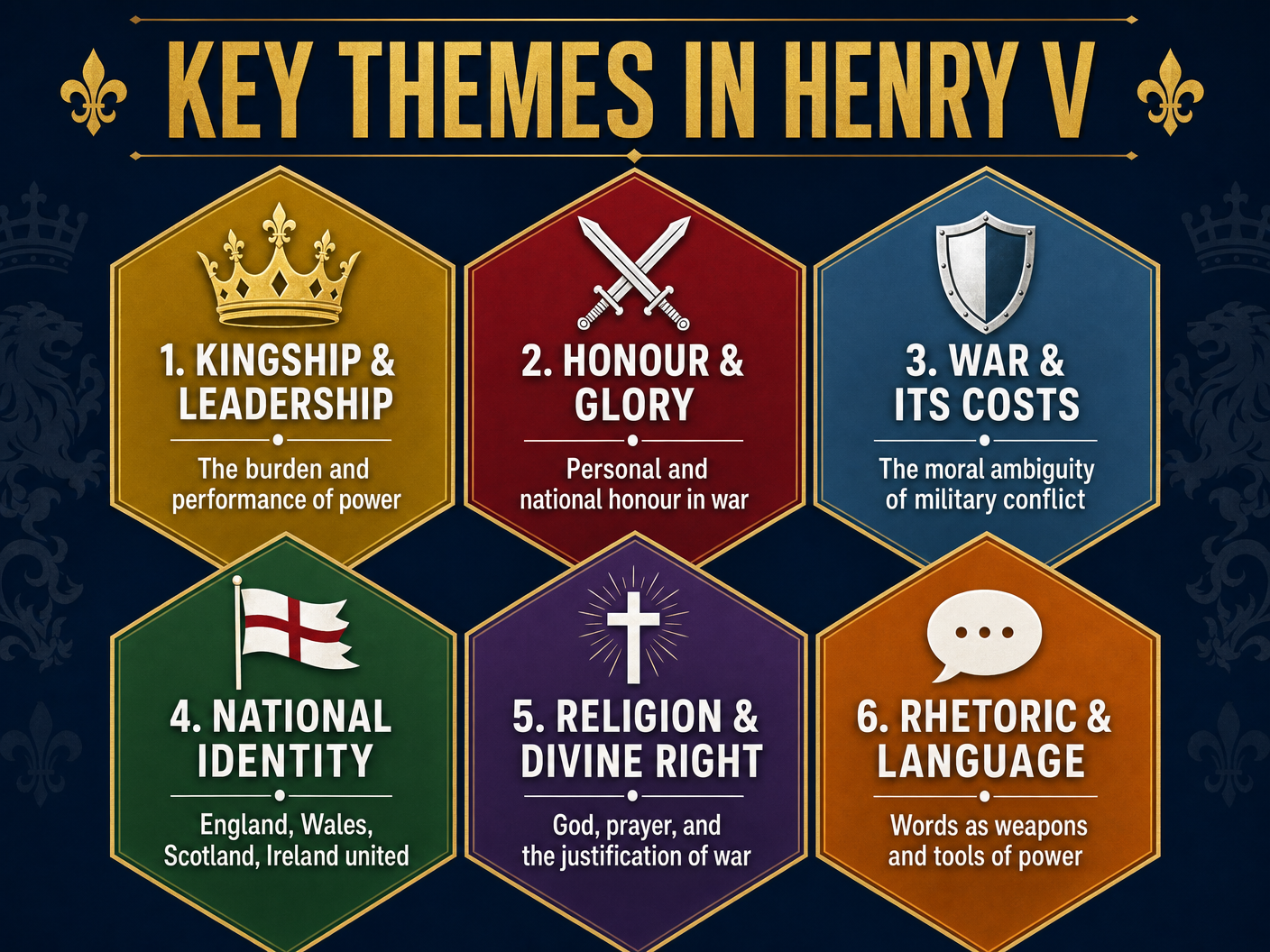
Theme 1: Kingship and Leadership
Shakespeare explores the burden and performance of power. Henry is presented as the "mirror of all Christian kings," yet his leadership often requires ruthless pragmatism and calculated theatricality. He consciously shapes his public image, using rhetoric to manipulate and inspire his subjects. The contrast between his public persona and private doubts reveals the heavy toll of kingship.
Key Quotes:
- "Upon the king! Let us our lives, our souls, / Our debts, our careful wives, / Our children, and our sins lay on the king!" (Act 4, Scene 1) - Analysis: Henry's soliloquy reveals the crushing weight of responsibility, highlighting the isolation of leadership.
- "We few, we happy few, we band of brothers" (Act 4, Scene 3) - Analysis: Henry uses inclusive language and the concept of a "band of brothers" to artificially flatten class distinctions and forge a unified fighting force.
Theme 2: War and Morality
The play presents a deeply ambivalent view of war. While it celebrates English valour and the miraculous victory at Agincourt, it also exposes the brutal realities of conflict. Henry's actions—such as the Harfleur ultimatum and the execution of the French prisoners—challenge the audience to question the morality of his campaign and the true cost of military glory.
Key Quotes:
- "The blind and bloody soldier with foul hand / Defile the locks of your shrill-shrieking daughters" (Act 3, Scene 3) - Analysis: Henry's graphic, violent imagery at Harfleur reveals the horrific reality of war, contrasting sharply with his earlier rhetoric of honour.
- "But if the cause be not good, the king himself hath a heavy reckoning to make" (Act 4, Scene 1) - Analysis: Williams challenges the morality of the king's war, voicing the common soldier's perspective and introducing a note of profound moral doubt.
Theme 3: Rhetoric and Language
Language is a tool of power in Henry V. Henry's ability to shift his linguistic register—from elevated blank verse when addressing his nobles to plain prose when speaking with commoners—demonstrates his political astuteness. The play also explores how language can both unite and divide, as seen in the diverse dialects of the British captains and Katherine's struggles with English.
Key Quotes:
- "Once more unto the breach, dear friends, once more; / Or close the wall up with our English dead." (Act 3, Scene 1) - Analysis: The driving iambic rhythm and repetition ("once more") create a sense of relentless momentum, showcasing Henry's ability to use language as a weapon of motivation.
- "O, not today, think not upon the fault / My father made in compassing the crown!" (Act 4, Scene 1) - Analysis: In private prayer, Henry's language shifts from public confidence to desperate pleading, revealing his underlying insecurity about his legitimacy.
Character Analysis
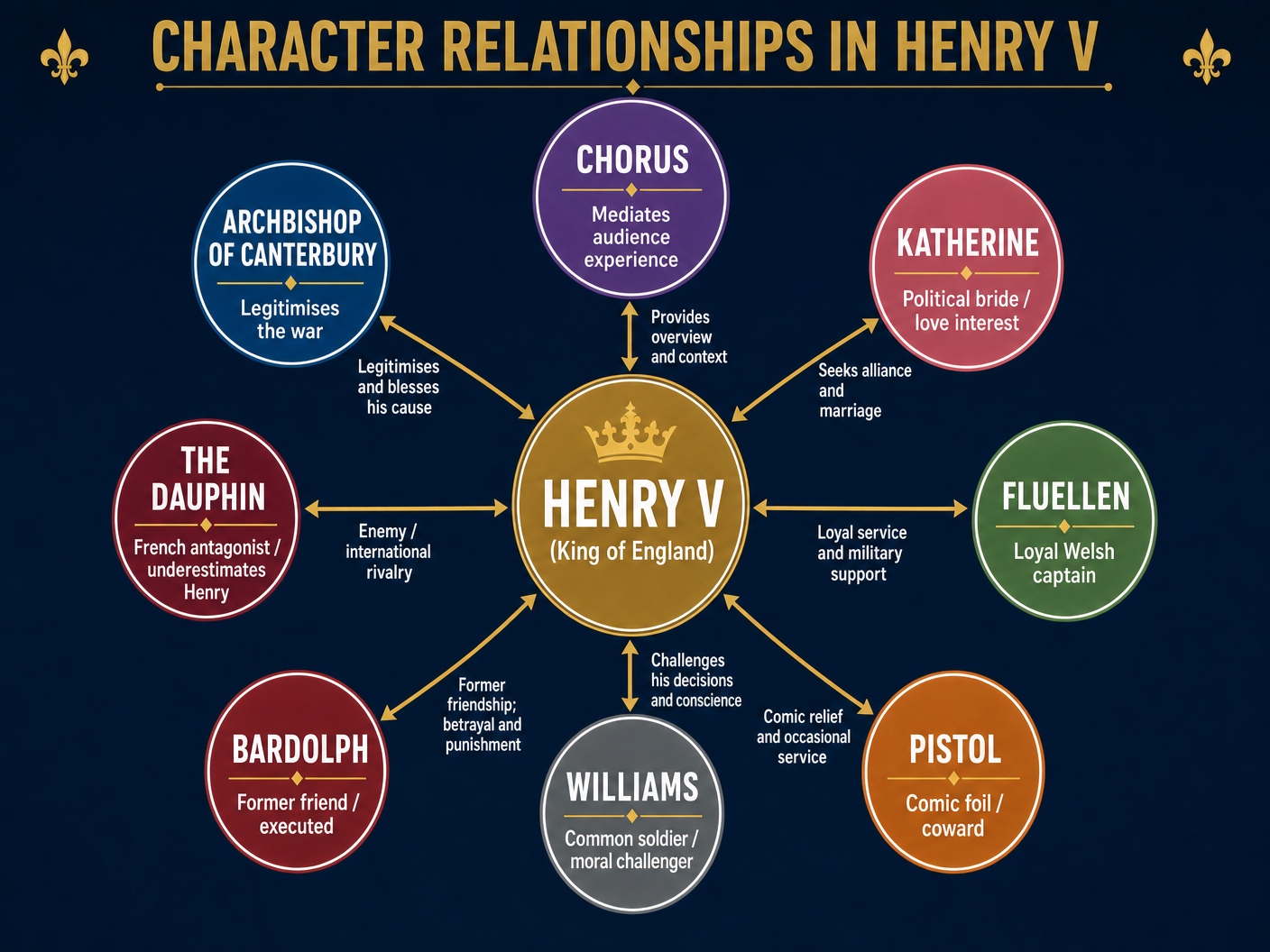
Henry V
Role: The King of England; the protagonist whose transformation from a wayward youth to a mature monarch is the central focus.
Key Traits: Charismatic, pragmatic, ruthless, pious (or outwardly so), and rhetorically brilliant.
Character Arc: Henry moves from the seemingly irresponsible Prince Hal (referenced in the play) to a decisive, commanding king who unites his nation, wins a seemingly impossible war, and secures a political marriage, though the Epilogue undermines the permanence of his achievements.
Essential Quotes:
- "I will dazzle all the eyes of France, / Yea, strike the Dauphin blind to look on us." (Act 1, Scene 2)
- "Every subject's duty is the king's; but every subject's soul is his own." (Act 4, Scene 1)
The Chorus
Role: A single actor who addresses the audience at the beginning of each act and the end of the play.
Key Traits: Apologetic, persuasive, patriotic, and metatheatrical.
Character Arc: The Chorus continuously attempts to shape the audience's perception, building up Henry's heroic image while simultaneously drawing attention to the limitations of the stage in representing historical truth.
Essential Quotes:
- "O for a Muse of fire, that would ascend / The brightest heaven of invention" (Prologue)
- "Small time, but in that small most greatly lived / This star of England" (Epilogue)
Pistol, Nym, and Bardolph
Role: Former tavern companions of Henry; they represent the comic subplot and the reality of the common soldier.
Key Traits: Cowardly, opportunistic, and self-interested.
Character Arc: Their journey provides a stark contrast to Henry's heroic narrative. Bardolph is executed for stealing, Nym is hanged, and Pistol survives only to return to England as a thief, undermining the play's patriotic rhetoric.
Essential Quotes:
- "To England will I steal, and there I'll steal" (Act 5, Scene 1 - Pistol)
Writer's Methods
Form and Structure: Shakespeare uses the Chorus to create a metatheatrical framework, constantly reminding the audience that they are watching a play. This structure encourages a critical distance, allowing the audience to question the heroic narrative being presented. The play also alternates between high-stakes political/military scenes and comic subplots, using juxtaposition to undercut the nobility of war with the grim reality of the common soldiers.
Language (Prose vs. Blank Verse): Shakespeare employs blank verse (unrhymed iambic pentameter) for noble characters and elevated moments, reflecting authority and seriousness. Prose is used for comic characters, commoners, and moments of intimacy or disguise (such as Henry's conversation with Williams). Henry's ability to seamlessly switch between the two demonstrates his political versatility and his connection to all levels of society.
Imagery: The play is rich in imagery of blood, nature, and the body politic. Henry often uses aggressive, violent imagery (as in the Harfleur speech) to assert dominance, while the French use imagery of English barbarism and their own aristocratic superiority. The contrast between the "sun" imagery associated with Henry and the "shadow" of his father's usurpation highlights his ongoing struggle for legitimacy.
Context
Historical Context: The play is set in 1415, during the Hundred Years' War, but it was written in 1599, during the final years of Elizabeth I's reign. Elizabeth was ageing, had no heir, and the nation was anxious about succession and potential civil war. By presenting an idealized (yet complex) warrior-king who unites a fractured nation, Shakespeare was addressing contemporary anxieties about leadership and national unity.
The Essex Rebellion: In 1599, the Earl of Essex was sent to Ireland to suppress a rebellion. The Chorus explicitly references this in Act 5, hoping Essex will return victorious. Essex's subsequent failure and treasonous rebellion in 1601 highlight the very real dangers of political instability and the fragile nature of royal authority—themes central to Henry V.
The Divine Right of Kings: The Tudor belief that monarchs were appointed by God and were his representatives on earth. Henry constantly invokes God to validate his cause, reflecting this doctrine. However, his father's usurpation of Richard II (the previous, legitimate king) casts a shadow over Henry's claim, explaining his anxiety and his desperate need for divine validation at Agincourt.
Interactive Diagrams
1 interactive diagram to visualise key concepts
Conceptual Flow Outline
The trajectory of Henry's character development and the play's narrative arc.
Worked Examples
2 detailed examples with solutions and examiner commentary
Practice Questions
Test your understanding — click to reveal model answers
Explore how Shakespeare presents the relationship between the king and the common people in Henry V. (30 marks + 4 AO4)
Hint: Consider the St. Crispin's Day speech, Henry's disguise in Act 4 Scene 1, and the fate of the Eastcheap characters.
Starting with the Prologue, explore how Shakespeare uses the Chorus to shape the audience's understanding of events. (30 marks + 4 AO4)
Hint: Don't just say what the Chorus tells us. Analyse *how* the Chorus speaks (hyperbole, patriotic imagery) and contrast it with the gritty reality of the scenes that follow.
Explore how Shakespeare presents the character of Princess Katherine and the role of women in the play. (30 marks + 4 AO4)
Hint: Look at the language lesson scene (Act 3, Scene 4) and the wooing scene (Act 5, Scene 2). How is language used as a tool of power and conquest?
How does Shakespeare present the theme of religion and piety in Henry V? (30 marks + 4 AO4)
Hint: Consider the Archbishop's justification for war, Henry's prayers, and his insistence that God won the battle of Agincourt.