Living Space
Imtiaz Dharker's 'Living Space' is a striking exploration of life in a Mumbai slum, where extreme fragility meets miraculous resilience. It's a highly rewarding poem to study because its irregular structure directly mirrors its themes, giving you fantastic opportunities to hit AO2 marks by analysing form alongside language.
Study Notes
Overview
Imtiaz Dharker's 'Living Space' is a powerful exploration of the precarious slum dwellings of Mumbai. It contrasts the extreme fragility of these makeshift homes with the miraculous resilience of the people who live in them. For examiners, the key to success with this poem lies in moving beyond simply describing the poverty. Top candidates will analyse how Dharker's structural choices—such as free verse, irregular line lengths, and enjambment—physically enact the instability of the buildings on the page. Furthermore, a perceptive analysis of the central metaphor of the eggs, and the recurring motif of light, is essential for securing high marks in AO2 (writer's methods).
Poem Overview
The poem begins by describing a precarious, leaning structure in a slum, emphasizing its instability with the phrase "There are just not enough / straight lines." The speaker notes how the building leans dangerously towards the miraculous. In the second stanza, the speaker observes that someone has managed to squeeze a "living space" into this chaotic structure. The final stanza introduces the poem's central, striking image: a wire basket containing eggs, which hang suspended in the dark space. The poem concludes by transforming these fragile eggs into a symbol of faith and hope, glowing with a "bright, thin" light.
Themes
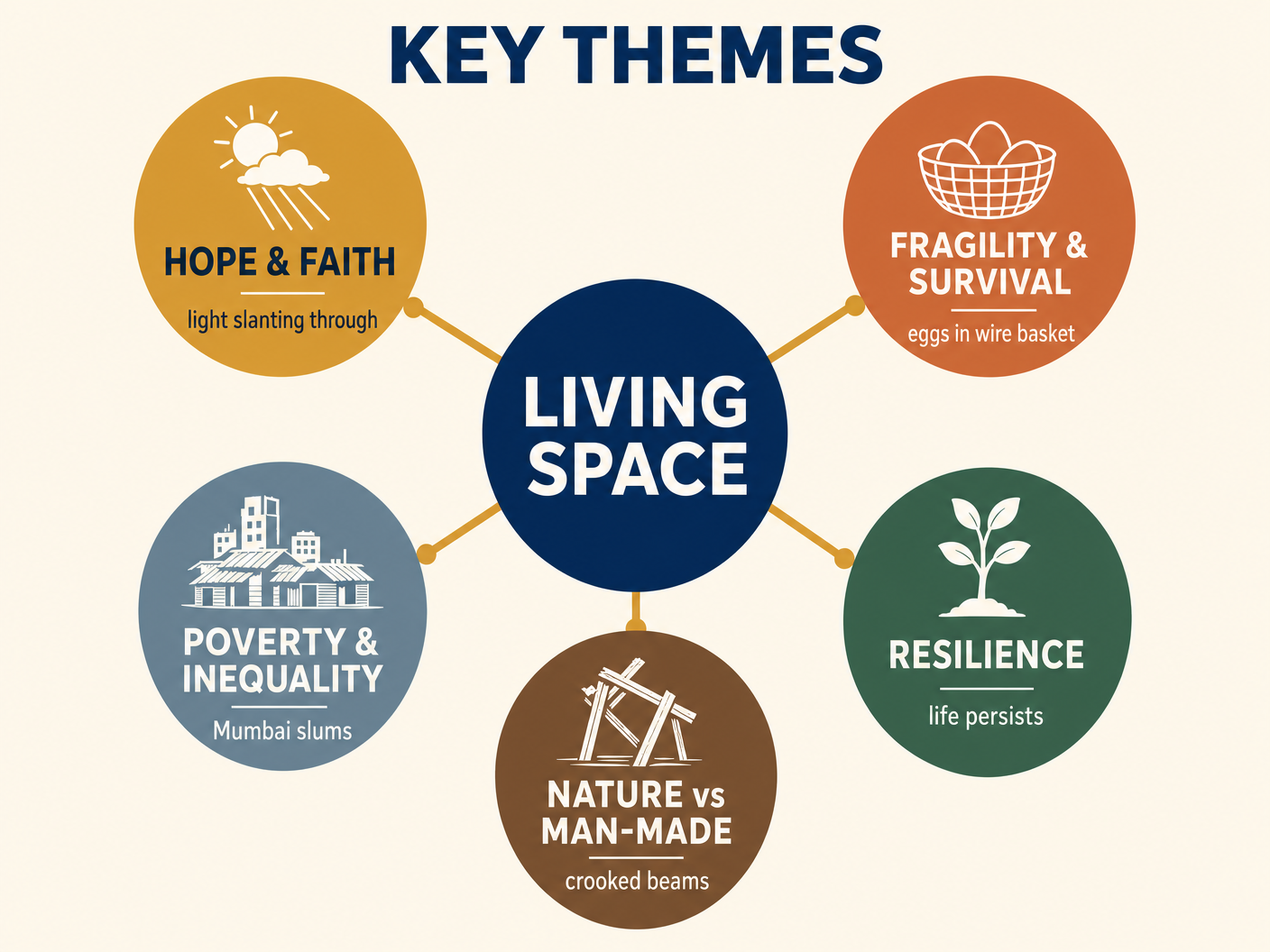
Theme 1: Fragility and Survival
Dharker presents human existence in the slums as incredibly precarious, yet she marvels at the capacity for survival. The physical environment is constantly on the verge of collapse, mirroring the vulnerability of the inhabitants.
Key Quotes:
- "The whole structure leans dangerously / towards the miraculous." - The juxtaposition of "dangerously" and "miraculous" captures the tension of slum life; survival itself is framed as a daily miracle against overwhelming odds.
- "slanted universe" - Suggests an environment that is fundamentally off-balance and unpredictable, lacking the stability and "straight lines" of privileged existence.
Theme 2: Hope and Faith
The poem does not dwell purely on despair. Instead, it locates profound hope and spiritual resilience within the darkest spaces, often symbolised by light.
Key Quotes:
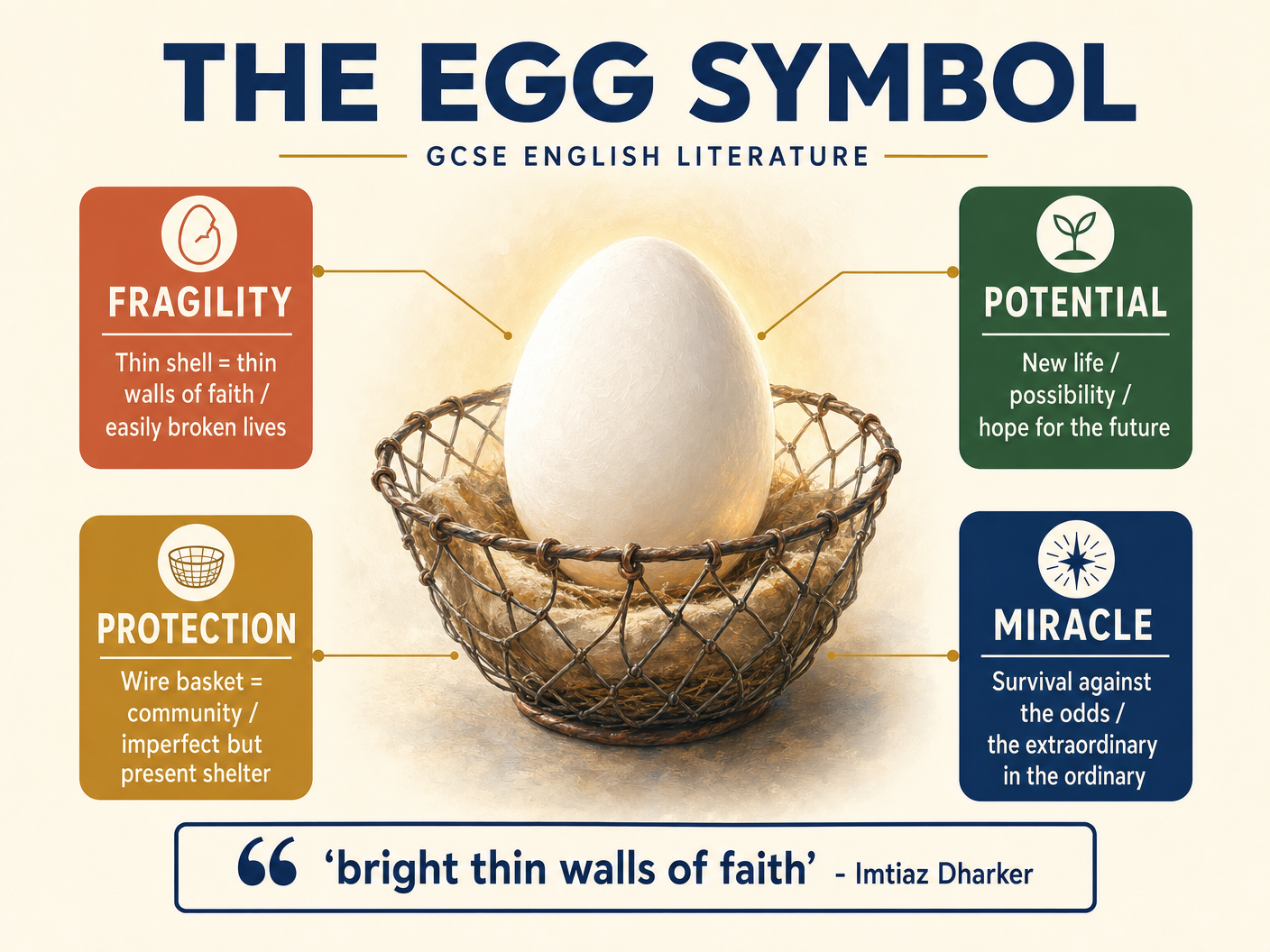
- "the bright, thin walls of faith." - A powerful metaphor. The physical walls may be thin corrugated iron, but "faith" provides a different kind of shelter. The word "bright" introduces a sense of divine or spiritual light, suggesting hope that cannot be extinguished by poverty.
- "gathering the light / into themselves" - The eggs seem to actively draw in what little light there is, symbolising how the inhabitants hold onto hope and possibility.
Writer's Methods
Form and Structure
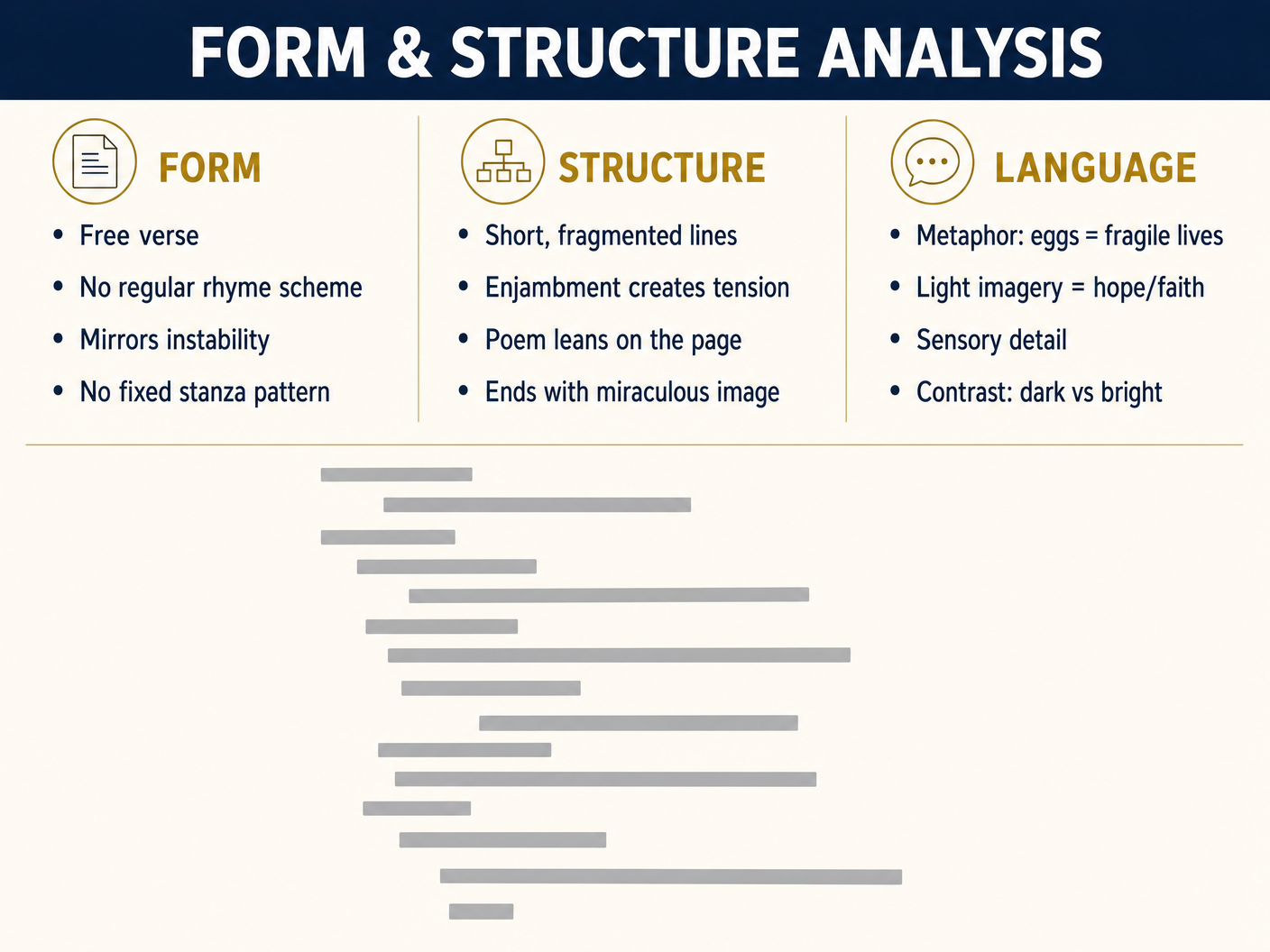
Dharker's structural choices are arguably the most important aspect of this poem to analyse for AO2.
- Free Verse: The poem lacks a regular rhyme scheme or consistent metre. This absence of formal rules reflects the improvised, unregulated nature of the slum dwellings. There are "no straight lines" in the architecture, and no straight lines in the poem's form.
- Irregular Line Lengths: The lines vary dramatically in length, from single words to longer phrases. Visually, the poem leans and juts out on the page, mimicking the crooked, leaning walls of the buildings it describes.
- Enjambment: Lines frequently run on without punctuation (e.g., "There are just not enough / straight lines"). This creates a breathless, tumbling rhythm, giving the reader a sense of vertigo or instability, as if the poem itself might collapse.
Language and Imagery
- The Eggs Metaphor: The "eggs in a wire basket" serve as the poem's emotional core. Eggs are universally recognised symbols of fragility, new life, and potential. Placing them in a precarious, leaning structure heightens the sense of vulnerability, but their unbroken state represents the miracle of survival.
- Sensory Contrast: Dharker contrasts the harsh, rough materials of the slum ("corrugated iron," "wire") with the smooth, delicate fragility of the eggs ("fragile curve of white").
Context
Imtiaz Dharker is a poet and documentary filmmaker who divides her time between London, Wales, and Mumbai. Her deep familiarity with Mumbai informs this poem. Mumbai is home to some of the world's largest slums, such as Dharavi, where millions live in extreme density and poverty. However, Dharker's perspective is not one of pity from an outsider; rather, it is an observation of the ingenuity, community, and sheer resilience required to build a "living space" in such conditions. Understanding this context helps explain why the poem focuses on the "miraculous" nature of survival rather than just the tragedy of poverty.
Visual Resources
3 diagrams and illustrations
Interactive Diagrams
1 interactive diagram to visualise key concepts
Conceptual Flow Outline
The thematic progression of 'Living Space' from physical danger to spiritual hope.
Worked Examples
1 detailed example with solutions and examiner commentary
Practice Questions
Test your understanding — click to reveal model answers
Compare how poets present the reality of difficult environments in 'Living Space' and one other poem from your anthology. (30 marks)
Hint: Good comparison poems include 'London' by William Blake (for a contrasting view of urban despair) or 'Ozymandias' (for the decay of structures).