Macbeth
Shakespeare's 'Macbeth' is a thrilling psychological tragedy exploring the corrupting power of unchecked ambition and guilt. By mastering its rich imagery, complex character arcs, and Jacobean context, candidates can demonstrate sophisticated critical analysis that examiners reward with top marks.
Study Notes
Overview
'Macbeth' is one of Shakespeare's most intense and focused tragedies, charting the psychological and moral descent of a Scottish general who murders his king to seize the throne. For GCSE Literature, examiners are looking for more than just plot recall. Top-tier candidates (Levels 5 and 6) must demonstrate a perceptive understanding of how Shakespeare uses dramatic techniques—such as soliloquies, structural parallels, and recurring motifs—to explore themes of ambition, guilt, and the supernatural. Crucially, your analysis must integrate the Jacobean context, particularly King James I's views on kingship and witchcraft, showing how the play functioned as both a political warning and a philosophical exploration of human agency.
Audio Revision
Listen to our comprehensive revision podcast for an in-depth breakdown of themes and examiner tips:
Plot/Content Overview
Act 1: The Prophecy and TemptationMacbeth and Banquo encounter three Witches who prophesy Macbeth will be King. Spurred by this and Lady Macbeth's relentless manipulation, Macbeth agrees to murder King Duncan while he stays at their castle.
Act 2: The MurderDespite hallucinations (the dagger) and severe misgivings, Macbeth murders Duncan. Lady Macbeth smears the guards with blood to frame them. Duncan's sons, Malcolm and Donalbain, flee in fear, making Macbeth the prime suspect but allowing him to claim the throne.
Act 3: Paranoia and TyrannyFearing the Witches' prophecy that Banquo's heirs will be kings, Macbeth orders the murder of Banquo and his son Fleance (who escapes). Banquo's ghost haunts Macbeth at a royal banquet, exposing his guilt and deteriorating mental state.
Act 4: The Second PropheciesMacbeth returns to the Witches, who offer deceptive reassurances: he cannot be killed by one "of woman born" and is safe until Birnam Wood moves. Feeling invincible, he slaughters Macduff's family. Macduff, in England, joins Malcolm to raise an army.
Act 5: The DownfallLady Macbeth, consumed by guilt, sleepwalks and dies (likely by suicide). The English army advances, camouflaged with branches from Birnam Wood. Macduff reveals he was born via Caesarean section (not naturally "born") and kills Macbeth. Malcolm is restored as the rightful King.
Themes
Theme 1: Ambition and Power
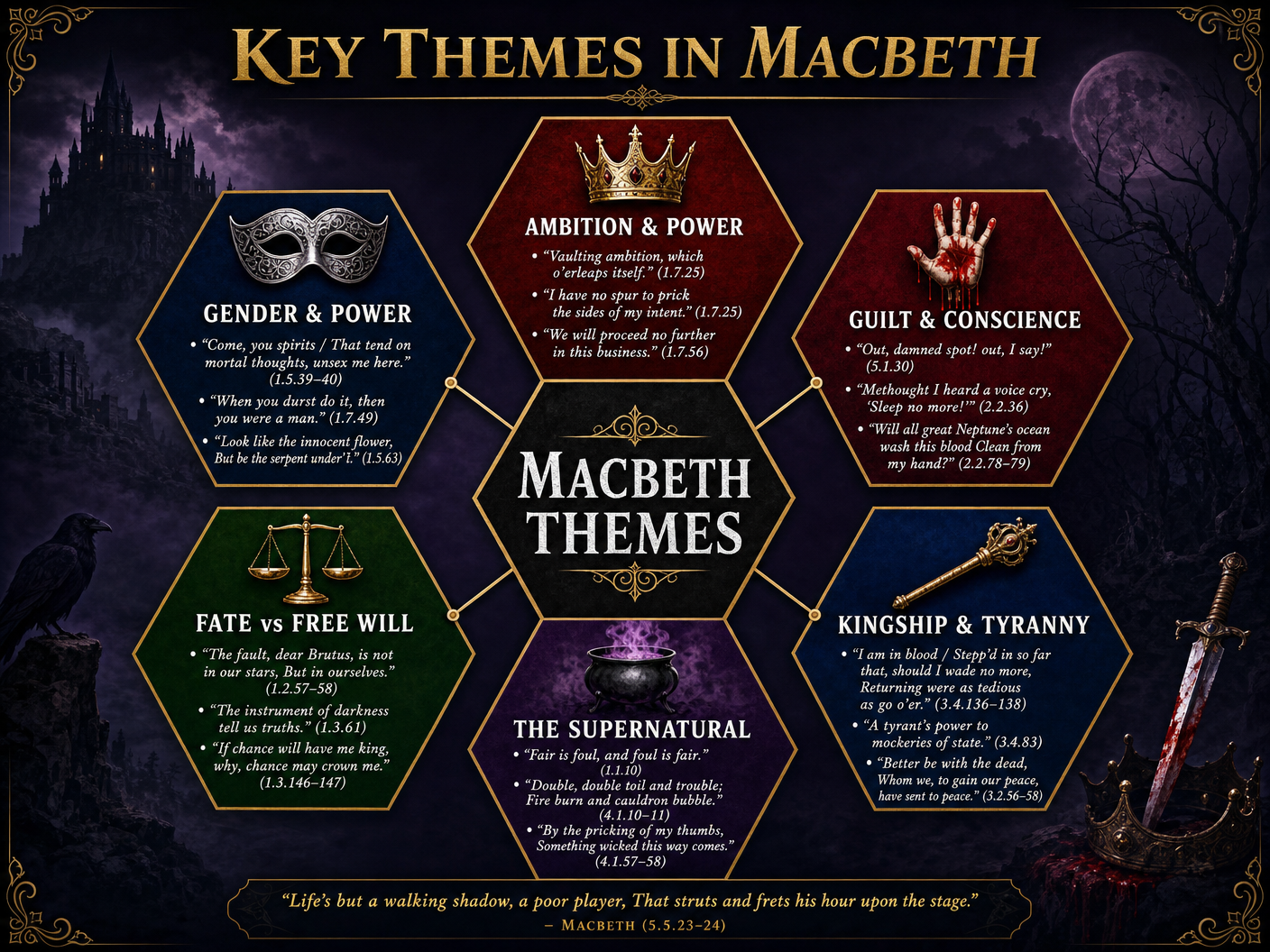
Ambition is the central driving force of the play, presented as a fatal flaw (hamartia) that destroys the moral order. Shakespeare shows that ambition without moral constraint leads to tyranny and psychological ruin. The play acts as a warning against usurping the natural hierarchy (The Great Chain of Being).
Key Quotes:
- "I have no spur / To prick the sides of my intent, but only / Vaulting ambition, which o'erleaps itself" (1.7.25-27) - Analysis: The extended metaphor of horse-riding shows Macbeth's self-awareness; he knows his ambition is dangerous and unnatural, yet he cannot stop himself.
- "To be thus is nothing, / But to be safely thus." (3.1.47-48) - Analysis: Highlights the insatiable nature of power; achieving his ambition brings Macbeth no peace, only deeper paranoia.
Theme 2: Guilt and Conscience
Shakespeare uses powerful sensory imagery—particularly blood and sleeplessness—to manifest the psychological weight of guilt. Both Macbeth and Lady Macbeth are ultimately destroyed not by external forces, but by their own inescapable consciences.
Key Quotes:
- "Will all great Neptune's ocean wash this blood / Clean from my hand?" (2.2.59-60) - Analysis: Hyperbolic language emphasizes the permanence of his sin. The blood is metaphorical, representing a guilt that taints the entire world.
- "Out, damned spot! out, I say!" (5.1.30) - Analysis: Lady Macbeth's prose and fragmented syntax in her sleepwalking scene contrast sharply with her earlier controlled blank verse, visually and aurally demonstrating her mental fragmentation.
Theme 3: The Supernatural and Fate vs. Free Will
The supernatural creates an atmosphere of malevolence and ambiguity. The key critical debate is whether the Witches control Macbeth's fate or merely act as a catalyst for his latent desires. Shakespeare leaves this deliberately ambiguous to emphasize human agency and moral responsibility.
Key Quotes:
- "Fair is foul, and foul is fair" (1.1.10) - Analysis: This chiasmus establishes the theme of deception and moral inversion that permeates the play.
- "The instruments of darkness tell us truths, / Win us with honest trifles, to betray's / In deepest consequence." (1.3.124-126) - Analysis: Banquo acts as a foil here, demonstrating that one can hear the prophecies and still choose to reject evil.
Character Analysis
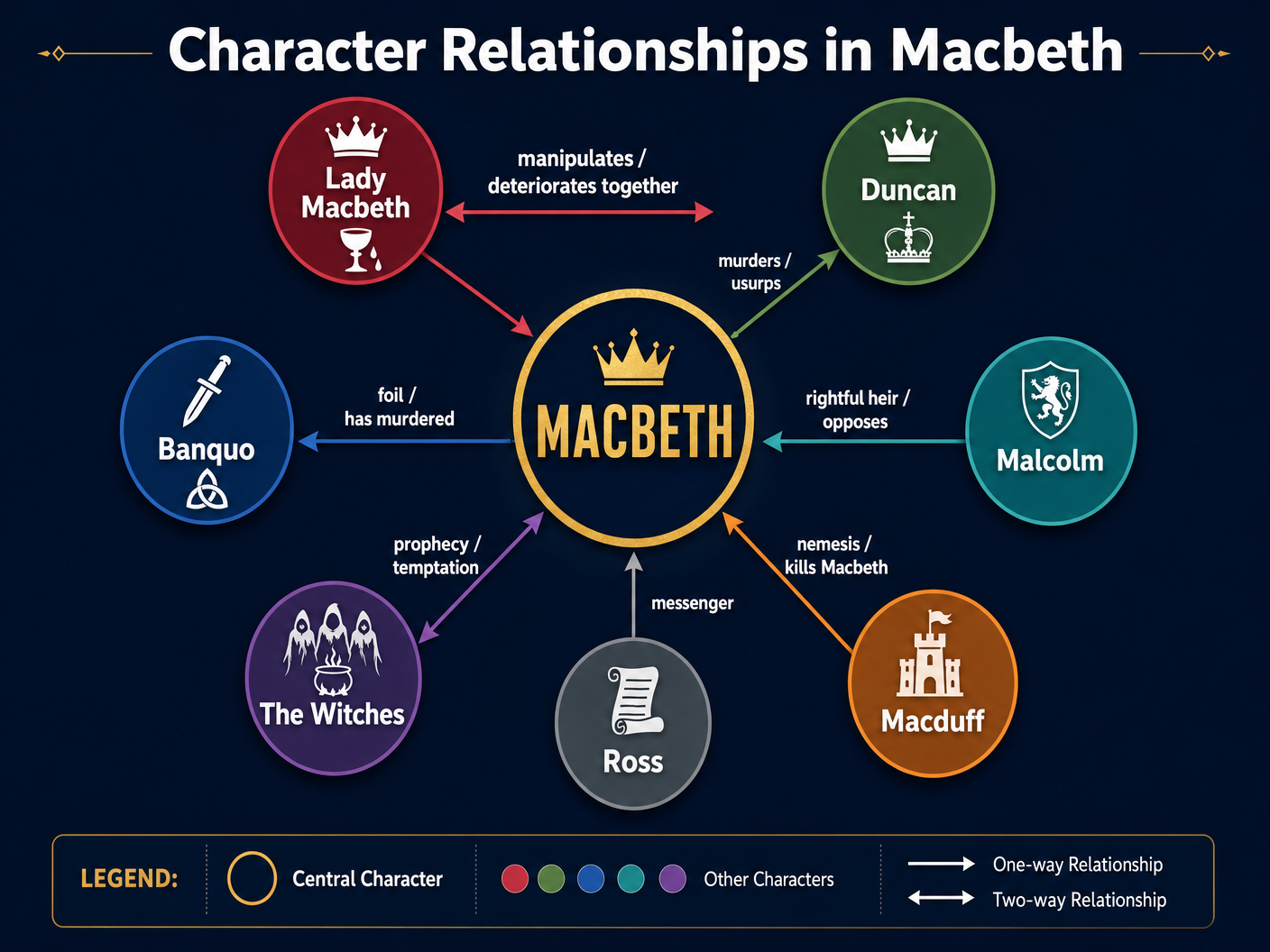
Macbeth
Role: The Tragic Hero
Key Traits: Brave, ambitious, easily manipulated, self-aware, tyrannical, paranoid.
Character Arc: Transforms from a loyal, celebrated warrior ("valour's minion") to a hesitant murderer, and finally to a hardened, nihilistic tyrant ("dead butcher"). His tragedy lies in his acute self-awareness; he knows the moral cost of his actions but commits them anyway.
Essential Quotes:
- "Stars, hide your fires; / Let not light see my black and deep desires." (1.4.50-51)
- "I am in blood / Stepp'd in so far that, should I wade no more, / Returning were as tedious as go o'er." (3.4.136-138)
Lady Macbeth
Role: Catalyst and Co-conspirator
Key Traits: Manipulative, ruthless (initially), ambitious, ultimately fragile.
Character Arc: Begins as the dominant force, questioning Macbeth's masculinity to spur him to murder. However, her suppression of her natural conscience ("unsex me here") is temporary. She becomes isolated from her husband and is destroyed by subconscious guilt.
Essential Quotes:
- "Look like the innocent flower, / But be the serpent under't." (1.5.64-65)
- "All the perfumes of Arabia will not sweeten this little hand." (5.1.42-43)
Banquo
Role: The Foil
Key Traits: Noble, perceptive, cautious, loyal.
Character Arc: Serves as a moral contrast to Macbeth. He hears the same prophecies but relies on his conscience rather than ambition. His murder marks Macbeth's transition into full tyranny, and his ghost represents Macbeth's inescapable guilt.
Essential Quotes:
- "Thou hast it now: king, Cawdor, Glamis, all... and, I fear, / Thou play'dst most foully for't." (3.1.1-3)
Writer's Methods
- Dramatic Irony: Shakespeare frequently places the audience in a position of superior knowledge. For example, Duncan praises the "pleasant seat" of Macbeth's castle just before he is murdered there. This heightens the tension and emphasizes the theme of deception.
- Soliloquies: Crucial for revealing the internal psychological battles of the characters, particularly Macbeth's wavering conscience in Act 1 and his nihilistic despair in Act 5 ("Tomorrow, and tomorrow, and tomorrow").
- Motifs and Imagery: The recurring motifs of blood (guilt), sleep (innocence and peace), and ill-fitting clothing (usurped power) visually and linguistically reinforce the play's themes.
- Metre: Noble characters typically speak in iambic pentameter (blank verse), representing order. The Witches speak in trochaic tetrameter, a chanted, unnatural rhythm that sounds like casting a spell, immediately marking them as "other" and disruptive.
Context
To achieve top marks, candidates must integrate context (AO3) into their analysis of methods and themes, rather than treating it as a history lesson.
- King James I and Witchcraft: James I wrote 'Daemonologie' and deeply feared witches. Shakespeare includes the Witches not just as spooky elements, but as genuine threats to the moral and political order, catering to the King's interests.
- The Divine Right of Kings: The Jacobean belief that the monarch was appointed directly by God. Murdering the King (regicide) was not just a crime, but a sacrilegious act that disrupted the entire universe (The Great Chain of Being), reflected in the unnatural weather and animal behavior in the play.
- The Gunpowder Plot (1605): A failed Catholic attempt to assassinate James I. 'Macbeth' acts as a cautionary tale about the consequences of treason and the ultimate triumph of legitimate rule.
Interactive Diagrams
1 interactive diagram to visualise key concepts
Conceptual Flow Outline
Macbeth's Tragic Character Arc
Worked Examples
2 detailed examples with solutions and examiner commentary
Practice Questions
Test your understanding — click to reveal model answers
Starting with Act 2 Scene 2 (from "That which hath made them drunk..." to "...wash this filthy witness from your hand"), explore how Shakespeare presents the theme of guilt. Write about the extract and the play as a whole.
Hint: Consider how guilt affects Macbeth immediately after the murder, and contrast this with Lady Macbeth's delayed but ultimately fatal experience of guilt.
Explore how Shakespeare presents the relationship between Macbeth and Lady Macbeth.
Hint: Track the shift in power dynamics. Who is dominant at the start? How does their partnership fracture after Duncan's murder?
How far does Shakespeare present Macbeth as a victim of the supernatural?
Hint: Consider the difference between a 'catalyst' and a 'cause'. Do the Witches force him to act, or just tempt him?
Explore the significance of the motif of blood in 'Macbeth'.
Hint: Track how blood changes meaning: from honour/bravery in Act 1, to guilt in Act 2, to inescapable consequence in Act 5.