Mametz Wood
Mametz Wood is a powerful elegy that explores how the earth continues to unearth the human cost of the First World War decades later. It is highly rewarding to study because of its vivid, haunting imagery and its complex exploration of memory, making it an excellent text for high-level analysis of structure and language.
Study Notes
Overview
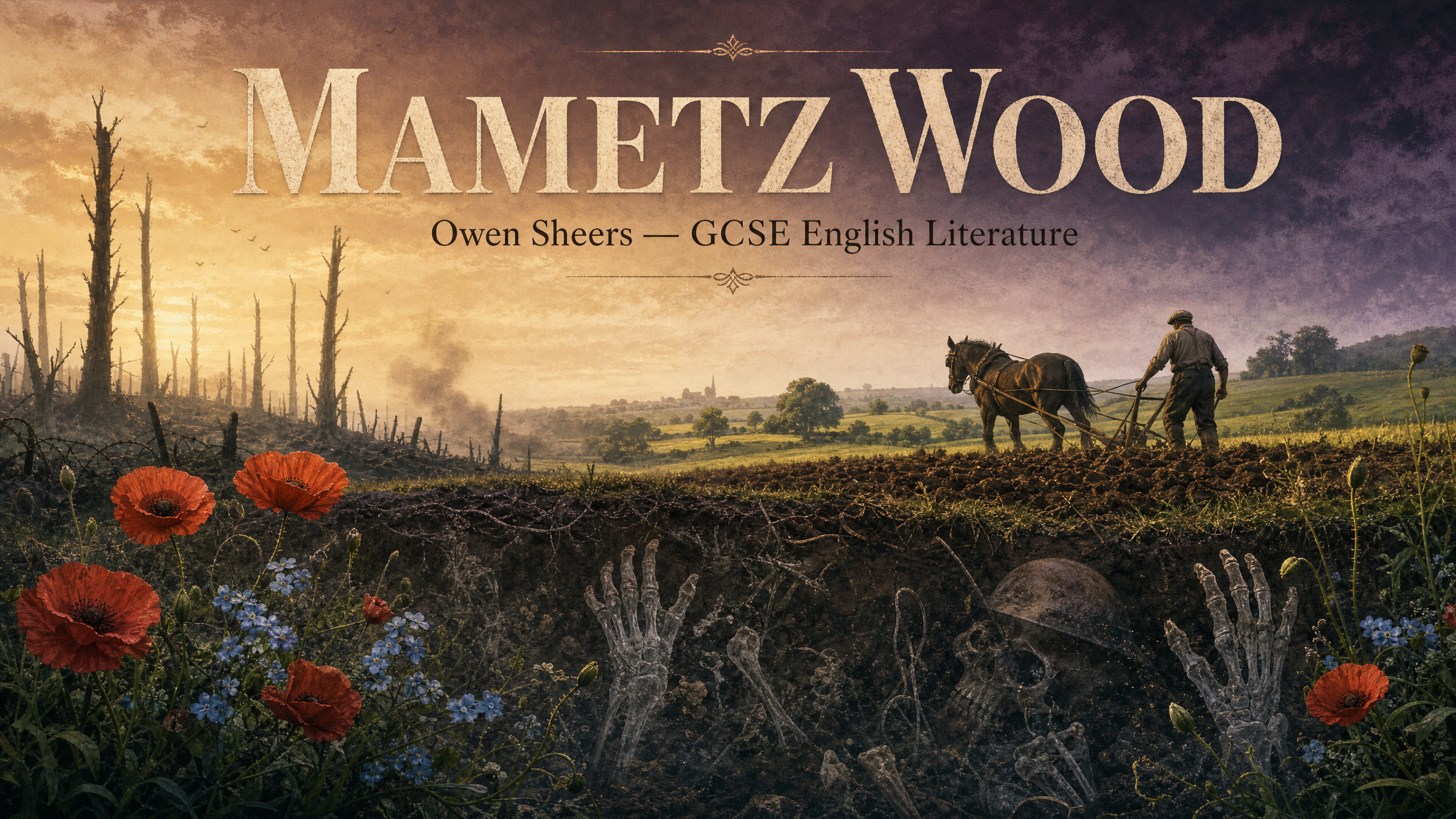
Owen Sheers' 'Mametz Wood' is a profound meditation on the enduring legacy of conflict, specifically the Battle of Mametz Wood during the 1916 Somme offensive. The poem is an elegy, written not from the immediate perspective of the trenches, but from the present day, where farmers peacefully ploughing their fields continue to unearth the remains of the 38th Welsh Division. Examiners highly reward candidates who can explore this central juxtaposition: the peaceful pastoral setting against the horrific intrusion of history. The poem's power lies in its extended metaphor of unearthing—suggesting that remembrance is an active, sometimes painful process of excavation. For top marks, candidates must move beyond feature-spotting to analyse how Sheers uses structure (tercets, enjambment) and shifting tenses to argue that the past and present are inextricably linked, and that the earth acts as both a witness and a memorial to human sacrifice.
Listen to the revision podcast for a deep dive into the poem:
Plot/Content Overview
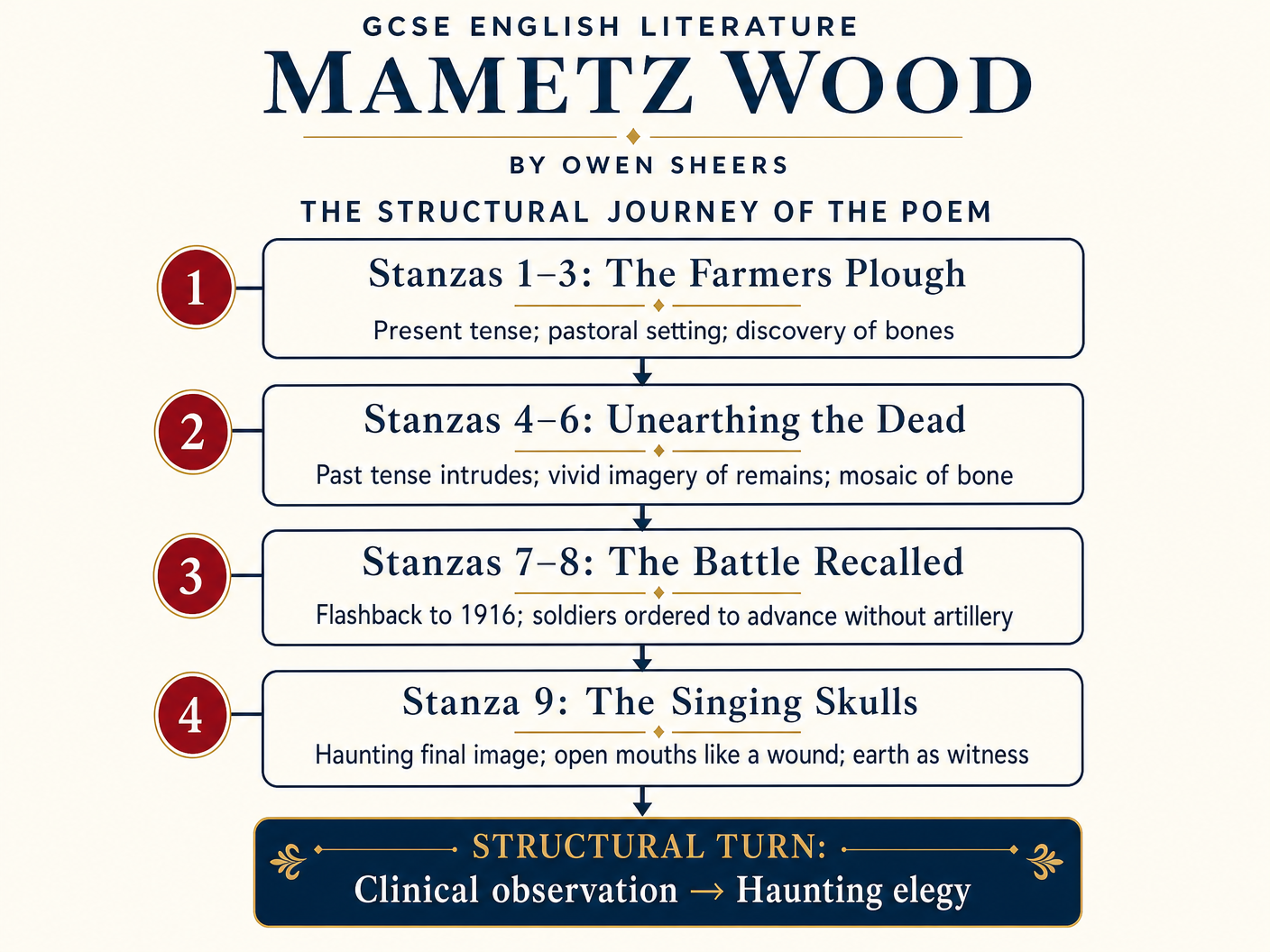
- Stanzas 1-3: The poem opens in the present tense. Farmers in France are ploughing their fields and discovering the remains of soldiers—a 'chit of bone', a 'shinbone', a 'skull'. The earth is presented as a 'sentinel' keeping watch over the dead.
- Stanzas 4-6: The perspective shifts as the imagery becomes more visceral. Sheers describes a 'mosaic of bone' and 'broken bird's egg of a skull'. The violence of their deaths is made clear through the imagery of the earth 'unearthing' them.
- Stanzas 7-8: A flashback to the historical reality of the battle. Sheers recounts how the soldiers were ordered to walk towards the wood, only to be cut down by machine-gun fire, their boots outlasting their bodies.
- Stanza 9: The poem concludes with a haunting, uncanny image of a mass grave. The unearthed skulls are described as having their jaws dropped open, as if they are singing or finally able to speak, suggesting a release or a demand for remembrance.
Themes
Theme 1: Memory and Remembrance
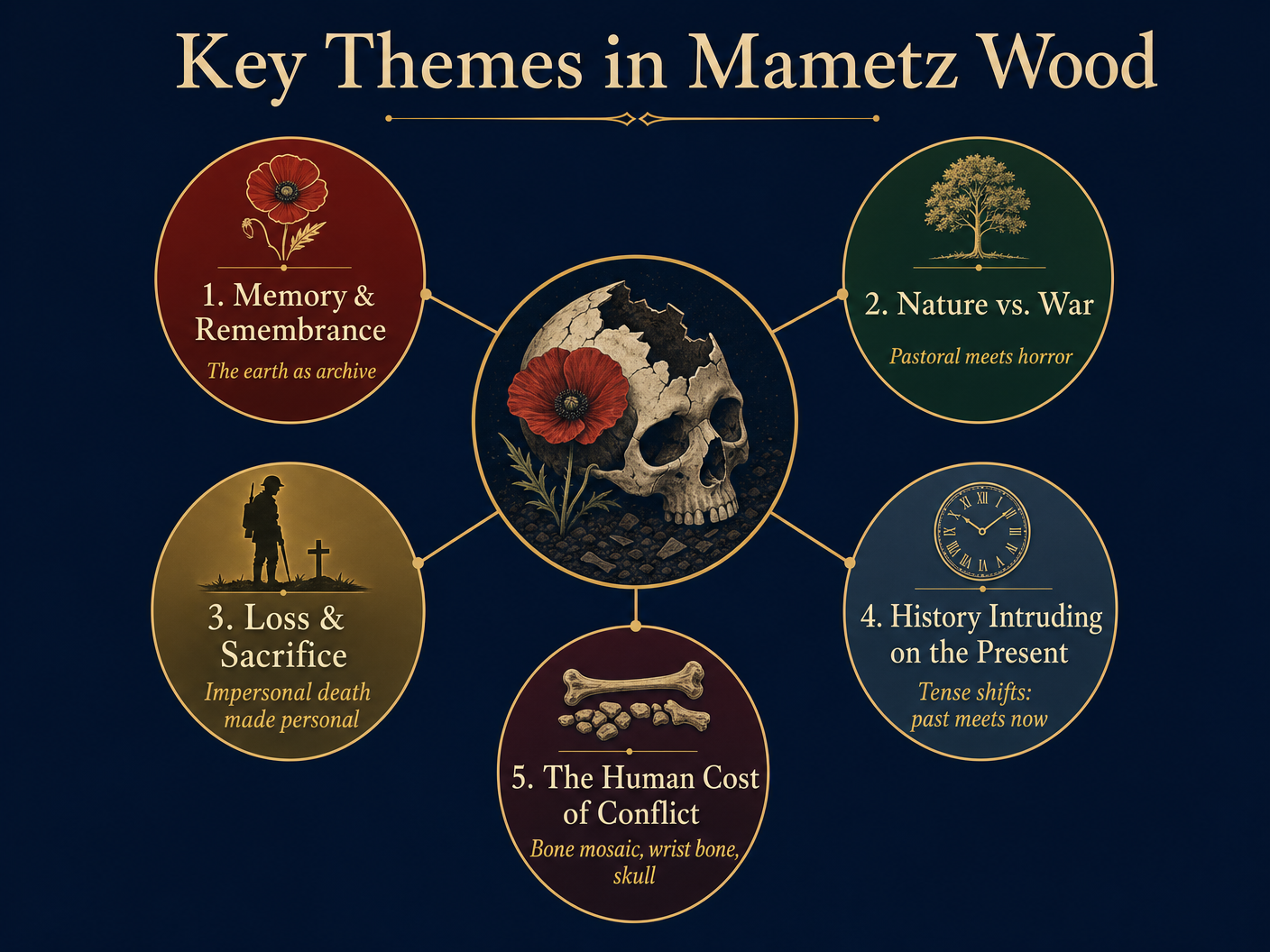
Remembrance is presented not as a passive thought, but as a physical act of excavation. The earth itself refuses to let the dead be forgotten, continuously pushing their remains to the surface.
Key Quotes:
- "the earth stands sentinel" (Stanza 3) - Personification suggests the landscape is actively guarding the dead, waiting for the right moment to reveal them.
- "a chit of bone" (Stanza 1) - A 'chit' is a short official note or receipt. This metaphor suggests the bones are a bureaucratic record of a debt owed to these men, a physical reminder of their sacrifice.
Theme 2: Nature vs. Conflict
The poem relies on the jarring juxtaposition of the natural, pastoral world (farming, spring, birds) with the unnatural horror of industrialised warfare.
Key Quotes:
- "the broken bird's egg of a skull" (Stanza 5) - This metaphor contrasts the fragility of new life (a bird's egg) with the brutal reality of death, highlighting the vulnerability of the young soldiers.
- "farmers found them - the wasted young" (Stanza 1) - The alliteration of 'f' sounds links the agricultural workers to the discovery, while 'wasted' carries a dual meaning: physically destroyed and tragically squandered potential.
Theme 3: The Human Cost of War
Sheers strips away the glory and patriotism often associated with war poetry, focusing instead on the grim, physical reality of death and the reduction of human beings to fragments.
Key Quotes:
- "a mosaic of bone" (Stanza 4) - A mosaic is art made of broken pieces. This implies the soldiers were shattered by war, but also that the earth is trying to piece them back together into something beautiful and worthy of respect.
- "their jaws, those that have them, dropped open" (Stanza 9) - A grotesque, haunting image that suggests a silent scream or an unfinished song, emphasising the violent interruption of their lives.
Writer's Methods
Form and Structure
The poem is written in three-line stanzas (tercets). This creates a sense of control and order, perhaps mirroring the neat rows of a ploughed field or a military graveyard. However, this order is constantly disrupted by enjambment (lines running into one another without punctuation). This structural tension reflects the way the past spills over into the present—the neatness of modern life cannot contain the messy, sprawling reality of history. The poem's shifting tenses—moving from the present day ('For years afterwards') to the past ('They were told to walk') and back to the haunting present—reinforce the idea that time is fluid and the past is never truly gone.
Imagery and Metaphor
Sheers uses an extended metaphor of 'unearthing'. The physical unearthing of bones by the plough becomes a metaphor for the psychological and historical unearthing of truth. The imagery is highly tactile and specific ('the china plate of a shoulder blade'), grounding the elegy in physical reality. This prevents the poem from becoming overly abstract or sentimental; the grief is rooted in dirt and bone.
Context
Owen Sheers is a contemporary Welsh poet. He wrote 'Mametz Wood' after visiting the Somme battlefield in France. During the Battle of the Somme in July 1916, the 38th (Welsh) Division was ordered to take Mametz Wood. They faced fierce machine-gun fire and suffered around 4,000 casualties. For decades, their specific sacrifice was somewhat overlooked in wider histories of the Somme. Sheers' poem is an attempt to give voice to these forgotten Welsh soldiers. Examiners expect candidates to integrate this context to explain why Sheers focuses so heavily on the physical remains—it is a literal unearthing of a buried Welsh history.
Visual Resources
2 diagrams and illustrations
Interactive Diagrams
1 interactive diagram to visualise key concepts
Conceptual Flow Outline
The narrative and temporal structure of Mametz Wood
Worked Examples
1 detailed example with solutions and examiner commentary
Practice Questions
Test your understanding — click to reveal model answers
Compare how poets present the reality of war in 'Mametz Wood' and one other poem from your anthology.
Hint: Choose a poem like 'Exposure' or 'Bayonet Charge'. Compare the *methods* used—how does Sheers use nature compared to the other poet?