Miracle on St David's Day
Gillian Clarke's 'Miracle on St David's Day' is a profound exploration of the enduring power of poetry and human connection. It offers excellent opportunities for GCSE students to analyse rich natural imagery, structural contrasts, and the profound thematic link between memory, identity, and language.
Study Notes

Overview
'Miracle on St David's Day' by Gillian Clarke is a deeply moving autobiographical poem that recounts a visit to a mental institution in Wales. The poem explores the sudden, transformative moment when a patient, previously mute, stands and recites William Wordsworth's 'Daffodils' from memory. For GCSE Literature candidates, this poem is a goldmine. Examiners consistently reward perceptive analysis of Clarke's contrasting imagery—specifically the juxtaposition of the vibrant natural world outside with the sterile, static environment inside. To achieve top band marks (Level 5/6), candidates must move beyond narrative summary and critically examine how Clarke uses form, structure, and sensory language to explore the themes of memory, isolation, and the restorative power of art.
Plot/Content Overview
- Stanzas 1-2: The poet arrives at a mental institution on St David's Day (March 1st) to read poetry. The natural world outside is vibrant and alive with spring ('a torrent of birdsong'), contrasting sharply with the patients inside, who are described as silent and frozen ('still as wax').
- Stanzas 3-4: Clarke describes specific patients, highlighting their isolation and physical decline. She focuses on a 'big, gentle man' who is entirely mute and unresponsive.
- Stanza 5: The poet reads Wordsworth's 'I Wandered Lonely as a Cloud' (Daffodils). The mute man suddenly stands up.
- Stanzas 6-7: The 'miracle' occurs. The man recites the entire Wordsworth poem perfectly from memory. His voice is described as rising 'like a sudden bird'. The room is electrified by this unexpected connection to language and memory.
Themes
Theme 1: The Power of Language and Poetry
Clarke presents poetry not merely as words on a page, but as a deeply embedded human instinct capable of transcending severe mental and physical decline. The poem suggests that language—specifically poetic rhythm and imagery—resides in a profound part of our memory that illness cannot easily erase.
Key Quotes:
- "He is suddenly standing, silently, / huge and mild" - The use of the adverbs 'suddenly' and 'silently' creates a moment of suspended tension before the power of speech returns.
- "his voice for the first time / like a sudden bird" - This crucial simile (AO2) connects the man's returning voice to the natural world, suggesting that language is a natural, instinctive release from the 'cage' of his silence.
Theme 2: Nature vs. Institution
Examiners reward candidates who explore the stark structural and linguistic contrast between the vibrant Welsh spring outside and the sterile, stagnant atmosphere of the institution inside. Nature represents freedom, vitality, and rebirth, while the institution represents decay and confinement.
Key Quotes:
- "the air was a torrent of birdsong" - The synaesthetic metaphor (AO2) 'torrent' conveys an overwhelming, rushing vitality to the natural world.
- "They sit, blind, in a cage of light" - The oxymoronic metaphor 'cage of light' (AO2) highlights the patients' entrapment; even the sunlight cannot free them from their mental or physical confines.
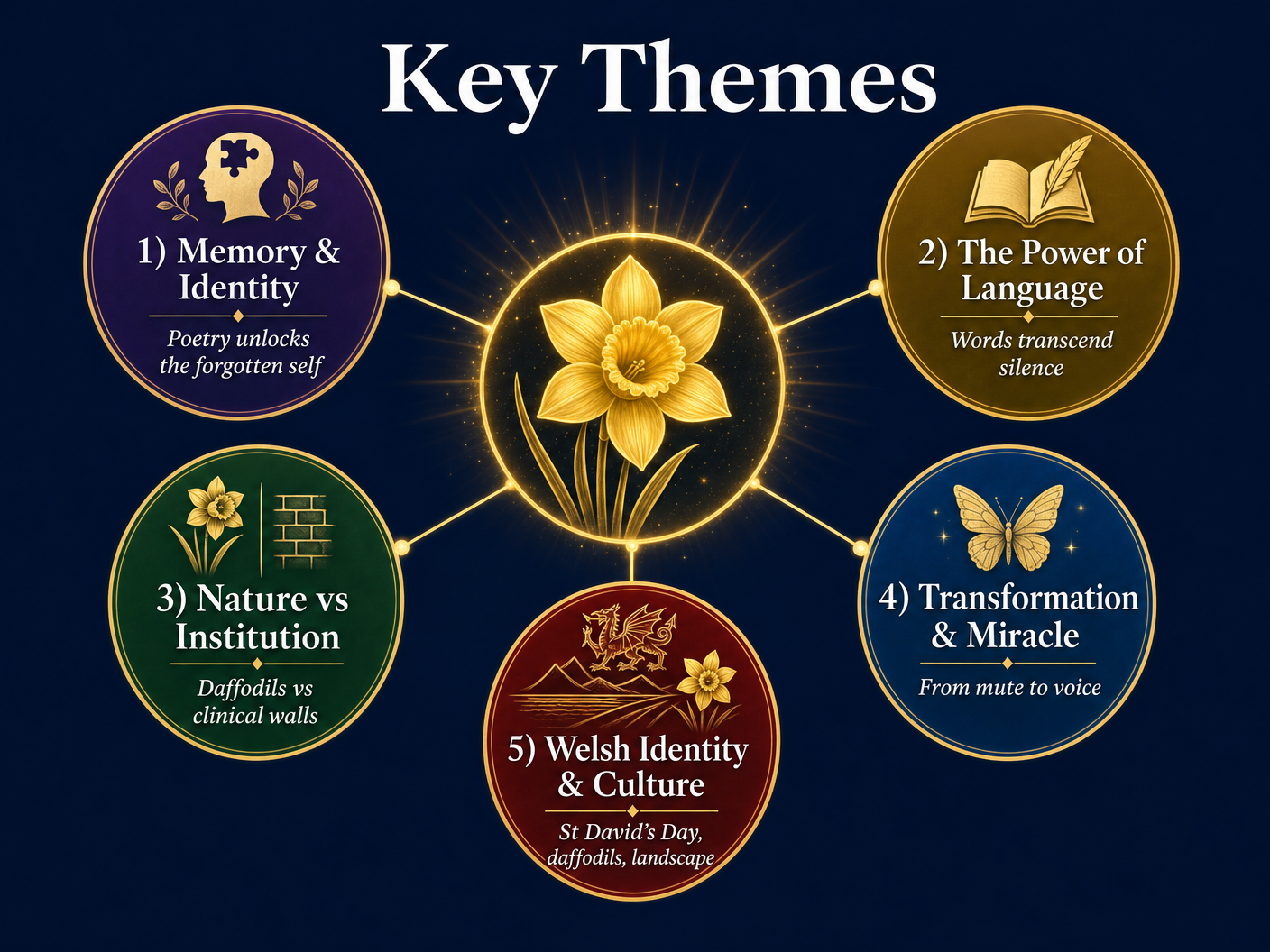
Theme 3: Memory and Identity
The poem explores how our identity is inextricably linked to our memories, and how those memories can be unexpectedly unlocked. The patient's identity has been erased by his muteness, but reciting the poem briefly restores his sense of self.
Key Quotes:
- "Remembering there was a music / of speech" - The noun 'music' elevates ordinary speech to an art form, suggesting that the rhythm of language is fundamental to human connection.
- "hoarded / in the winter of his mind" - The metaphor 'hoarded' implies that the poem was kept safe and precious, while 'winter' symbolises the barren, silent period of his illness before this 'spring' awakening.
Character Analysis
The Mute Patient
Role: The central figure of the poem's 'miracle', representing the endurance of the human spirit and memory.
Key Traits: Physically imposing but gentle; completely silent until the climax; profoundly disconnected from his surroundings.
Character Arc: He transforms from being "mute as a stone" (static, unfeeling, permanent) to having a voice that rises "like a sudden bird" (dynamic, free, natural).
Essential Quotes:
- "mute as a stone"
- "huge and mild"
- "his voice... like a sudden bird"
The Speaker (Gillian Clarke)
Role: The observer and catalyst. She bridges the gap between the outside world and the patients.
Key Traits: Empathetic, observant, deeply moved by the event.
Essential Quotes:
- "I read them poetry"
- "Before I had finished / he is suddenly standing"
Writer's Methods
Imagery and Contrast: Clarke structures the poem around binary oppositions: inside vs. outside, silence vs. sound, winter vs. spring. The sensory language shifts from visual and auditory abundance outside to sensory deprivation inside ('blind', 'deaf').
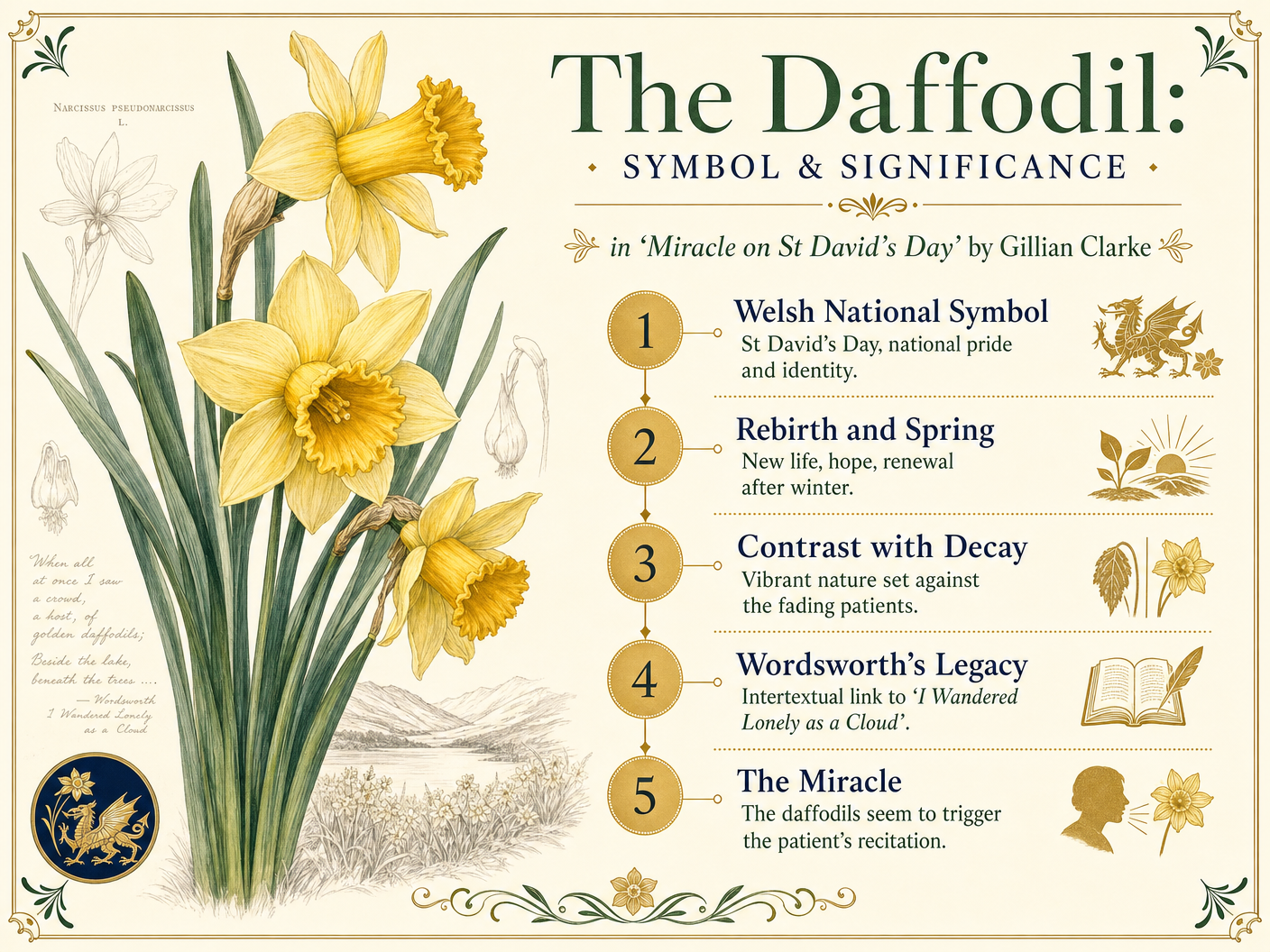
Intertextuality: The poem relies heavily on the reader's knowledge of Wordsworth's 'Daffodils'. This intertextual link is crucial; Clarke uses another poet's work about nature and memory to trigger a real-life moment of memory and connection.
Form and Structure: Written in free verse, the poem lacks a rigid rhyme scheme, giving it a conversational, documentary feel that suits its autobiographical nature. However, the stanza lengths vary, often isolating key moments (like the man standing) to mimic the suddenness of the 'miracle'. Enjambment is used frequently to create a flowing, continuous narrative that mirrors the pouring out of the man's memory.
Context
St David's Day: March 1st is the national day of Wales. St David is the patron saint, and the daffodil is the national flower. The poem is deeply rooted in Welsh cultural identity. The blooming of daffodils signals the arrival of spring and rebirth, mirroring the 'rebirth' of the patient's voice.
William Wordsworth: The Romantic poet whose famous poem 'I Wandered Lonely as a Cloud' focuses on the lasting power of memory (the 'inward eye') to bring joy. Clarke proves Wordsworth's theory true in a modern, clinical setting.
Visual Resources
2 diagrams and illustrations
Interactive Diagrams
1 interactive diagram to visualise key concepts
Conceptual Flow Outline
Thematic structure and contrasts in 'Miracle on St David's Day'
Worked Examples
2 detailed examples with solutions and examiner commentary
Practice Questions
Test your understanding — click to reveal model answers
Explore how Clarke presents the theme of isolation in 'Miracle on St David's Day'. (30 marks + 4 AO4)
Hint: Consider the physical isolation of the nursing home, the mental isolation of the patients ('blind', 'deaf'), and how the 'miracle' briefly breaks this isolation.
Compare how poets present the power of nature in 'Miracle on St David's Day' and one other poem you have studied. (30 marks)
Hint: Focus on nature as an active force. In Clarke's poem, nature (spring, daffodils) acts as a catalyst for memory and healing.
Starting with the lines 'He is suddenly standing...' to the end of the poem, explore how Clarke presents the idea of transformation. (30 marks + 4 AO4)
Hint: Look closely at the verbs and similes used before he stands vs after he speaks.
How does Clarke use setting to create mood in 'Miracle on St David's Day'? (30 marks + 4 AO4)
Hint: The poem has two settings: the vibrant Welsh spring outside, and the clinical, depressing nursing home inside.