Ozymandias
Ozymandias is a masterpiece of political critique disguised as a traveller's tale. Studying this poem rewards you with rich opportunities to explore irony, structural subversion, and the Romantic rebellion against tyrannical power.
Study Notes
Overview
Written by Percy Bysshe Shelley in 1817, 'Ozymandias' is a sonnet that powerfully critiques the arrogance of human power and the inevitability of its decay. Examiners look for candidates who can unpick the layers of irony in the poem, moving beyond simple plot retelling to analyse the complex narrative framing (the speaker, the traveller, the sculptor, and the king). High-scoring responses seamlessly weave in Shelley's Romantic context, showing how his radical politics inform his depiction of a ruined statue in a vast, indifferent desert.
Listen to the companion podcast for a deep dive into these concepts:
Content Overview
The poem begins with a first-person speaker who recounts meeting a "traveller from an antique land." This traveller describes discovering the ruins of a massive statue in the desert. Only two huge stone legs remain standing, while a shattered stone face lies half-buried nearby. The face bears an arrogant, cruel expression ("sneer of cold command"). On the statue's pedestal, an inscription boasts of the ruler's supreme power, commanding onlookers to "despair." However, the poem concludes by revealing that nothing else remains of his empire—only the endless, flat sands stretching away into the distance.
Themes
Theme 1: The Fragility of Power and Tyranny
Shelley presents political power, especially tyrannical rule, as inherently transient and ultimately futile. The ruler's attempts to immortalise himself through a "colossal" monument have failed, leaving only a "Wreck."
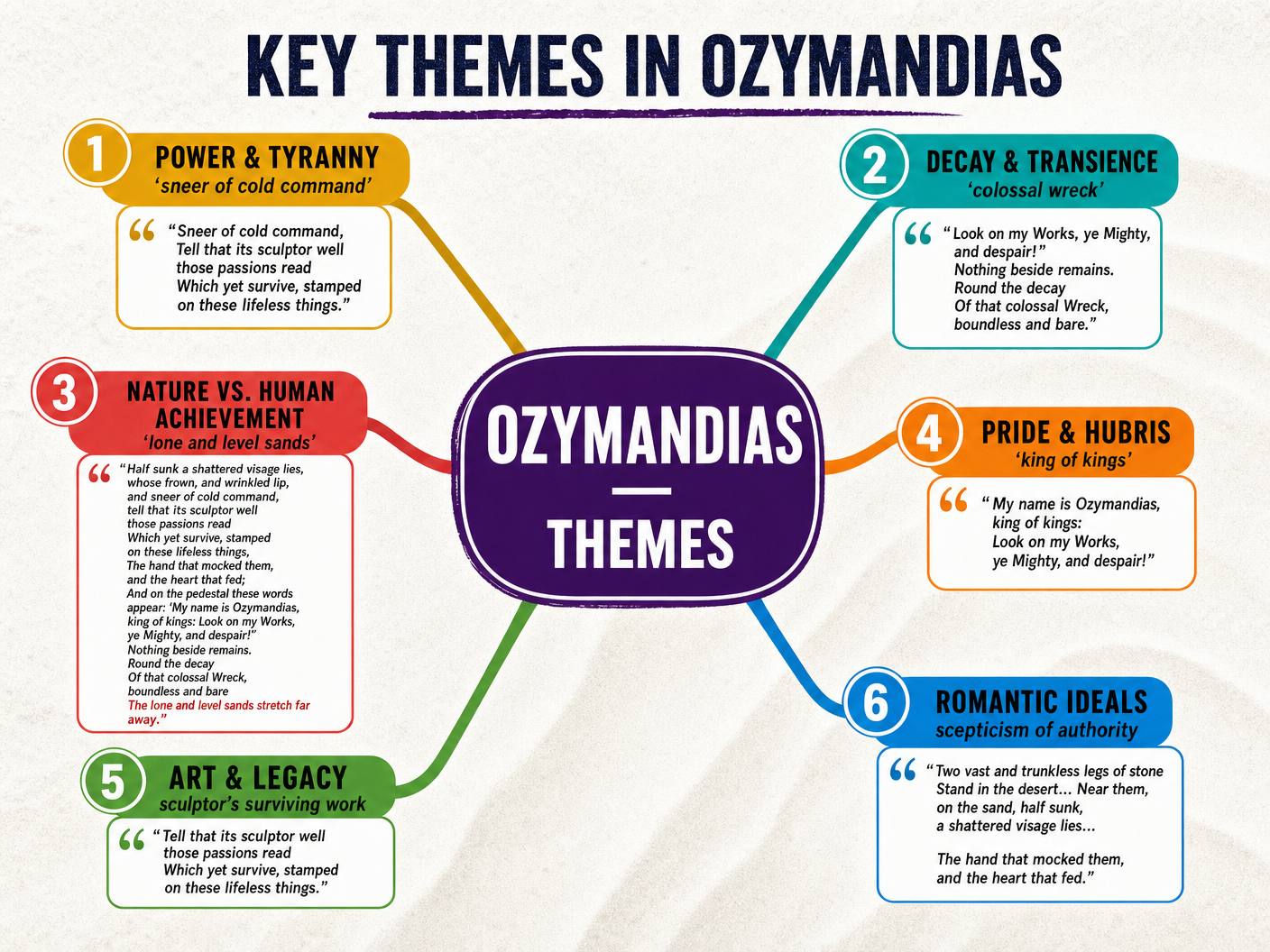
Key Quotes:
- "sneer of cold command" - The noun "sneer" and adjective "cold" convey arrogance and emotional detachment, typical of a tyrant. The alliteration of the hard 'c' sound reinforces his harsh authority.
- "colossal Wreck" - An oxymoron. "Colossal" highlights his vast ambition and former power, but "Wreck" completely undermines it, emphasising the totality of his fall.
Theme 2: The Enduring Power of Nature
In stark contrast to human fragility, nature is presented as eternal, vast, and indifferent to human achievement. The desert ultimately reclaims the king's empire.
Key Quotes:
- "boundless and bare" - The plosive 'b' alliteration emphasises the vast emptiness of the landscape, stripping away any illusion of human control.
- "The lone and level sands stretch far away" - The long vowel sounds and gentle 'l' and 's' alliteration create a sense of endlessness and peace, showing nature's quiet triumph over the tyrant's noisy boasts.
Theme 3: Pride, Hubris, and Irony
Ozymandias's overwhelming pride (hubris) is mocked through dramatic irony. His words demand awe, but his reality inspires pity or amusement.
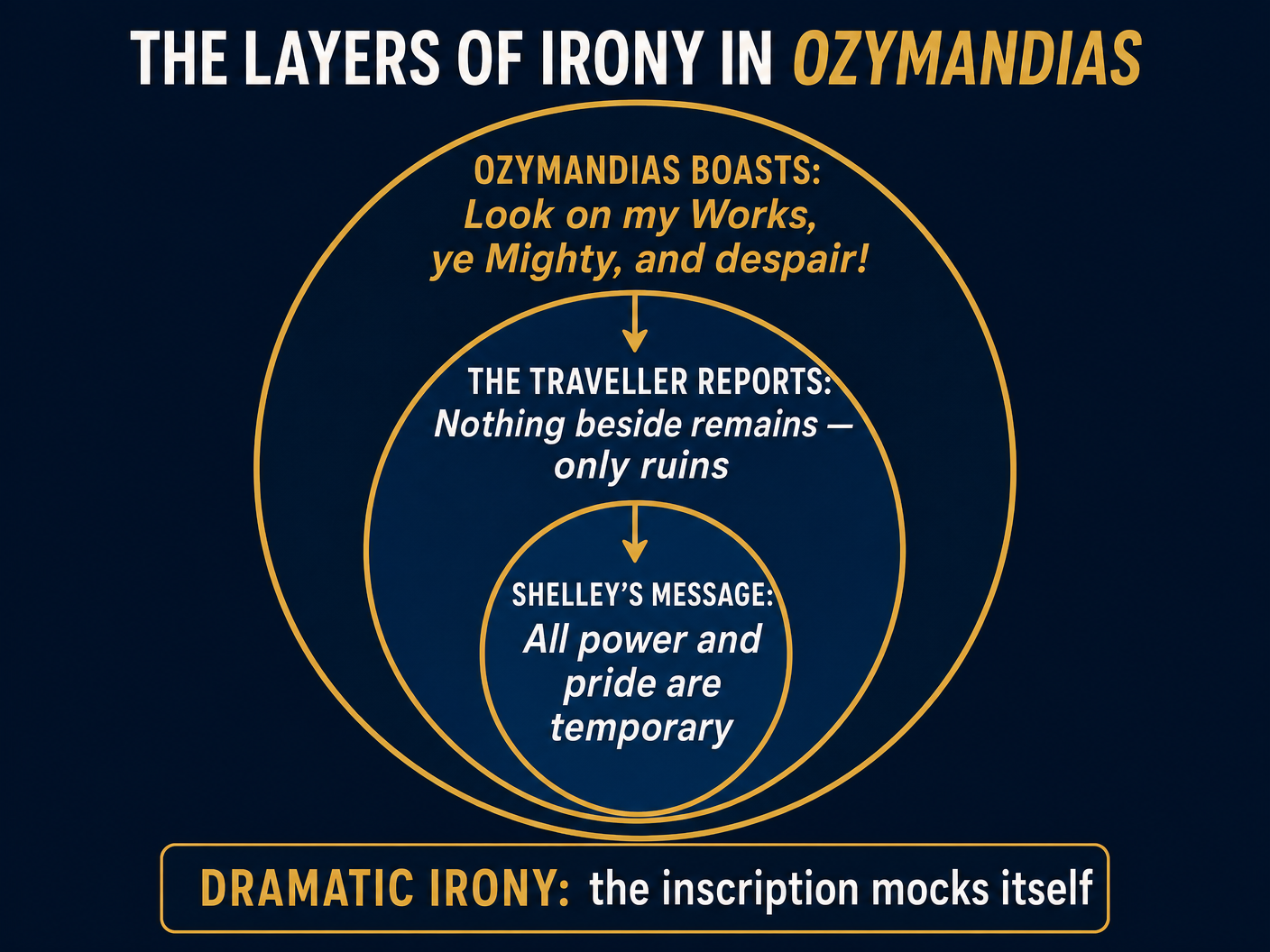
Key Quotes:
- "My name is Ozymandias, king of kings:" - The repetition in "king of kings" shows his belief in his absolute supremacy, challenging even God.
- "Look on my Works, ye Mighty, and despair!" - The imperative verbs ("Look", "despair") show his commanding nature. The irony is that the reader does despair, but at the inevitability of death and decay, not at his greatness.
Theme 4: Art and Legacy
The poem suggests that art outlasts political power. The sculptor's work has survived, capturing the truth of the king's cruelty better than the king's own boasts.
Key Quotes:
- "the hand that mocked them, and the heart that fed" - "Mocked" can mean both to create a likeness of, and to ridicule. The artist has immortalised the king's flaws.
- "Which yet survive, stamped on these lifeless things" - The passions survive, not the man. The verb "stamped" shows the permanence of the artist's skill.
Character Analysis
Ozymandias (Ramesses II)
Role: The subject of the poem, a symbol of tyrannical power.
Key Traits: Arrogant, cruel, boastful, ultimately powerless against time.
Essential Quotes: "king of kings", "sneer of cold command"
The Sculptor
Role: The unnamed artist whose work outlives the subject.
Key Traits: Perceptive, skilled, subtly rebellious.
Essential Quotes: "well those passions read", "the hand that mocked them"
The Traveller
Role: The narrator of the main story, providing distance.
Key Traits: Observant, objective.
Essential Quotes: "from an antique land"
Writer's Methods
Form: Shelley subverts the traditional sonnet form. Sonnets are typically 14-line poems about love (often Petrarchan or Shakespearean). By using this form to write about a tyrant's self-love and decay, Shelley creates structural irony. The rhyme scheme is irregular (ABAB ACDC EDEF EF), mirroring the broken, decaying nature of the statue.
Structure: The poem uses a framed narrative (a story within a story). The speaker hears from a traveller, who reads the words of Ozymandias. This distances the reader from the king, reducing his immediacy and power.
Language: The use of juxtaposition is striking. The grandeur of "king of kings" is immediately followed by the anti-climax of "Nothing beside remains."
Context
Romanticism: Shelley was a second-generation Romantic poet. Romantics valued nature, emotion, and the individual, and were deeply sceptical of absolute power, institutions, and tyranny.
Political Radicalism: Shelley opposed the monarchy and the oppressive government of King George III. The poem can be read as a veiled attack on contemporary rulers and a warning that all empires (including the British Empire) will eventually fall.
Historical Inspiration: The poem was inspired by the recent acquisition of a large fragment of a statue of Ramesses II by the British Museum in 1817.
Visual Resources
2 diagrams and illustrations
Interactive Diagrams
1 interactive diagram to visualise key concepts
Conceptual Flow Outline
The Framed Narrative Structure in Ozymandias
Worked Examples
1 detailed example with solutions and examiner commentary
Practice Questions
Test your understanding — click to reveal model answers
Compare how poets present the effects of time and nature in 'Ozymandias' and one other poem. (30 marks)
Hint: Consider using 'Exposure' or 'Extract from, The Prelude'. Focus on how nature is depicted as an unstoppable, indifferent force.
Explore how Shelley presents the character of Ozymandias in the poem. (24 marks)
Hint: Look at the adjectives used to describe him, the words he speaks, and the irony of his current situation.
How does Shelley use structure and form to convey his message in 'Ozymandias'? (24 marks)
Hint: Think about the sonnet form, the framed narrative, and the use of caesura and enjambment.
Compare how poets present pride in 'Ozymandias' and 'My Last Duchess'. (30 marks)
Hint: Both feature arrogant rulers who commission art to preserve their power.