Romeo and Juliet
Romeo and Juliet is a timeless tragedy exploring the devastating consequences of a bitter family feud on two passionate young lovers. Studying this play rewards candidates who can unpick Shakespeare's intricate language, analyse the tension between fate and free will, and understand the oppressive patriarchal context of Elizabethan Verona.
Study Notes
Overview
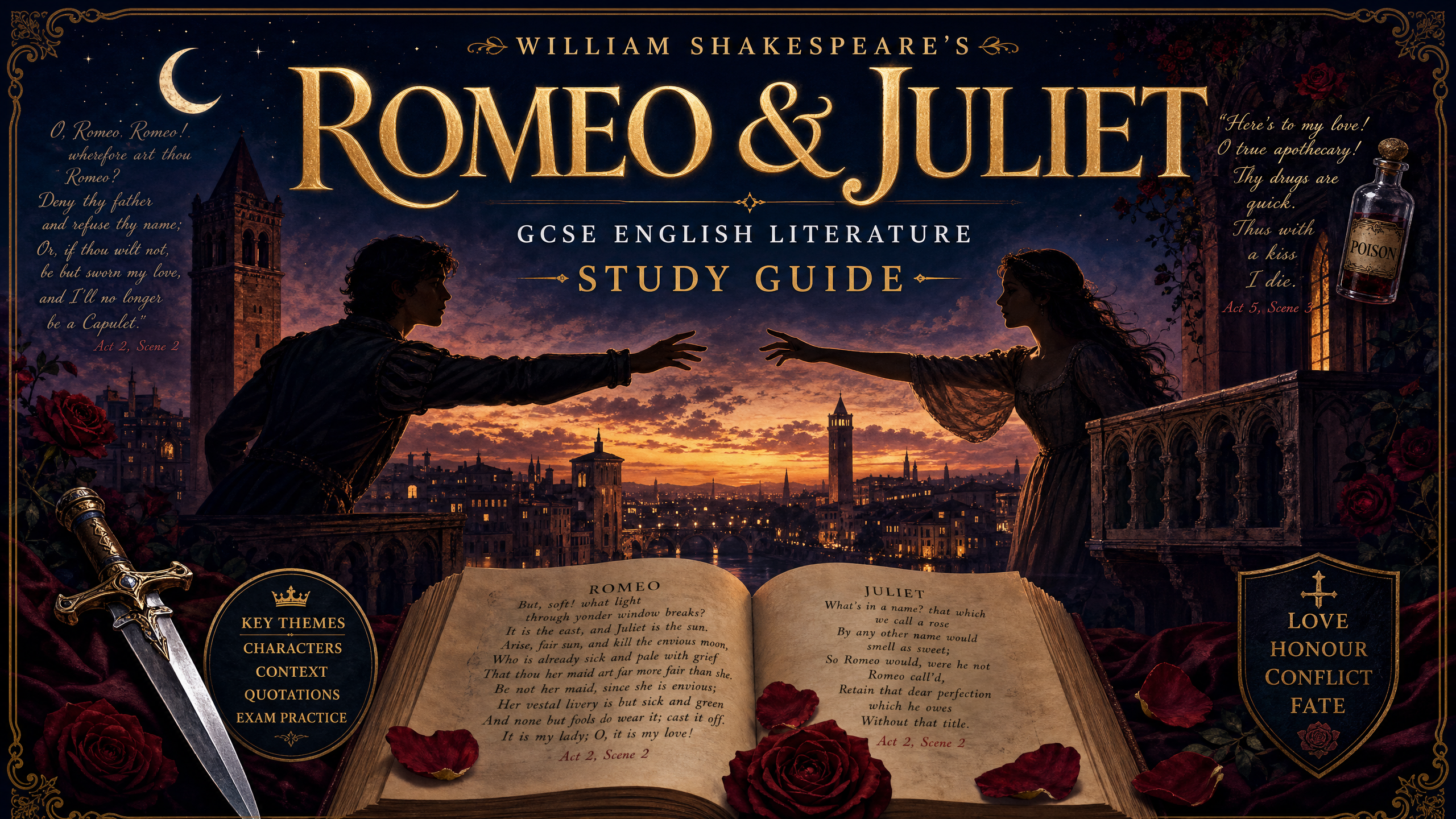
Romeo and Juliet remains one of Shakespeare's most celebrated and frequently examined plays. It is a tragedy that masterfully balances the intense, elevated poetry of young love against the brutal, senseless violence of an ancient family feud. Examiners consistently reward candidates who move beyond simply recounting the plot to deeply analyse Shakespeare's methods—specifically his use of contrasting imagery (light/dark, love/hate), dramatic irony, and structural pacing that accelerates the lovers towards their inevitable doom. A perceptive reading also requires an understanding of the patriarchal Elizabethan society that restricts Juliet's agency and the toxic masculinity that drives the violence between the Montagues and Capulets.
Listen to our comprehensive audio guide for a deeper dive into the play's core themes and examiner expectations:
Plot/Content Overview
Act 1: The play opens with a violent brawl between the Montagues and Capulets. Prince Escalus threatens death to anyone who disturbs the peace again. Romeo is depressed over his unrequited love for Rosaline. Meanwhile, Lord Capulet arranges for Paris to marry Juliet. Romeo and his friends gatecrash the Capulet feast, where Romeo and Juliet meet and instantly fall in love, only to discover their families are sworn enemies.
Act 2: In the famous Balcony Scene, Romeo and Juliet declare their love and agree to marry secretly. Friar Lawrence agrees to perform the ceremony, hoping it will end the family feud. The Nurse acts as a messenger, and the two are married that afternoon.
Act 3: The turning point. Tybalt challenges Romeo to a duel. Romeo refuses, so Mercutio fights Tybalt instead and is killed when Romeo intervenes. In a rage, Romeo kills Tybalt and is banished from Verona by the Prince. Juliet is devastated, and her grief is compounded when her father aggressively demands she marry Paris in three days.
Act 4: Juliet seeks help from Friar Lawrence, who gives her a potion that will make her appear dead for 42 hours. The plan is for Romeo to rescue her from the family tomb. Juliet drinks the potion and is discovered 'dead' on the morning of her wedding to Paris.
Act 5: The tragic climax. The Friar's letter explaining the plan fails to reach Romeo. Hearing Juliet is dead, Romeo buys poison and goes to her tomb. He encounters Paris, kills him, and then drinks the poison next to Juliet. Juliet wakes up, finds Romeo dead, and stabs herself with his dagger. The Montagues and Capulets arrive, see the tragic consequences of their feud, and finally agree to peace.
Themes
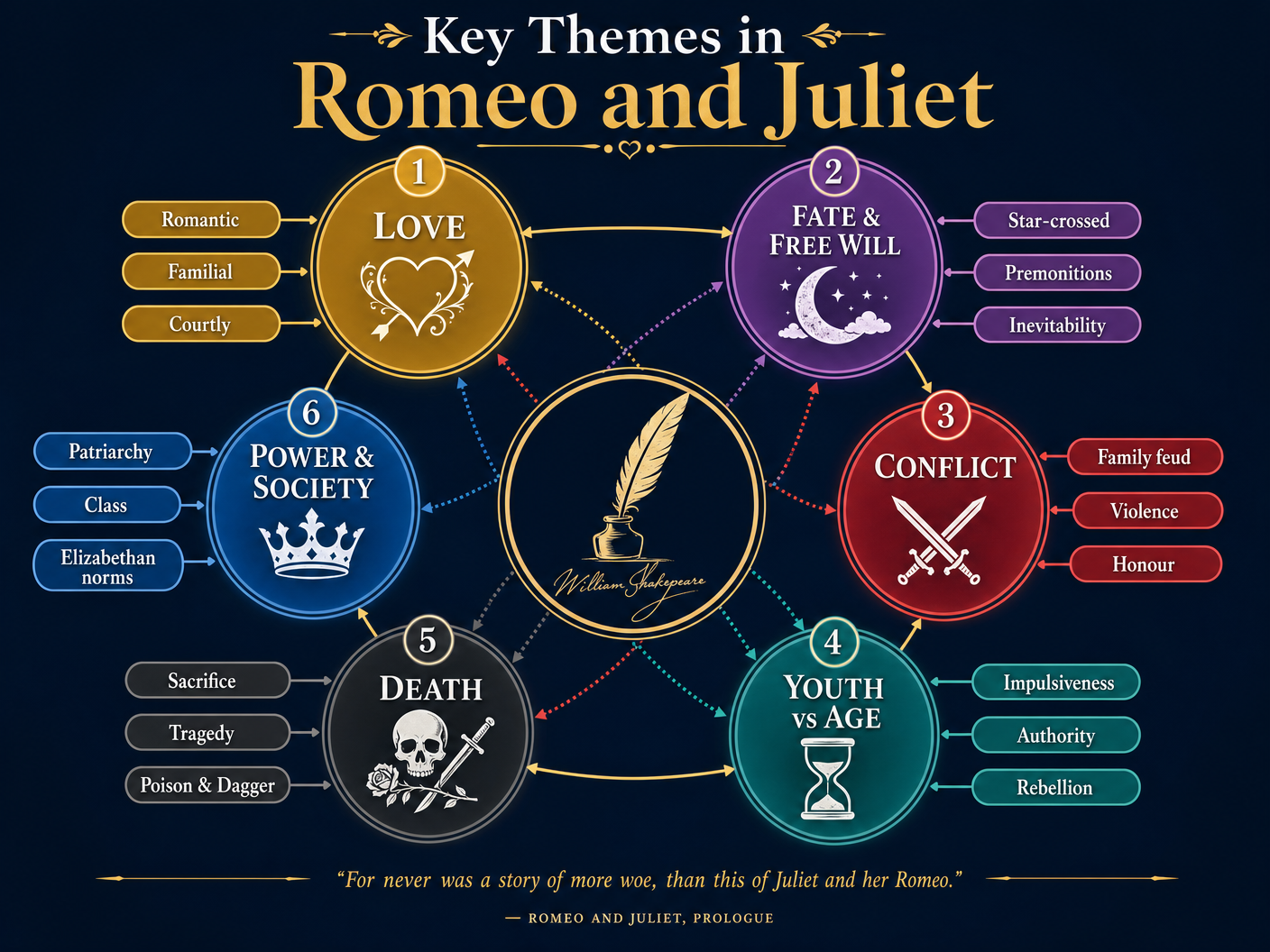
Theme 1: Love
Shakespeare presents love not as a single emotion, but as a complex, multifaceted force. It ranges from the artificial, courtly love Romeo initially feels for Rosaline, to the profound, transformative romantic love between the protagonists, and the crude, physical interpretations offered by Mercutio and the Nurse. The lovers' language is elevated, often sharing sonnets to demonstrate their perfect intellectual and spiritual connection, yet their love is inextricably linked with violence and death.
Key Quotes:
- "O brawling love! O loving hate!" (Act 1, Scene 1) - Romeo uses oxymorons to describe his unrequited love for Rosaline, showing his confusion and highlighting how closely love and conflict are entwined in Verona.
- "It is the east, and Juliet is the sun." (Act 2, Scene 2) - This powerful metaphor positions Juliet as Romeo's life-giving force, elevating their love to a cosmic, natural scale.
- "My bounty is as boundless as the sea, / My love as deep" (Act 2, Scene 2) - Juliet's simile emphasizes the infinite, overwhelming nature of her genuine love, contrasting with Romeo's earlier artificial poetry.
Theme 2: Fate and Free Will
The tension between destiny and human agency drives the tragedy. The Prologue explicitly tells the audience that the lovers are "star-crossed," creating a pervasive sense of dramatic irony and inevitability. However, Shakespeare also emphasizes how impulsive decisions, miscommunications, and the deeply ingrained societal hatred of the feud actively precipitate the tragic conclusion.
Key Quotes:
- "A pair of star-cross'd lovers take their life" (Prologue) - The celestial imagery establishes fate as an inescapable, hostile force governing their lives.
- "O, I am fortune's fool!" (Act 3, Scene 1) - Romeo realizes his lack of control after killing Tybalt; he sees himself as a plaything of destiny rather than taking responsibility for his impulsive violence.
- "Then I defy you, stars!" (Act 5, Scene 1) - Romeo's attempt to assert free will upon hearing of Juliet's death ironically plays directly into the tragic fate the audience knows is coming.
Theme 3: Conflict and Honour
The ancient grudge between the Montagues and Capulets poisons all aspects of life in Verona. It is a senseless, systemic violence rooted in fragile masculine honour. The feud not only causes physical death but also corrupts familial love, forcing Juliet to choose between her husband and her family.
Key Quotes:
- "Peace? I hate the word, / As I hate hell, all Montagues, and thee." (Act 1, Scene 1) - Tybalt's dialogue uses parallel phrasing to equate the Montagues with damnation, showcasing the irrational, absolute nature of the feud.
- "A plague o' both your houses!" (Act 3, Scene 1) - Mercutio's dying curse serves as a turning point, highlighting that the feud destroys even those who mock it, and foreshadowing the tragedy to come.
Character Analysis
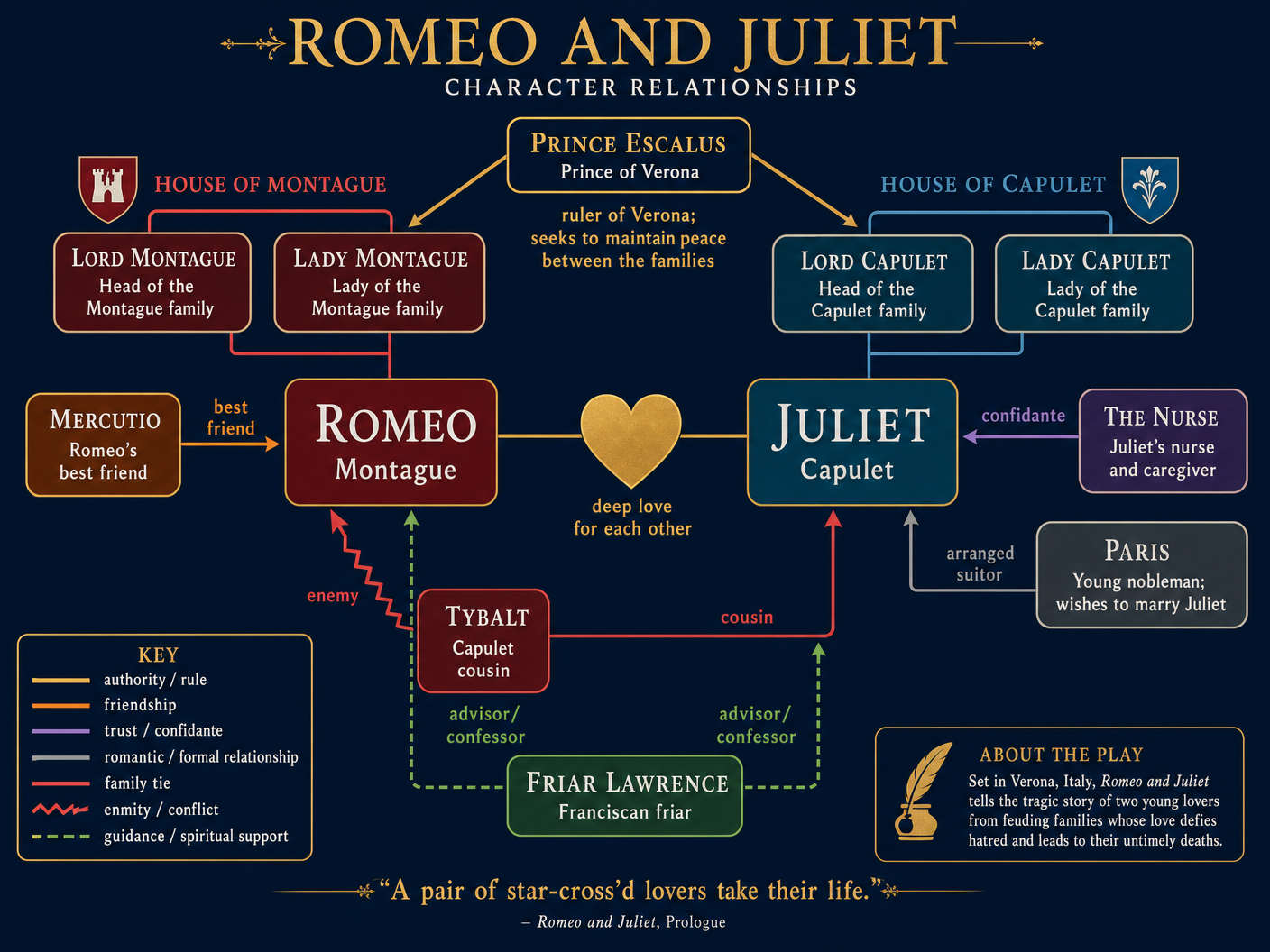
Romeo
Role: The tragic hero; a passionate, impulsive young Montague.
Key Traits: Romantic, hasty, emotionally volatile, deeply loyal to his friends.
Character Arc: Romeo matures from a melancholic, superficial lover (infatuated with Rosaline) to a genuinely devoted husband. However, his fatal flaw—his impulsivity—drives him to murder Tybalt and ultimately commit suicide without pausing to investigate Juliet's apparent death.
Essential Quotes:
- "Did my heart love till now? Forswear it, sight! / For I ne'er saw true beauty till this night." (Act 1, Scene 5)
- "Fire-eyed fury be my conduct now!" (Act 3, Scene 1)
Juliet
Role: The tragic heroine; a strong-willed, intelligent young Capulet.
Key Traits: Pragmatic, decisive, courageous, trapped by patriarchal expectations.
Character Arc: Juliet undergoes the most significant transformation, evolving from an obedient, sheltered child to a fiercely independent young woman who defies her family, her nurse, and societal norms for her husband.
Essential Quotes:
- "O Romeo, Romeo! wherefore art thou Romeo? / Deny thy father and refuse thy name" (Act 2, Scene 2)
- "If all else fail, myself have power to die." (Act 3, Scene 5)
Lord Capulet
Role: Juliet's father; the patriarch of the Capulet household.
Key Traits: Authoritative, volatile, protective but ultimately oppressive.
Character Arc: Initially appearing as a reasonable father who wants Juliet's consent to marry, he becomes violently tyrannical when she disobeys him, perfectly illustrating the absolute power of the Elizabethan patriarch.
Essential Quotes:
- "Hang thee, young baggage! disobedient wretch!" (Act 3, Scene 5)
- "My child is yet a stranger in the world" (Act 1, Scene 2)
Writer's Methods
Shakespeare employs a rich variety of techniques to shape audience response. Form is crucial: the play is a tragedy, but the first two acts follow the structure of a comedy, making the sudden shift to violence in Act 3 all the more shocking. He uses structural pacing, compressing the action into just four days to create a sense of breathless, unstoppable momentum.
In terms of language, Shakespeare relies heavily on contrasting imagery—particularly light and dark—to emphasize the extremes of the lovers' experience. Romeo and Juliet's dialogue often forms shared sonnets, demonstrating their perfect harmony, while characters like the Nurse speak in prose or bawdy blank verse to highlight their lower social status and pragmatic worldview.
Context
To achieve top marks (AO3), candidates must weave contextual understanding into their analysis. The play reflects the strict patriarchal society of Elizabethan England, where women were considered property of their fathers and arranged marriages were economic transactions. Juliet's rebellion is therefore not just romantic, but socially subversive. Furthermore, the Elizabethan audience held strong beliefs in astrology and fate, making the concept of "star-crossed lovers" deeply resonant. The senseless violence of the feud also critiques the destructive nature of the code of honour and duelling, which was a significant social issue in Shakespeare's time.
Visual Resources
2 diagrams and illustrations
Interactive Diagrams
1 interactive diagram to visualise key concepts
Conceptual Flow Outline
The structural pacing and tragic trajectory of Romeo and Juliet
Worked Examples
2 detailed examples with solutions and examiner commentary
Practice Questions
Test your understanding — click to reveal model answers
Starting with this extract (Act 1 Scene 5, Romeo and Juliet's first meeting), explore how Shakespeare presents the power of love. (30 marks)
Hint: Focus on the shared sonnet in the extract to show their connection, then contrast this genuine love with Romeo's earlier infatuation with Rosaline and the violent backdrop of Verona.
How does Shakespeare present the character of the Nurse and her importance to the play? (30 marks)
Hint: Consider her dual role: she provides comic relief and maternal affection early on, but her pragmatic advice in Act 3 represents a devastating betrayal of Juliet.
Explore how Shakespeare presents the theme of male aggression and honour in the play. (30 marks)
Hint: Look closely at Tybalt, Mercutio, and the opening brawl. How does the need to defend 'honour' lead directly to tragedy?
How does Shakespeare present Juliet as a strong female character? (30 marks)
Hint: Contrast her initial obedience with her later defiance. Look at her pragmatic language in the balcony scene and her courage in taking the Friar's potion.