Silas Marner
George Eliot's 'Silas Marner' is a profound exploration of isolation, community, and the redemptive power of love. Studying this novel rewards candidates who can unpick Eliot's subtle narrative voice and rich symbolism.
Study Notes
Overview
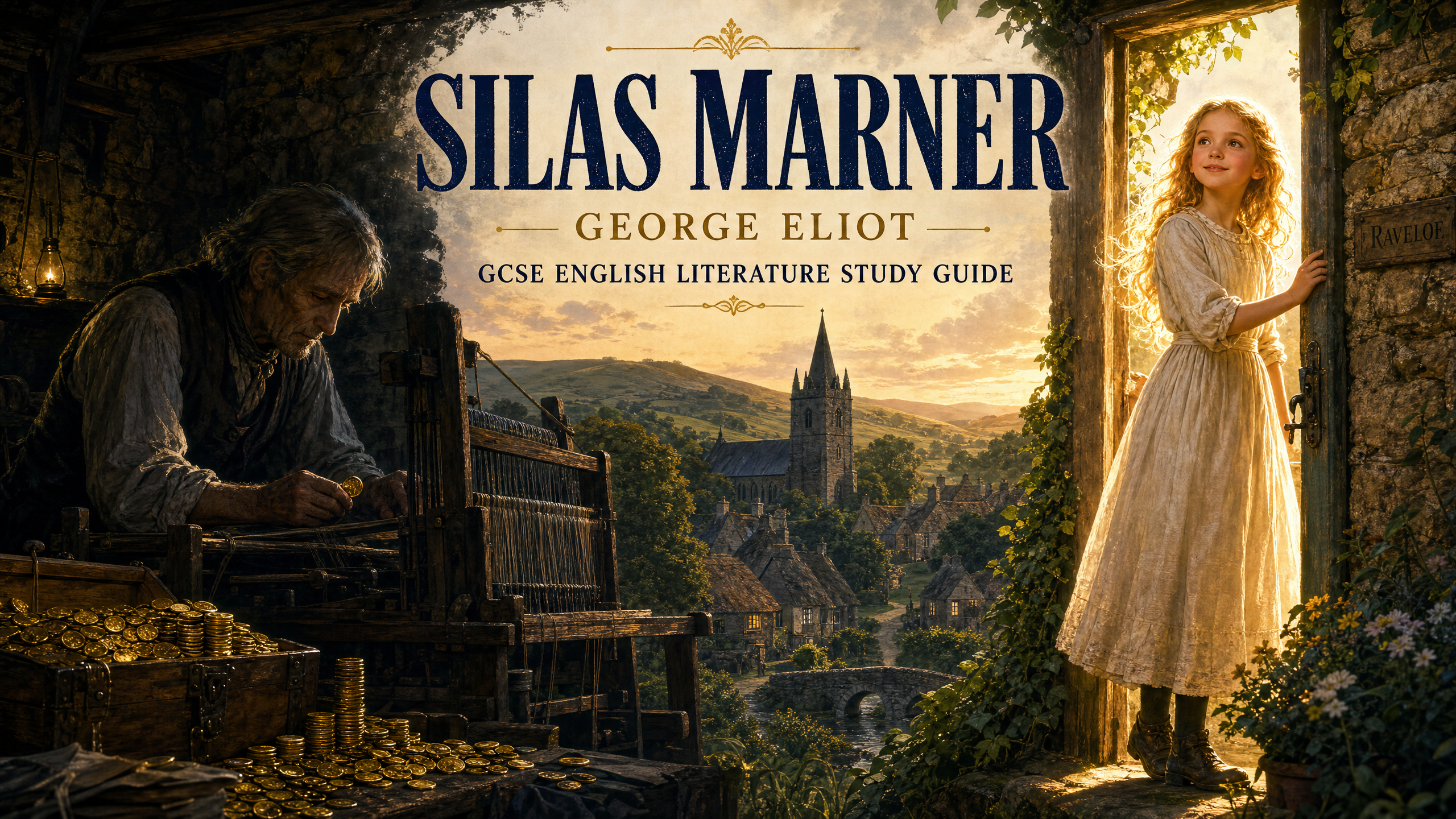
George Eliot's Silas Marner (1861) is a staple of the GCSE English Literature specification. It offers rich opportunities for students to explore themes of redemption, community, and the corrupting influence of materialism. Set in the early 19th century, the novel contrasts the warm, organic community of Raveloe with the rigid, institutional religion of Lantern Yard. Examiners look for candidates who move beyond plot summary to analyse Eliot's omniscient narrative voice, her use of structural parallelism, and her intricate symbolism (particularly the substitution of gold for a golden-haired child).
Plot/Content Overview
Part One
- Chapter 1-2: We are introduced to Silas Marner, a solitary weaver in Raveloe. A flashback reveals his past in Lantern Yard, where he was falsely accused of theft by his friend William Dane and lost his faith.
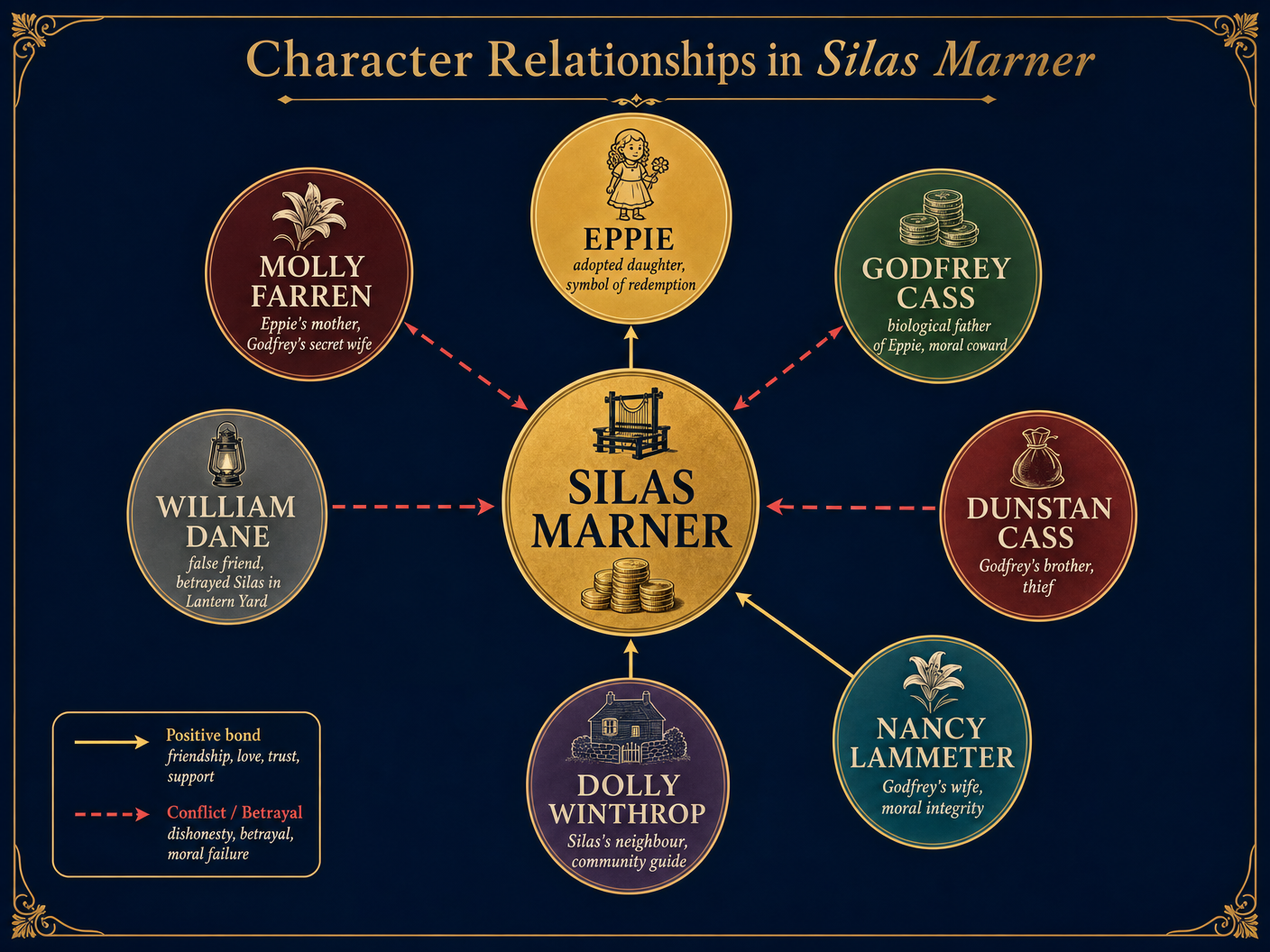
- Chapter 3-4: The narrative shifts to the Cass family. Godfrey Cass is secretly married to the opium-addicted Molly Farren. His brother, Dunstan, blackmails him. Dunstan steals Silas's gold.
- Chapter 5-10: Silas discovers the theft. The community of Raveloe, previously suspicious of him, begins to show sympathy, notably Dolly Winthrop.
- Chapter 11-15: New Year's Eve. Molly Farren dies in the snow while walking to the Red House to expose Godfrey. Her toddler crawls into Silas's cottage. Silas decides to keep the child, naming her Eppie. Godfrey marries Nancy Lammeter.
Part Two
- Chapter 16-21: Sixteen years later. Silas is fully integrated into Raveloe society through his love for Eppie. Dunstan's body and the stolen gold are discovered in the drained stone-pit. Godfrey confesses his secret marriage to Nancy and attempts to claim Eppie. Eppie rejects him, choosing to stay with Silas.
- Conclusion: Eppie marries Aaron Winthrop. The novel ends with a celebration of community and restored faith.
Themes
Theme 1: Redemption and Transformation
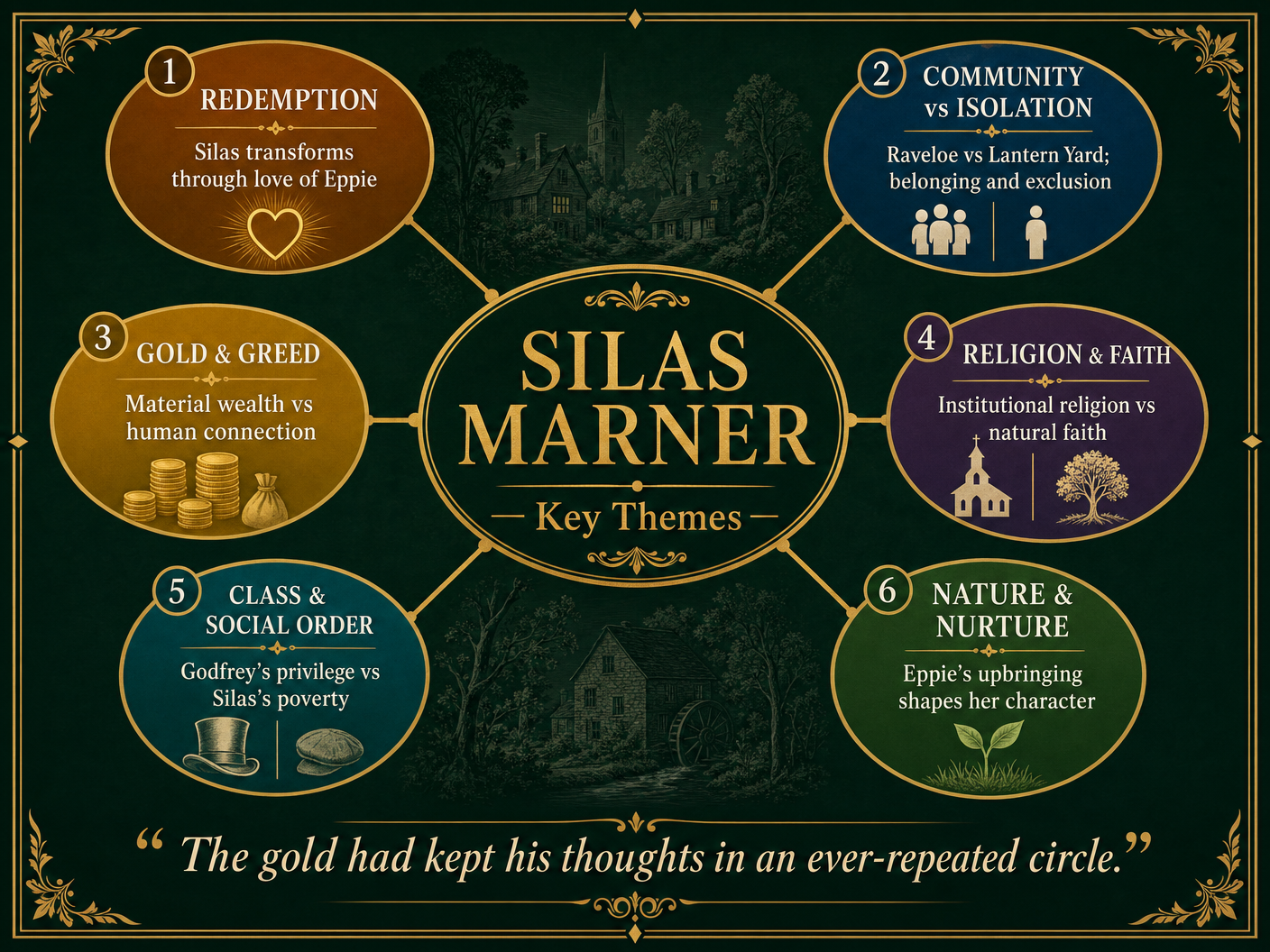
Silas's journey from a broken, isolated miser to a loving father is the moral core of the novel. Eliot suggests that true redemption comes not from institutional religion, but from human connection and nurturing love.
Key Quotes:
- "His life had reduced itself to the functions of weaving and hoarding." (Chapter 2) - Eliot's use of the reflexive verb highlights Silas's passive descent into isolation. His humanity is diminished.
- "The child created fresh and fresh links between his life and the lives from which he had hitherto shrunk continually into narrower isolation." (Chapter 14) - The repetition of 'fresh' emphasises renewal and rebirth. Eppie is the catalyst for his spiritual resurrection.
Theme 2: Community vs. Isolation
Eliot contrasts the rigid, unforgiving sect of Lantern Yard with the flawed but ultimately supportive community of Raveloe. Silas's initial isolation is both physical and emotional.
Key Quotes:
- "He seemed to weave, like the spider, from pure impulse, without reflection." (Chapter 2) - The animalistic simile emphasises his alienation from human society.
- "There's good i' this world—I've a feeling o' that now." (Chapter 16) - Silas's dialect shows his integration into the Raveloe community and his restored faith in humanity.
Theme 3: Materialism vs. Human Connection (The Symbolism of Gold)
Gold is a central motif. Initially, it represents Silas's emotional void. When Eppie arrives, her golden hair symbolically replaces the cold coins, asserting the superiority of human love over material wealth.
Key Quotes:
- "The gold had kept his thoughts in an ever-repeated circle." (Chapter 2) - The metaphor of the circle suggests entrapment and the sterile, unproductive nature of greed.
- "He thought it was his gold brought back to him... but instead of the hard coin with the familiar resisting outline, his fingers encountered soft warm curls." (Chapter 12) - The tactile contrast between 'hard coin' and 'soft warm curls' underscores the shift from materialism to human affection.
Character Analysis
Silas Marner
Role: Protagonist; the moral centre whose arc defines the novel's thematic structure.
Key Traits: Initially alienated, obsessive, and spiritually broken; later loving, integrated, and renewed.
Character Arc: Moves from the trauma of false accusation in Lantern Yard to the hoarding of gold in Raveloe, and finally to spiritual rebirth through his adoption of Eppie.
Essential Quotes:
- "A pallid undersized man, with the prominent eyes that belong to a vocation of pliant rather than muscular labour."
- "It's a lone thing—and I'm a lone thing."
Godfrey Cass
Role: Silas's foil; the biological father who fails in his moral duty.
Key Traits: Weak-willed, morally compromised, privileged but unhappy.
Character Arc: Godfrey's reliance on chance and his refusal to take responsibility lead to his ultimate punishment: being rejected by his own daughter.
Essential Quotes:
- "A moral cowardice which is the direct result of the life-long, unchecked pursuit of pleasure."
- "I wanted to pass for childless once... I shall pass for childless now against my wish."
Eppie
Role: The catalyst for Silas's redemption; a symbol of natural goodness and love.
Key Traits: Innocent, loyal, deeply connected to nature.
Character Arc: Grows from an abandoned toddler into a principled young woman who chooses love and loyalty over wealth and status.
Essential Quotes:
- "A creature of endless claims and ever-growing desires, seeking and loving sunshine."
- "I can't feel as I've got any father but one."
Writer's Methods
- Omniscient Narrator: Eliot uses a highly intrusive, omniscient narrative voice. The narrator frequently pauses the action to offer moral or philosophical commentary. Examiners reward candidates who analyse how this voice guides the reader's judgement.
- Structural Parallelism: The novel is structured around contrasts: Lantern Yard vs. Raveloe; Silas's hoarding vs. Godfrey's spending; Silas's loss of gold vs. his gain of Eppie.
- Symbolism: The use of gold, the loom, and the hearth are pervasive. The loom represents Silas's mechanical, isolated existence, while the hearth represents warmth, community, and domesticity.
Context
- Industrial Revolution: Written in 1861 but set in the early 1800s, the novel looks back nostalgically to a pre-industrial rural England. Silas, as a hand-loom weaver, represents a dying way of life.
- Religion and Faith: Eliot herself had lost her orthodox Christian faith. The novel reflects her belief in a 'Religion of Humanity'—the idea that God is found in human love and fellowship, rather than in strict dogma (like that of Lantern Yard).
Audio Revision
Listen to our comprehensive 10-minute podcast covering the key themes, characters, and exam techniques for Silas Marner.
Visual Resources
2 diagrams and illustrations
Interactive Diagrams
1 interactive diagram to visualise key concepts
Conceptual Flow Outline
Silas Marner's Arc of Redemption
Worked Examples
2 detailed examples with solutions and examiner commentary
Practice Questions
Test your understanding — click to reveal model answers
Starting with this extract (Chapter 2, describing Silas weaving), explore how Eliot presents isolation in the novel.
Hint: Look at the animalistic similes in the extract. Then contrast this early isolation with his later integration into the community.
How does Eliot present the importance of community in Silas Marner?
Hint: Think about Dolly Winthrop as the embodiment of community, and the Rainbow Inn as the physical centre of it.
Explore the significance of the ending of Silas Marner.
Hint: The ending resolves the moral arcs: Silas is rewarded, Godfrey is punished.
How far do you agree that Nancy Lammeter is a completely sympathetic character?
Hint: She is principled, but her principles are rigid. Her refusal to adopt a child causes suffering.