Skirrid Hill
Owen Sheers' 'Skirrid Hill' is a profound exploration of Welsh identity, landscape, and the universal experience of loss. Studying this collection offers candidates a rich opportunity to analyse how a contemporary poet uses natural imagery and fragmented structures to map the terrain of human relationships and history.
Study Notes
Overview
Owen Sheers’ 2005 collection Skirrid Hill takes its title from the Welsh mountain Ysgyryd Fawr, a name derived from the Welsh word for 'divorced' or 'separated'. This etymology is the conceptual key to the entire collection. Examiners look for candidates who understand that Sheers uses the physical fracture of the Welsh landscape as an extended metaphor for emotional, historical, and cultural separation. To achieve high marks (Level 5/6), candidates must move beyond merely identifying these themes to analysing how Sheers constructs them through precise, often fragile imagery and deliberate structural choices like enjambment and varying stanza lengths. The collection is deeply rooted in Welsh heritage, yet it addresses universal concerns: the transition from youth to adulthood, the fading of traditional masculinity, and the enduring scars of conflict.
Listen to the Revision Podcast
Key Poems Overview
While candidates should be familiar with the whole collection, certain poems are central to Sheers' thematic architecture:
- Skirrid Hill: The title poem establishes the central metaphor of a fractured landscape mirroring fractured relationships.
- Mametz Wood: A powerful elegy for the 38th Welsh Division at the Somme, exploring how the earth itself holds memory.
- The Farrier: A tender observation of a dying craft, examining a quiet, embodied form of masculinity.
- Hedge School: An exploration of how identity and culture are preserved and passed down outside formal structures.
- Winter Swans: A delicate examination of a struggling relationship finding resolution through the natural world.
Themes
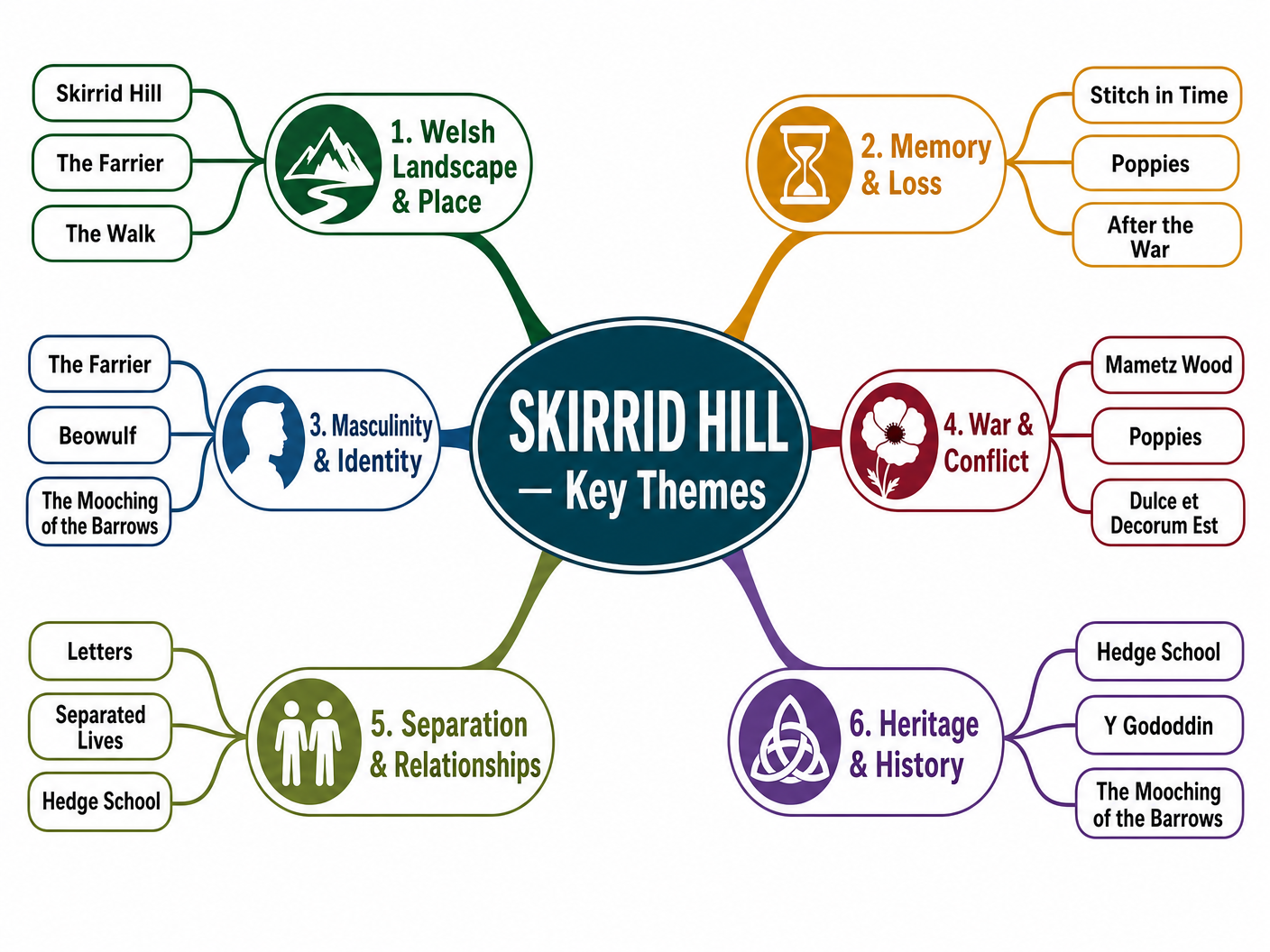
Theme 1: Separation and Loss
This is the gravitational centre of the collection. Sheers explores separation not just as an event, but as an ongoing state of being. The 'divorced' mountain of the title poem casts a shadow over the human relationships depicted throughout. Loss is presented as inevitable, whether it is the loss of life in war, the loss of love, or the loss of traditional ways of living.
Key Quotes:
- "the word skirrid meaning divorced, separated" (Skirrid Hill) - Establishes the linguistic and thematic foundation of the collection. The italicisation draws attention to the word's weight.
- "the earth stands sentinel" (Mametz Wood) - Personifies the landscape as a guardian of the lost, suggesting that while lives are separated from the present, they are held by the earth.
- "the waterlogged earth / gulping for breath at our feet" (Winter Swans) - The pathetic fallacy reflects the suffocating, difficult nature of a relationship on the brink of separation.
Theme 2: Welsh Landscape and Identity
For Sheers, the landscape is never merely a backdrop; it is an active participant in human history. The Welsh terrain—its mountains, soil, and weather—shapes the people who inhabit it. Examiners reward candidates who recognise that Sheers is consciously writing within a tradition of Welsh literature that links topography to national character.
Key Quotes:
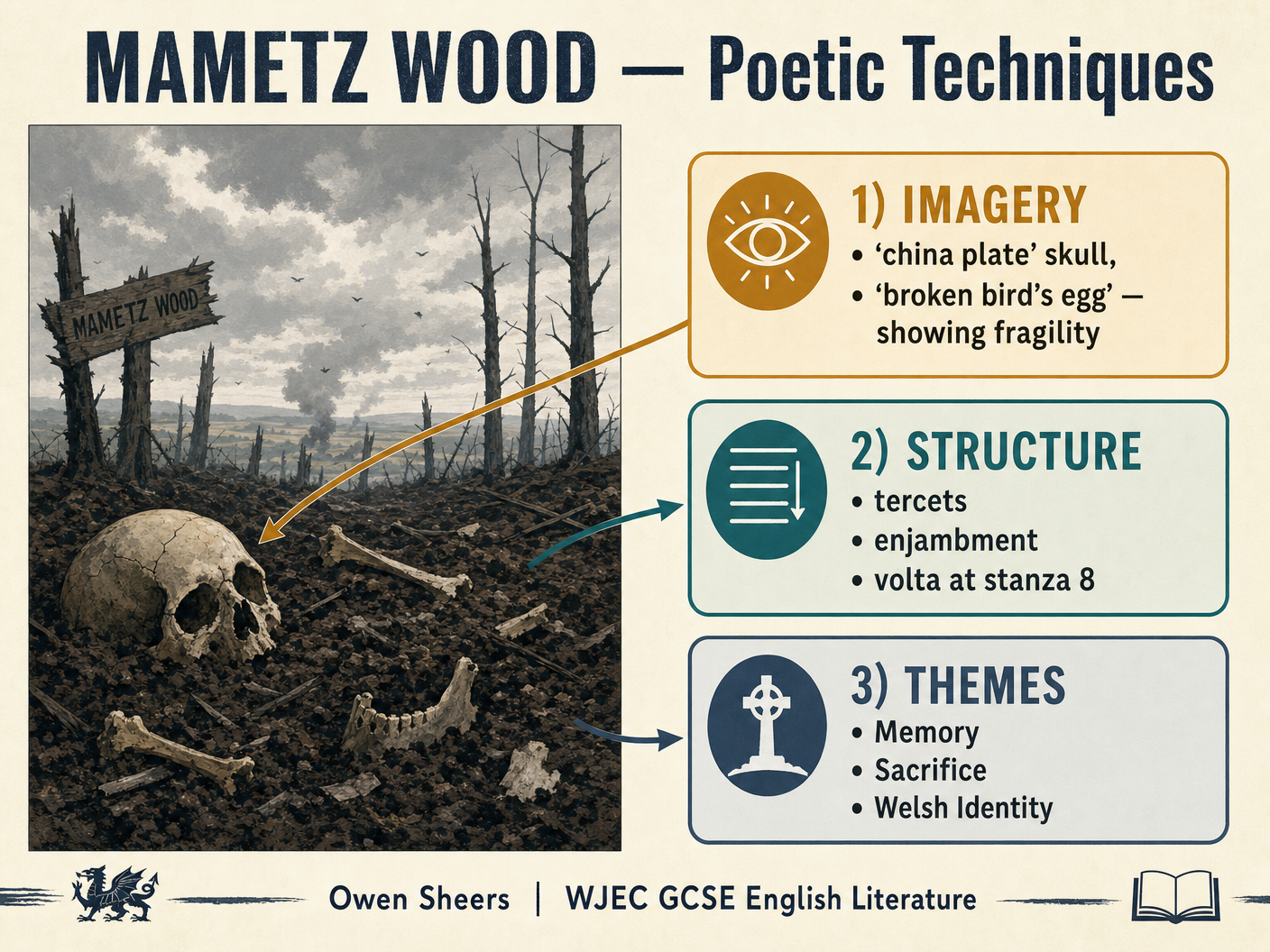
- "a broken bird's egg of a skull" (Mametz Wood) - This fragile, natural imagery connects the fallen Welsh soldiers directly to the natural world, suggesting vulnerability and the tragic interruption of potential.
- "the slow pulse of his good heart" (The Farrier) - Connects the rhythm of traditional Welsh labour to the fundamental rhythms of life, suggesting a deep, almost biological connection to the work and the land.
Theme 3: Masculinity and Craft
Sheers frequently examines what it means to be a man, often focusing on physical labour, skill, and silent endurance. Unlike stereotypical depictions of toxic or aggressive masculinity, Sheers' men—the farrier, the soldiers, the fathers—are defined by their quiet competence, their vulnerability, and their connection to history.
Key Quotes:
- "a romantic lead dropping to the knees of either one" (The Farrier) - Subverts expectations of masculinity by describing the farrier's physical labour in terms of romantic devotion and tenderness.
- "their skeletons paused mid dance-macabre" (Mametz Wood) - A grotesque yet poetic image of the soldiers, highlighting the vulnerability of the male body in the machinery of war.
Writer's Methods
To access AO2 marks, candidates must analyse Sheers' techniques:
Imagery of Fragility: Sheers repeatedly uses delicate imagery (china plates, bird's eggs, swans) to contrast with the harsh realities of war, physical labour, or emotional pain. This juxtaposition heightens the sense of vulnerability.
Structural Enjambment: Sheers frequently uses enjambment across stanzas. This visual 'spilling over' of lines often mimics the thematic content: the past bleeding into the present (in Mametz Wood), or the difficult, continuous effort of communication in a strained relationship.
Form and Stanza Length: Look closely at stanza structure. The tercets in Mametz Wood create a slow, ceremonial pace, like a funeral march or the careful unearthing of a grave. In contrast, poems dealing with fractured relationships often feature irregular or broken stanza forms.
Context (AO3)
Examiners expect context to be integrated, not bolted on. Key contextual factors include:
- The 38th Welsh Division: Understanding the specific historical tragedy at Mametz Wood during the 1916 Battle of the Somme is crucial for that poem.
- Welsh Topography and Language: The physical geography of the Black Mountains and the etymology of Welsh words (like Ysgyryd) deeply inform Sheers' metaphors.
- Post-Industrial Wales: The collection reflects a period of transition in Wales, where traditional agricultural and industrial crafts (like the farrier's) are fading, prompting a re-evaluation of masculine identity.
Visual Resources
2 diagrams and illustrations
Interactive Diagrams
1 interactive diagram to visualise key concepts
Conceptual Flow Outline
The Central Function of Landscape in Skirrid Hill
Worked Examples
2 detailed examples with solutions and examiner commentary
Practice Questions
Test your understanding — click to reveal model answers
Compare how Sheers presents the theme of memory in 'Mametz Wood' and one other poem from Skirrid Hill.
Hint: Think about whether memory is presented as a burden, a duty, or a comfort. 'Stitch in Time' or 'Hedge School' make excellent comparisons.
Explore how Sheers presents ideas about masculinity in 'The Farrier' and one other poem.
Hint: Look for poems that deal with fathers, grandfathers, or traditional male labour. Avoid assuming all masculinity in the collection is the same.
How does Sheers use form and structure to convey meaning in Skirrid Hill? Refer to at least two poems.
Hint: This is an AO2-heavy question. You must talk about stanzas, line lengths, enjambment, and caesura, not just imagery.
Starting with 'Winter Swans', explore how Sheers presents the resolution of conflict.
Hint: Look at the volta (turning point) in the poem. How does nature facilitate the resolution?