The Field-Mouse
Gillian Clarke's 'The Field-Mouse' is a powerful exploration of how global conflict intrudes upon pastoral innocence. By studying this poem, candidates will master the skill of tracking extended metaphors and analysing how subtle shifts in structure and tense can reveal profound anxieties about war, making it an excellent text for high-level AO2 analysis.
Study Notes
Overview
'The Field-Mouse' by Gillian Clarke is a deceptively simple poem that uses a rural Welsh haymaking scene to explore the devastating impact of conflict. Written against the backdrop of the Bosnian War in the 1990s, Clarke uses the pastoral setting as a microcosm for global violence. Examiners reward responses that move beyond a literal reading of the poem to explore how the field-mouse functions as an extended metaphor for innocent victims of war. Strong candidates will integrate contextual awareness (AO3) by linking the 'children sleeping' to the specific anxieties of the Bosnian conflict, while maintaining a sharp focus on Clarke's linguistic and structural methods (AO2).
Plot/Content Overview
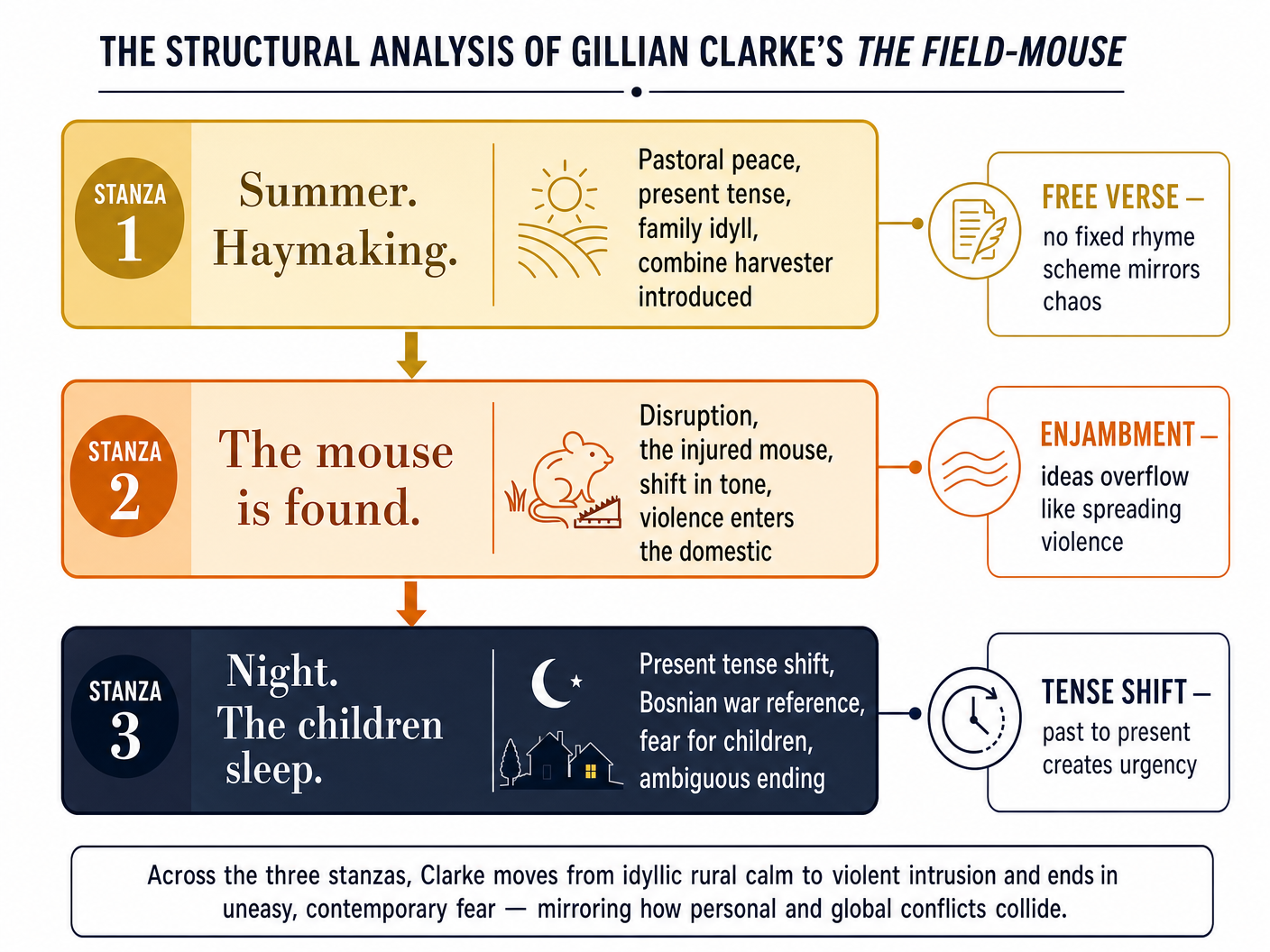
- Stanza 1: A peaceful summer scene is established as a family works in the fields during haymaking. However, the introduction of the combine harvester brings a sense of mechanical indifference and latent danger.
- Stanza 2: The pastoral harmony is shattered when a field-mouse is discovered, injured by the machinery. The mouse is described in human terms, highlighting its vulnerability.
- Stanza 3: The poem shifts to night time and the present tense. The speaker watches the injured mouse and thinks of her own children sleeping, connecting her immediate maternal fear to the broader horrors of children caught in the Bosnian War.
Themes
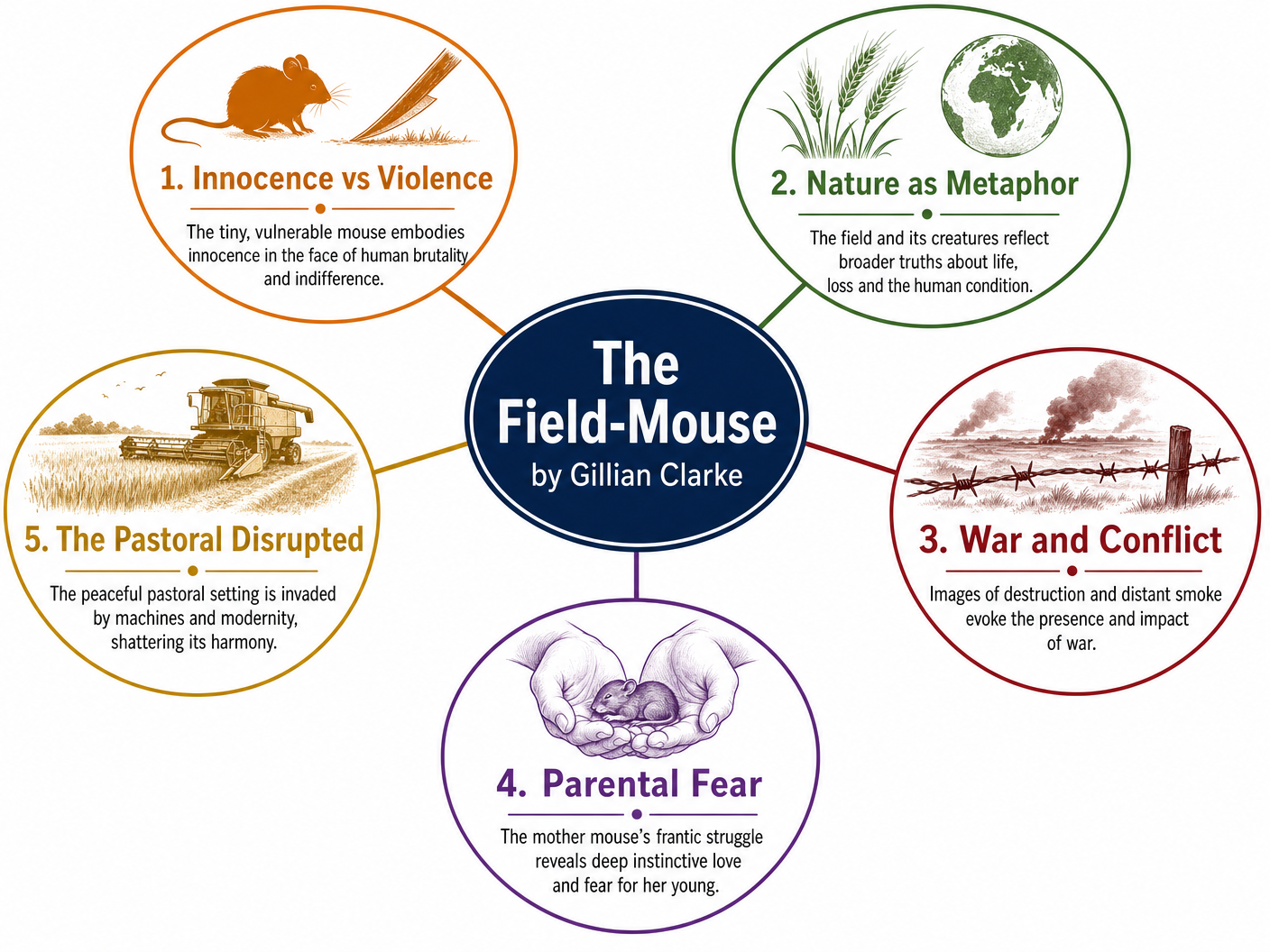
Theme 1: Innocence vs. Violence
Clarke contrasts the fragility of the natural world with the brutal, unfeeling power of machinery and human conflict. The poem suggests that innocence is constantly under threat from forces it cannot control or comprehend.
Key Quotes:
- "the blades didn't trouble to be kind" (Stanza 1) - The personification of the blades suggests a deliberate indifference to suffering. The word 'trouble' implies that mercy was an option, but one the machine (and by extension, humanity) chose to ignore.
- "curled like a fist" (Stanza 2) - This simile presents the mouse in a defensive posture. A fist is usually associated with aggression, but here it conveys a desperate, instinctive attempt at self-preservation against overwhelming odds.
Theme 2: The Disrupted Pastoral
The poem subverts traditional pastoral poetry, which typically idealises rural life. Here, the countryside is not a sanctuary but a site of violence and fear, reflecting how modern conflict respects no boundaries.
Key Quotes:
- "the long grass is a snare drum" (Stanza 1) - The metaphor combines the vitality of summer (the rhythm of the drum) with the threat of entrapment (a snare), establishing an underlying tension from the very first line.
- "the snare of the sun" (Stanza 1) - Even the sun, a source of life and warmth, is described as a trap, reinforcing the idea that nowhere is truly safe.
Theme 3: Parental Fear and Empathy
The speaker's reaction to the injured mouse bridges the gap between the animal and human worlds, culminating in a profound expression of maternal anxiety for all children caught in violence.
Key Quotes:
- "a child's finger" (Stanza 2) - By comparing the mouse to a child, Clarke makes the creature's suffering deeply relatable and foreshadows the poem's final stanza.
- "I watch the field-mouse's eye, / a bead of black fear" (Stanza 3) - The shift to the present tense ('I watch') creates a sense of immediate, visceral empathy. The 'bead of black fear' reflects the speaker's own terror.
Writer's Methods
Form and Structure
- Free Verse: The poem lacks a regular rhyme scheme or metre. This absence of formal structure mirrors the chaos of conflict and the unpredictability of violence intruding upon peaceful life.
- Enjambment: Lines frequently run on without punctuation (e.g., "the tractor / drives its combine"). This creates a sense of unstoppable momentum, reflecting the relentless progress of the machinery and the spreading nature of war.
- Tense Shift: The move from the past tense in the first two stanzas to the present tense in the final stanza ("I watch", "wept") is crucial. It brings the historical reality of the Bosnian War into the immediate, ongoing present of the reader, heightening the emotional impact.
Language and Imagery
- Sibilance: The repetition of 's' sounds ("Summer", "snare", "sun") creates a whispering, insidious tone that undercuts the apparent warmth of the setting.
- Plosives: The hard 'b' and 'd' sounds in "blades didn't trouble" mimic the harsh, mechanical violence of the harvester.
- Extended Metaphor: The field-mouse serves as a vehicle for exploring the vulnerability of all innocents, particularly children, in the face of conflict.
Context
Written during the early 1990s, the poem is explicitly informed by the Bosnian War, a brutal conflict characterised by ethnic cleansing and the displacement of civilians. Clarke, a Welsh poet known for her environmental and feminist concerns, uses her own rural setting to process the horrors she saw on the news. Examiners expect candidates to integrate this context seamlessly (AO3), using it to illuminate the poem's themes of disrupted peace and universal suffering, rather than simply stating historical facts.
Worked Examples
2 detailed examples with solutions and examiner commentary
Practice Questions
Test your understanding — click to reveal model answers
How does Gillian Clarke explore the theme of vulnerability in 'The Field-Mouse'?
Hint: Consider how the mouse is described, the power of the machinery, and the connection made to children at the end of the poem.
Compare how poets present the reality of conflict in 'The Field-Mouse' and one other poem from your anthology.
Hint: Choose a poem that also deals with the psychological impact of war or the suffering of innocents, such as 'War Photographer'.
Explore the significance of the setting in 'The Field-Mouse'.
Hint: How does the pastoral setting contrast with the violence that occurs? Look at the opening and closing lines.
How does the poet use imagery to create a sense of fear in 'The Field-Mouse'?
Hint: Look at the imagery of the machine, the physical description of the mouse, and the 'black bead' of the eye.