The Manhunt
Simon Armitage's 'The Manhunt' offers a profound exploration of the physical and psychological aftermath of war. It is a highly rewarding text for GCSE students as its rich, metaphorical language and deliberate structure provide excellent opportunities for top-band analysis of writer's methods.
Study Notes
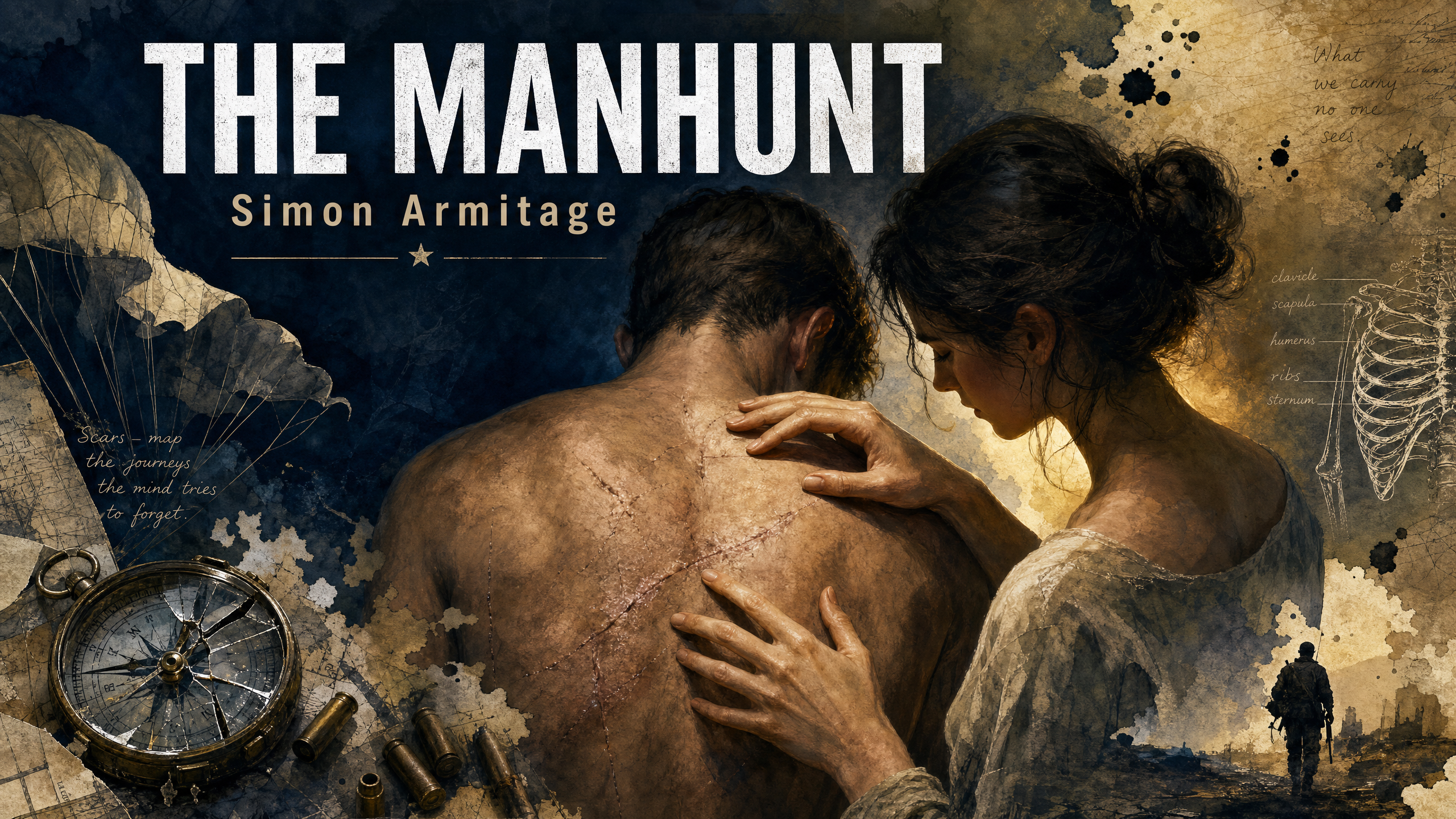
Overview
'The Manhunt' by Simon Armitage is a deeply moving poem that explores the devastating impact of war on a soldier and his relationship with his wife. Originally written for a Channel 4 documentary about the psychological toll of conflict, the poem is narrated from the perspective of Laura, the wife of Eddie Beddoes, a peacekeeper who was injured in Bosnia. Examiners highly reward candidates who can look beyond the literal description of physical injuries to analyse the poem's central metaphor: the painstaking, delicate process of trying to reconnect with a loved one who has been fundamentally changed by trauma. For top marks, you must focus on how Armitage uses structure (particularly the paired couplets) and imagery to enact this slow journey of discovery.
Plot/Content Overview
Unlike a narrative poem with a clear plot, 'The Manhunt' is structured as a physical and emotional journey. It traces the wife's gentle, step-by-step exploration of her husband's body after his return from war. The poem moves chronologically from the external, visible injuries (the scarred face, the damaged collarbone) down to the internal, psychological wounds (the 'punctured lung', the 'closed fist of his heart'). The progression mirrors the slow, difficult process of attempting to understand the depth of his trauma.
Themes
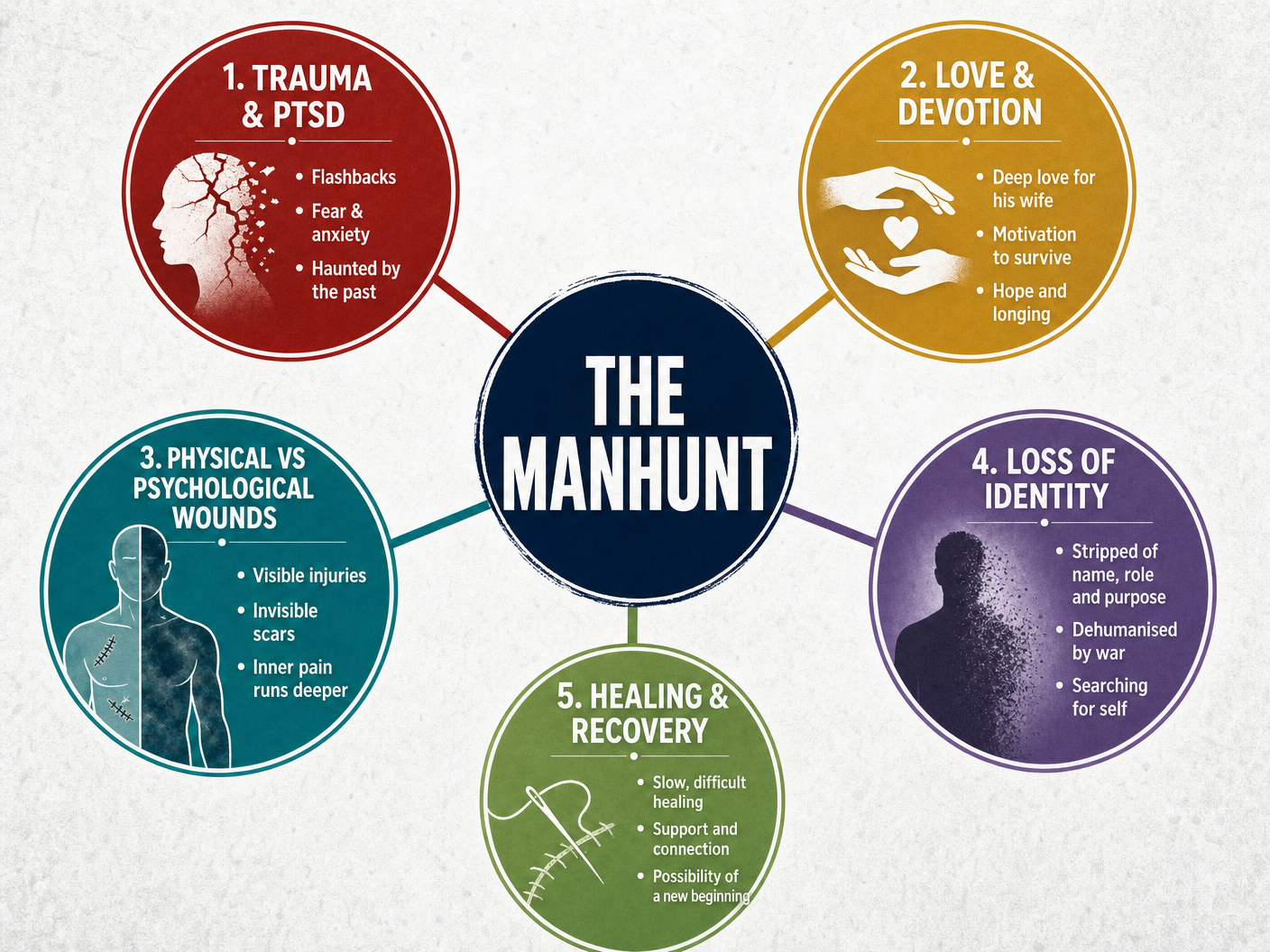
Theme 1: Trauma and PTSD
Armitage vividly captures the isolating and paralyzing effects of Post-Traumatic Stress Disorder. The poem suggests that while physical wounds may heal, the psychological damage of war is far more enduring and difficult to reach. The husband is presented as emotionally inaccessible, trapped within his own traumatic memories.
Key Quotes:
- "the frozen river which ran through his face" - The oxymoron of a 'frozen river' suggests that his ability to express emotion and connect with others has been paralyzed by trauma. A river should flow with life, but he is emotionally numb.
- "a sweating, unexploded mine / buried deep in his mind" - This metaphor powerfully conveys the constant, underlying threat of his PTSD. The trauma is hidden ('buried deep') but volatile and dangerous, capable of detonating at any moment.
Theme 2: Love, Devotion, and Healing
The poem is ultimately a testament to the wife's enduring love and commitment. Despite the profound changes in her husband, she remains dedicated to the slow, painstaking process of helping him heal. The poem emphasizes that healing is not an event, but a difficult, ongoing journey requiring immense patience.
Key Quotes:
- "After the first phase, / after passionate nights and intimate days" - The word 'phase' introduces a clinical, almost medical tone, suggesting that their reconnection is a structured, necessary process rather than purely romantic.
- "only then could I picture the scan" - The repetition of 'only then' throughout the poem emphasizes the gradual, step-by-step nature of her understanding. Healing cannot be rushed.
Theme 3: The Dehumanization of Conflict
Armitage uses language associated with machinery, metal, and inanimate objects to describe the husband's body. This creates a disturbing sense that war has stripped him of his humanity, reducing him to broken parts.
Key Quotes:
- "the blown hinge of his lower jaw" - Comparing a human jaw to a 'blown hinge' suggests he has been broken like a machine or a door. It emphasizes the violent, unnatural nature of his injuries.
- "the damaged, porcelain collar-bone" - Porcelain is beautiful but fragile and easily shattered. This image highlights his vulnerability and the permanent alteration of his physical self.
Character Analysis
The Wife (The Speaker)
Role: The active agent in the poem; the 'hunter' searching for her lost husband.
Key Traits: Patient, tender, determined, empathetic.
Character Arc: She moves from exploring visible physical scars to uncovering the deep, hidden psychological trauma.
Essential Quotes:
- "only then would he let me trace"
- "I bind the struts / and climb the rungs"
The Husband (Eddie Beddoes)
Role: The subject of the poem and the recipient of the 'manhunt'.
Key Traits: Damaged, vulnerable, emotionally closed off, traumatized.
Character Arc: He is entirely passive throughout the poem, reflecting his state of paralysis and emotional withdrawal due to PTSD.
Essential Quotes:
- "the closed fist of his heart"
- "the frozen river which ran through his face"
Writer's Methods
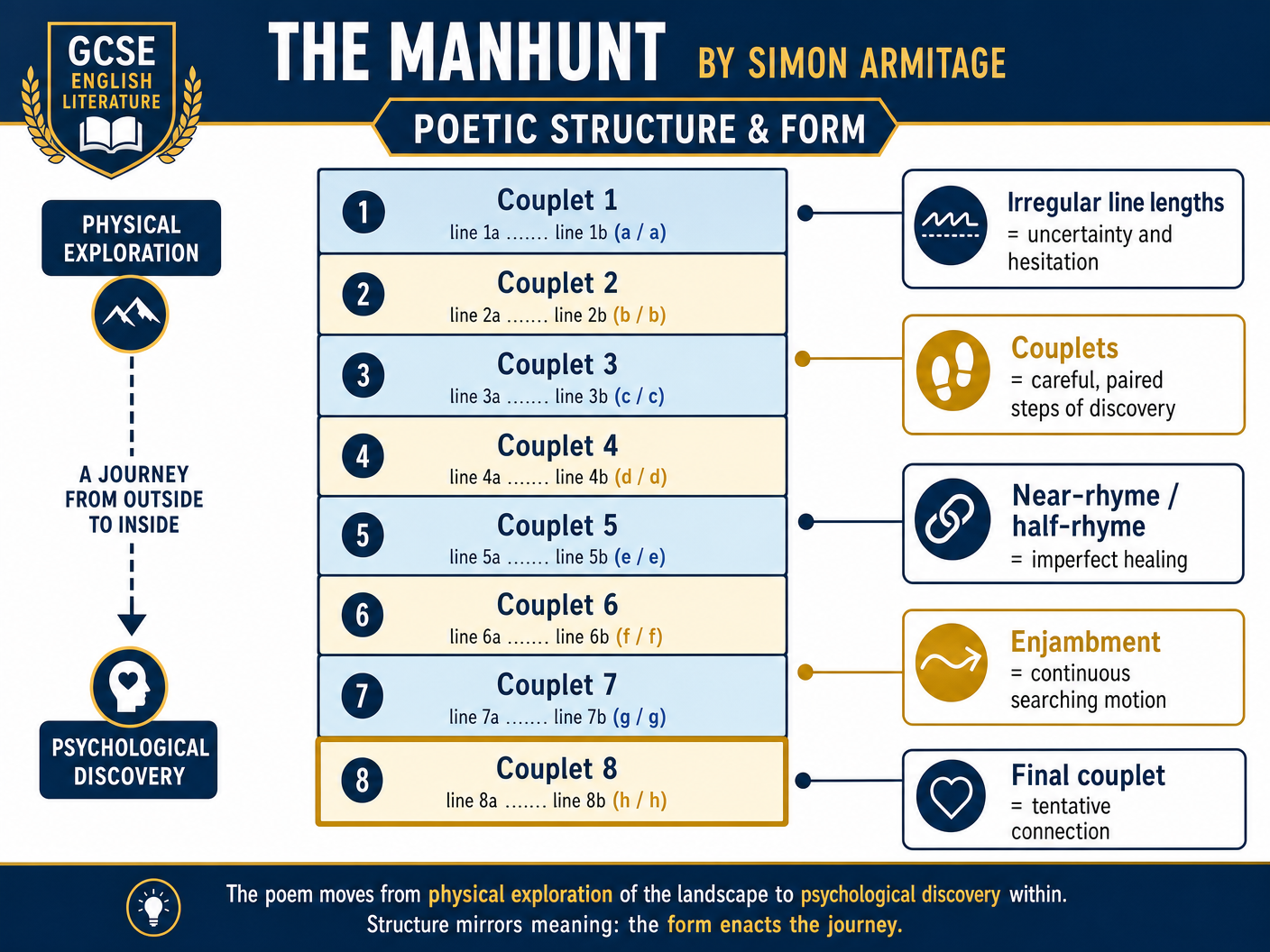
Armitage's use of structure is central to the poem's meaning. The poem is written in two-line stanzas (couplets). This form physically mirrors the careful, step-by-step progression of the wife's search. Each couplet represents a new discovery, a new touch.
Furthermore, the rhymes are often half-rhymes or near-rhymes (e.g., 'phase/days', 'lung/rungs'). This deliberate imperfection in the rhyme scheme reflects the imperfect nature of the healing process; the couple are trying to connect, but they are not quite perfectly aligned.
Enjambment (where lines run on without punctuation) is used frequently to create a sense of continuous, searching movement, mimicking the wife's ongoing effort to reach her husband.
Context
'The Manhunt' was originally broadcast as part of a Channel 4 documentary called Forgotten Heroes: The Not Dead (2007). It focuses on Eddie Beddoes, who served as a peacekeeper in Bosnia before being discharged due to injury and depression. Understanding this context is crucial for AO3 marks. The poem reflects a modern understanding of Post-Traumatic Stress Disorder (PTSD), acknowledging that the invisible psychological wounds of war are often far more devastating and difficult to treat than the visible physical injuries.
Interactive Diagrams
1 interactive diagram to visualise key concepts
Conceptual Flow Outline
The structural journey of the poem from physical to psychological.
Worked Examples
2 detailed examples with solutions and examiner commentary
Practice Questions
Test your understanding — click to reveal model answers
How does Armitage present the relationship between the husband and wife in 'The Manhunt'? (30 marks)
Hint: Consider the power dynamic: the wife is active and searching, while the husband is passive and damaged. Focus on the language of care versus the language of war.
Explore how Armitage uses imagery to convey the lasting impact of conflict. (30 marks)
Hint: Track the progression of imagery from the physical/mechanical to the psychological/emotional.