The Soldier
Rupert Brooke's 'The Soldier' is a profound exploration of patriotic idealism and the spiritual transcendence of death. Studying this poem allows candidates to engage deeply with early World War I attitudes, providing excellent opportunities to earn AO2 marks through its sophisticated use of the Petrarchan sonnet form and organic metaphors.
Study Notes
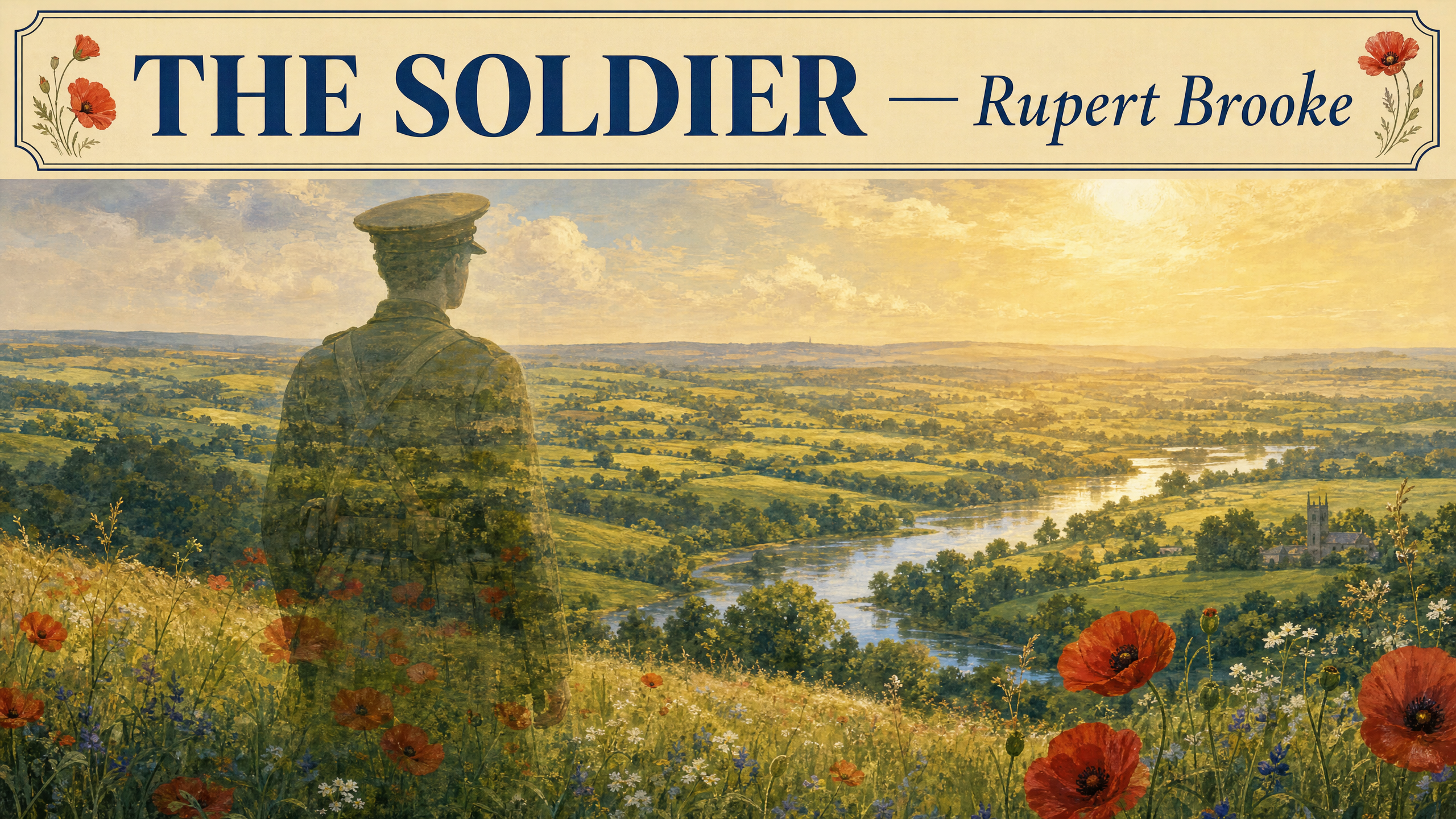
Overview
Rupert Brooke's 'The Soldier' (1914) is a cornerstone of First World War poetry, capturing the intense patriotic fervour that characterised the early months of the conflict. Unlike the later, disillusioned works of Wilfred Owen or Siegfried Sassoon, Brooke presents death in battle not as a tragedy, but as a noble, purifying sacrifice. For examiners, a top-tier response will move beyond merely describing this patriotism to critically analysing how Brooke constructs it. Candidates are heavily rewarded for exploring his deliberate use of the Petrarchan sonnet form to elevate national duty to the status of romantic love, and his complex personification of England as a nurturing, almost divine mother figure.
Listen to our revision podcast here:
Poem Overview
The poem is structured in two distinct movements, following the traditional sonnet form:
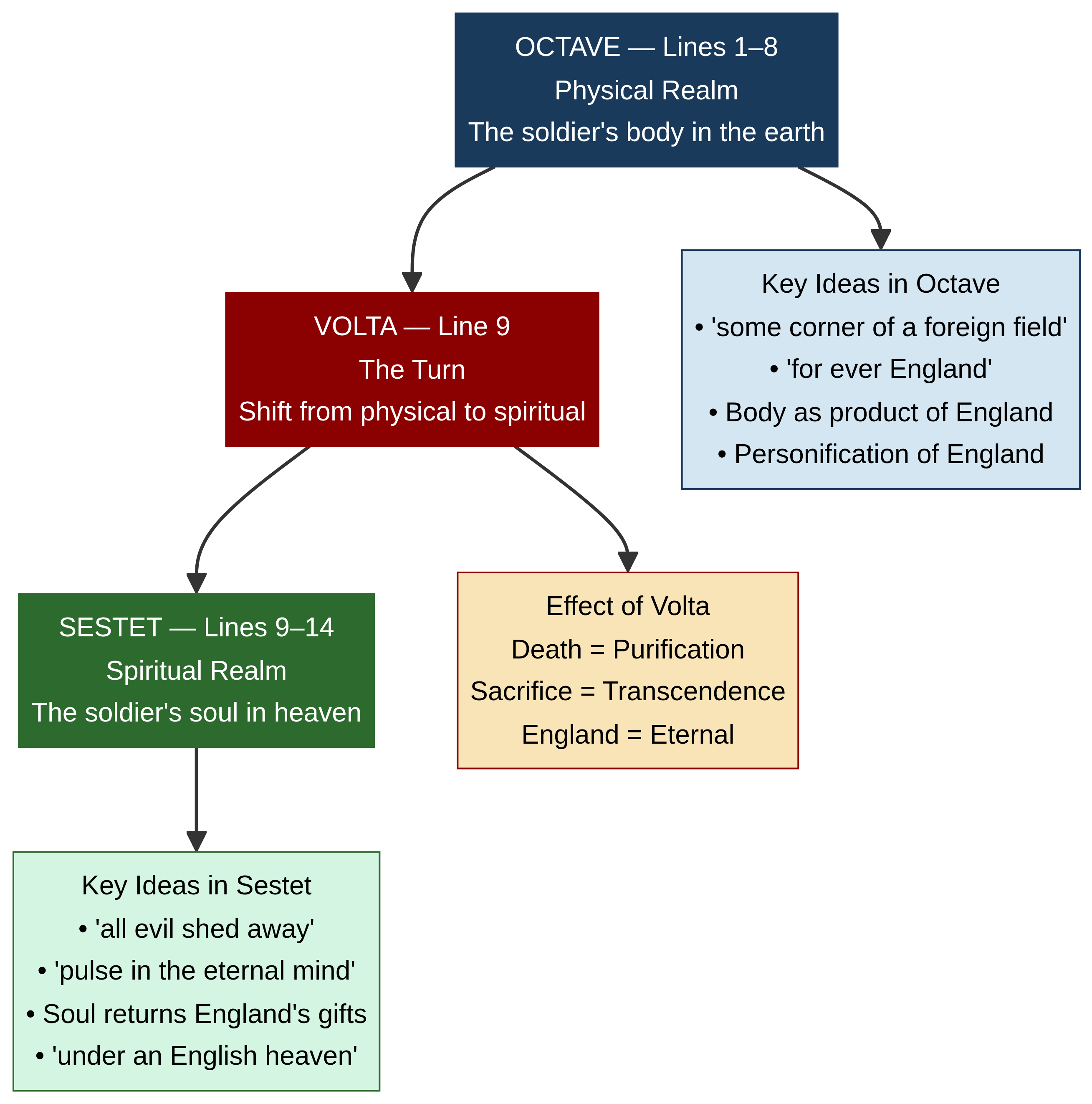
The Octave (Lines 1-8): The Physical RealmThe speaker contemplates the possibility of his death in a foreign land. He asserts that wherever his body falls, that patch of earth will become "for ever England" because his body was entirely formed and nurtured by the English landscape.
The Sestet (Lines 9-14): The Spiritual RealmThe focus shifts from the physical body to the immortal soul. The speaker imagines his soul, now purified of "all evil," returning to an "eternal mind" (God or a collective consciousness). Even in heaven, he will experience the peace, dreams, and gentle laughter that England originally gave him.
Themes
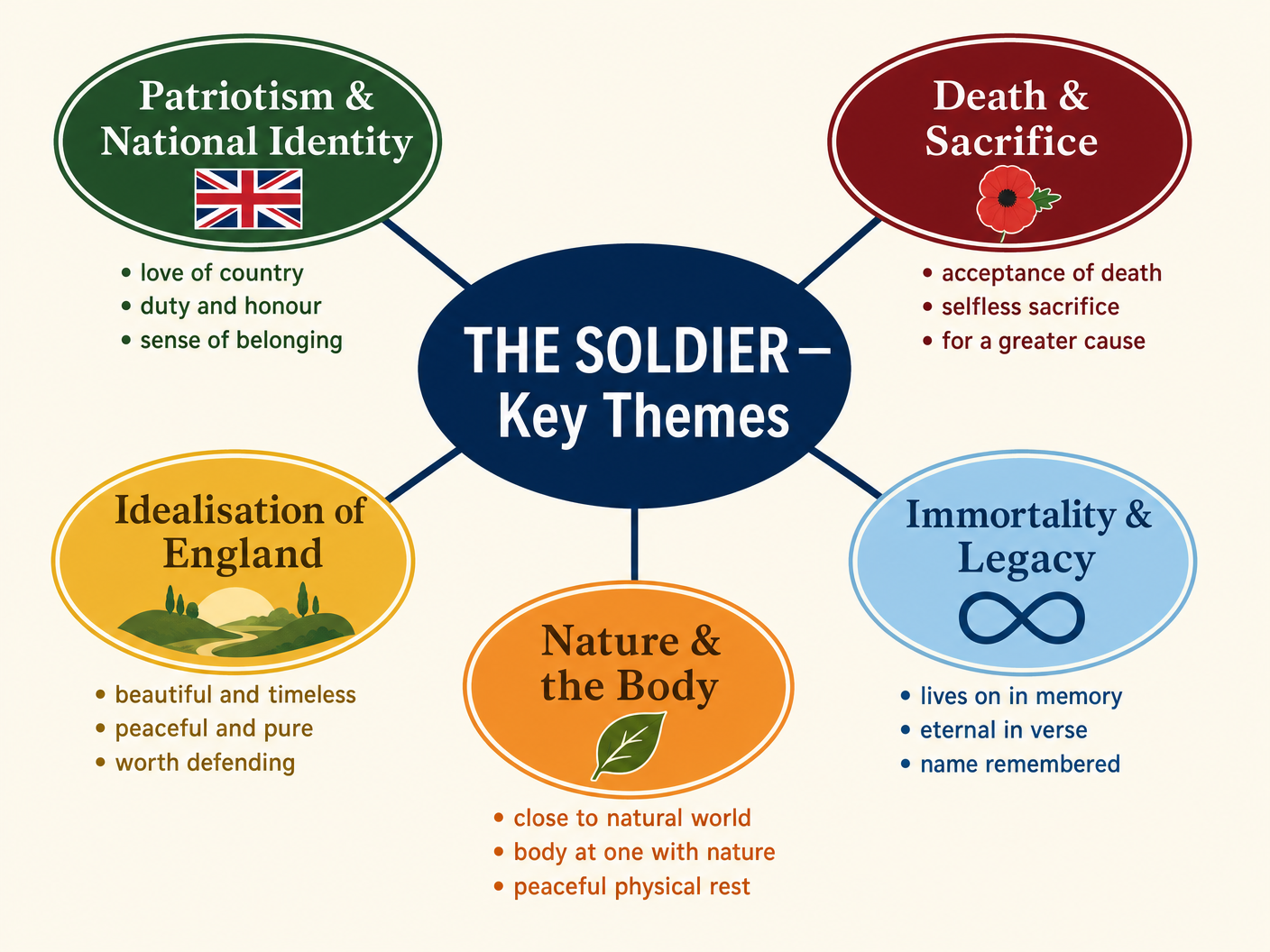
Theme 1: Patriotism and National Identity
Brooke presents patriotism not merely as loyalty, but as an existential condition. The soldier does not just serve England; he is England. This total identification between the individual and the state reflects the intense nationalism of 1914.
Key Quotes:
- "A body of England's, breathing English air" - The repetition of "England" emphasizes that the soldier is physically constructed from his nation. The organic imagery roots his identity in the very soil and air.
- "Washed by the rivers, blest by suns of home" - The religious connotations of "washed" (baptism) and "blest" elevate his English upbringing to a holy sacrament.
Theme 2: The Idealisation of Death and Sacrifice
Death in 'The Soldier' is entirely stripped of physical horror. There is no blood, no pain, and no fear. Instead, death is presented as a peaceful transformation and a profound act of giving back.
Key Quotes:
- "If I should die, think only this of me:" - The conditional "If" combined with the imperative "think only this" creates a tone of calm instruction, banishing grief or mourning.
- "this heart, all evil shed away" - Death is framed as a purifying force. The sacrifice cleanses the soldier, making him worthy of eternity.
Theme 3: Immortality and Legacy
The poem argues that the soldier achieves immortality through his connection to England. His physical remains permanently alter the foreign landscape, while his soul lives on in an English afterlife.
Key Quotes:
- "That there's some corner of a foreign field / That is for ever England." - The juxtaposition of the modest "some corner" with the absolute "for ever" creates a powerful sense of enduring legacy.
- "In hearts at peace, under an English heaven." - The final line confirms that the soldier's reward is eternal peace, explicitly branded as "English," suggesting that heaven itself is shaped by national identity.
Writer's Methods
Form: The Petrarchan Sonnet
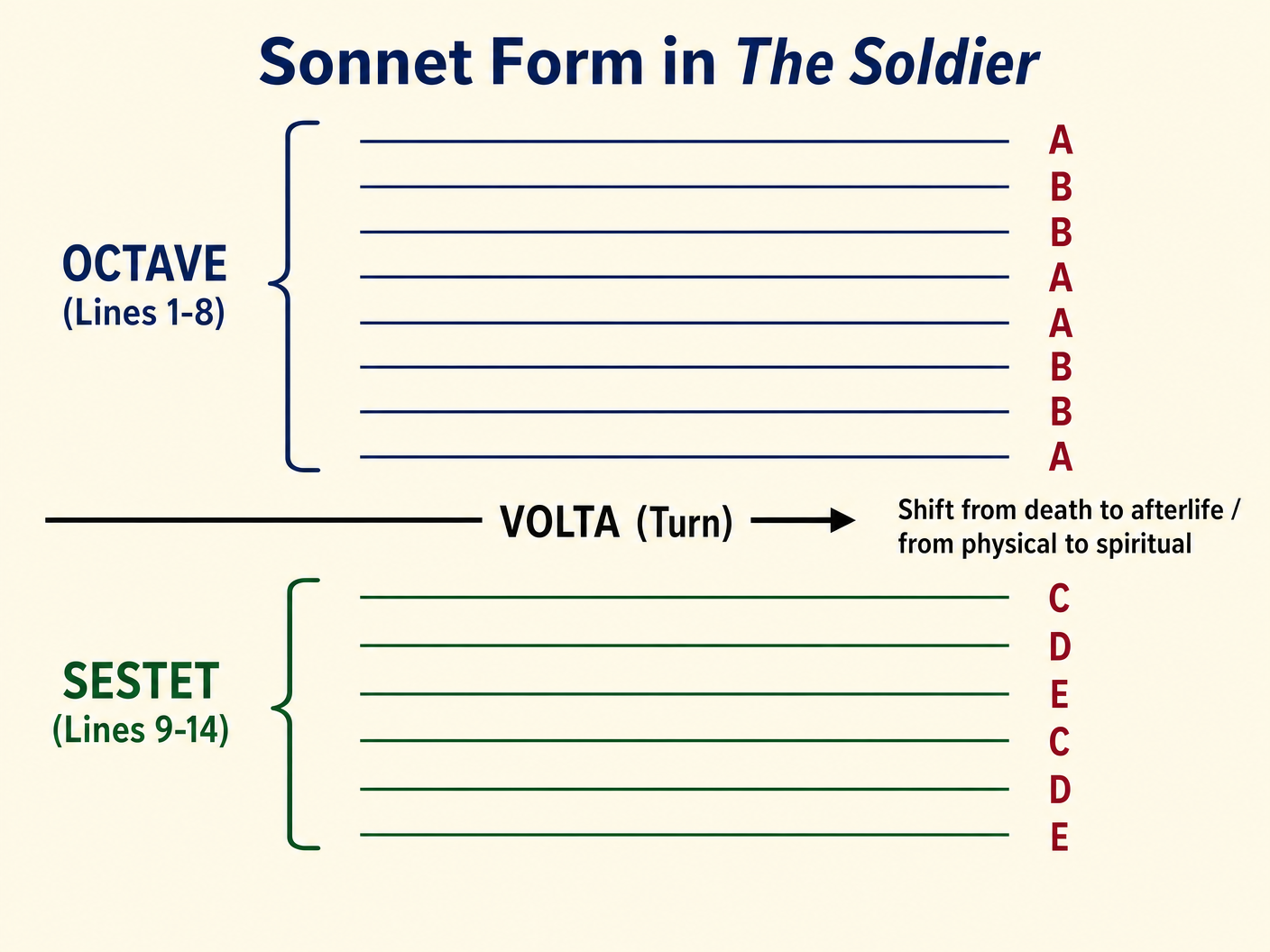
Brooke's choice of the Petrarchan sonnet is his most significant structural method. Traditionally used to express intense romantic love (often unrequited), Brooke repurposes the form to express love for his country.
- The Octave (ABBAABBA) focuses on the physical reality of his body in the earth.
- The Volta (Line 9) marks the "turn" in the argument.
- The Sestet (CDECDE) moves to the metaphysical reality of his soul in heaven.
Examiners heavily reward candidates who explain how this structure mirrors the soldier's transcendence from physical death to spiritual immortality.
Language: Personification and Organic Metaphors
Brooke extensively personifies England as a maternal figure who "bore, shaped, made aware" the soldier. This maternal imagery makes the soldier's sacrifice seem natural—a child returning a debt to a mother. Furthermore, the semantic field of nature ("flowers," "air," "rivers," "suns") naturalises the war effort, suggesting that dying for one's country is as natural as the turning of the seasons.
Context
Understanding the context of 1914 is vital for AO3. Brooke wrote this at the outbreak of WWI, before the realities of trench warfare, gas attacks, and mass slaughter were understood by the British public. The poem reflects the initial wave of enthusiastic, romanticised patriotism. Brooke himself died of sepsis from a mosquito bite on his way to Gallipoli in 1915, never seeing frontline combat. His handsome appearance and early death turned him into a mythic figure—a symbol of tragic, beautiful youth sacrificed for the nation. When comparing poems, contrasting Brooke's naive idealism with the bitter realism of later poets like Wilfred Owen is a highly effective strategy.
Worked Examples
1 detailed example with solutions and examiner commentary
Practice Questions
Test your understanding — click to reveal model answers
Compare how poets present ideas about national identity in 'The Soldier' and one other poem from your anthology.
Hint: Think about whether national identity is presented as something innate and glorious (Brooke) or something oppressive, fragile, or complex in your chosen comparison poem (e.g., 'Checking Out Me History' or 'Kamikaze').
How does Brooke use natural imagery to present his ideas about death in 'The Soldier'?
Hint: Look at the semantic field of nature in the octave. How does it make death seem less scary?