To Autumn
Dive into John Keats' most celebrated ode, 'To Autumn'. This study guide breaks down the poem's rich sensory imagery, structural progression, and deep Romantic themes, showing you exactly how to hit the top bands in your GCSE Literature exam.
Study Notes
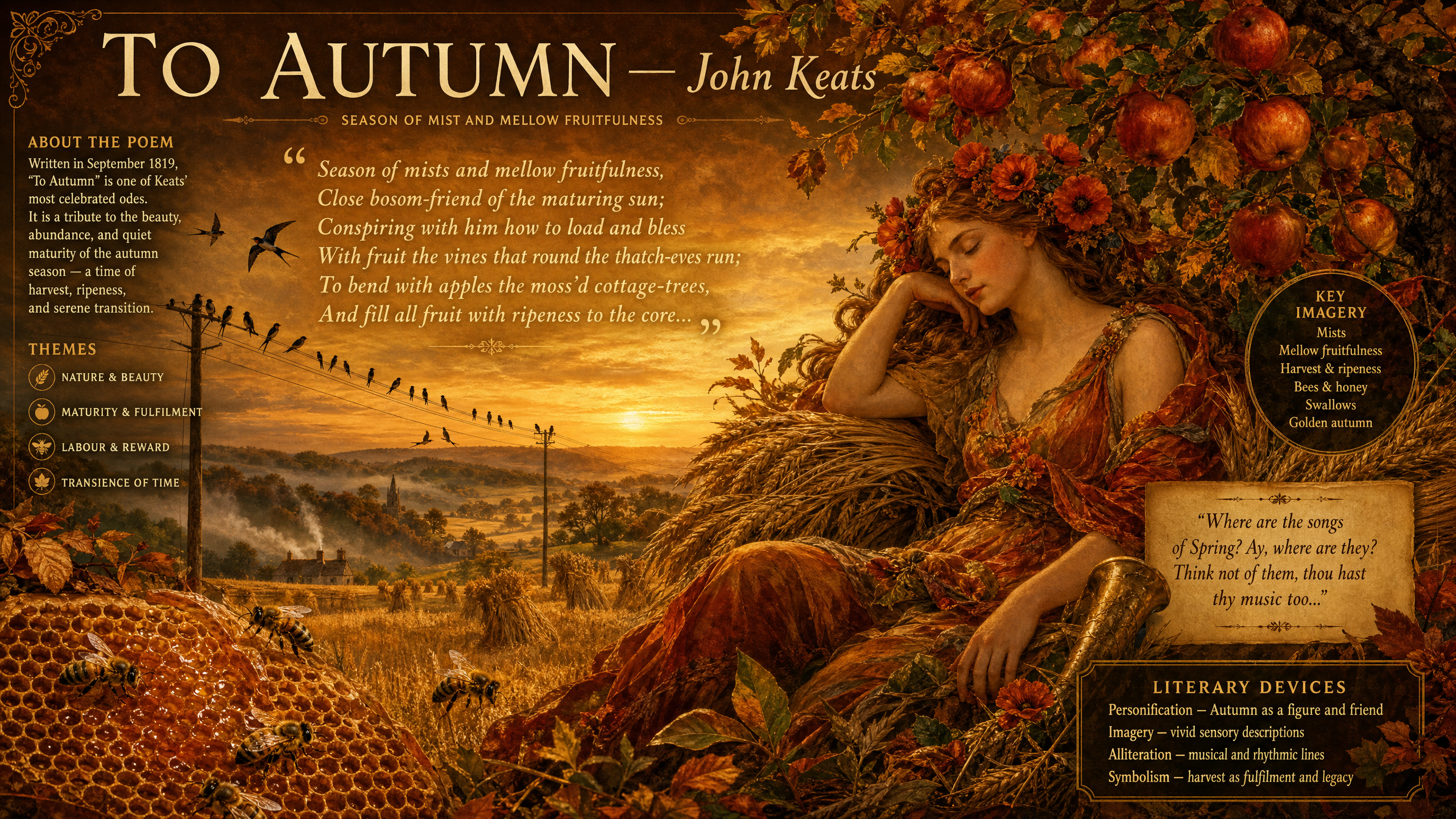
Overview
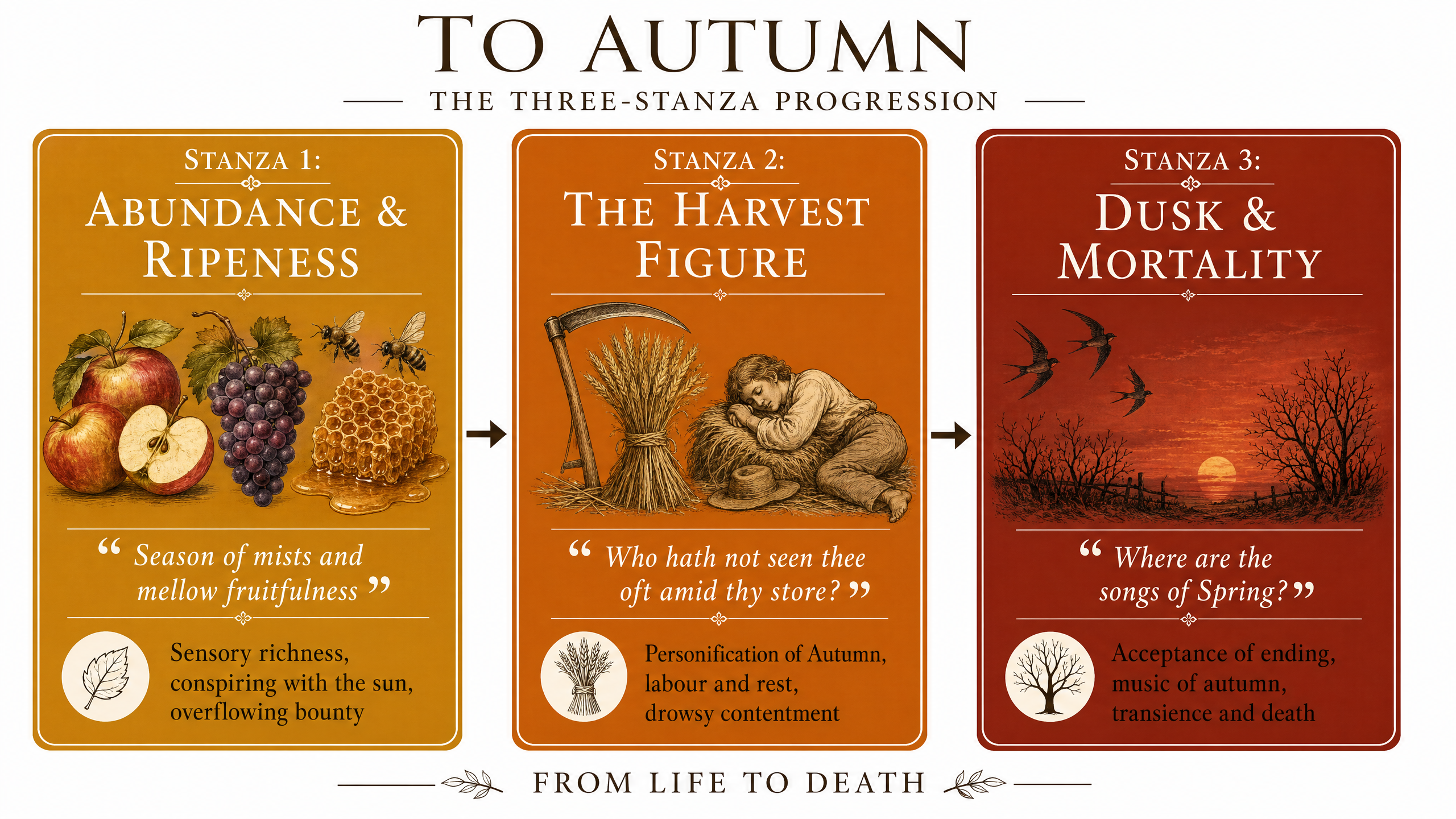
Written in September 1819, just two years before his death from tuberculosis at age 25, John Keats' 'To Autumn' is a masterpiece of Romantic poetry. The poem celebrates the beauty and abundance of the autumn season while subtly acknowledging the inevitability of death and the passing of time. For examiners, a top-band response to this poem demonstrates an understanding of its three-stanza progression: from the overwhelming abundance of the harvest, to the drowsy personification of the season, and finally to the melancholic but accepting 'music' of dusk. Candidates who can seamlessly integrate Keats' context—his awareness of his own mortality and his Romantic ideals—with close analysis of his rich sensory imagery will be heavily rewarded.
Stanza-by-Stanza Overview
Stanza 1: Abundance and RipenessThe poem opens by addressing autumn directly, describing it as a season of 'mists and mellow fruitfulness' that conspires with the sun to bring all crops to a state of perfect, heavy ripeness. The imagery here is overwhelmingly rich, focusing on excess and fulfilment.
Stanza 2: The Harvest FigureKeats personifies autumn as an agricultural worker—a gleaner, a reaper, or a cider-presser. The figure is depicted in various states of rest and drowsy contentment amid the harvest, slowing down time as the season reaches its peak.
Stanza 3: Dusk and MortalityThe final stanza shifts in tone. The speaker asks where the 'songs of Spring' have gone, but immediately reassures autumn that it has its own unique 'music'. The imagery turns to sunset, mourning gnats, bleating lambs, and gathering swallows, symbolizing the end of the day, the end of the year, and the approach of death.
Themes
Theme 1: Nature and Beauty
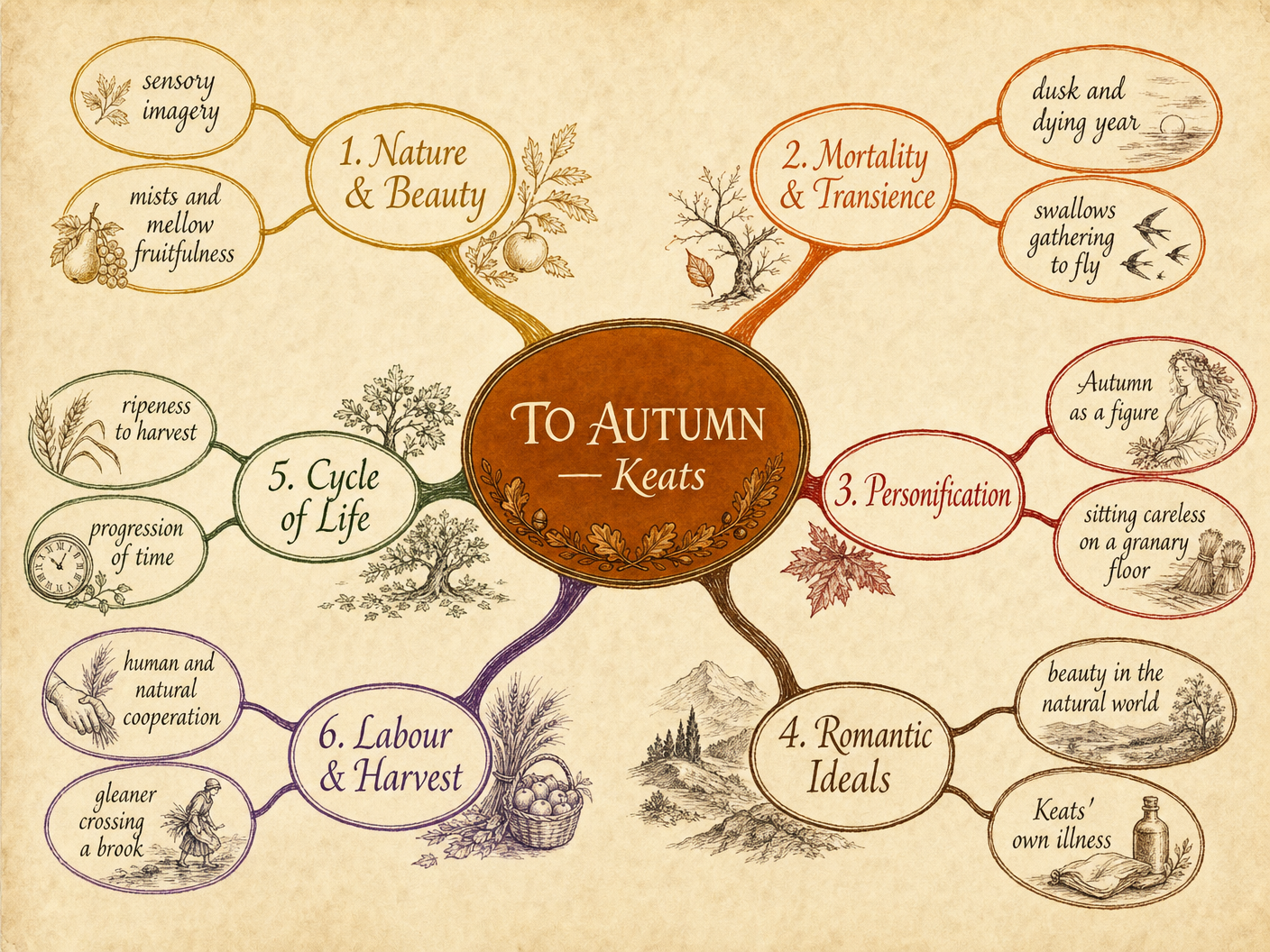
Keats presents nature not merely as a backdrop, but as a powerful, active force. The poem is saturated with sensory imagery that celebrates the physical beauty of the natural world, a key Romantic ideal. The beauty of autumn is shown to be just as valid as the more traditionally celebrated beauty of spring.
Key Quotes:
- "Season of mists and mellow fruitfulness" (Stanza 1) - The alliteration of the 'm' sound creates a soft, rich tone, establishing autumn as a time of calm abundance.
- "To bend with apples the moss'd cottage-trees" (Stanza 1) - The verb 'bend' emphasizes the sheer weight and excess of nature's bounty.
Theme 2: Mortality and Transience
Beneath the celebration of the harvest lies a profound awareness of transience—the idea that all things must end. The progression of the poem from morning/ripeness to dusk/bareness mirrors the human life cycle. Keats suggests that death is a natural, inevitable process that should be accepted rather than feared.
Key Quotes:
- "Where are the songs of Spring? Ay, where are they?" (Stanza 3) - This rhetorical question introduces a moment of doubt or mourning for what has passed, before Keats pivots to acceptance.
- "And gathering swallows twitter in the skies" (Stanza 3) - The collective noun 'gathering' and the image of migration hint at departure and the coming winter (death).
Theme 3: Labour and Fulfilment
The poem explores the relationship between human labour and natural processes. In the second stanza, the personified autumn is seen resting after or during labour. It's a vision of work that is harmonious and peaceful, contrasting with the harsh realities of agricultural life in the 19th century.
Key Quotes:
- "Sitting careless on a granary floor" (Stanza 2) - The adjective 'careless' suggests a lack of anxiety; the work is done, and the season can rest.
- "Thou watchest the last oozings hours by hours" (Stanza 2) - The repetition of 'hours' and the long vowel sounds in 'oozings' stretch out time, creating a sense of suspended animation.
Writer's Methods
Form and Structure
The poem is an ode—a formal lyric poem that addresses and celebrates a person, place, thing, or idea. It consists of three eleven-line stanzas. The rhyme scheme in the first stanza is ABABCDEDCCE, but it varies slightly in the second and third stanzas. This structural progression is vital: it mirrors the passage of time from early autumn (morning/growth) to mid-autumn (afternoon/harvest) to late autumn (dusk/decay).
Personification
Keats' use of personification in Stanza 2 is his most significant structural device. By turning the abstract season into a tangible, resting figure ("Thy hair soft-lifted by the winnowing wind"), he makes the abstract concept of time passing feel intimate, gentle, and human.
Sensory Imagery
Keats employs synaesthesia (blending the senses). We feel the weight of the apples ("bend"), taste the sweetness ("plump the hazel shells"), hear the "wailful choir" of gnats, and see the "rosy hue" of the stubble-plains. This overwhelms the reader's senses, replicating the overwhelming abundance of the season.
Context
To achieve top marks (AO3), candidates must integrate context into their analysis.
- Biographical Context: Keats wrote this shortly after the deaths of his mother and brother from tuberculosis, and he was already showing symptoms himself. His acceptance of autumn's 'dying' is a poignant acceptance of his own early death.
- Romanticism: As a second-generation Romantic poet, Keats valued emotion, nature, and the sublime over logic and industrialization. The poem is a quintessential Romantic text, finding profound philosophical meaning in a simple country walk.
Interactive Diagrams
1 interactive diagram to visualise key concepts
Conceptual Flow Outline
The Structural Progression of 'To Autumn'
Worked Examples
1 detailed example with solutions and examiner commentary
Practice Questions
Test your understanding — click to reveal model answers
How does Keats use imagery to present the natural world in 'To Autumn'?
Hint: Track the imagery chronologically. Start with the tactile/visual imagery of fruitfulness in Stanza 1, move to the personification in Stanza 2, and end with the auditory imagery (music/sounds) in Stanza 3.
Explore how Keats presents the theme of acceptance in 'To Autumn'.
Hint: Focus heavily on the transition between Stanza 2 and Stanza 3. How does the poem move from avoiding the end of the year to embracing its 'music'?
Compare how poets present the power of nature in 'To Autumn' and one other poem from your anthology.
Hint: If comparing to 'Ozymandias' or 'Exposure', contrast Keats' view of nature as a gentle, nurturing, cyclical force with the other poet's view of nature as a destructive, hostile force.
Starting with the final stanza, explore how Keats creates a sense of ending in 'To Autumn'.
Hint: Spend half your essay analysing the 'soft-dying day', the 'wailful choir', and the 'gathering swallows'. Then link this back to how the earlier stanzas set up this ending.