
Study Notes
Overview
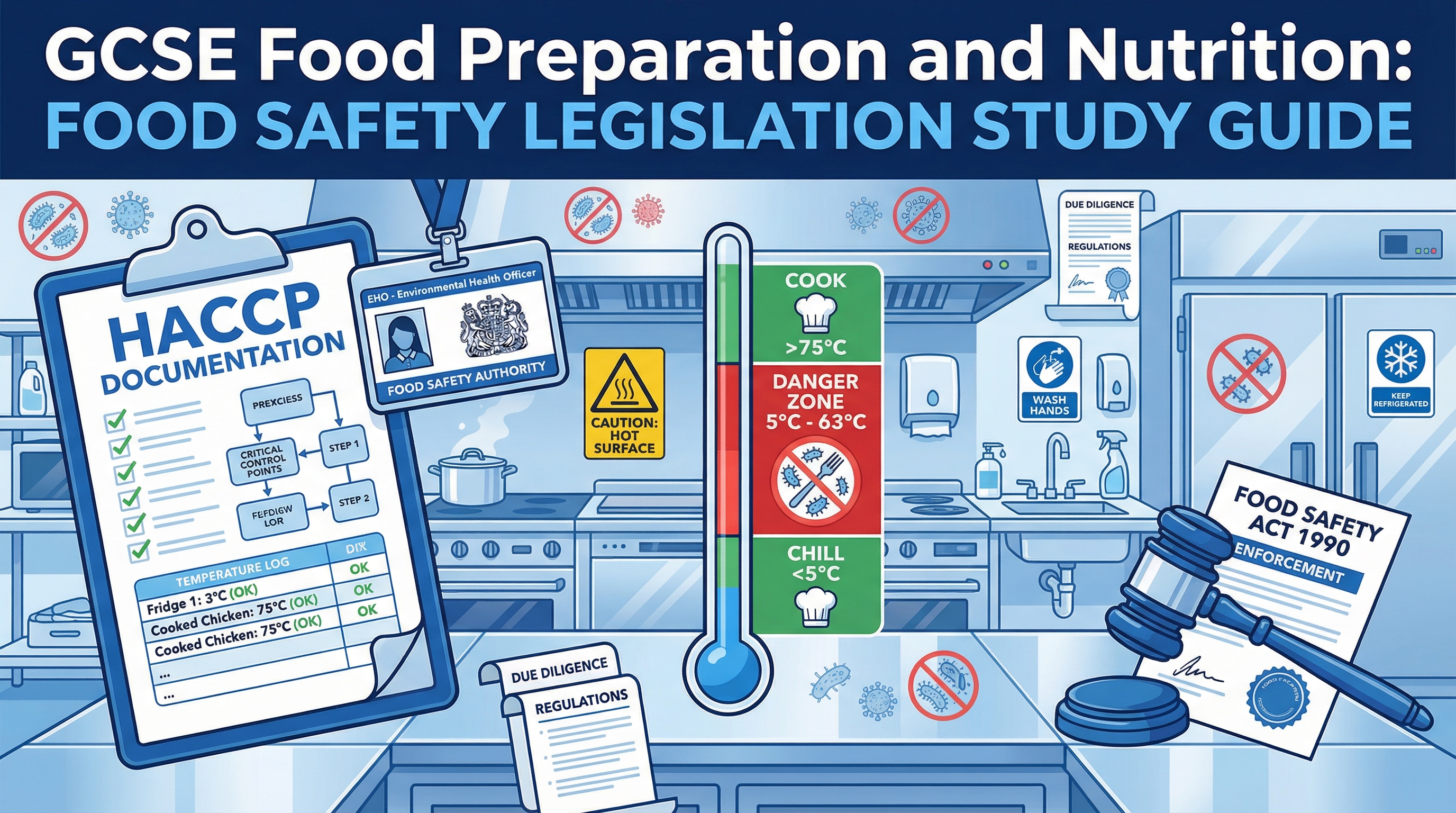
This study guide focuses on the legal framework governing food safety in the UK, a critical component of the AQA GCSE Food Preparation and Nutrition specification. A thorough understanding of this topic is essential, as it underpins the safe and professional practices required in any food-related industry. Examiners expect candidates to demonstrate precise knowledge of the Food Safety Act 1990, the associated Food Safety (General Food Hygiene) Regulations, and the practical application of systems like HACCP. Marks are awarded for not just recalling facts, but for applying them to commercial scenarios, analysing the consequences of non-compliance, and evaluating the roles of different stakeholders, particularly the Environmental Health Officer (EHO). This section will equip you with the detailed, specific knowledge required to confidently tackle exam questions on this topic, moving beyond common sense to demonstrate genuine legislative understanding.
Key Legislation & Systems
The Food Safety Act 1990
What it is: This is the primary piece of UK legislation governing food safety. It provides the legal framework for all food production, processing, and sales.
Why it matters: The Act makes it a criminal offence to: sell food that is not of the nature, substance, or quality demanded by the consumer; falsely or misleadingly describe or present food; and sell food that is unfit for human consumption. It establishes the fundamental legal duties of food businesses to ensure their products are safe. For your exam, you must be able to state the purpose of this Act as the foundation of all other regulations.
Specific Knowledge: Candidates should know that this Act gives enforcement officers (EHOs) their powers and establishes the key offences. Penalties for serious breaches can include unlimited fines and imprisonment for up to two years.
Food Safety (General Food Hygiene) Regulations
What they are: These regulations provide the specific, detailed rules that food businesses must follow to comply with the Food Safety Act 1990. They translate the broad principles of the Act into actionable requirements.
Why they matter: These regulations are where the practical rules of food safety are found. They cover premises requirements, personal hygiene for food handlers, and, most importantly, the legal requirement for food businesses to implement and maintain a food safety management system based on HACCP principles. This is a common area for exam questions.
Specific Knowledge: You must link these regulations to the legal requirement for HACCP, temperature control, and preventing cross-contamination.
HACCP (Hazard Analysis and Critical Control Points)
What it is: HACCP is a systematic, preventative approach to food safety that identifies, evaluates, and controls hazards at specific points in the food production process. It is a legal requirement for all food businesses.
Why it matters: HACCP is the practical system that businesses use to ensure they are complying with the law. It moves food safety from a reactive (punishing mistakes) to a proactive (preventing mistakes) model. Examiners expect you to understand not just what HACCP stands for, but how it works in practice. Credit is given for explaining that it involves identifying hazards (biological, chemical, physical), determining Critical Control Points (CCPs) where control is essential, and setting critical limits (e.g., a specific temperature).
Specific Knowledge: Know the 7 principles of HACCP. Be able to give practical examples of a CCP (e.g., cooking a chicken burger) and a critical limit (e.g., ensuring the core temperature reaches 75°C for 2 minutes).
Key Individuals & Roles
The Environmental Health Officer (EHO)
Role: An EHO is a qualified professional employed by local authorities to enforce food safety legislation. They are the primary enforcement agents of the Food Safety Act.
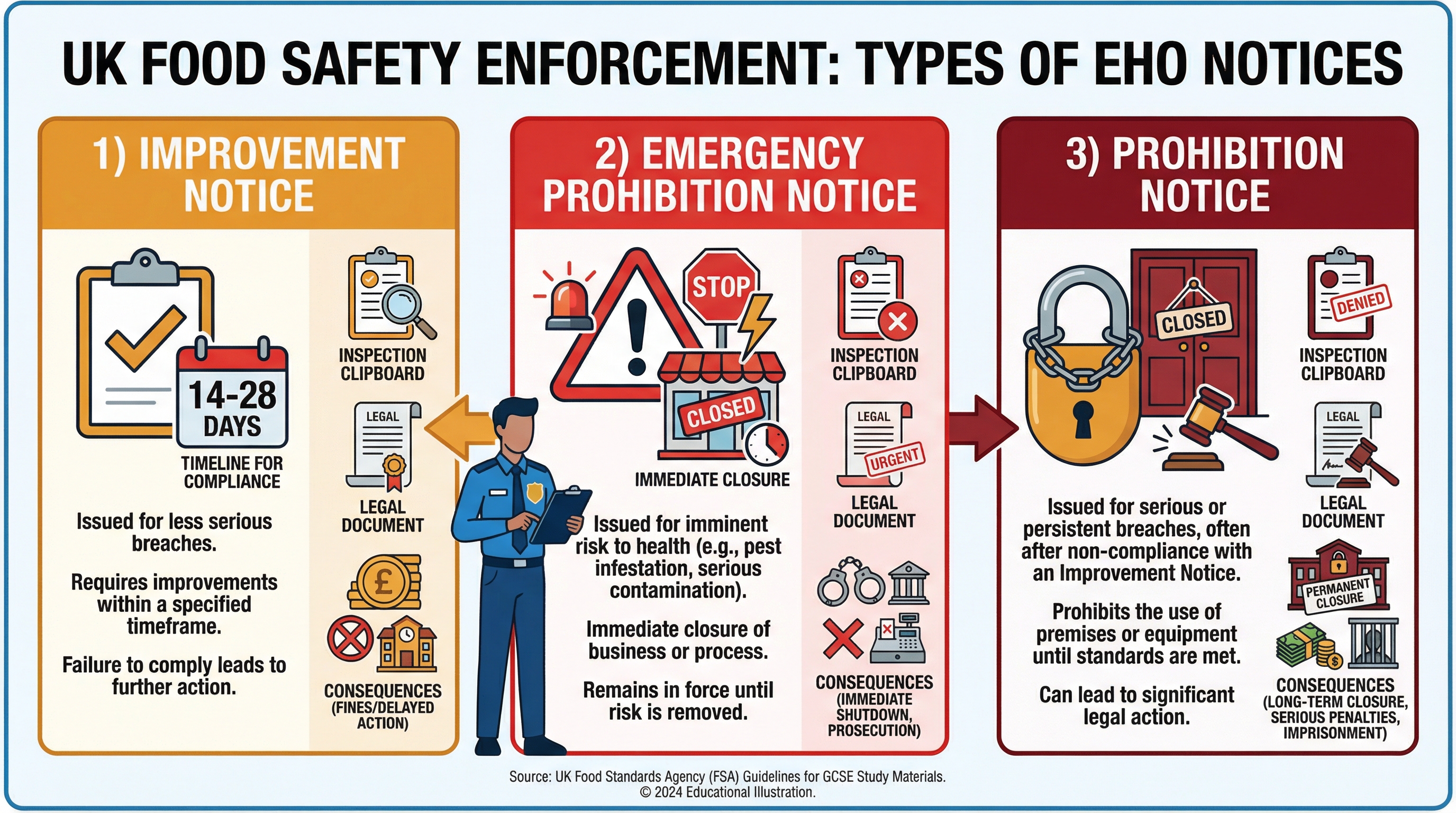
Key Actions: EHOs have significant legal powers. They have the right of entry to any food premises at any reasonable time. Their key actions include: inspection of premises and practices; taking food samples for analysis; seizing and detaining suspect food; and issuing legal notices.
Impact: The EHO's role is to protect public health. Their impact on a business can be huge, from requiring minor changes to forcing an immediate closure. For the exam, you must be able to detail their enforcement powers and the specific notices they can issue.
Second-Order Concepts
The Danger Zone & Temperature Control
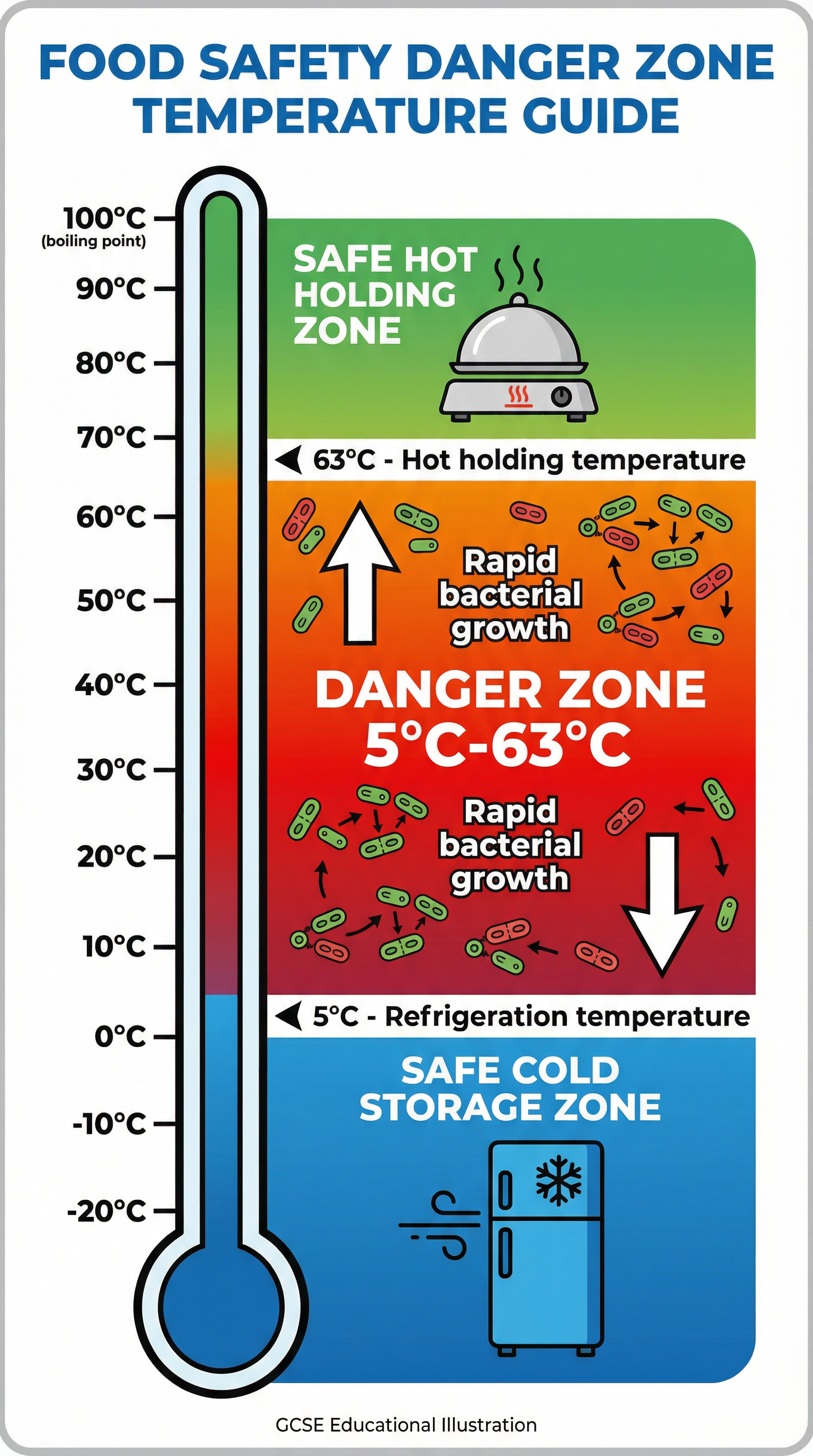
Concept: The temperature range in which pathogenic bacteria multiply most rapidly. AQA defines this as 5°C to 63°C.
Why it matters: Controlling temperature is one of the most critical aspects of food safety. The law requires high-risk foods to be kept out of the danger zone. This concept is fundamental to understanding safe storage and cooking. Marks are frequently awarded for specifying these exact temperatures.
Application: Cold food must be stored at or below 5°C. Hot food must be held for service at or above 63°C. Food must be cooked to a core temperature of 75°C to kill most bacteria.
Due Diligence
Concept: A legal defence for a food business. If prosecuted, a business can argue that it took all reasonable precautions and exercised all due diligence to avoid committing the offence.
Why it matters: This concept highlights the importance of record-keeping. To use the due diligence defence, a business must provide evidence of its food safety management system. This is why temperature logs, cleaning schedules, and staff training records are not just good practice—they are a vital legal safeguard. Candidates who can explain the link between HACCP records and the due diligence defence will gain high marks.