
Study Notes
Overview
Knife skills are a cornerstone of culinary competence and a key area of assessment in the AQA GCSE Food Preparation and Nutrition specification. Examiners expect candidates to demonstrate not only practical proficiency but also a deep understanding of why specific techniques and knives are chosen. This guide covers the critical safety grips—the claw grip and the bridge hold—and the classic French precision cuts: julienne, brunoise, jardinière, and macédoine. Mastery of these skills is essential for achieving high marks in the Non-Exam Assessment (NEA) tasks and for providing detailed, justified answers in written papers. This section will equip you with the specific knowledge and language required to impress examiners and showcase high-level subject expertise.
Key Techniques & Terminology
Safety First: The Foundation of Good Practice
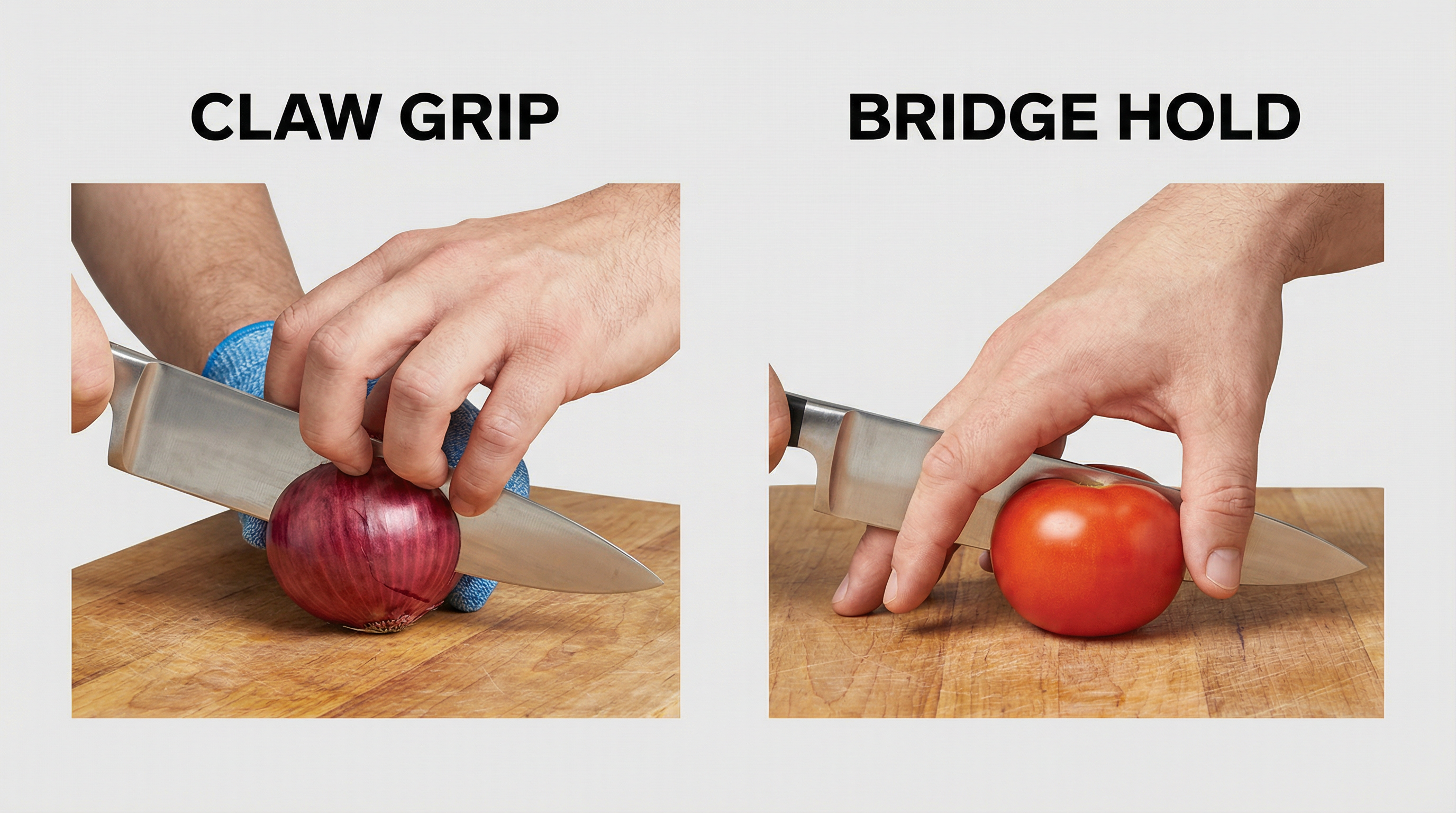
Claw Grip: This is the primary technique for protecting your non-cutting hand. Curl your fingers inwards to form a claw, with your thumb tucked safely behind. Your knuckles should press against the side of the knife blade, acting as a guide. This method prevents accidental cuts to the fingertips and ensures even, consistent slicing. Marks are directly awarded for demonstrating and explaining this technique.
Bridge Hold: Used for securing round or irregular-shaped items like tomatoes, onions, or potatoes. Form a "bridge" over the food item with your thumb and index finger, holding it firmly on the cutting board. The knife blade passes under the bridge to safely and accurately slice the item in half. This technique provides stability and control, preventing the food from slipping.
Choosing the Right Tool: Knife Selection
Candidates must be able to select the appropriate knife for a specific task and justify their choice based on the food's properties. Rote-learning knife types is not enough; you must explain the link between the knife's features and its function.
- Chef's Knife (Cook's Knife): Your multi-purpose tool. It has a broad, rigid blade tapering to a point, making it ideal for chopping, slicing, and dicing a wide variety of foods.
- Serrated Knife: Features a toothed or scalloped blade. This is essential for cutting foods with a hard exterior and soft interior, such as bread, tomatoes, or bell peppers. The serrations grip the surface without requiring downward pressure that would crush the food.
- Paring Knife: A small, short-bladed knife used for intricate tasks like peeling, trimming, and coring fruits and vegetables.
- Filleting Knife: Characterised by its long, thin, flexible blade. This flexibility is crucial for maneuvering around the bones of fish to remove fillets with minimal waste.
Precision Cuts: The Art of French Classic Technique
Using correct terminology for precision cuts demonstrates a high level of skill and knowledge. These cuts are not just for presentation; their uniform size ensures even cooking.
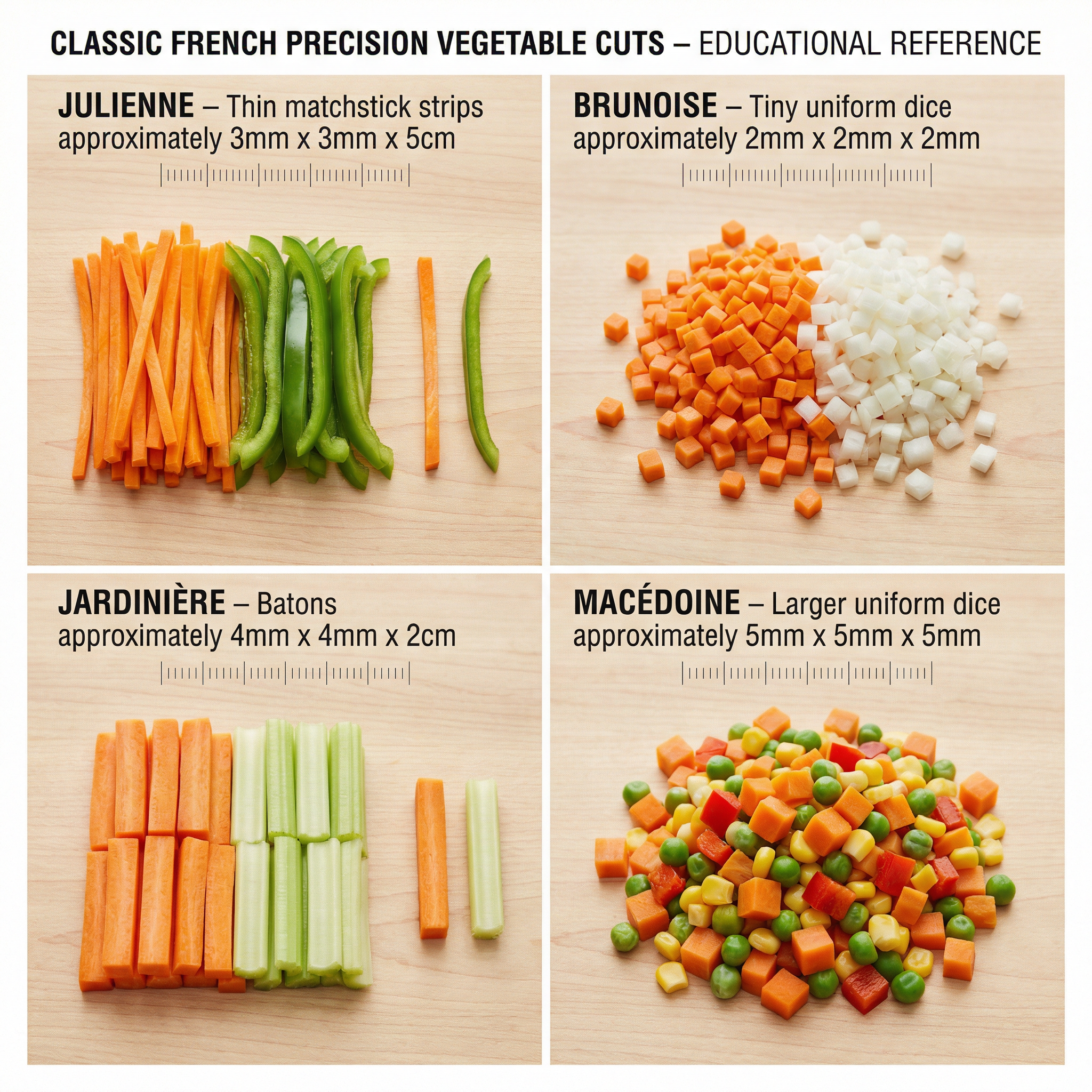
- Julienne: Long, thin matchstick-like strips. The classic dimensions are approximately 3mm × 3mm × 5cm.
- Brunoise: A very fine dice, approximately 2mm cubed. It is created by taking julienne strips, gathering them, and dicing them finely. Ideal for soups, sauces, and garnishes.
- Jardinière: A short, thick baton, measuring approximately 4mm x 4mm x 2cm.
- Macédoine: A larger dice, approximately 5mm cubed. Often used for mixed vegetable dishes.
Second-Order Concepts
Causation
Why are knife skills so important? The primary cause is safety. Incorrect technique is a major hazard in the kitchen. Secondly, efficiency and precision lead to better culinary outcomes. Uniform cuts ensure even heat transfer, meaning food cooks at the same rate, improving texture and taste. Finally, presentation is a key assessment criterion; precise knife skills are essential for creating professional-looking dishes.
Consequence
Poor knife skills have immediate consequences: injury from cuts, uneven cooking leading to a poor quality final product, and food waste from inefficient preparation. In an exam context, the consequences are lost marks in both the NEA and written papers for failing to demonstrate competence and understanding.
Change & Continuity
While the fundamental principles of knife safety (using a sharp knife, stable board, correct grips) are continuous, the types of knives and cuts used can change depending on culinary trends and technology. However, the classic French cuts have remained a continuous standard of excellence in professional kitchens for centuries.
Significance
Mastering knife skills is significant as it is a transferable skill applicable across almost all areas of food preparation. It signifies a candidate's progression from a novice to a more competent cook and is a clear indicator of their attention to detail, understanding of food science (even cooking), and commitment to professional standards.