Study Notes
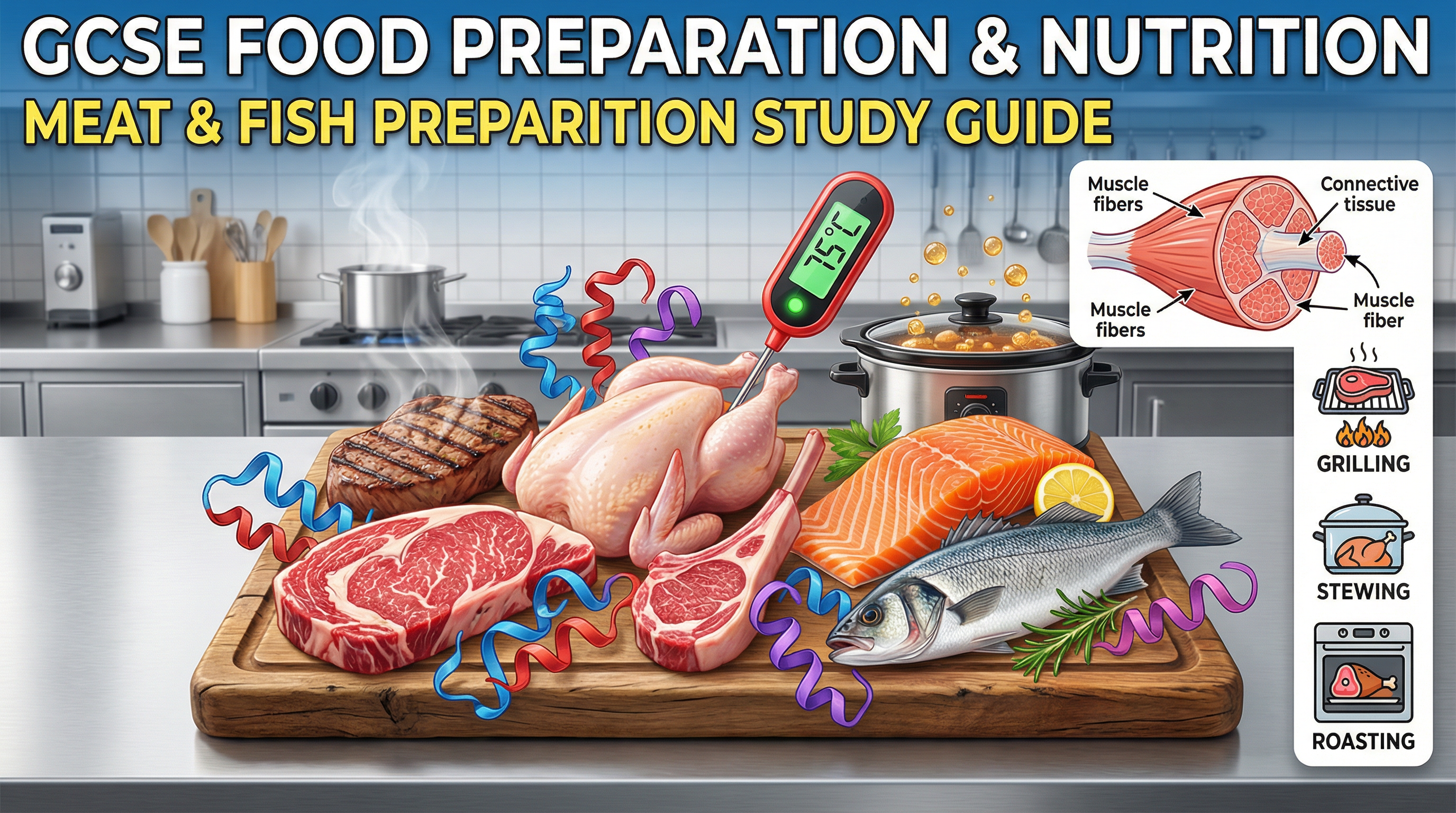
Overview
This study guide delves into the scientific principles underpinning the preparation and cooking of meat and fish, a core component of the AQA GCSE specification. AQA requires candidates to demonstrate a robust understanding of food provenance, safety, and the chemical and physical changes that occur during cooking. Examiners expect precise scientific terminology and a clear application of knowledge to practical scenarios. This means moving beyond simple descriptions of cooking and instead explaining the how and why of heat transfer, protein transformation, and sensory changes. Marks are awarded for linking the choice of cooking method to the specific cut of meat, understanding the critical role of temperature in food safety, and articulating the science behind flavour and texture development. This topic is not just about cooking; it's about becoming a food scientist in the kitchen.
Key Concepts: The Science of Cooking Meat & Fish
Protein Transformation: Denaturation & Coagulation
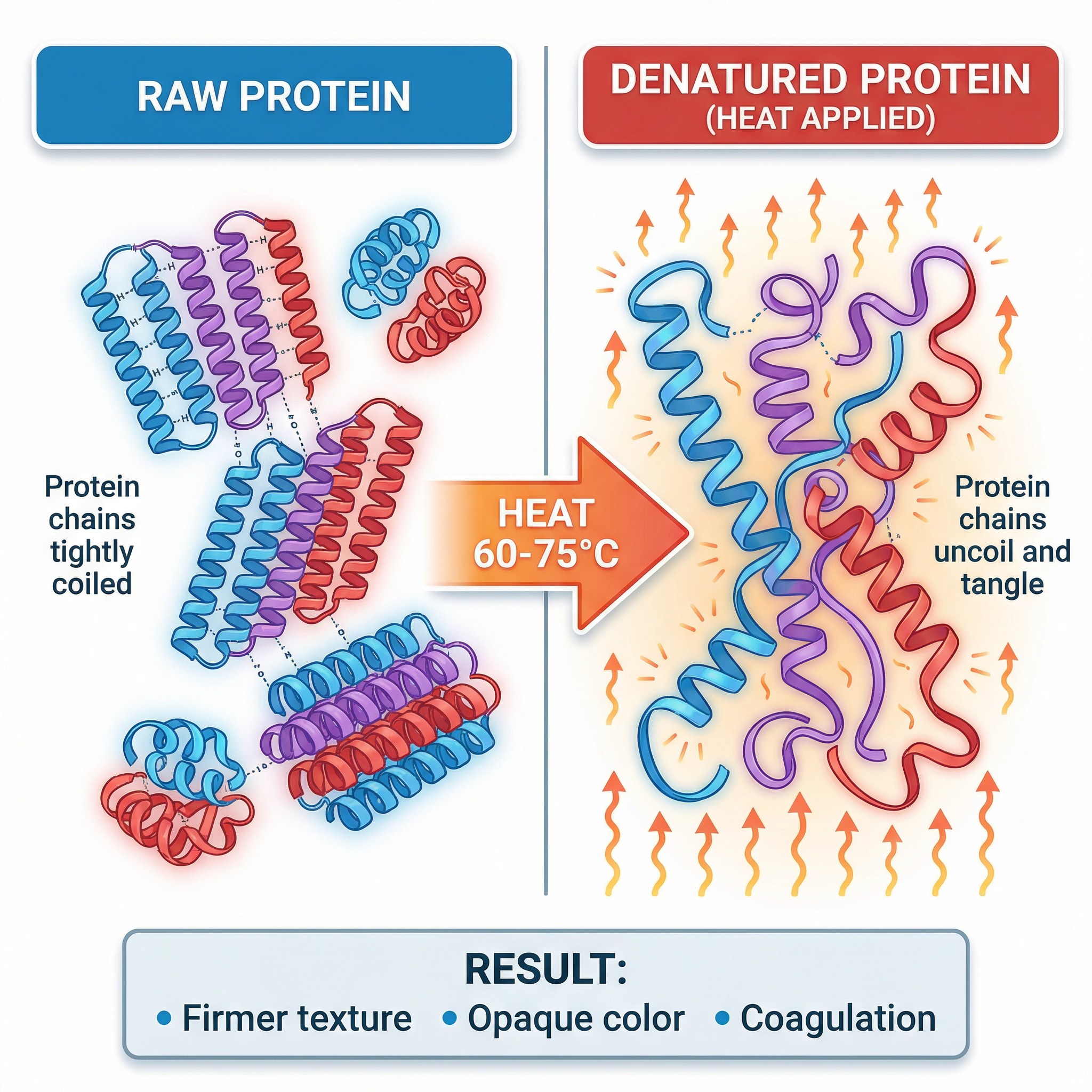
What happens: When heat is applied to meat or fish, its proteins undergo two critical changes: denaturation and coagulation. These are non-negotiable terms for your exam answers. Denaturation is the process where the tightly coiled protein chains unravel and lose their shape. This typically occurs between 60°C and 75°C. Following this, coagulation occurs, where the unravelled chains bond together, forming a firmer, more solid structure. This is what changes the texture from soft and pliable to firm and cooked.
Why it matters: This process is responsible for the change in appearance (from translucent to opaque), texture (from soft to firm), and is essential for making the food safe to eat. Credit is given for explaining this sequence clearly.
Connective Tissue: Collagen vs. Elastin
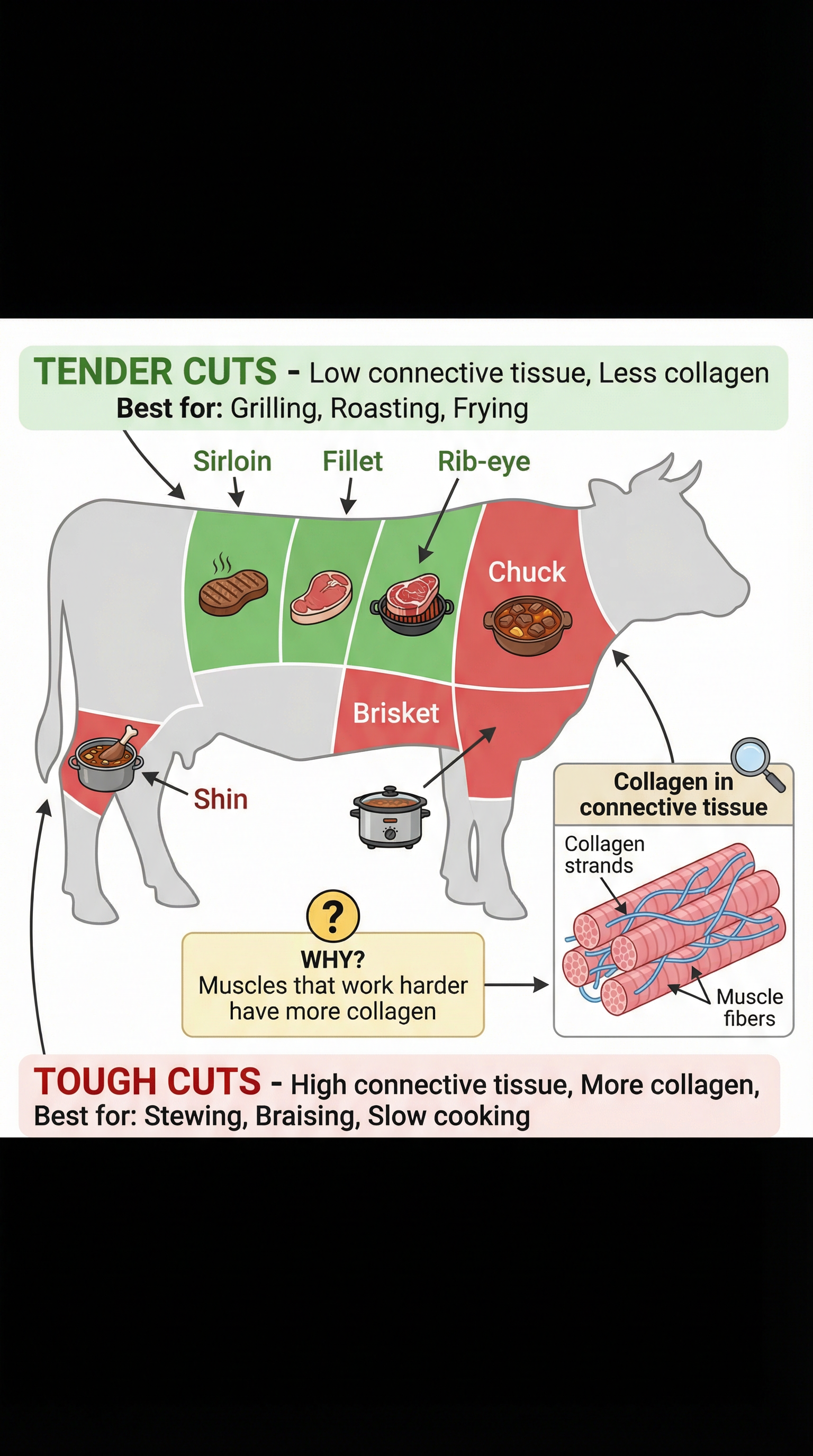
What it is: The texture of meat is largely determined by the amount and type of connective tissue. There are two types to know: collagen and elastin. Collagen is found in abundance in muscles that work hard (e.g., shin, shoulder, neck). These are your 'tough cuts'. Elastin is another connective tissue, but it does not break down during cooking and remains tough.
Why it matters: This is the scientific reason we choose different cooking methods for different cuts. Tough cuts rich in collagen require slow, moist cooking methods (like stewing) to break the collagen down into tender gelatin. Tender cuts with less collagen (e.g., fillet, sirloin) can be cooked quickly using dry heat.
Heat Transfer & Cooking Methods
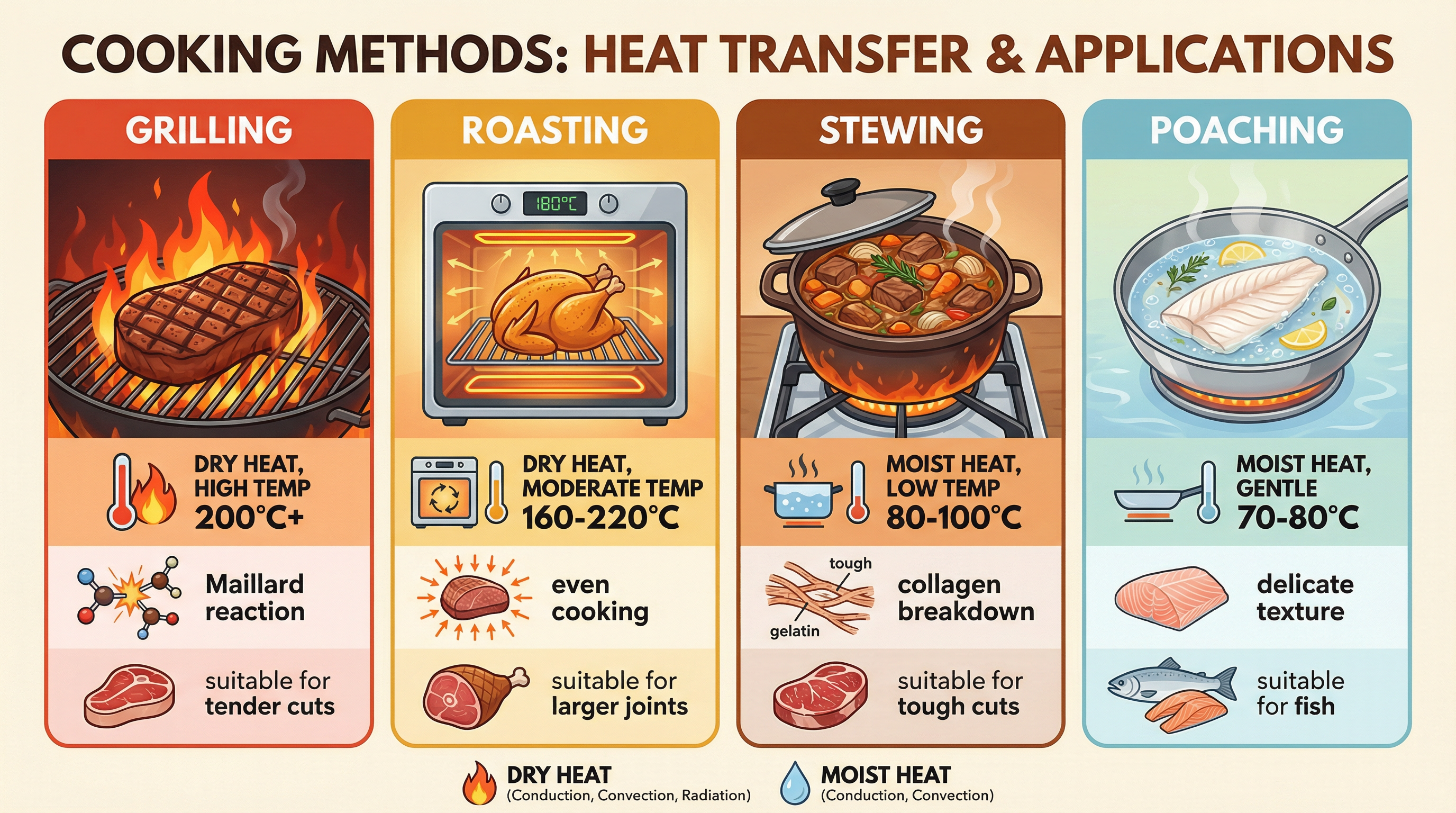
What happened: Heat is transferred to food through conduction, convection, and radiation. The choice of cooking method dictates how this heat is applied and its effect on the food.
- Dry Heat Methods: (Grilling, Roasting, Frying). These methods use high temperatures and are best for tender cuts. They are responsible for the Maillard Reaction, a chemical reaction between amino acids and sugars that creates the desirable brown crust and complex, savoury flavours. This is NOT the same as caramelisation.
- Moist Heat Methods: (Stewing, Braising, Poaching). These methods use liquid and lower temperatures. They are ideal for tough cuts as the gentle, prolonged cooking breaks down collagen. Poaching is particularly suited for delicate fish, as it cooks gently without damaging the flesh.
Why it matters: Marks are awarded for explicitly linking the cut of meat to the appropriate cooking method and explaining the scientific reasoning behind the choice.
Food Safety: The Critical Temperatures
What it is: Ensuring meat and fish are safe to eat is paramount. This involves controlling bacterial growth. The 'Danger Zone' for bacterial multiplication is between 5°C and 63°C. To destroy harmful pathogenic bacteria, such as Salmonella and Campylobacter, meat and poultry must be cooked to a core temperature of 75°C for at least two minutes.
Why it matters: This is a major source of marks. Candidates must be specific. Stating 'kills germs' is insufficient. You must use the term 'pathogenic bacteria' and cite the 75°C core temperature.
{{asset:meat_fish_preparation_podcast.wav