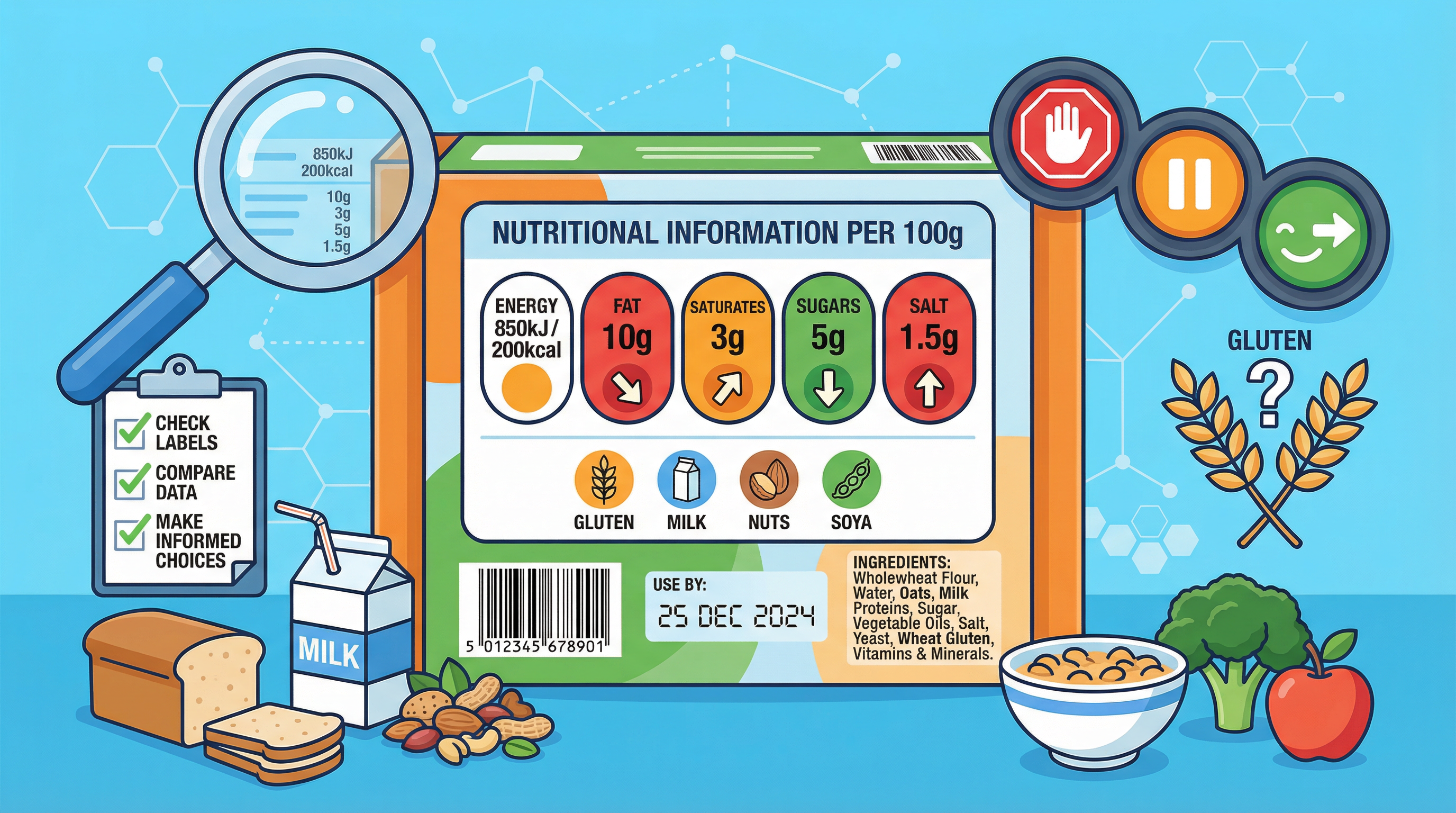
Interpreting labeling information — WJEC GCSE study guide illustration

    Interpreting labeling information

    This study guide provides a comprehensive breakdown of how to interpret food labelling information for the WJEC GCSE Food Preparation and Nutrition exam. Mastering this skill is crucial for demonstrating the application of knowledge, a key assessment objective, and can significantly boost marks in questions related to health, diet, and food safety.

    5
    Min Read
    3
    Examples
    5
    Questions
    6
    Key Terms
    🎙 Podcast Episode
    Interpreting labeling information
    0:00-0:00

    Study Notes

    A visual guide to interpreting food labels.

    Overview

    This guide focuses on interpreting food labelling information as required by the WJEC GCSE specification, underpinned by Regulation (EU) No 1169/2011 on Food Information for Consumers. A strong understanding of this topic is essential for candidates to analyse and evaluate food products, a skill frequently tested in the exam. Examiners expect candidates to move beyond simple identification of label elements and apply this information to make justified decisions about dietary suitability, health implications, and food safety. This involves a detailed analysis of nutritional data, including the traffic light system and Reference Intakes (RIs), the correct interpretation of date marks, and the identification of allergens. Marks are awarded for precision, such as using "per 100g" data for comparisons and explicitly linking nutritional content to health conditions like Coronary Heart Disease (CHD) or Type 2 Diabetes.

    Key Concepts for Food Labelling

    Mandatory Information

    What it is: A set of legally required details that must appear on the packaging of all pre-packed foods.

    Why it matters: This ensures consumers have consistent and clear information to make safe and informed choices. For the exam, candidates must be able to identify these components and may be asked to spot omissions on a sample label.

    Specific Knowledge: The mandatory information includes:

    • Name of the food
    • List of ingredients (in descending order of weight)
    • Allergen information
    • Quantitative Ingredient Declaration (QUID) for certain ingredients
    • Net quantity
    • Date mark ("Use by" or "Best before")
    • Storage conditions and/or conditions of use
    • Name and address of the food business operator
    • Country of origin or place of provenance
    • Instructions for use
    • Nutrition declaration

    Nutritional Information & Traffic Light Labelling
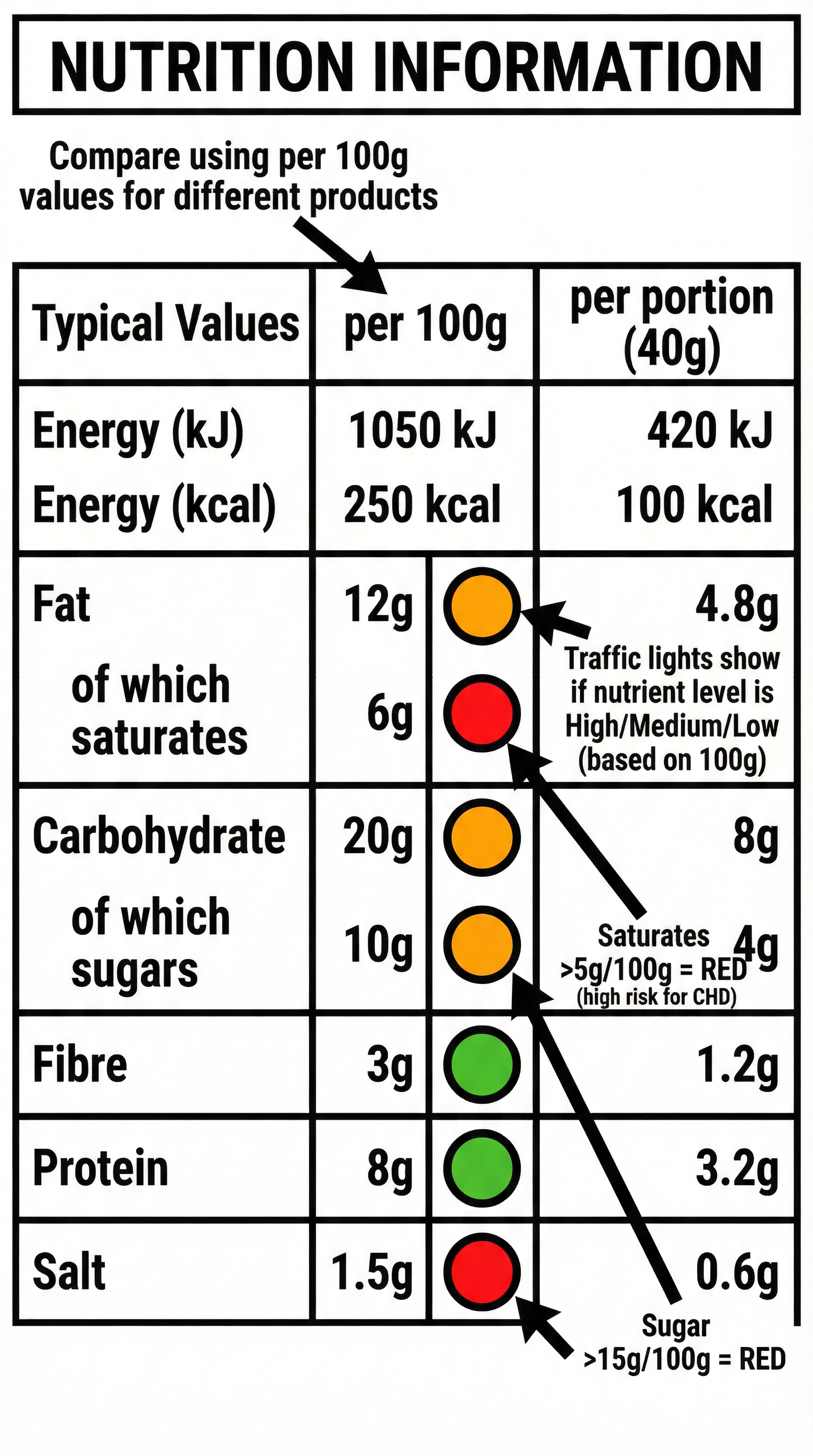
    How to read a nutrition label.

    What it is: The nutritional declaration provides details on the energy and nutrient content of the food. The front-of-pack traffic light system provides an at-a-glance guide to the levels of fat, saturates, sugars, and salt.

    Why it matters: This is the primary tool for assessing a product's healthiness and suitability for different dietary needs. Examiners award high marks for candidates who can correctly interpret this data and use it to justify their answers with specific figures.

    Specific Knowledge:

    • Comparison: Always use the "per 100g" column to compare products, as portion sizes can be misleading.
    • Traffic Light Thresholds (per 100g):
      • Fat: High (Red) >17.5g; Medium (Amber) 3.1g-17.5g; Low (Green) ≤3.0g
      • Saturates: High (Red) >5g; Medium (Amber) 1.6g-5g; Low (Green) ≤1.5g
      • Sugars: High (Red) >22.5g; Medium (Amber) 5.1g-22.5g; Low (Green) ≤5.0g
      • Salt: High (Red) >1.5g; Medium (Amber) 0.31g-1.5g; Low (Green) ≤0.3g
    • Health Links: Candidates must link high saturated fat to increased blood cholesterol and CHD risk. High sugar intake should be linked to obesity and Type 2 Diabetes.

    Allergen Labelling
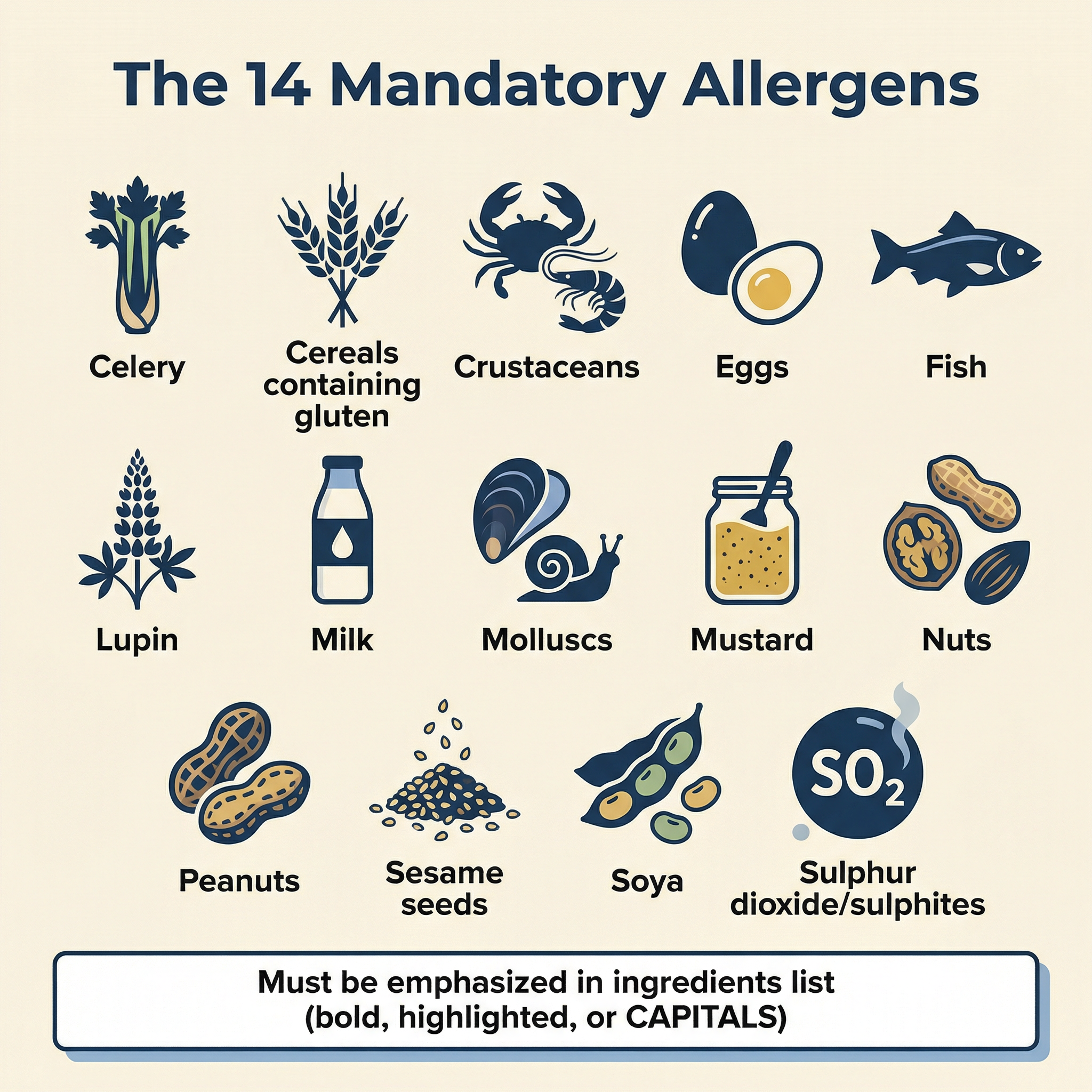
    The 14 mandatory food allergens.

    What it is: The 14 major allergens must be legally declared and emphasised in the ingredients list.

    Why it matters: This is a critical food safety issue. Marks are awarded for precise identification of allergens and the method of emphasis (e.g., bolding, italics, underlining).

    Specific Knowledge: Candidates should be able to name several of the 14 allergens: Celery, Cereals containing gluten, Crustaceans, Eggs, Fish, Lupin, Milk, Molluscs, Mustard, Nuts, Peanuts, Sesame seeds, Soya, Sulphur dioxide/sulphites.

    Date Marking
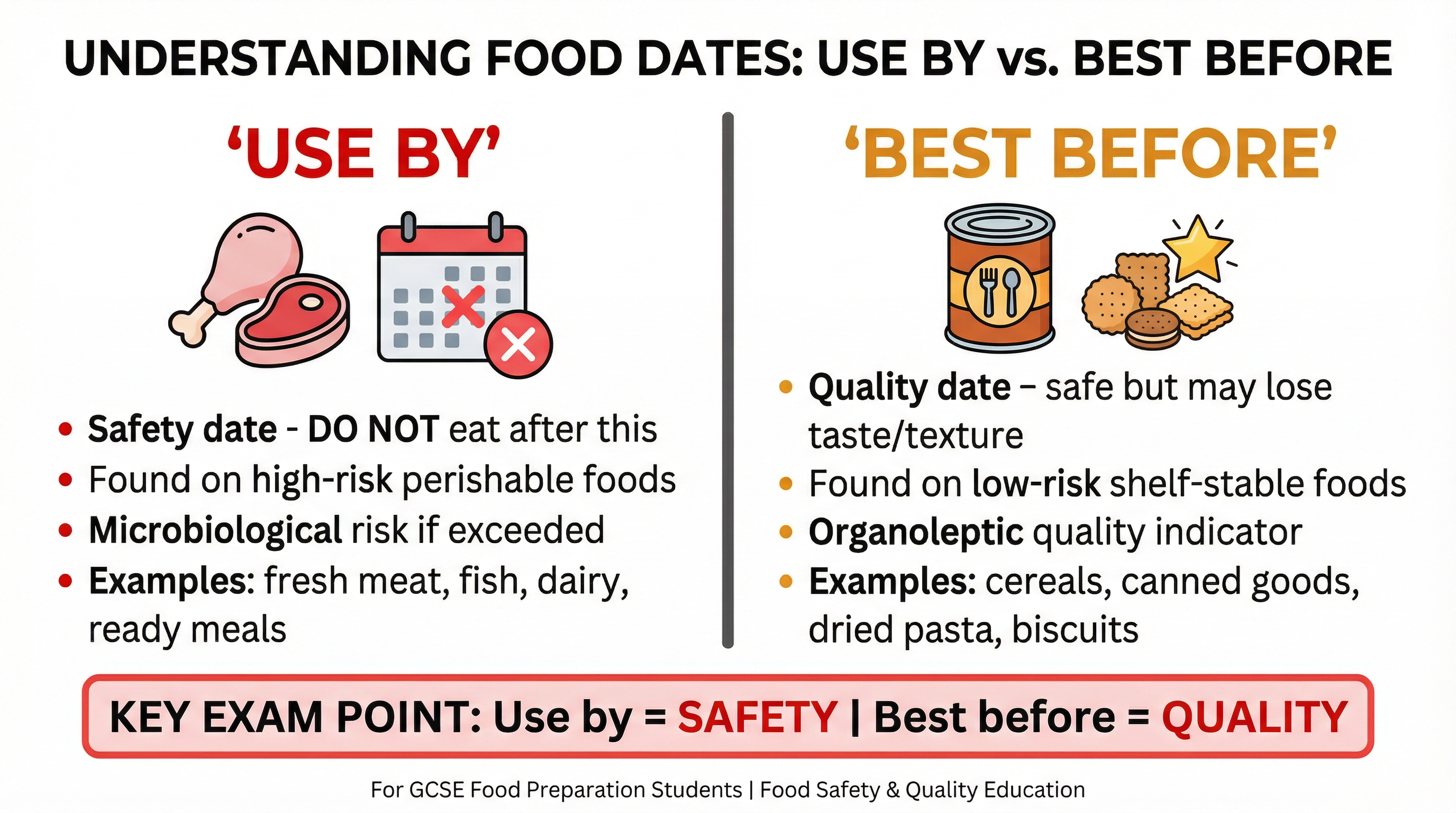
    Understanding the difference between 'Use by' and 'Best before'.

    What it is: The system used to indicate how long a food will remain at its best quality and/or safe to eat.

    Why it matters: Confusing these dates is a common mistake. Correctly identifying the date mark is fundamental to assessing food safety.

    Specific Knowledge:

    • Use by: A safety mark for high-risk, perishable foods (e.g., milk, meat). It is illegal to sell food past its use-by date, and it should not be eaten due to microbiological risk.
    • Best before: A quality mark for lower-risk, shelf-stable foods (e.g., biscuits, canned soup). The food is safe to eat after this date, but its organoleptic properties (taste, texture) may have deteriorated.

    Worked Examples

    3 detailed examples with solutions and examiner commentary

    Practice Questions

    Test your understanding — click to reveal model answers

    Q1

    Analyse the ingredients list of a ready-made pasta sauce which lists 'Tomatoes (60%), Water, Onion, Sugar, Sunflower Oil, Modified Maize Starch, Salt, Acidity Regulator (Citric Acid), Basil'. A person with Type 2 Diabetes is considering buying it. Justify whether this sauce would be a suitable choice. (6 marks)

    6 marks
    standard

    Hint: Look at the order of ingredients. Where does sugar appear? What other ingredients might affect a diabetic diet?

    Q2

    A food label for a lasagne ready meal shows it contains 6.5g of saturated fat per 100g. Explain the health implications of consuming this product regularly. (4 marks)

    4 marks
    standard

    Hint: What is the traffic light colour for this level of saturated fat? What specific health condition is it linked to?

    Q3

    Describe two common mistakes candidates make when interpreting food labels in an exam. (2 marks)

    2 marks
    easy

    Hint: Think about comparing products and date marks.

    Q4

    A food product is described as 'low-fat'. Explain why this claim might be misleading for a consumer trying to choose a healthy option. (3 marks)

    3 marks
    standard

    Hint: When fat is removed, what is often added to improve the taste and texture?

    Q5

    A soup ingredients list includes: Water, Vegetables (25%) (Carrot, Potato, Celery), Lentils, Hydrolysed Vegetable Protein, Salt. Identify one allergen and explain its suitability for a person with Coeliac disease. (3 marks)

    3 marks
    expert

    Hint: Look for the emphasised allergen. Then consider hidden sources of gluten.

    Key Terms

    Essential vocabulary to know

    More Food Preparation and Nutrition Study Guides

    View all

    Food preservation methods

    AQA
    GCSE

    Unlock top marks in your AQA GCSE Food exam by mastering the science of food preservation. This guide breaks down how stopping microbial growth through temperature, water removal, and chemical means is not just a cooking technique, but a core scientific principle essential for food safety and product development.

    Food waste

    AQA
    GCSE

    This study guide tackles the critical issue of food waste, a key component of the AQA GCSE Food Preparation and Nutrition specification (Section 5: Food Provenance). It explores the environmental, economic, and social impacts of waste, providing candidates with the specific knowledge and exam techniques needed to achieve top marks. Understanding this topic is vital for explaining the link between consumer behaviour and global food sustainability.

    Food miles and sustainability

    AQA
    GCSE

    This study guide delves into the critical topic of food miles and sustainability, a key area of the AQA GCSE Food Preparation and Nutrition specification. It explores the environmental impact of our food choices, equipping candidates with the analytical skills needed to evaluate food provenance and secure top marks in their exam.

    Cooking methods

    Edexcel
    GCSE

    Mastering cooking methods is fundamental to excelling in your GCSE Food Preparation and Nutrition exam. This guide breaks down the core science of heat transfer and chemical changes, giving you the precise language and analytical skills examiners reward. Move beyond simply following recipes to scientifically justifying your cooking choices for top marks.

    Seasonal foods

    AQA
    GCSE

    This study guide explores the crucial topic of seasonal foods within the AQA GCSE Food Preparation and Nutrition specification. Understanding seasonality is vital for exam success, as it connects directly to food provenance, sustainability, and the organoleptic qualities of ingredients, allowing candidates to achieve higher marks by demonstrating a deep and applied knowledge of where food comes from.

    Organic food production

    AQA
    GCSE

    This study guide delves into the crucial topic of Organic Food Production for AQA GCSE Food Preparation and Nutrition. It provides a comprehensive overview of the principles, practices, and regulations governing organic farming, equipping students with the knowledge to evaluate its environmental and economic trade-offs effectively.