Study Notes
Overview
The AQA GCSE French 'Travel and Tourism' topic requires candidates to discuss holidays and travel experiences with confidence and detail. Examiners expect students to demonstrate a strong command of vocabulary related to accommodation, transport, and tourist activities, but more importantly, to manipulate time frames effectively. A successful candidate can seamlessly switch between talking about a past holiday (Passé Composé and Imparfait), their current travel preferences (Présent), and future holiday plans (Futur Simple and Futur Proche). This guide will break down these key grammatical areas, provide essential vocabulary, and offer strategies to tackle exam questions, ensuring you can write and speak like a top-band student. Marks are awarded for linguistic accuracy, complexity, and the ability to give and justify opinions, making this a crucial topic to master.
Key Concepts: Mastering Time Frames
Examiners award significant credit for the ability to control different tenses. Your goal is to be a linguistic time-traveller, moving effortlessly between past, present, and future.
The Past: Narrating Your Holidays
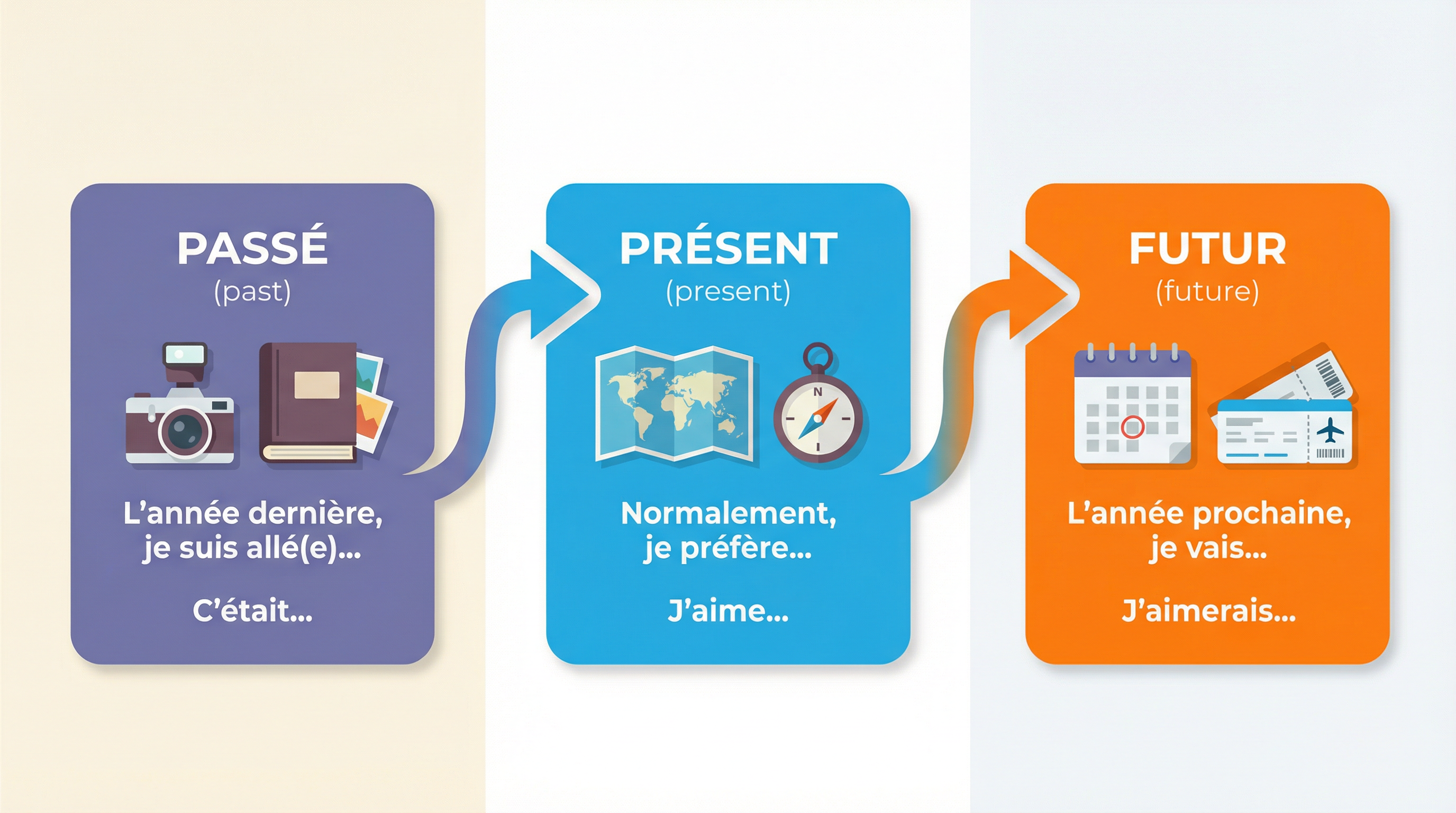
What happened: To describe a past holiday, you will primarily use the Passé Composé for key events and the Imparfait for descriptions and background context.
Why it matters: Using both tenses correctly is a hallmark of a high-level candidate. The Passé Composé tells the examiner what you did, while the Imparfait paints a picture of what it was like.
Specific Knowledge:
- Passé Composé with Avoir: For most verbs. Example: J'ai visité le musée. (I visited the museum.)
- Passé Composé with Être: For 'MRS VAN DER TRAMP' verbs of movement and all reflexive verbs. Example: Je suis allé(e) à la plage. (I went to the beach.) Remember to make the past participle agree!
- Imparfait: For descriptions, weather, and feelings. Example: C'était magnifique et il faisait beau. (It was magnificent and the weather was beautiful.)
The Present: Opinions and Preferences
What happened: Use the present tense to discuss your general opinions on travel, tourism, and your typical holiday choices.
Why it matters: This is where you justify your opinions, a key requirement of AO3 (Speaking) and AO4 (Writing). Using a range of connectives and opinion phrases is essential.
Specific Knowledge:
- Opinion starters: À mon avis... (In my opinion...), Je pense que... (I think that...), Selon moi... (According to me...)
- Connectives: car (because), cependant (however), donc (so), par conséquent (consequently)
- Justification: ...parce que c'est relaxant/intéressant/amusant. (...because it is relaxing/interesting/fun.)
The Future: Plans and Aspirations
What happened: Discuss future travel plans using the Futur Proche (going to do) for immediate plans and the Futur Simple (will do) for more distant or certain plans.
Why it matters: Showing you can use both future tenses demonstrates grammatical range. For top marks, incorporate the conditional to talk about what you would do.
Specific Knowledge:
- Futur Proche: aller + infinitive. Example: Je vais voyager en France. (I am going to travel to France.)
- Futur Simple: infinitive + endings (-ai, -as, -a, -ons, -ez, -ont). Example: Je visiterai Paris. (I will visit Paris.)
- Conditional: infinitive + imperfect endings. Example: Si j'étais riche, je voyagerais autour du monde. (If I were rich, I would travel around the world.)
Key Vocabulary & Structures
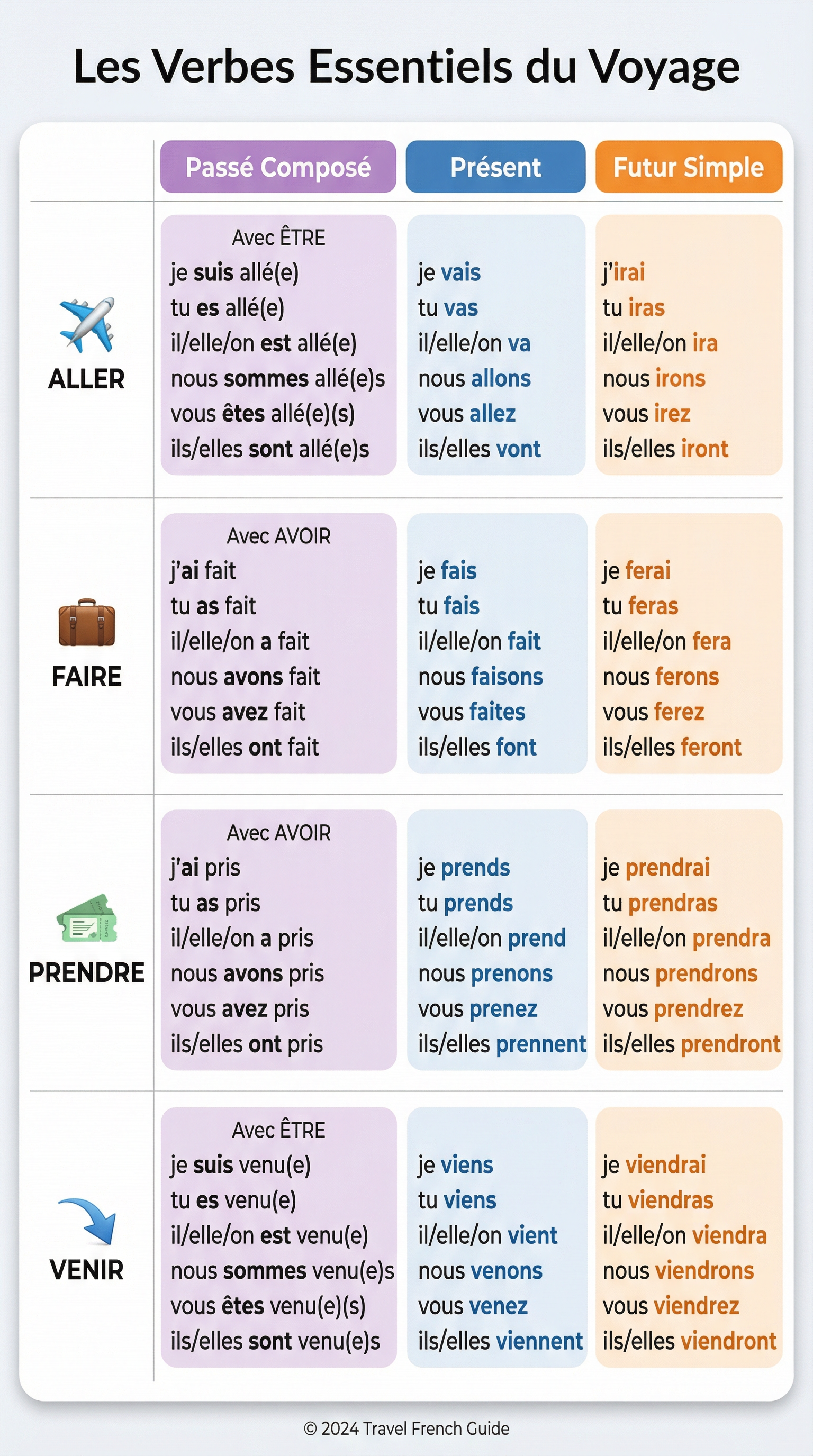
Irregular Verbs
Mastering irregular verbs is non-negotiable. These are high-frequency and essential for fluency.
Accommodation Vocabulary
Being able to describe where you stayed is a common requirement.
{{asset:accommodation_vocab_visual.png