Global issues — AQA GCSE study guide illustration

    Global issues

    AQA
    GCSE
    French

    This study guide for AQA GCSE French (Theme 2, Topic 3: Global Issues) provides a comprehensive, exam-focused resource to help students master the vocabulary and grammar needed to discuss environmental and social problems. It is designed to build confidence and secure top marks by focusing on examiner expectations, complex structures, and common pitfalls.

    4
    Min Read
    3
    Examples
    2
    Questions
    6
    Key Terms
    🎙 Podcast Episode
    Global issues
    0:00-0:00

    Study Notes

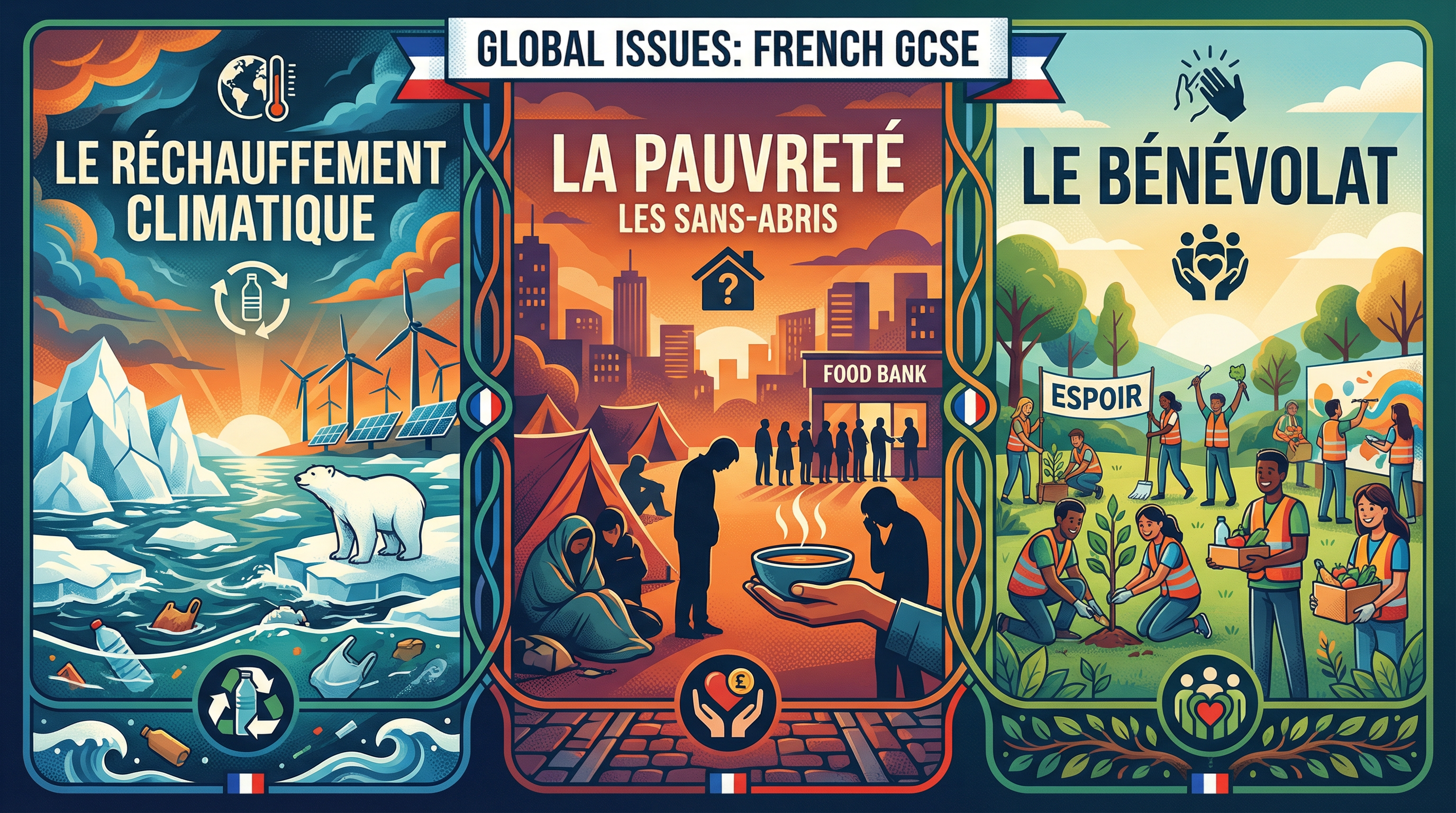
    Header image for AQA GCSE French: Global Issues

    Overview

    This guide covers the AQA GCSE French topic of Global Issues (Les Problèmes Mondiaux), a core component of Theme 2. Examiners expect candidates to demonstrate a strong command of vocabulary related to environmental problems (l'environnement), social issues (la pauvreté, les sans-abris), and solutions like voluntary work (le bénévolat). Success in this area requires not just knowing words, but using them accurately within complex grammatical structures. Marks are awarded for manipulating different time frames, using the subjunctive mood correctly (e.g., 'il faut que...'), and forming conditional sentences with 'si' clauses to discuss hypothetical solutions. This guide will break down these key areas, providing the specific knowledge and skills needed to impress examiners and achieve high grades across listening, speaking, reading, and writing assessments.

    Podcast: Mastering AQA GCSE French - Global Issues

    Key Concepts & Vocabulary

    This topic is divided into three main pillars. Mastering the specific lexis for each is essential for earning marks.

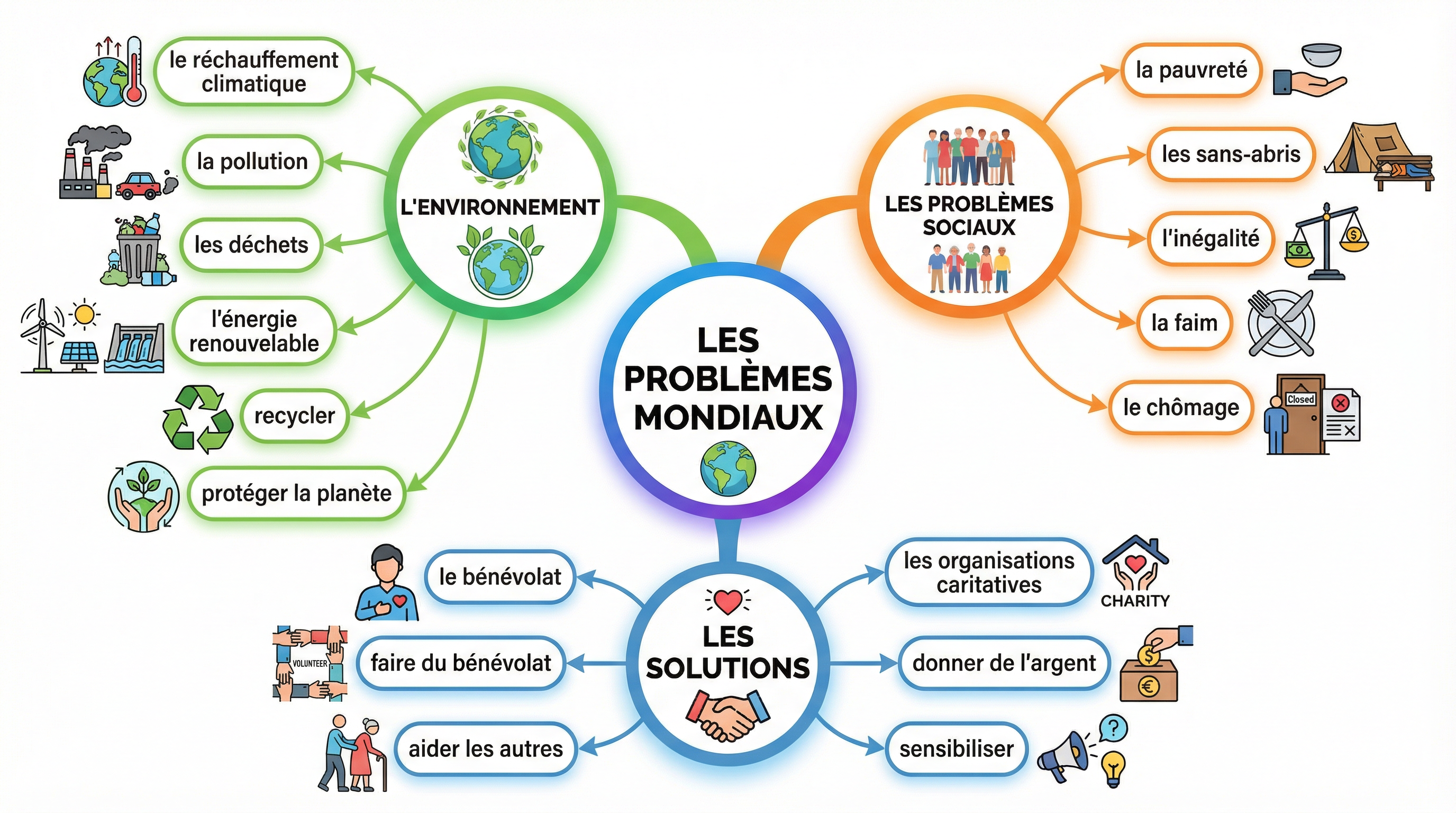
    1. L'Environnement (The Environment)

    Candidates must be able to discuss environmental problems and solutions. Pay close attention to gender agreement, as this is a frequent source of error.

    Key Vocabulary:

    • Le réchauffement climatique: Global warming (masculine)
    • La pollution (de l'air/de l'eau): Pollution (of the air/water) (feminine)
    • Les déchets (m): Waste / rubbish
    • Les gaz à effet de serre (m): Greenhouse gases
    • L'énergie renouvelable (f): Renewable energy
    • Protéger: To protect
    • Recycler: To recycle
    • Réduire: To reduce
    • Jeter: To throw away

    Mind Map of Key Vocabulary for Global Issues

    2. Les Problèmes Sociaux (Social Problems)

    This section focuses on issues like poverty, homelessness, and inequality. Expressing opinions with justification is key.

    Key Vocabulary:

    • La pauvreté: Poverty (feminine)
    • Les sans-abris (m. pl.): The homeless (Note: always plural)
    • Un SDF (un sans domicile fixe): A homeless person
    • L'inégalité (f): Inequality
    • La faim: Hunger
    • Le chômage: Unemployment
    • Aider: To help

    3. Les Solutions et Le Bénévolat (Solutions and Volunteering)

    Examiners look for candidates who can propose and discuss solutions using sophisticated language.

    Key Vocabulary:

    • Le bénévolat: Volunteering / voluntary work
    • Faire du bénévolat: To do voluntary work
    • Un bénévole / une bénévole: A volunteer
    • Une association caritative: A charity
    • Donner de l'argent: To give money
    • Sensibiliser le public: To raise public awareness

    Grammar for Top Marks

    To move into the top bands, you must use complex grammatical structures. Focus on these three.

    1. The Subjunctive Mood

    Used to express necessity, doubt, or emotion. The key trigger phrase for this topic is 'Il faut que...' (It is necessary that...).

    • Structure: Il faut que + subject + subjunctive verb.
    • Example: Il faut que nous protégions l'environnement. (We must protect the environment.)
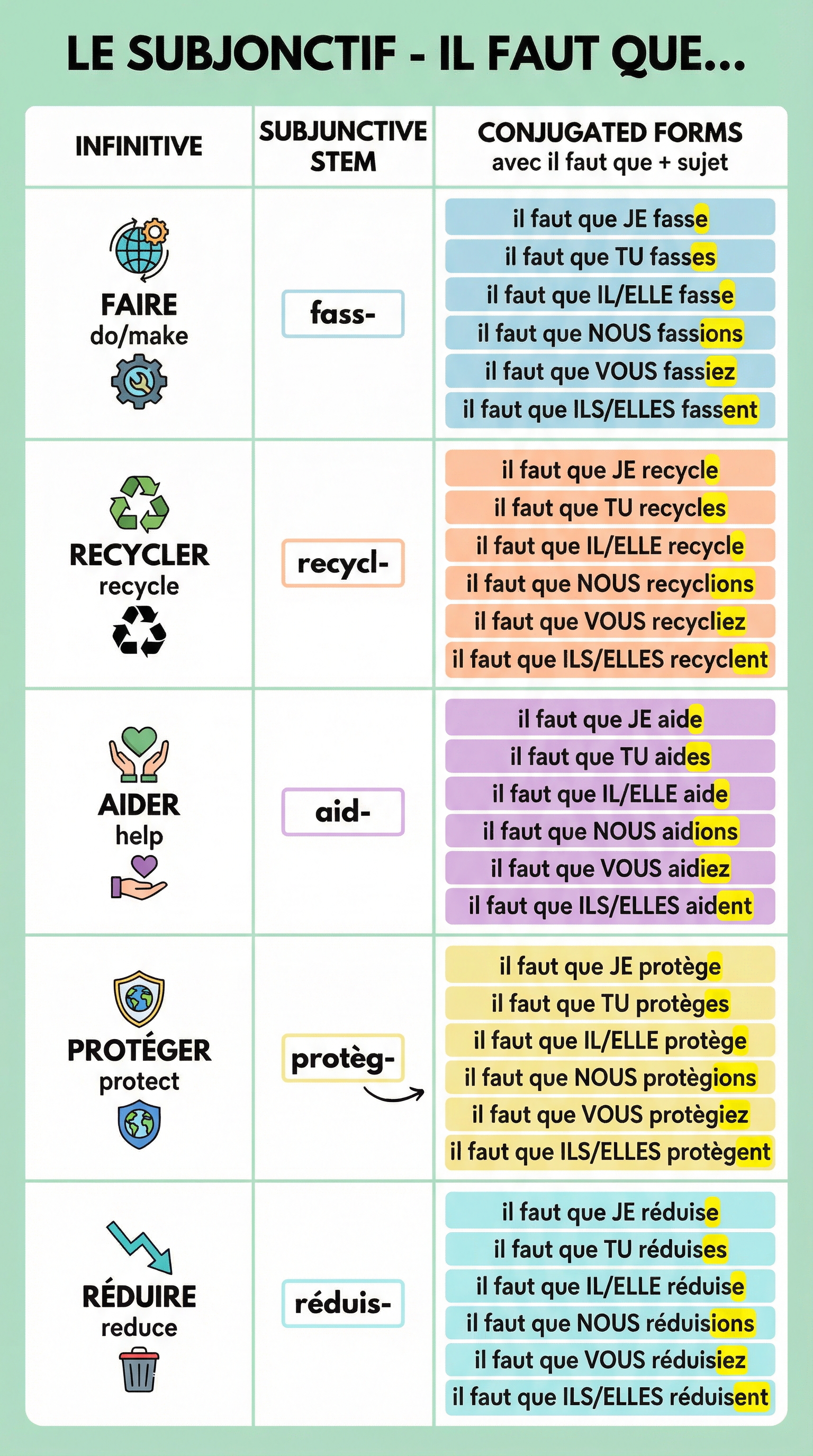
    Le Subjonctif - Key Verb Conjugations

    2. 'Si' Clauses (Conditional Sentences)

    Used to discuss hypothetical situations and their consequences. Perfect for suggesting solutions.

    • Structure: Si + imperfect tense, ... conditional tense.
    • Example: Si j'avais plus de temps, je ferais du bénévolat. (If I had more time, I would do voluntary work.)

    3. Using Three Time Frames

    Demonstrate linguistic flexibility by discussing the topic in the past, present, and future/conditional.

    • Past: Avant, on recyclait moins. (Before, people recycled less.)
    • Present: Aujourd'hui, la pollution est un problème grave. (Today, pollution is a serious problem.)
    • Future: À l'avenir, nous devrons utiliser les énergies renouvelables. (In the future, we will have to use renewable energies.)

    Worked Examples

    3 detailed examples with solutions and examiner commentary

    Practice Questions

    Test your understanding — click to reveal model answers

    Q1

    Tu participes à un forum en ligne pour les jeunes. Exprime ton opinion sur la pauvreté dans le monde. (Environ 150 mots). Tu dois :

    • décrire le problème de la pauvreté
    • expliquer les causes
    • suggérer ce que les jeunes peuvent faire pour aider
    • dire ce que tu feras à l'avenir pour aider.
    32 marks
    high

    Hint: Remember to include at least two justified opinions and use complex structures like the subjunctive and conditional to access the top marks.

    Q2

    Comment peut-on protéger l'environnement ?

    12 marks
    standard

    Hint: Try to mention actions at a personal, local, and governmental level. Use 'on peut' (one can), 'il faut' (one must), and the conditional ('on devrait' - one should).

    Key Terms

    Essential vocabulary to know

    More French Study Guides

    View all

    Prepositions

    AQA
    GCSE

    Mastering French prepositions is a game-changer for your AQA GCSE exam. This guide breaks down the essential rules for using words like 'à', 'de', and 'en' correctly, giving you the tools to boost your grade by demonstrating precision and a wider range of language, which is critical for hitting the top marks in both speaking and writing.

    Conjunctions

    AQA
    GCSE

    Unlock top marks in your AQA GCSE French exams by mastering conjunctions. This guide will transform your writing and speaking from simple to sophisticated, showing you how to use linking words to demonstrate the complexity and range of language that examiners reward.

    Identifying key information

    AQA
    GCSE

    Identifying key information in AQA GCSE French is the foundation skill that determines whether candidates earn marks for precision or lose them through vague responses. This study focuses on extracting specific details from authentic French sources, distinguishing timeframes, recognising negation, and navigating examiner-designed distractors. Mastering this skill unlocks success across 80% of the assessment objectives in Papers 1 and 3.

    Travel and tourism

    AQA
    GCSE

    This study guide for AQA GCSE French focuses on the 'Travel and Tourism' topic, a core component of Theme 2. It is designed to equip candidates with the vocabulary, grammar, and exam techniques required to narrate holidays across three time frames, justify opinions, and secure top marks in writing and speaking assessments.

    Describing people, places, and events

    Edexcel
    GCSE

    Mastering the art of description is crucial for achieving top grades in Edexcel GCSE French. This guide provides the essential vocabulary, grammar, and exam techniques to describe people, places, and events with the precision and flair that examiners reward.

    Dealing with unfamiliar vocabulary

    AQA
    GCSE

    Mastering the art of decoding unfamiliar French vocabulary is your secret weapon for top marks in AQA GCSE French. This guide provides a powerful five-step strategy to turn confusion into confidence, helping you excel in reading, listening, and translation tasks by thinking like a true linguist.