Study Notes
Overview
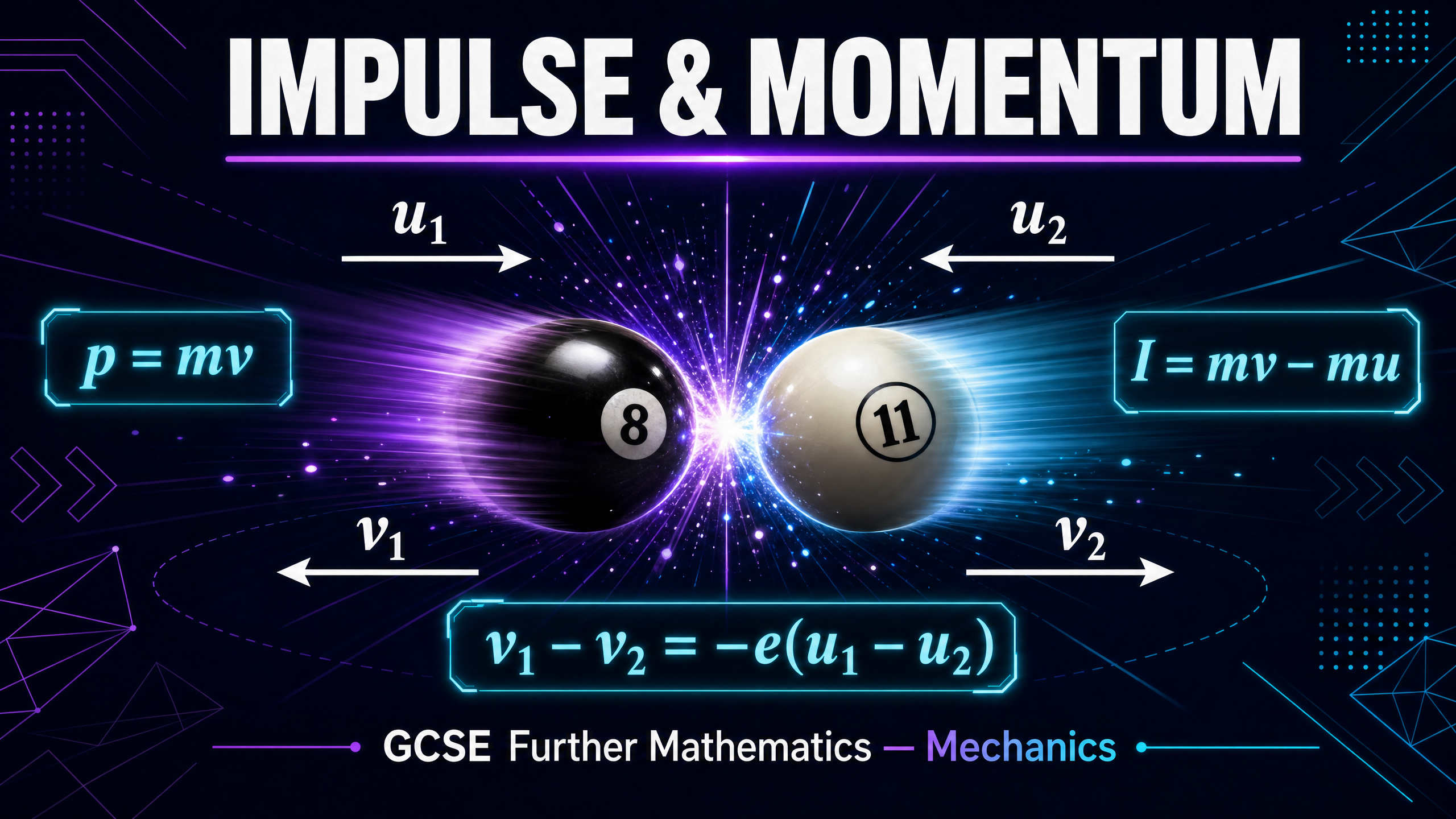
Welcome to Mechanics (2e): Impulse, Momentum, and Collisions. This topic bridges the gap between basic kinematics and advanced physical modelling. You will learn how forces change the motion of objects over time (impulse) and how objects interact when they crash into each other (collisions).
This area of Further Mathematics is highly synoptic, meaning it draws on your knowledge of vectors, integration, and energy. Examiners love testing this topic because it requires a methodical approach and clear communication of mathematical principles. A typical exam question might ask you to find the final velocities of two colliding spheres, or calculate the coefficient of restitution given the energy lost during impact.
Listen to our companion podcast for a complete audio review of these concepts:
Key Concepts
Concept 1: Momentum
Momentum is the product of an object's mass and its velocity. It is a vector quantity, meaning it has both magnitude and direction. A heavy lorry moving slowly can have the same momentum as a light car moving quickly. Because it is a vector, defining a positive direction (usually to the right) is critical before starting any calculation.
Example: A 5 kg mass moving at 4 m/s to the right has a momentum of 20 kg m/s. If it moves to the left, its momentum is -20 kg m/s.
Concept 2: Conservation of Linear Momentum
The Principle of Conservation of Linear Momentum states that in a closed system (where no external forces act), the total momentum before a collision equals the total momentum after the collision. This is the foundation of almost every collision problem.
Concept 3: Newton's Experimental Law and Restitution
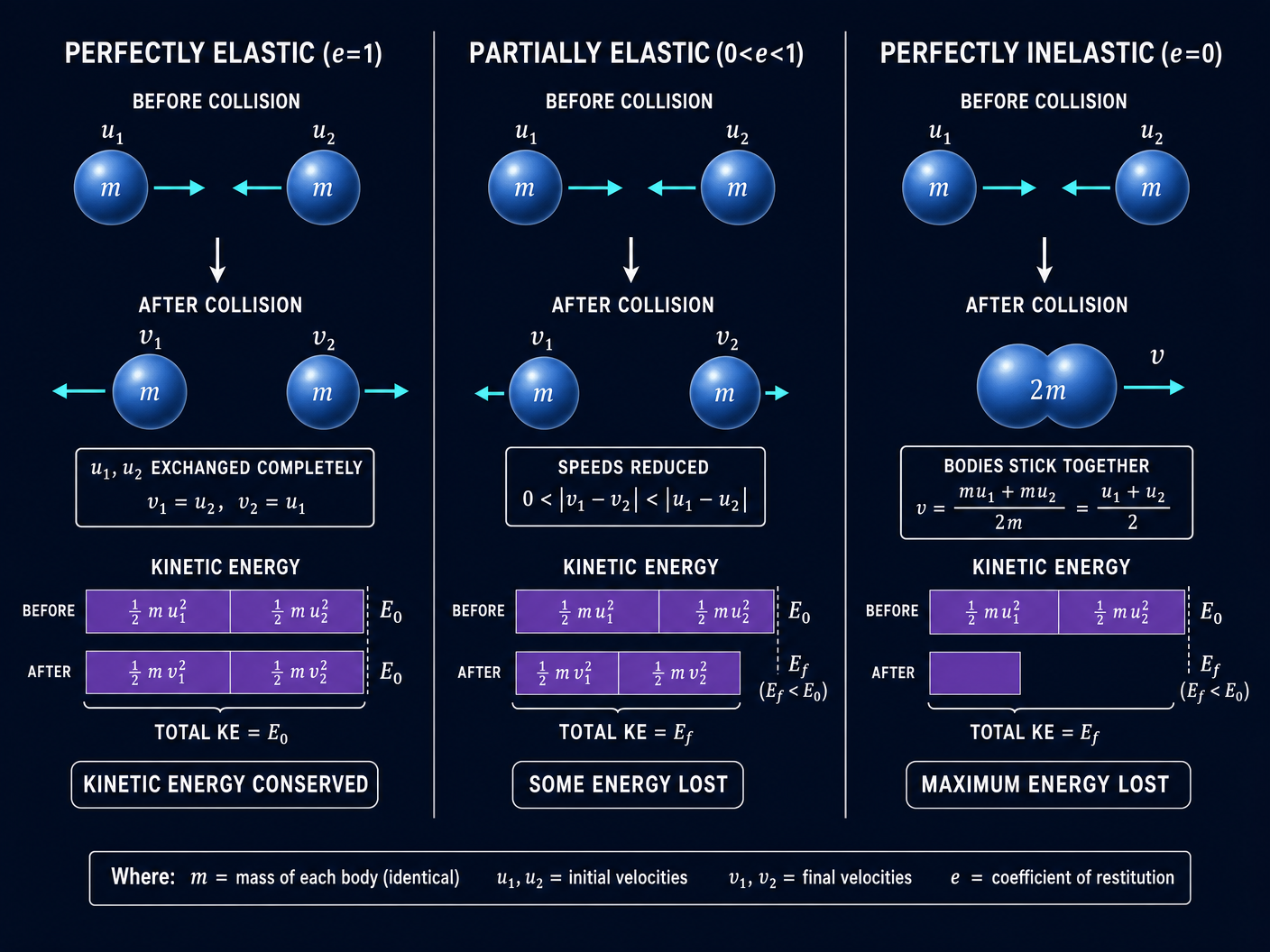
When two objects collide, how 'bouncy' the collision is depends on the materials involved. This is quantified by the coefficient of restitution, e. Newton's Experimental Law (NEL) states that the relative speed of separation is directly proportional to the relative speed of approach. The constant of proportionality is e, which always satisfies 0 \leq e \leq 1.
Concept 4: Impulse
Impulse is the change in momentum. When a force acts on an object for a certain amount of time, it delivers an impulse. For a constant force, Impulse = Force × time. For a variable force, Impulse is the integral of the force with respect to time.
Concept 5: Oblique Impacts
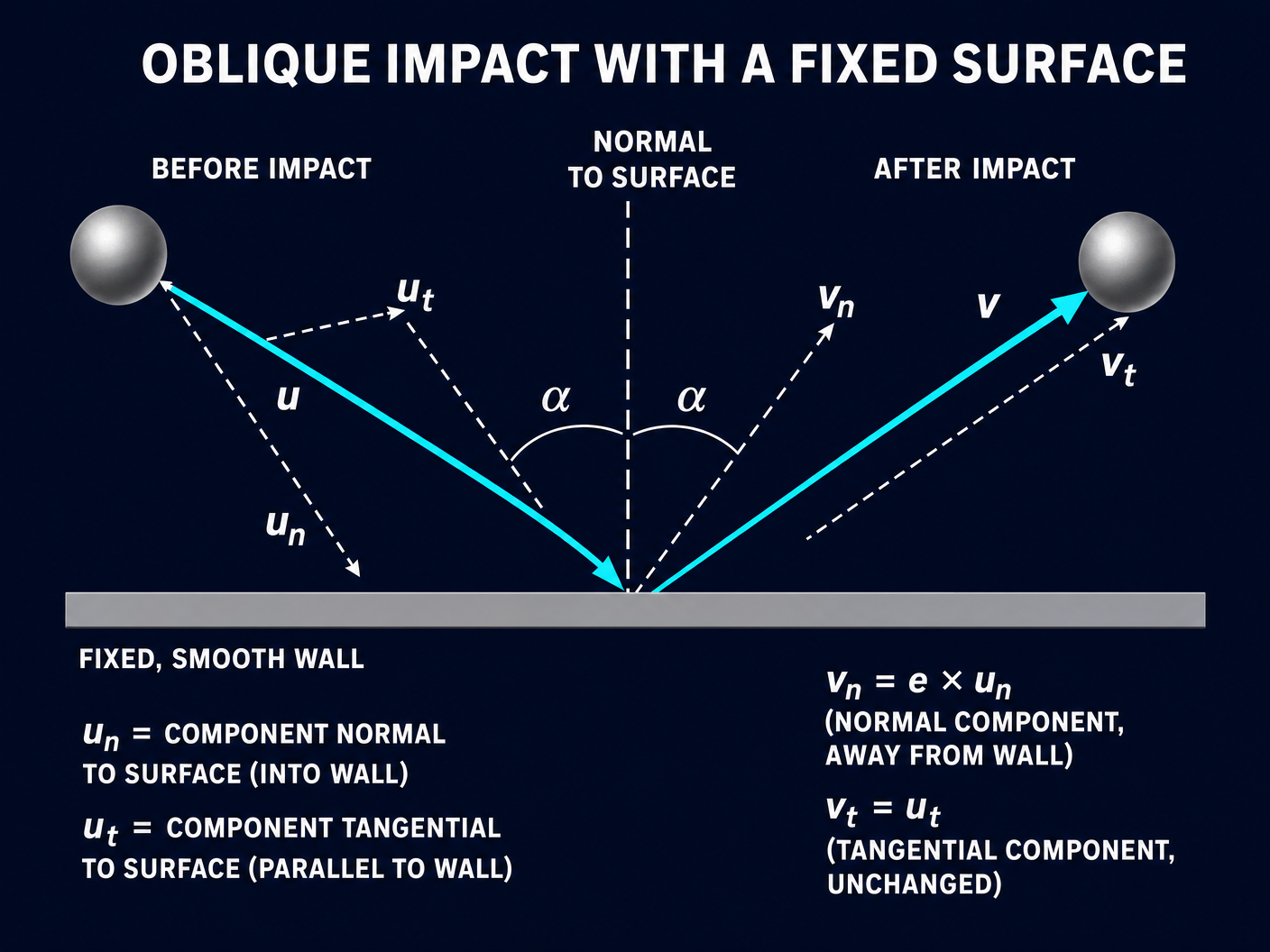
In two-dimensional collisions, such as a snooker ball hitting a cushion at an angle, you must resolve the velocity into components parallel and perpendicular to the surface. The parallel (tangential) component remains unchanged. The perpendicular (normal) component is multiplied by e and reversed in direction.
Mathematical Relationships
- Momentum: p = mv
- Conservation of Momentum: m_1u_1 + m_2u_2 = m_1v_1 + m_2v_2
- Newton's Experimental Law: v_1 - v_2 = -e(u_1 - u_2) or \frac{v_2 - v_1}{u_1 - u_2} = e
- Impulse (constant force): I = Ft = mv - mu
- Impulse (variable force): I = \int_{t_1}^{t_2} F , dt
- Kinetic Energy: KE = \frac{1}{2}mv^2
Practical Applications
These principles are used extensively in vehicle safety design (crumple zones to increase collision time and reduce force), sports (the 'sweet spot' on a tennis racket), and astrophysics (orbital slingshots and meteor impacts).
Visual Resources
2 diagrams and illustrations
Interactive Diagrams
2 interactive diagrams to visualise key concepts
Conceptual Flow Outline
Flowchart for solving collision problems
Conceptual Flow Outline
Choosing the correct impulse formula
Worked Examples
3 detailed examples with solutions and examiner commentary
Practice Questions
Test your understanding — click to reveal model answers
A particle P of mass 3 kg is moving with speed 4 m/s. It collides directly with a particle Q of mass 2 kg which is moving in the opposite direction with speed 1 m/s. After the collision, P continues to move in the same direction with speed 1.5 m/s. Calculate the coefficient of restitution between P and Q.
Hint: Define your positive direction carefully. If P is moving in the positive direction, Q's initial velocity must be negative.
Two spheres A and B are approaching each other. They collide directly and coalesce. State the coefficient of restitution for this collision and explain what happens to the total kinetic energy of the system.
Hint: What does the word 'coalesce' mean in a physical context?
A smooth sphere falls vertically and hits a smooth horizontal floor with speed u. It rebounds with speed v. The coefficient of restitution is e. Show that the fraction of kinetic energy lost in the impact is 1 - e^2.
Hint: Write expressions for initial KE and final KE. Use NEL to find v in terms of u and e.
A particle of mass 0.2 kg is moving with velocity (3\mathbf{i} - 4\mathbf{j}) m/s when it receives an impulse of (-2\mathbf{i} + 3\mathbf{j}) Ns. Calculate the final speed of the particle.
Hint: Use the vector form of the impulse-momentum equation. Remember that speed is the magnitude of the velocity vector.
A force F = 5t Newtons acts on a body of mass 2 kg, initially at rest, for 4 seconds. Calculate the impulse exerted by the force and the final velocity of the body.
Hint: Because the force depends on time (t), you must integrate.