Study Notes
Overview
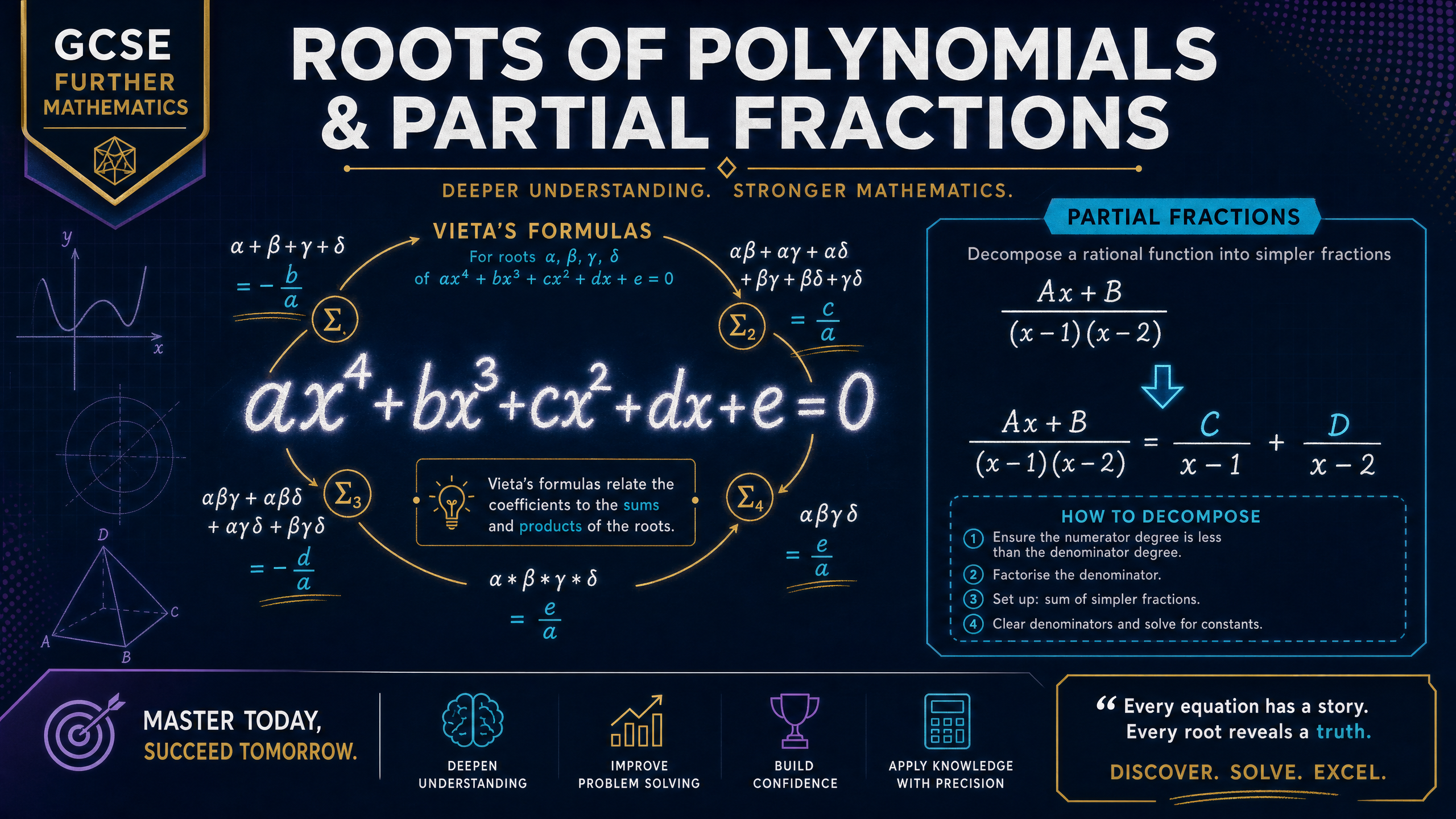
Roots of Polynomials and Partial Fractions form a cornerstone of the Pure Core (2c) specification in GCSE Further Mathematics. This topic bridges the gap between basic algebra and advanced calculus. By understanding Vieta's formulas, you will learn to relate the coefficients of any polynomial directly to the sums and products of its roots—meaning you can manipulate and evaluate complex root expressions without ever needing to solve the equation itself.
Simultaneously, Partial Fractions teaches you the reverse process of algebraic addition. You will learn to decompose complicated rational functions into simpler fractions. This is not just an abstract exercise; it is a critical preparatory skill for advanced integration and binomial expansions at A-Level. Examiners frequently test these skills together in multi-part questions, requiring strong algebraic fluency, careful attention to signs, and a methodical approach to equating coefficients.
Key Concepts
Concept 1: Vieta's Formulas for Roots and Coefficients
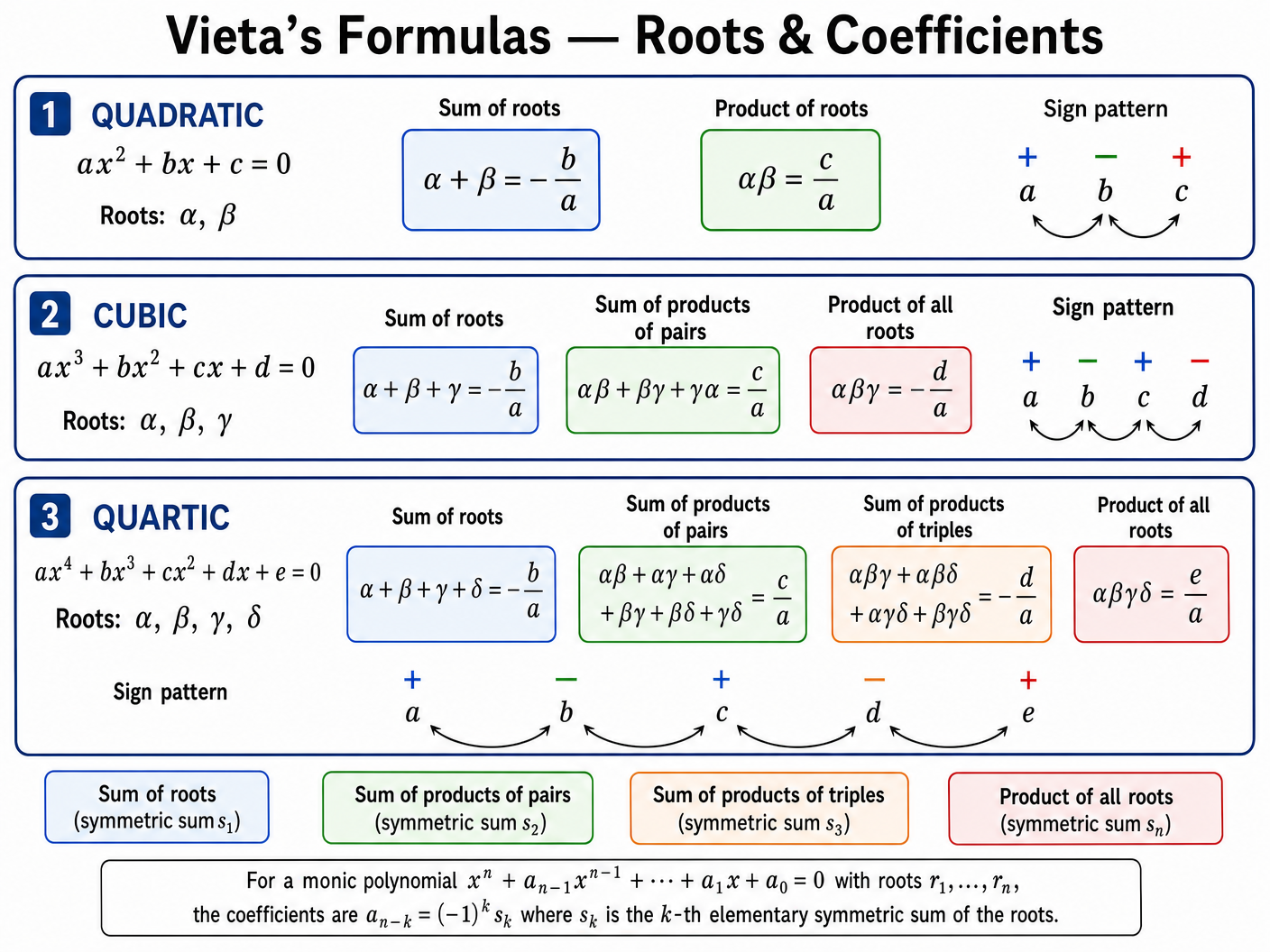
Vieta's formulas establish a direct relationship between the roots of a polynomial and its coefficients. The fundamental principle is that when a polynomial is written in monic form (leading coefficient of 1), the coefficients represent alternating symmetric sums of the roots.
For a quadratic ax^2 + bx + c = 0 with roots \alpha, \beta:
- Sum of roots: \alpha + \beta = -\frac{b}{a}
- Product of roots: \alpha\beta = \frac{c}{a}
For a cubic ax^3 + bx^2 + cx + d = 0 with roots \alpha, \beta, \gamma:
- Sum of roots: \sum \alpha = -\frac{b}{a}
- Sum of pairs: \sum \alpha\beta = \frac{c}{a}
- Product of roots: \alpha\beta\gamma = -\frac{d}{a}
**Why does this work?**If you expand a(x-\alpha)(x-\beta)(x-\gamma) = 0, the x^2 term is formed by choosing two x's and one constant (which are -\alpha, -\beta, -\gamma). Summing these gives -a(\alpha+\beta+\gamma)x^2. Equating this to bx^2 gives \alpha+\beta+\gamma = -\frac{b}{a}. The alternating signs emerge naturally from the negative signs in the factors (x-\text{root}).
Concept 2: Algebraic Manipulation of Roots
Examiners will rarely just ask for the sum or product; they will ask for more complex symmetric expressions like \alpha^2 + \beta^2 + \gamma^2 or \frac{1}{\alpha} + \frac{1}{\beta} + \frac{1}{\gamma}. You must express these in terms of the elementary symmetric sums.
Key Identities (Must Memorise):
- \alpha^2 + \beta^2 = (\alpha+\beta)^2 - 2\alpha\beta
- \alpha^2 + \beta^2 + \gamma^2 = (\alpha+\beta+\gamma)^2 - 2(\alpha\beta + \beta\gamma + \gamma\alpha)
- \frac{1}{\alpha} + \frac{1}{\beta} + \frac{1}{\gamma} = \frac{\beta\gamma + \alpha\gamma + \alpha\beta}{\alpha\beta\gamma}
**Example:**If 2x^3 - 5x^2 + 4x - 1 = 0, find \alpha^2 + \beta^2 + \gamma^2.
Here a=2, b=-5, c=4, d=-1.
\sum \alpha = -\frac{-5}{2} = \frac{5}{2}
\sum \alpha\beta = \frac{4}{2} = 2
\alpha^2 + \beta^2 + \gamma^2 = (\frac{5}{2})^2 - 2(2) = \frac{25}{4} - 4 = \frac{9}{4}.
Concept 3: Proper vs Improper Rational Functions
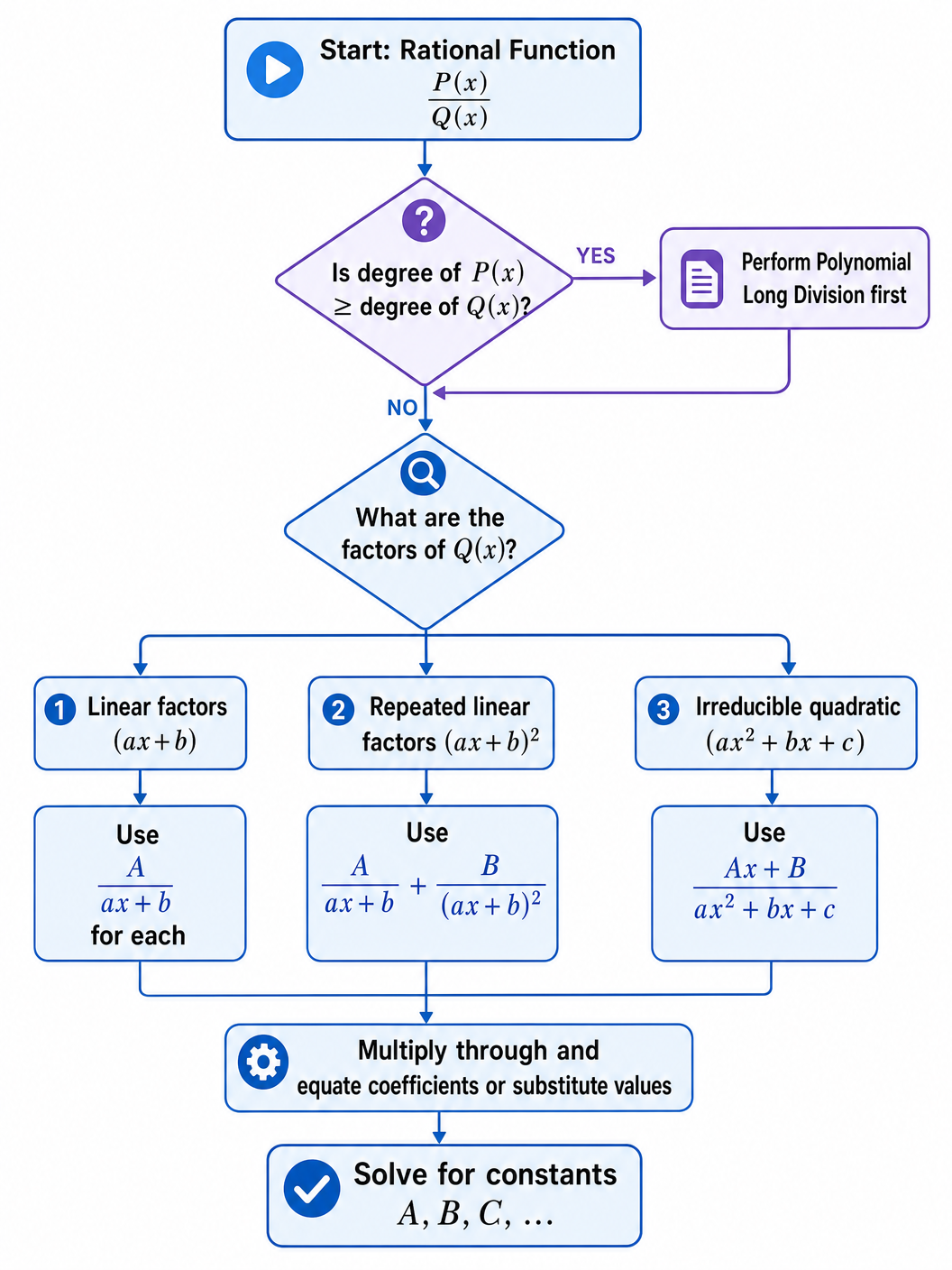
Before starting any partial fraction decomposition, you MUST check the degrees of the numerator (P(x)) and denominator (Q(x)).
- Proper: Degree of P(x) < Degree of Q(x). Proceed directly to partial fractions.
- Improper: Degree of P(x) \ge Degree of Q(x). You MUST perform algebraic long division first to extract a polynomial, leaving a proper fraction remainder.
**Why does this matter?**Attempting to decompose an improper fraction directly will result in missing the polynomial terms, losing all subsequent method marks. The structure A/(x+a) + B/(x+b) can only ever sum to a proper fraction.
Concept 4: Forms of Partial Fractions
The form of the decomposition depends entirely on the factors of the denominator Q(x):
-
Distinct Linear Factors:
\frac{P(x)}{(x+a)(x+b)} \equiv \frac{A}{x+a} + \frac{B}{x+b} -
Repeated Linear Factors:
\frac{P(x)}{(x+a)^2} \equiv \frac{A}{x+a} + \frac{B}{(x+a)^2}
Note: You must include both the linear and squared terms! -
Irreducible Quadratic Factors:
\frac{P(x)}{(x^2+c)} \equiv \frac{Ax+B}{x^2+c}
Note: The numerator must be linear (degree 1), which is one less than the quadratic denominator (degree 2).
Concept 5: Finding the Constants
Once the identity is set up and multiplied through by the denominator, there are two main methods to find the constants A, B, C, etc.
- Method 1: Substitution (The Cover-Up Rule). Substitute values of x that make the linear factors zero. This is the fastest method for distinct linear factors.
- Method 2: Equating Coefficients. Expand the right-hand side and equate the coefficients of x^2, x, and the constants. This is necessary for irreducible quadratics and is a robust fallback method.
Examiner Tip: The best candidates use a hybrid approach—substituting roots to find A and B, then equating the highest power of x to quickly find C.
Mathematical Relationships
Vieta's Formulas (Given polynomial ax^n + bx^{n-1} + cx^{n-2} + \dots = 0):
- Sum of roots (s_1) = -\frac{b}{a}
- Sum of products of pairs (s_2) = \frac{c}{a}
- Sum of products of triples (s_3) = -\frac{d}{a}
- Product of all roots (s_n) = (-1)^n \frac{\text{constant term}}{a}
Practical Applications
While highly theoretical, these techniques are foundational. Partial fractions are required in control theory and signal processing (Laplace transforms) to break down complex system transfer functions into simple, recognizable responses. Root-coefficient relationships are used in digital error correction coding (like Reed-Solomon codes used in CDs and QR codes) to locate and correct data errors without solving massive polynomials.
Visual Resources
2 diagrams and illustrations
Interactive Diagrams
2 interactive diagrams to visualise key concepts
Conceptual Flow Outline
Standard workflow for Roots of Polynomials questions.
Conceptual Flow Outline
Choosing the correct form for partial fractions.
Worked Examples
3 detailed examples with solutions and examiner commentary
Practice Questions
Test your understanding — click to reveal model answers
The roots of the equation x^3 - 2x^2 + 5x - 7 = 0 are \alpha, \beta, \gamma. Find the value of \alpha^2 + \beta^2 + \gamma^2. (3 marks)
Hint: Use the identity for the sum of squares.
Express \frac{5x+1}{(x-1)(x+2)} in partial fractions. (4 marks)
Hint: Set it equal to A/(x-1) + B/(x+2) and use substitution.
Express \frac{2x^2 + 3x}{(x+1)^2(x-2)} in partial fractions. (5 marks)
Hint: Watch out for the repeated linear factor.
The equation x^4 - 3x^3 + px^2 + qx + r = 0 has roots \alpha, -\alpha, \beta, \gamma. Given that \beta+\gamma = 4, find the value of p, q, and r if the product of the roots is -12 and \alpha = 2. (6 marks)
Hint: Use the sum of roots to find beta and gamma, then use the other Vieta formulas.
Express \frac{x^3}{x^2+1} in partial fractions. (4 marks)
Hint: Is it proper or improper?