OCR · GCSE · Further Mathematics
Algebraic Fractions
Master OCR GCSE Further Maths Algebraic Fractions (2.1) with this comprehensive study guide. Learn to simplify complex expressions, solve equations, and avoid common exam pitfalls through expert-written content, worked examples, and engaging multi-modal resources designed to secure top marks.
- 5 min read
- 3 worked examples
- 5 practice questions
- 6 key terms
Check what you remember
Read the wording for your board, then hide it and explain Rational Expression in your own words. Rough notes are fine. This is a self-check, with no mark or grade.
Reference: OCR
An algebraic expression that can be written as a fraction where both the numerator and the denominator are polynomials.
Study Notes
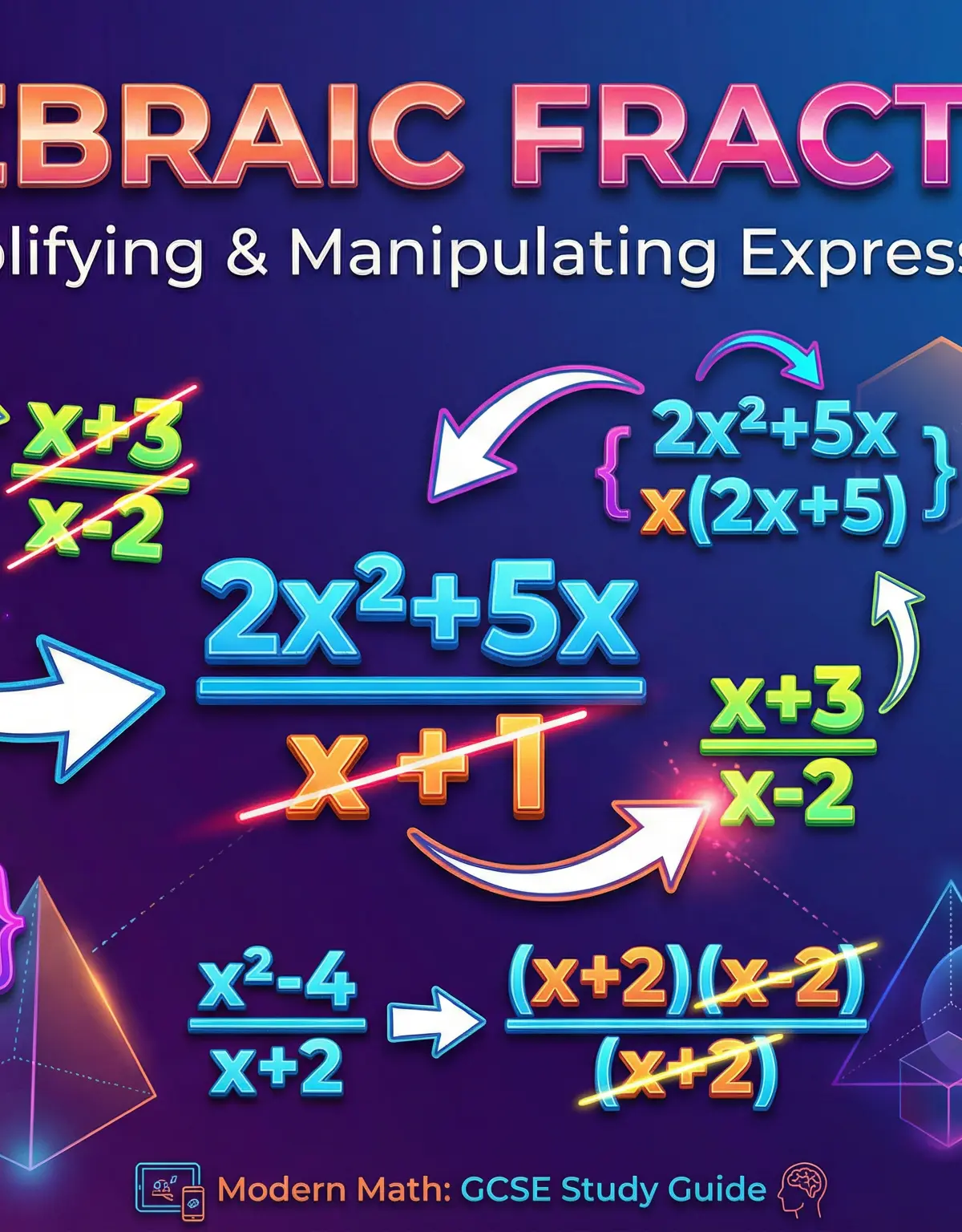
Overview
Algebraic Fractions are a cornerstone of the OCR GCSE Further Mathematics specification, representing a significant step up from standard GCSE algebra. This topic tests not just your ability to manipulate algebraic expressions, but your fundamental understanding of number theory as applied to polynomials. Mastery in this area is crucial as it integrates several key skills: factorizing quadratics, simplifying rational expressions, and solving complex equations. Examiners frequently use algebraic fractions to differentiate between candidates, as success requires both procedural fluency and conceptual understanding. A typical exam question might ask you to simplify a complex fraction for 3-4 marks, or solve an equation involving algebraic fractions that leads to a quadratic, often for 5-6 marks. This guide will equip you with the techniques and insights needed to tackle these questions with confidence.
Key Concepts
1. Simplifying Algebraic Fractions
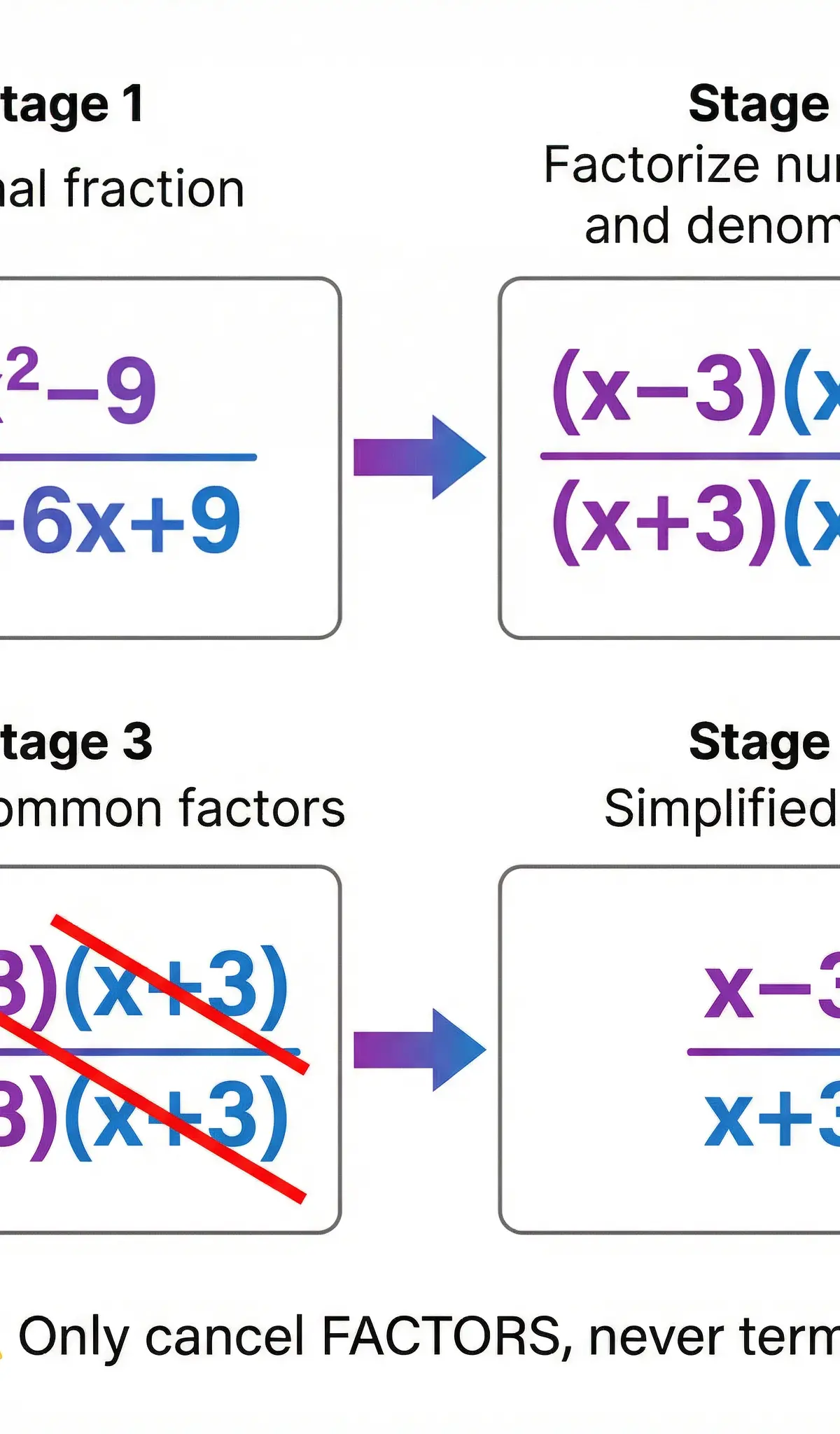
The fundamental principle of simplifying any fraction, whether numerical or algebraic, is to cancel out common factors from the numerator and denominator. The most common mistake candidates make is to cancel terms that are added or subtracted, rather than factors that are multiplied. To avoid this, you must follow a strict two-step process:
- Factorize Completely: Always begin by factorizing both the numerator and the denominator into their simplest factors. This often involves identifying differences of two squares, perfect square trinomials, or factorizing quadratics of the form ax² + bx + c.
- Cancel Common Factors: Once everything is factorized, you can cancel out any factor that appears in both the numerator and the denominator.
Example:
Simplify the expression: (2x² + 5x - 3) / (x² - 9)
- Step 1: Factorize Numerator: 2x² + 5x - 3 = (2x - 1)(x + 3)
- Step 2: Factorize Denominator: x² - 9 = (x - 3)(x + 3) (Difference of two squares)
- Step 3: Cancel Common Factor: The expression becomes [(2x - 1)(x + 3)] / [(x - 3)(x + 3)]. The common factor is (x + 3).
- Final Answer: (2x - 1) / (x - 3)
2. Adding and Subtracting Algebraic Fractions
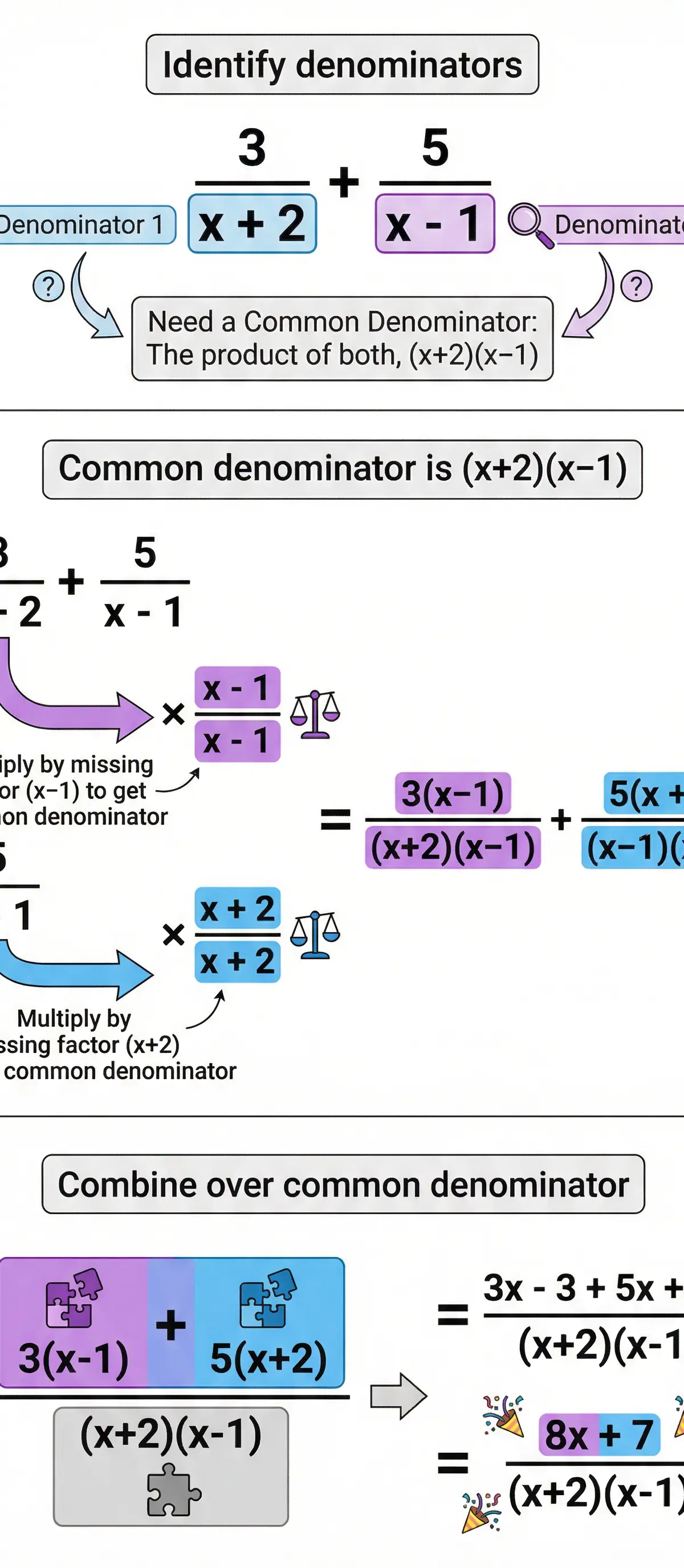
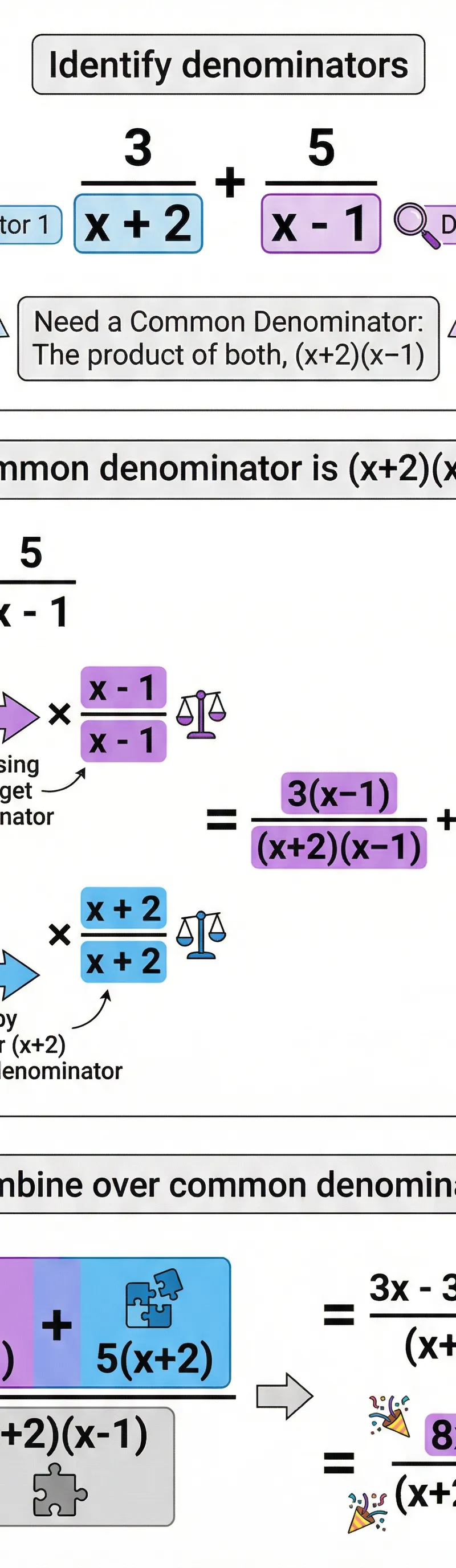
To add or subtract algebraic fractions, you must first find a common denominator, just as you would with numerical fractions. The process is as follows:
- Find the Lowest Common Multiple (LCM) of the denominators. For most GCSE questions, this will simply be the product of the individual denominators.
- Rewrite Each Fraction: For each fraction, multiply the numerator and denominator by the factor(s) needed to make its denominator equal to the LCM.
- Combine the Numerators: Add or subtract the new numerators, placing the result over the common denominator.
- Simplify: Expand any brackets in the numerator and collect like terms. Finally, check if the resulting fraction can be simplified further by factorizing.
Examiner Tip: When subtracting, always place the second numerator in brackets to ensure you distribute the negative sign correctly across all its terms. This is a major source of lost marks.
3. Solving Equations with Algebraic Fractions
When faced with an equation containing algebraic fractions, the primary goal is to eliminate the denominators. This transforms the problem into a more familiar linear or quadratic equation.
- Find the LCM of all denominators in the equation.
- Multiply Every Term: Multiply every single term on both sides of the equation by the LCM. This will cancel out all the denominators.
- Solve the Resulting Equation: You will be left with an equation (usually linear or quadratic) without fractions. Solve this using standard methods.
- Check for Invalid Solutions: It is crucial to check if your solution(s) make any of the original denominators equal to zero. If a solution does this, it is an extraneous solution and must be discarded.
Example:
Solve: 4 / (x - 1) = 2 + 3 / x
- LCM: The LCM of (x - 1) and x is x(x - 1).
- Multiply by LCM: x(x - 1) * [4 / (x - 1)] = x(x - 1) * [2] + x(x - 1) * [3 / x]
- Simplify: 4x = 2x(x - 1) + 3(x - 1)
- Expand and Solve: 4x = 2x² - 2x + 3x - 3 -> 2x² - 3x - 3 = 0. This can then be solved using the quadratic formula.
Mathematical Relationships
- Difference of Two Squares: a² - b² = (a - b)(a + b). This is a non-negotiable formula to memorize and recognize instantly.
- Perfect Square Trinomial: a² + 2ab + b² = (a + b)² and a² - 2ab + b² = (a - b)². Recognizing these saves time in factorization.
- Quadratic Formula: For ax² + bx + c = 0, x = [-b ± sqrt(b² - 4ac)] / 2a. This is given on the formula sheet but you must know how and when to apply it, especially after clearing fractions from an equation.
Practical Applications
While seemingly abstract, algebraic fractions are fundamental in various fields of science and engineering. They are used to model and solve problems involving rates (e.g., speed, distance, time), electrical circuits (resistance in parallel), and in physics to describe relationships between variables. For example, the formula for the combined resistance (R_T) of two resistors (R1, R2) in parallel is 1/R_T = 1/R1 + 1/R2. To solve for R_T, you would add the algebraic fractions on the right-hand side.
Visual Resources
2 diagrams and illustrations
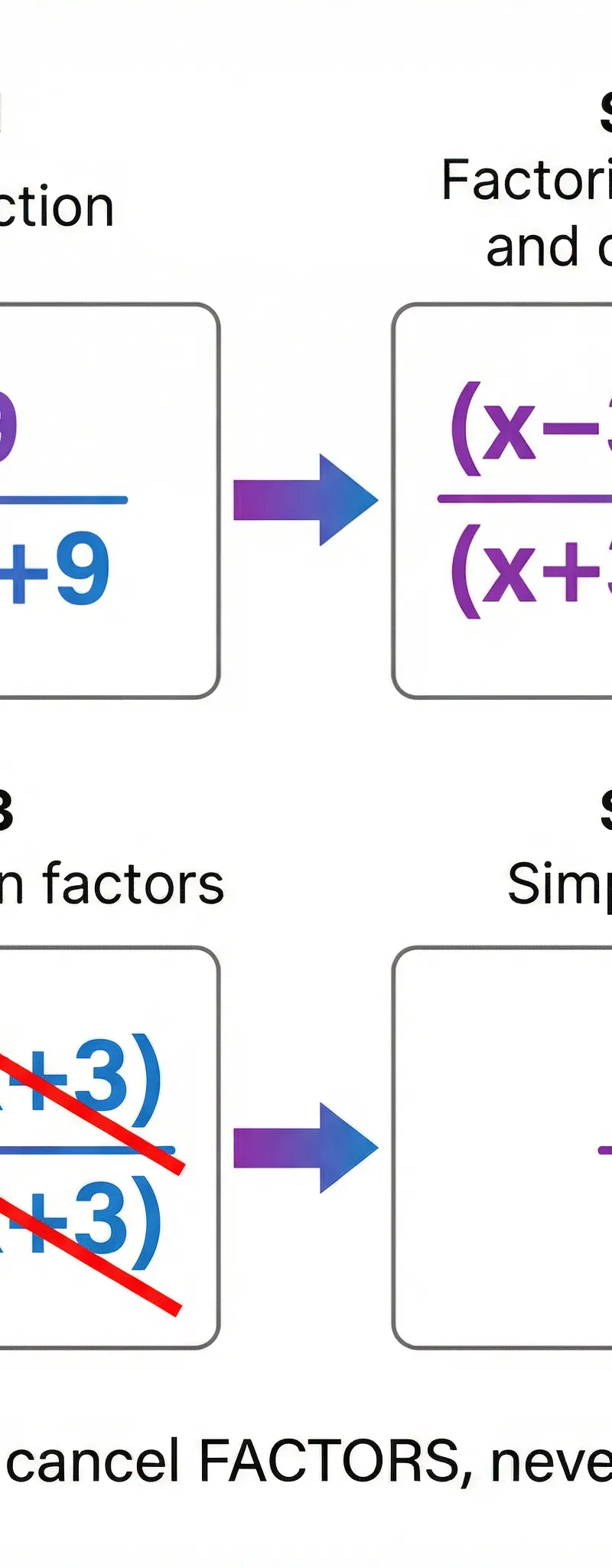
Interactive Diagrams
2 interactive diagrams to visualise key concepts
Conceptual Flow Outline
Flowchart showing the step-by-step process for simplifying an algebraic fraction. It emphasizes the 'Factorize, then Cancel' workflow.
Conceptual Flow Outline
Flowchart illustrating the procedure for adding two algebraic fractions, highlighting the critical steps of finding the LCM and combining numerators.
Worked Examples
3 worked examples — open one to explore the question and available guidance.
Practice Questions
Try the question, then reveal an answer plan or example response
Simplify fully: (x² + x - 12) / (2x² - 7x + 3)
Hint: Factorize both the numerator and the non-monic quadratic in the denominator.
Express as a single fraction: 4 / (x - 2) - 5 / (x + 3)
Hint: The common denominator is the product of the two denominators.
Show that (4x² - 1) / (2x² + 5x - 3) simplifies to (2x + 1) / (x + 3).
Hint: This is a 'Show that' question. You must work from the left-hand side only and show every step to reach the right-hand side.
Solve: 7 / (x + 2) + 1 / (x - 1) = 3
Hint: Clear the fractions by multiplying all three terms by the LCM of the denominators.
A rectangle has a length of (x+5)/(x-3) cm and a width of (x-3)/(2) cm. Its area is 10 cm². Show that x satisfies the equation x² - 4x - 25 = 0.
Hint: Area of a rectangle is length times width. Set up the equation and simplify.
Exam technique
How to turn what you know into marks
How to approach the question
1. Read the question carefully: is it 'simplify', 'express as a single fraction', or 'solve'? Each requires a different end goal. 2. Scan for opportunities to factorize (quadratics, difference of two squares). 3. Identify the operation (+, -, x, ÷) and apply the correct rule. 4. Show every step of your working clearly. 5. For 'solve' questions, always check your answers in the original equation.
How to structure your answer
For a 3-mark simplification: 1 mark for factorizing numerator, 1 mark for factorizing denominator, 1 mark for final answer. For a 5-mark addition/subtraction: 1 mark for factorizing, 1 mark for common denominator, 1 mark for correct numerator combination (with sign), 1 mark for simplified numerator, 1 mark for final answer.
Timing
Approximately 1 minute per mark, so a 6-mark question should take about 6-7 minutes. If you are spending longer, flag it and move on.
Common pitfalls
- Cancelling individual terms instead of factors. For example, in (x²+3)/x², you CANNOT cancel the x² terms.
- Sign errors when subtracting. Forgetting to distribute the negative sign to all terms in the second numerator, e.g., -(2x-5) becomes -2x+5, not -2x-5.
- Incomplete factorization. Forgetting to take out a numerical factor first, or not fully factorizing a non-monic quadratic.
- Cross-multiplying in an expression. You can only cross-multiply to solve an EQUATION (i.e. with an equals sign), not to simplify an expression.
What the command words want
- Solve
- Find the value(s) of the variable that satisfy the equation.
- Compare
- Not typically used for this topic.
- Explain
- Use mathematical reasoning to justify your steps, using words like 'because' or 'therefore'.
- Describe
- Provide a step-by-step account of the process.
- Evaluate
- Not typically used for this topic.
- Calculate
- Produce a numerical answer, showing all relevant working.
- State/Give
- Write down the answer directly, minimal working required.
- Simplify fully/Express as a single fraction
- Your final answer must be a single rational expression with no common factors between the numerator and denominator.
Test your understanding of Algebraic Fractions
Active recall beats re-reading. Take an instant quiz now to test what you’ve learned and lock it into long-term memory.
A week of Premium from your first lesson · Then the free plan continues · No card, no charge