OCR · GCSE · Further Mathematics
Circle Theorems
Master OCR GCSE Further Maths with this deep dive into Circle Theorems (5.1). This guide breaks down all seven key theorems, provides algebraic proof strategies, and includes examiner-approved worked examples to help you secure top marks.
- 5 min read
- 3 worked examples
- 5 practice questions
- 6 key terms
Study Notes
Overview
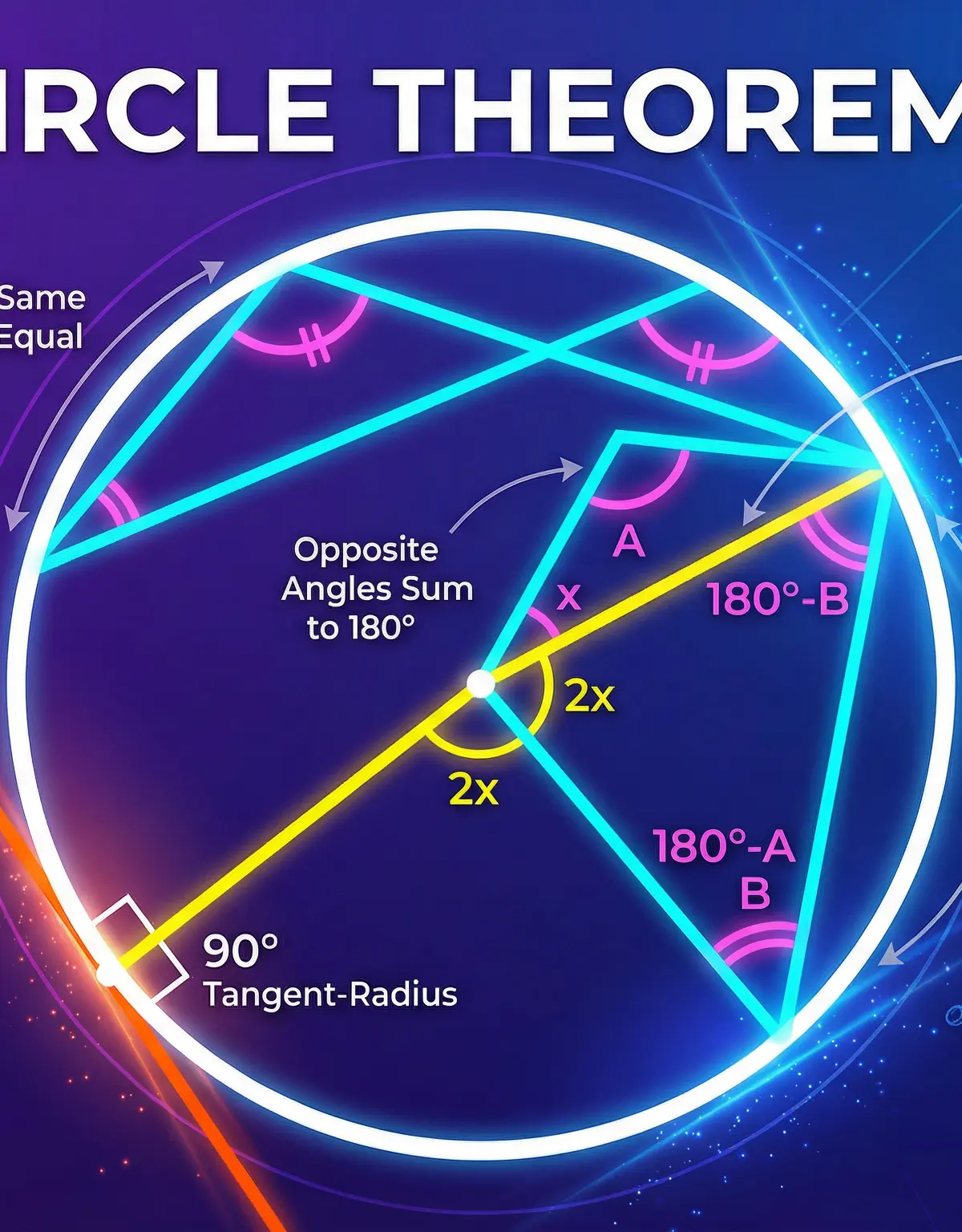
Circle Theorems are a cornerstone of the OCR GCSE Further Mathematics specification, moving beyond simple numerical application into the realm of rigorous algebraic proof. This topic is not just about finding angles; it's about constructing logical arguments and justifying every step with precise geometric reasoning. Examiners frequently use circle theorems to test a candidate's ability to link different areas of mathematics, such as algebra, trigonometry, and coordinate geometry. A typical exam question might involve a complex diagram where you need to identify and apply multiple theorems in sequence, often requiring you to form and solve algebraic equations to find unknown values or to formally prove a geometric property. Mastering the seven key theorems and, crucially, the exact wording required by the mark scheme, is essential for achieving a high grade. This guide will equip you with the knowledge, exam technique, and practice required to tackle these challenging but rewarding questions with confidence.
Key Concepts
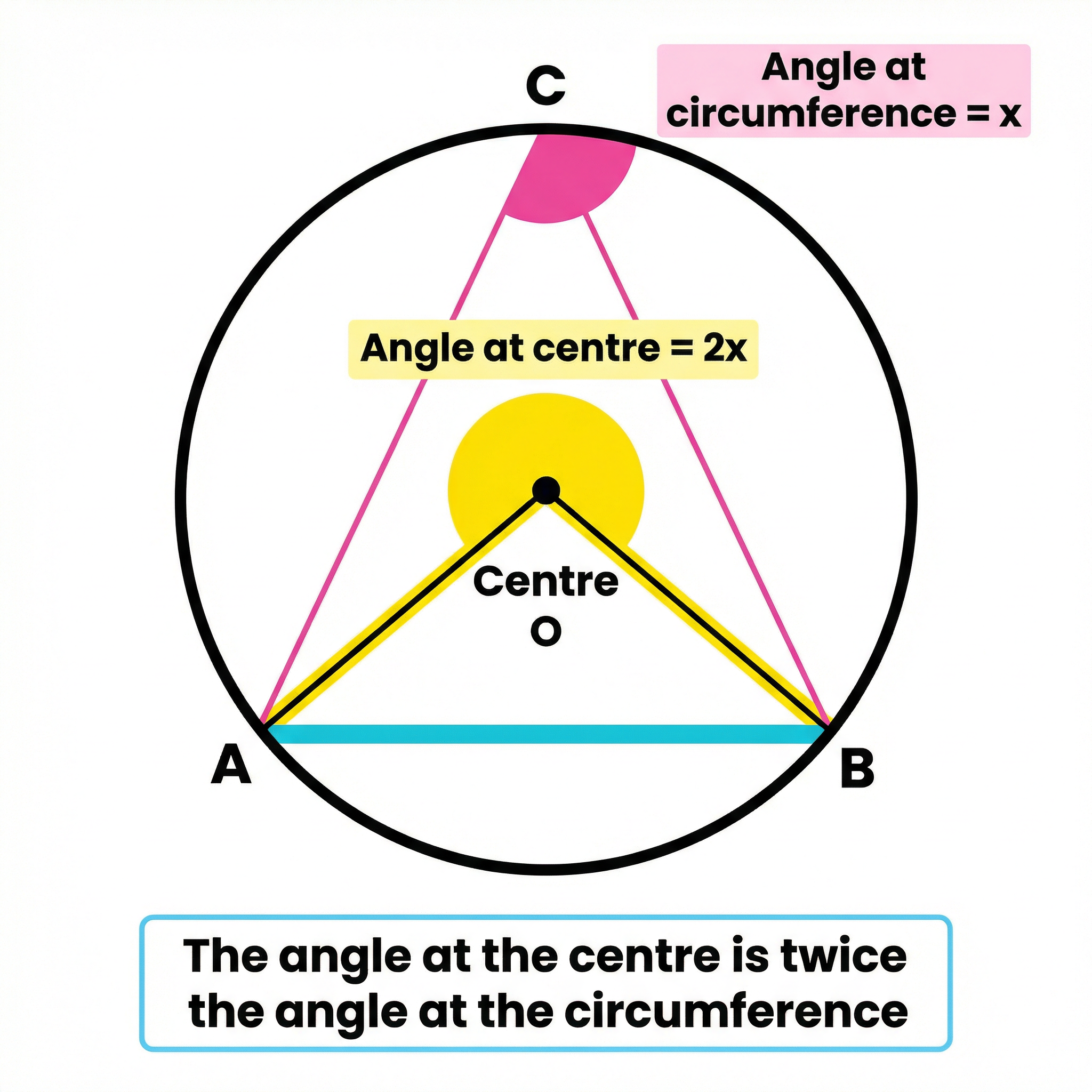
Concept 1: The Angle at the Centre is Twice the Angle at the Circumference
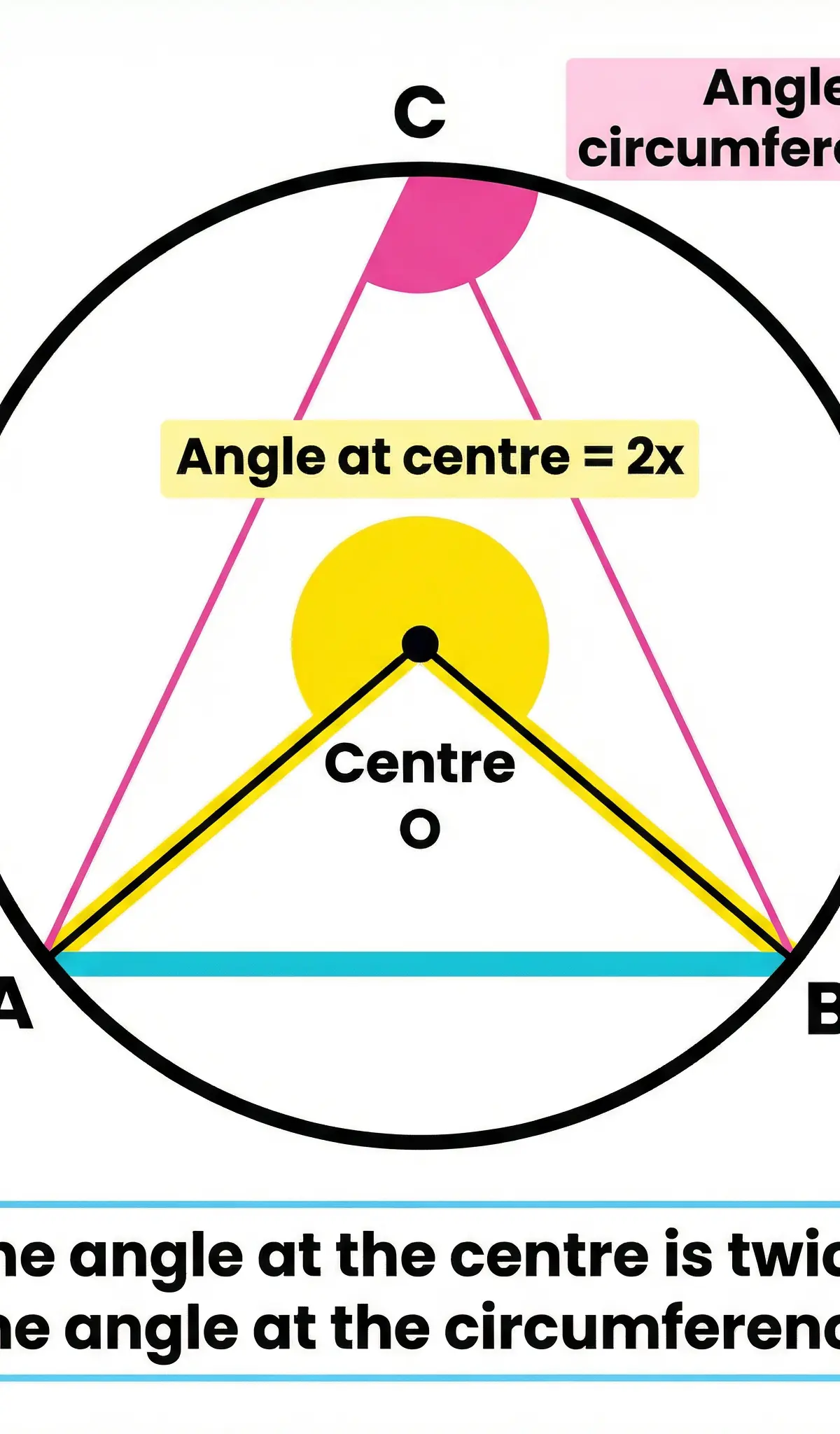
This is a foundational theorem. If you have two points on the circumference of a circle, the angle formed by connecting them to the centre is always exactly double the angle formed by connecting them to any point on the major arc of the circumference. This relationship is fundamental for solving many problems and for proving other theorems.
Example: If the angle at the circumference (subtended by chord AB) is 42°, the angle at the centre (also subtended by chord AB) will be 2 * 42° = 84°.
Concept 2: Angles in the Same Segment are Equal
A 'segment' is the region of a circle bounded by a chord and an arc. If you take any two points on the circumference and draw lines from them to the ends of a chord, the angles formed will be identical. Examiners often test this by presenting a 'bowtie' shape within a circle. Credit is given for identifying that the two angles at the top of the 'bowtie' are equal, and the two at the bottom are equal.
Example: If a chord AC creates an angle of 28° at point B on the circumference (angle ABC), it will also create an angle of 28° at any other point D on that same segment (angle ADC).
Concept 3: The Angle in a Semicircle is 90°
This is a special case of the 'angle at the centre' theorem. A diameter is a chord that passes through the centre. The angle at the centre on a straight line is 180°. Therefore, any angle at the circumference subtended by the diameter must be half of 180°, which is always 90°. If a diagram contains a triangle inscribed within a semicircle, candidates should immediately identify the right angle.
Example: If AB is the diameter of a circle and C is any point on the circumference, then triangle ABC is a right-angled triangle, with the right angle at C.
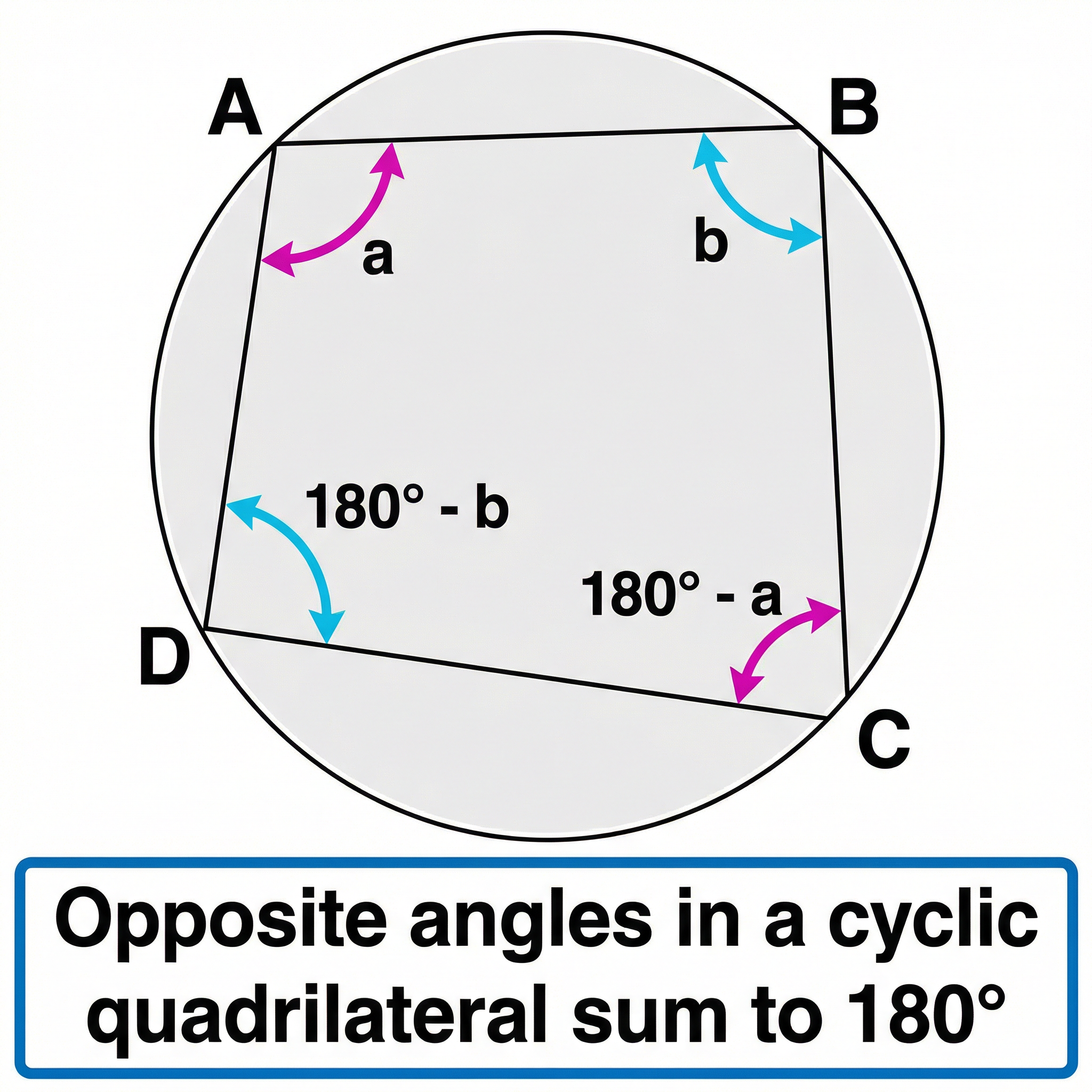
Concept 4: Opposite Angles of a Cyclic Quadrilateral Sum to 180°
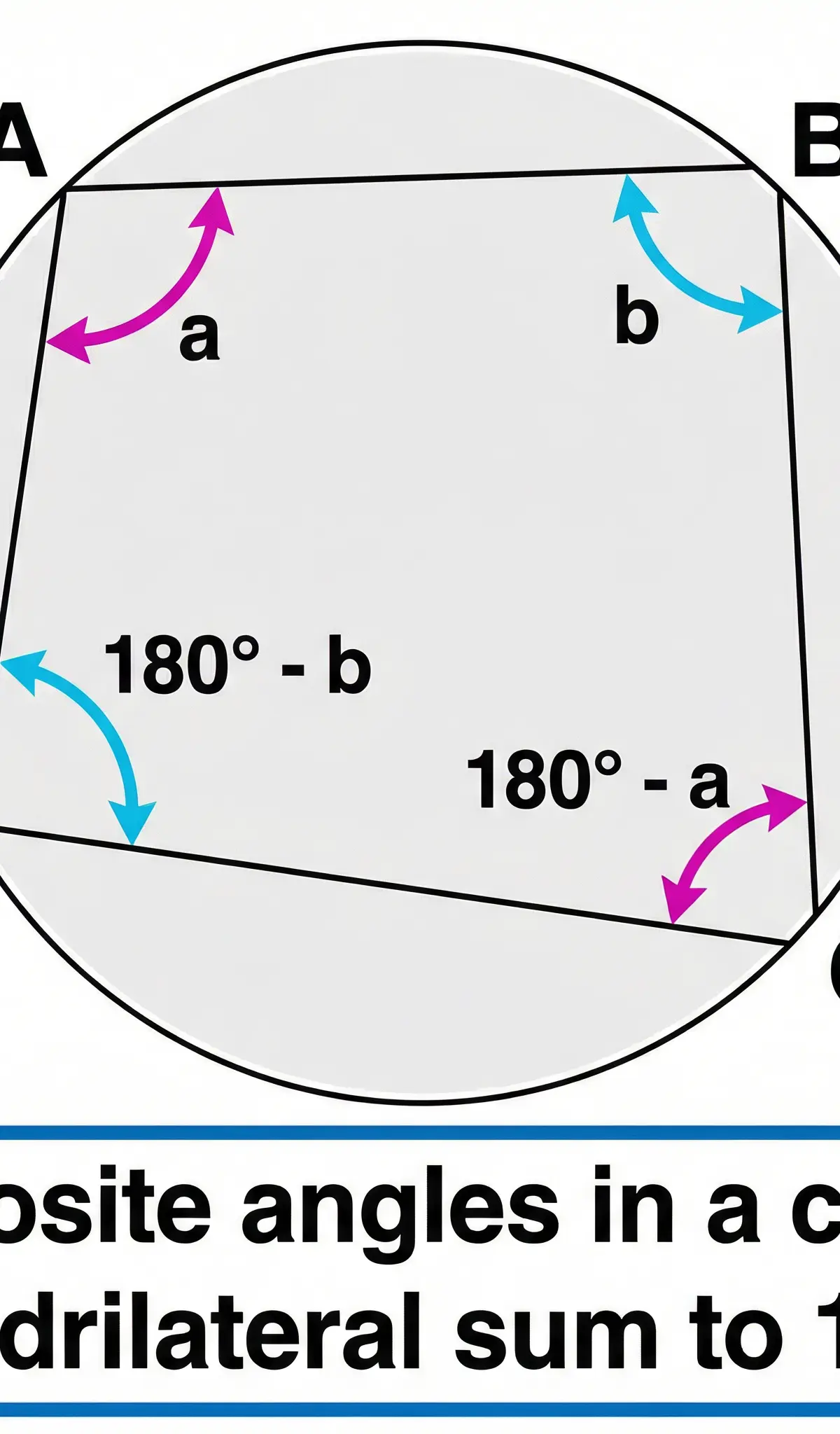
A cyclic quadrilateral is a four-sided figure whose vertices all lie on the circumference of a circle. For any such shape, the pairs of opposite angles will always add up to 180°. This is a crucial theorem for algebraic questions.
Example: In a cyclic quadrilateral ABCD, if angle A = 110°, then angle C must be 180° - 110° = 70°. Similarly, if angle B = 85°, angle D must be 95°.
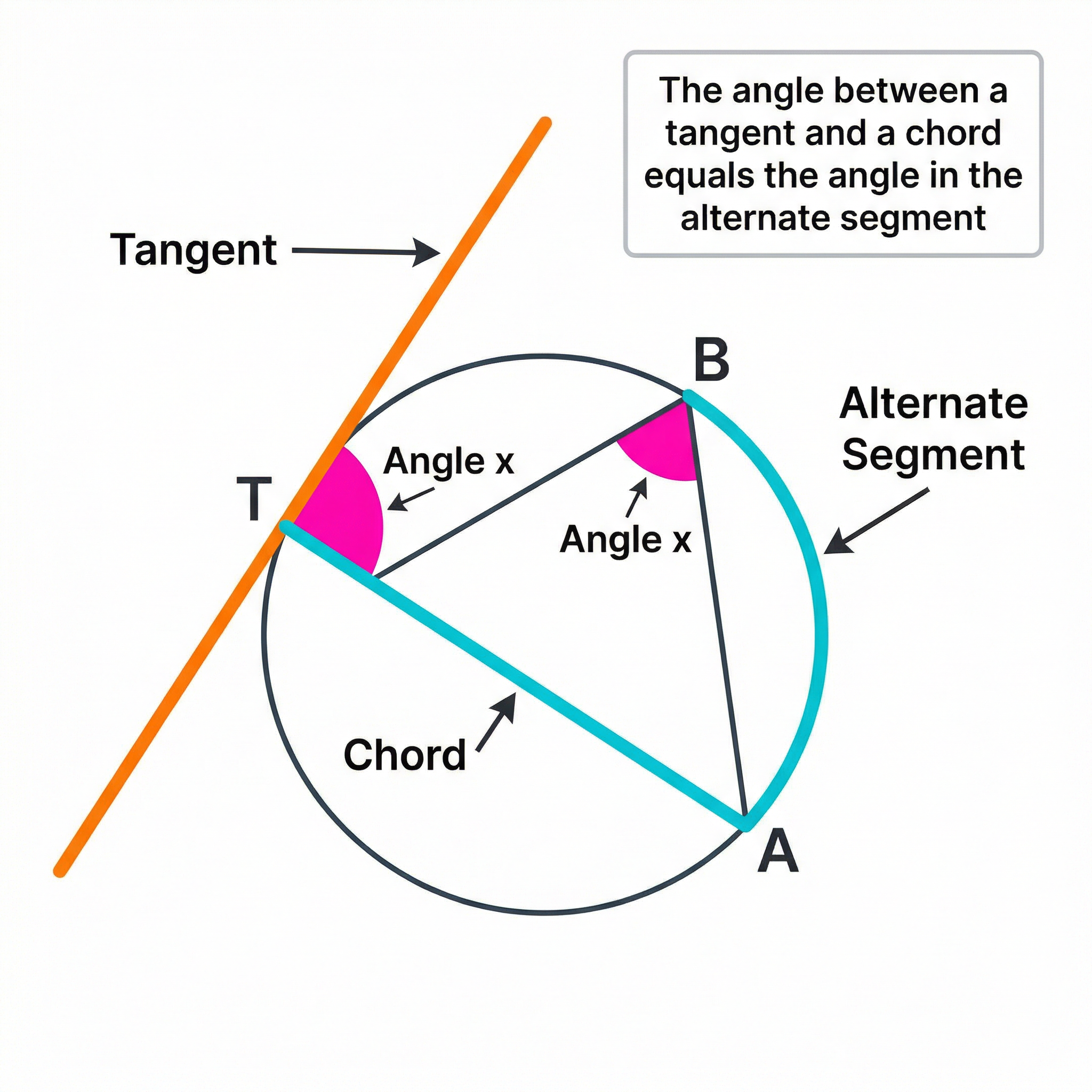
Concept 5: The Alternate Segment Theorem
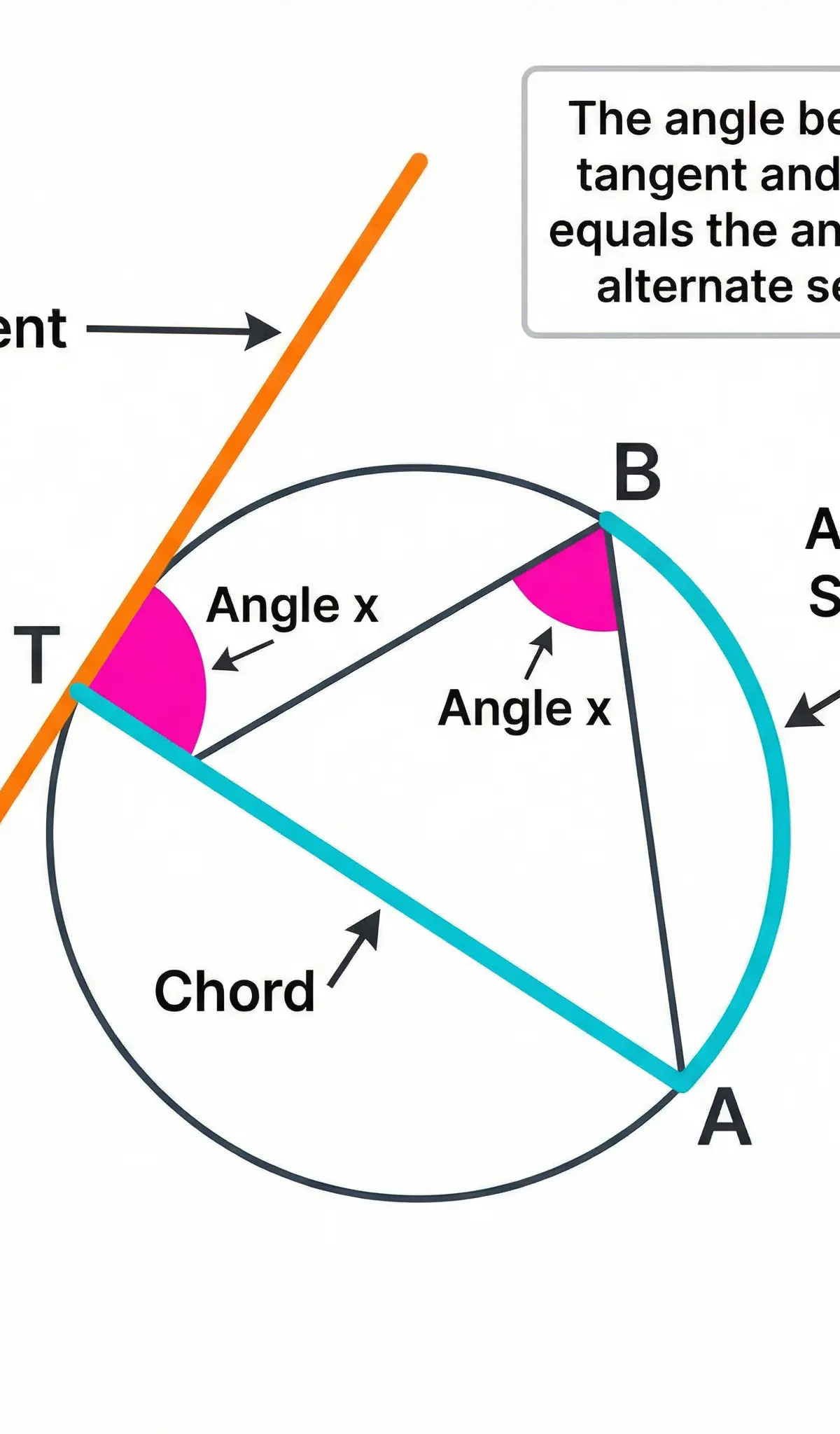
This is often considered the most challenging theorem. It states that the angle between a tangent and a chord through the point of contact is equal to the angle in the alternate segment. It is vital not to confuse this with 'alternate angles' found with parallel lines. Candidates must use the full term 'Alternate Segment Theorem' to be awarded marks.
Example: A tangent touches a circle at point A. A chord AC is drawn. The angle between the tangent and chord AC is 55°. An angle in the alternate segment, angle ABC, will also be 55°.
Mathematical Relationships
- Angle at Centre: ∠AOB = 2 × ∠ACB
- Cyclic Quadrilateral: ∠A + ∠C = 180° and ∠B + ∠D = 180°
- Tangent-Radius: The angle between a tangent and a radius at the point of contact is always 90°. This is a non-negotiable property.
- Tangents from a point: Two tangents drawn from an external point to a circle are equal in length. This creates an isosceles triangle with the chord connecting the points of contact.
Practical Applications
While abstract, circle theorems have applications in fields requiring precise geometric calculations. For example, in satellite navigation and GPS, the principles of triangulation and positioning rely on geometric relationships that are extensions of circle theorems. In design and architecture, creating curved structures, domes, and arches often involves applying these geometric rules to ensure stability and aesthetic form. For the exam, however, the application will be purely mathematical within the context of the provided diagrams.
Visual Resources
3 diagrams and illustrations
Interactive Diagrams
2 interactive diagrams to visualise key concepts
Conceptual Flow Outline
A flowchart for approaching a circle theorem problem.
Conceptual Flow Outline
A concept map showing the relationships between key circle theorems.
Worked Examples
3 worked examples — open one to explore the question and available guidance.
Practice Questions
Test your understanding — click to reveal model answers
P, Q, R and S are points on a circle. PQ = PS. Angle QRS = 65°. Find the size of angle QPS. Give a reason for each stage of your working.
Hint: Start by finding the angle opposite to QRS in the cyclic quadrilateral.
A, B and C are points on the circumference of a circle, centre O. TA is a tangent to the circle. Angle OAC = 25°. Calculate the size of angle ATC.
Hint: Start by finding other angles in the isosceles triangle OAC.
Prove that opposite angles of a cyclic quadrilateral sum to 180°.
Hint: Start by connecting two opposite vertices to the centre of the circle.
In the diagram, O is the centre. Angle AOB = 100°. Find angle ACB and angle ADB.
Hint: Use the angle at the centre theorem and the angles in the same segment theorem.
A tangent at point P on a circle has equation y = 2x + 1. The centre of the circle is (3, 5). Find the equation of the radius OP.
Hint: Remember the relationship between the gradient of a tangent and the gradient of a radius at the point of contact.
Test your understanding of Circle Theorems
Active recall beats re-reading. Take an instant quiz now to test what you’ve learned and lock it into long-term memory.
7 days Premium · Then free forever · No card, no charge