OCR · GCSE · Further Mathematics
Transformations of functions
Master OCR GCSE Further Maths Transformations of Functions (3.4). This guide breaks down translations, reflections, and stretches, showing you how to secure top marks with examiner insights, worked examples, and powerful memory hooks.
- 5 min read
- 3 worked examples
- 5 practice questions
Study Notes
Overview
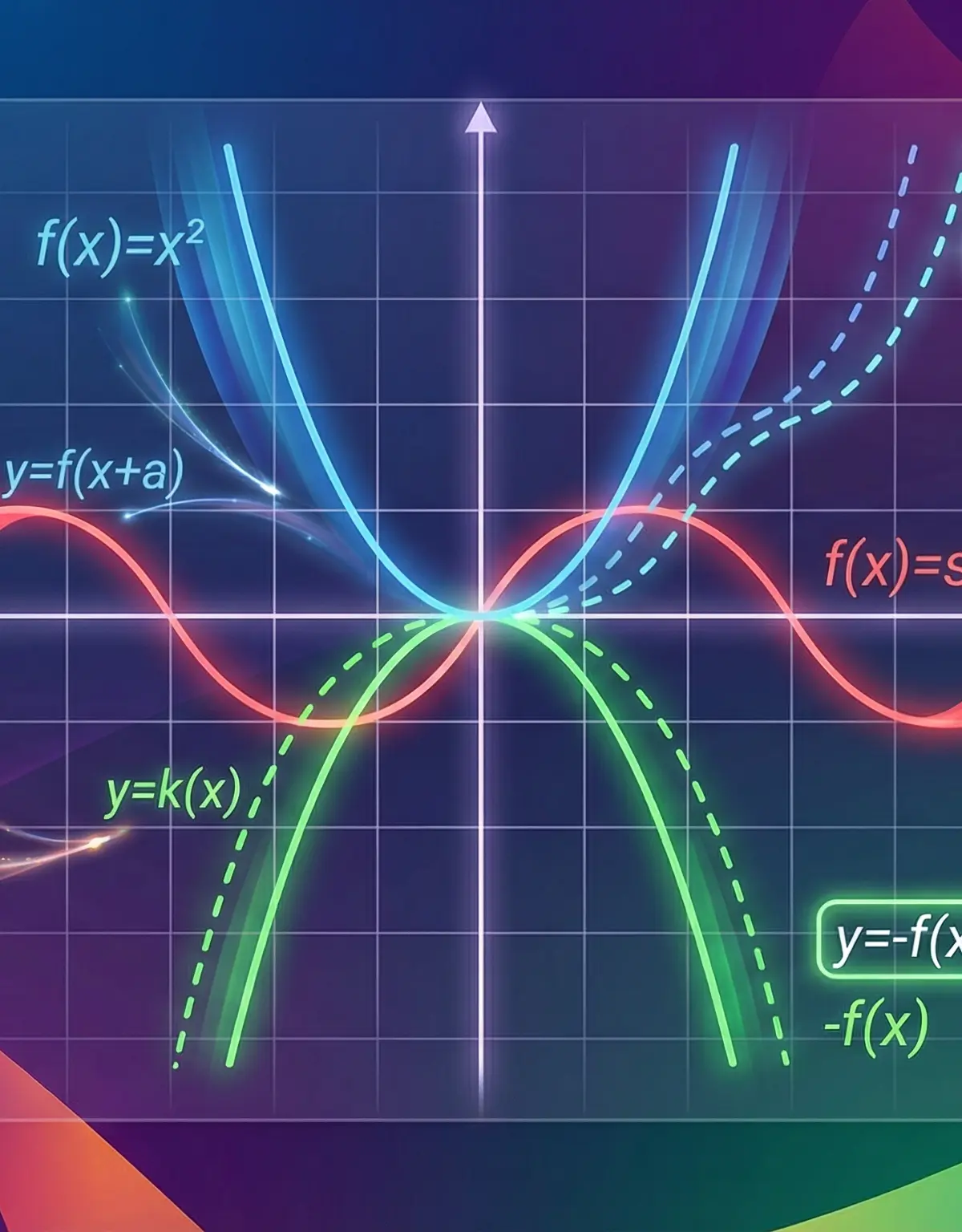
Welcome to the definitive guide for Transformations of Functions, section 3.4 of the OCR GCSE Further Mathematics specification. This topic is a cornerstone of advanced mathematical thinking, moving beyond simple plotting to manipulating entire graphs with precision. In this guide, we will deconstruct the four key transformations: translations, reflections, and both vertical and horizontal stretches. A solid grasp of this topic is crucial, as it not only accounts for a significant portion of exam marks (AO1: 50%) but also provides a foundation for understanding more complex functions in A-Level Mathematics. Candidates are expected to handle function notation like f(x+a) and f(kx) with fluency, often in multi-step, composite transformation questions. This guide will equip you with the terminology, techniques, and exam strategies to turn this challenging topic into a reliable source of marks.
Key Concepts
Concept 1: Translations (Shifting the Graph)
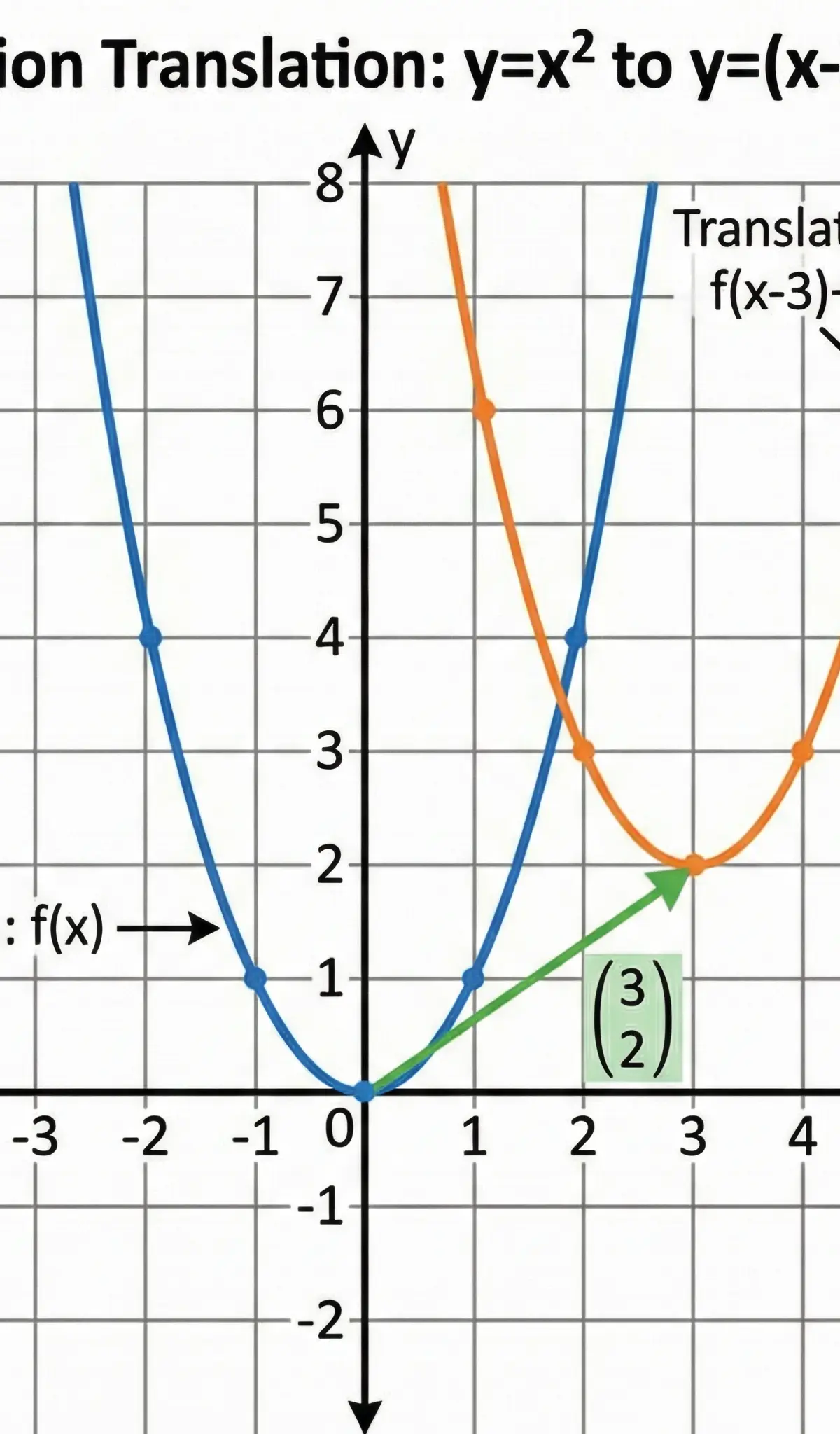
A translation slides a graph to a new position without rotating, reflecting, or changing its size. The key is to understand how the function's equation dictates the movement.
-
Vertical Translation:
y = f(x) + a
This transformation moves the graph vertically. If 'a' is positive, the graph shifts up. If 'a' is negative, it shifts down. This is an intuitive transformation; it happens outside the function, directly affecting the y-values.
Example:f(x) + 2moves the graph off(x)up by 2 units. -
Horizontal Translation:
y = f(x + a)
This transformation moves the graph horizontally. This is where candidates often make mistakes. If 'a' is positive, the graph shifts left. If 'a' is negative, it shifts right. This is counter-intuitive. It happens inside the function, affecting the x-values. Think of it as what you need to do to x to bring it back to its original value.
Example:f(x - 3)moves the graph off(x)right by 3 units.
Concept 2: Reflections (Flipping the Graph)
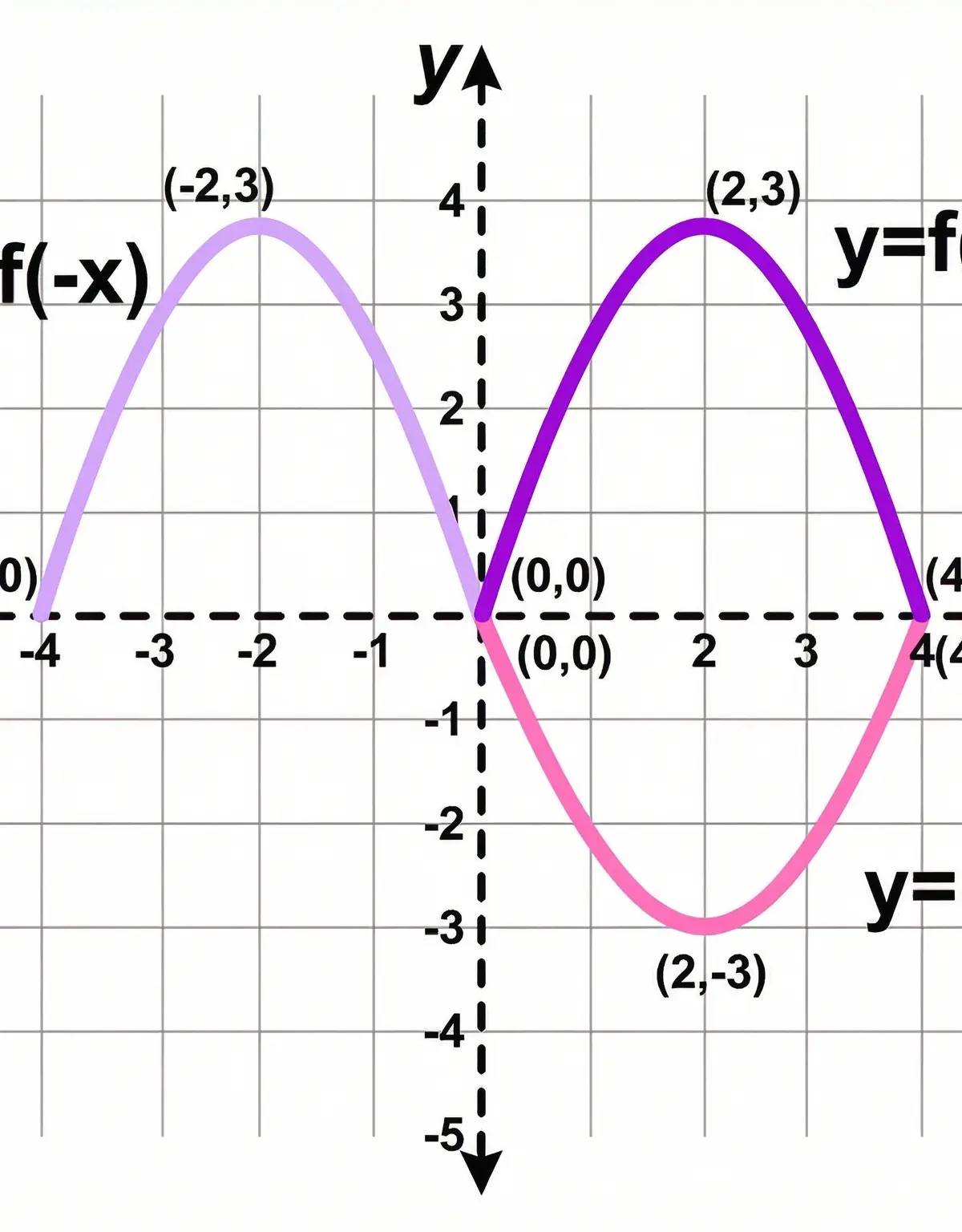
Reflections create a mirror image of the graph across a specific line.
-
Reflection in the x-axis:
y = -f(x)
This transformation flips the graph across the x-axis. All the y-coordinates are multiplied by -1. What was positive becomes negative, and vice-versa. -
Reflection in the y-axis:
y = f(-x)
This transformation flips the graph across the y-axis. All the x-coordinates are multiplied by -1. The left side of the graph becomes the right side, and vice-versa.
Concept 3: Stretches (Scaling the Graph)
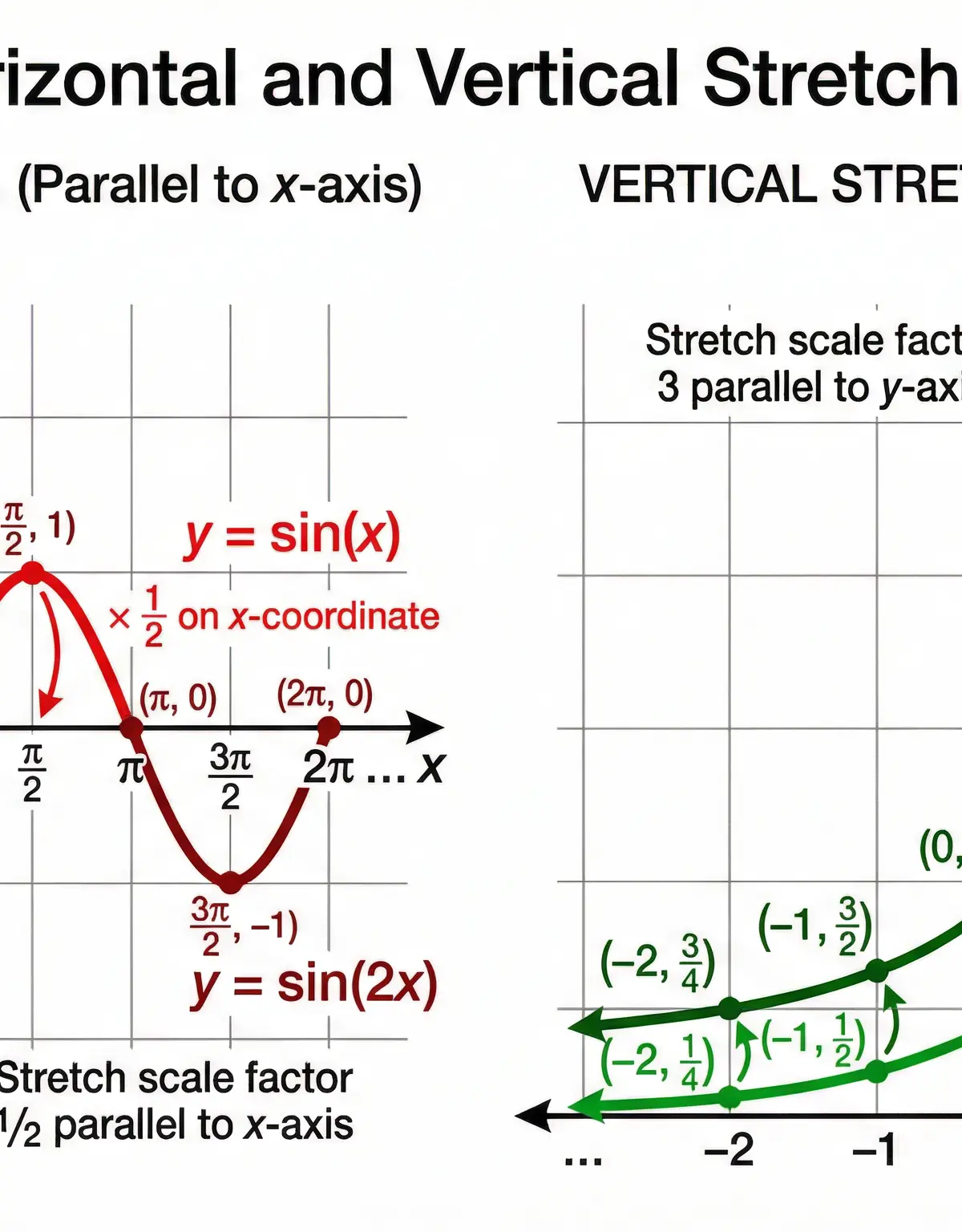
Stretches expand or compress the graph either vertically or horizontally.
-
Vertical Stretch:
y = af(x)
This transformation stretches the graph vertically by a scale factor of 'a'. It is a stretch parallel to the y-axis. Ifa > 1, the graph gets taller. If0 < a < 1, the graph gets shorter. -
Horizontal Stretch:
y = f(kx)
This is the other counter-intuitive transformation. It stretches the graph horizontally by a scale factor of1/k. It is a stretch parallel to the x-axis. Ifk > 1, the graph gets narrower. If0 < k < 1, the graph gets wider.
Mathematical Relationships
| Transformation | Equation Form | Effect on Coordinate (x, y) | Given on Formula Sheet? | Must Memorise? |
|---|---|---|---|---|
| Vertical Translation | y = f(x) + a | (x, y + a) | No | Yes |
| Horizontal Translation | y = f(x + a) | (x - a, y) | No | Yes |
| Reflection in x-axis | y = -f(x) | (x, -y) | No | Yes |
| Reflection in y-axis | y = f(-x) | (-x, y) | No | Yes |
| Vertical Stretch | y = af(x) | (x, ay) | No | Yes |
| Horizontal Stretch | y = f(kx) | (x/k, y) | No | Yes |
Practical Applications
While abstract, function transformations have real-world applications in fields like signal processing (stretching and shifting sound waves), computer graphics (moving and resizing objects on a screen), and even in economics to model shifts in supply and demand curves. Understanding these transformations provides a powerful toolkit for modeling and interpreting real-world phenomena.
Worked Examples
3 worked examples — open one to explore the question and available guidance.
Practice Questions
Test your understanding — click to reveal model answers
The graph of y = cos(x) is transformed to the graph of y = cos(x) - 1. Describe the transformation.
Hint: Is the `-1` inside or outside the `cos` function?
Find the equation of the graph y = x^3 after it has been stretched by a scale factor of 1/2 parallel to the x-axis.
Hint: A horizontal stretch by scale factor `1/k` is represented by `f(kx)`. What is `k` in this case?
The point (4, 8) on the graph of y = f(x) is mapped to the point (2, -8) on the graph of y = g(x). Given that g(x) = af(bx), find the values of a and b.
Hint: How do the x and y coordinates change? Relate this to the stretch factors `a` and `b`.
Describe a sequence of two transformations that maps the graph of y = x^2 to y = (x+3)^2 + 4.
Hint: Look at the changes inside and outside the squared function separately.
Sketch the graph of y = -f(x) where f(x) = x^2 - 1 for -2 <= x <= 2. Label the coordinates of the turning point and the endpoints.
Hint: First sketch `y = f(x)`. Then consider how a reflection in the x-axis affects the key points.
Test your understanding of Transformations of functions
Active recall beats re-reading. Take an instant quiz now to test what you’ve learned and lock it into long-term memory.
7 days Premium · Then free forever · No card, no charge