OCR · GCSE · Further Mathematics
Completing the Square
This guide provides a deep dive into Completing the Square for OCR GCSE Further Mathematics (2.4). It covers everything from the core algebraic method to its powerful application in finding the turning points of parabolas, ensuring you can tackle exam questions with confidence and secure top marks.
- 5 min read
- 3 worked examples
- 5 practice questions
- 6 key terms
Study Notes

Overview
Completing the square is a fundamental technique in algebra that allows us to rewrite any quadratic expression from the standard form, ax^2 + bx + c, into the much more informative vertex form, a(x+p)^2 + q. For the OCR Level 2 Further Mathematics qualification, this skill is not just a procedural exercise; it is the gateway to understanding the geometric properties of quadratic functions. Mastering this topic is crucial as it directly reveals the coordinates of a parabola's turning point (its vertex) and its line of symmetry without the need for calculus or plotting numerous points. Examiners frequently test this skill in questions that require candidates to find the maximum or minimum value of a quadratic function, solve quadratic equations, or sketch the corresponding graph. It forms a vital bridge between algebra and geometry, and its principles are foundational for more advanced mathematical concepts you will encounter at A-Level.
Key Concepts
Concept 1: The Perfect Square Trinomial
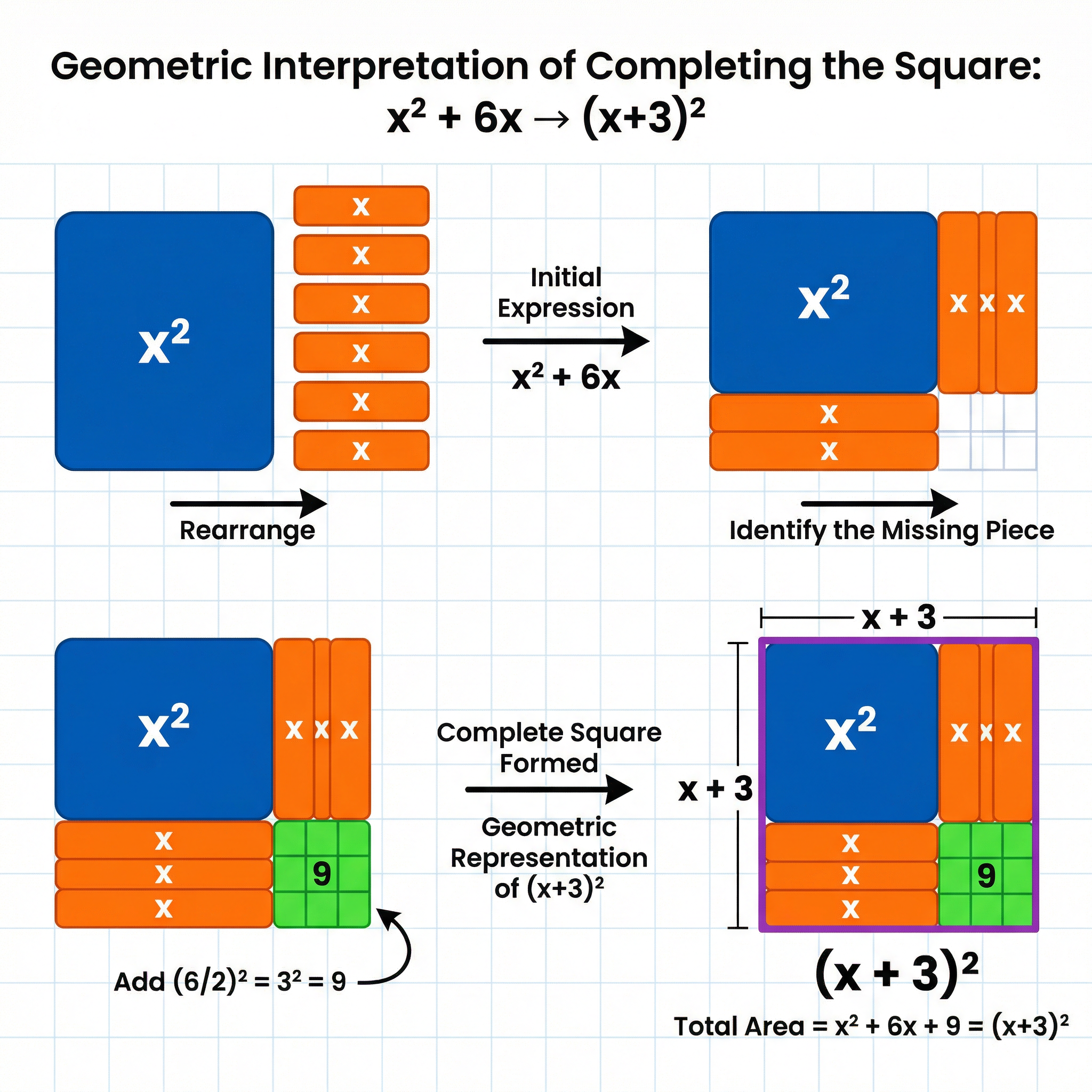
The entire goal of completing the square is to create a special type of quadratic called a perfect square trinomial. This is an expression that can be factored into a single squared bracket, like (x+p)^2 or (x-p)^2. For example, x^2 + 6x + 9 is a perfect square trinomial because it factors neatly into (x+3)^2. The key relationship here is between the coefficient of the x term (the 'b' value) and the constant term (the 'c' value). In a perfect square, the constant term is always the square of half the coefficient of x. For x^2 + 6x + 9, half of 6 is 3, and 3^2 is 9. This is the relationship we exploit. When an expression isn't a perfect square, like x^2 + 6x + 5, we force it to become one by adding the missing amount and then immediately subtracting it to keep the expression balanced. This is the 'completion' of the square.

Concept 2: Handling the Coefficient 'a'
In Further Mathematics, you will frequently encounter quadratics where the coefficient of x^2, denoted by 'a', is not 1 (e.g., 3x^2 - 12x + 7) or is negative (e.g., -x^2 + 4x - 1). This adds a critical step that is often a source of error for candidates. Before you can complete the square, you must factorise the coefficient 'a' out of the first two terms (ax^2 + bx). It is crucial that you do not factor it out of the constant term. For 3x^2 - 12x + 7, the first step is to write 3[x^2 - 4x] + 7. Now, you complete the square on the expression inside the square brackets. The most common mistake is forgetting that any number you add and subtract inside the bracket is being multiplied by the 'a' value outside. When you subtract the compensating term, you must multiply it by 'a' before combining it with the original constant term. Forgetting this step is a guaranteed way to lose marks.
Concept 3: The Link to the Parabola
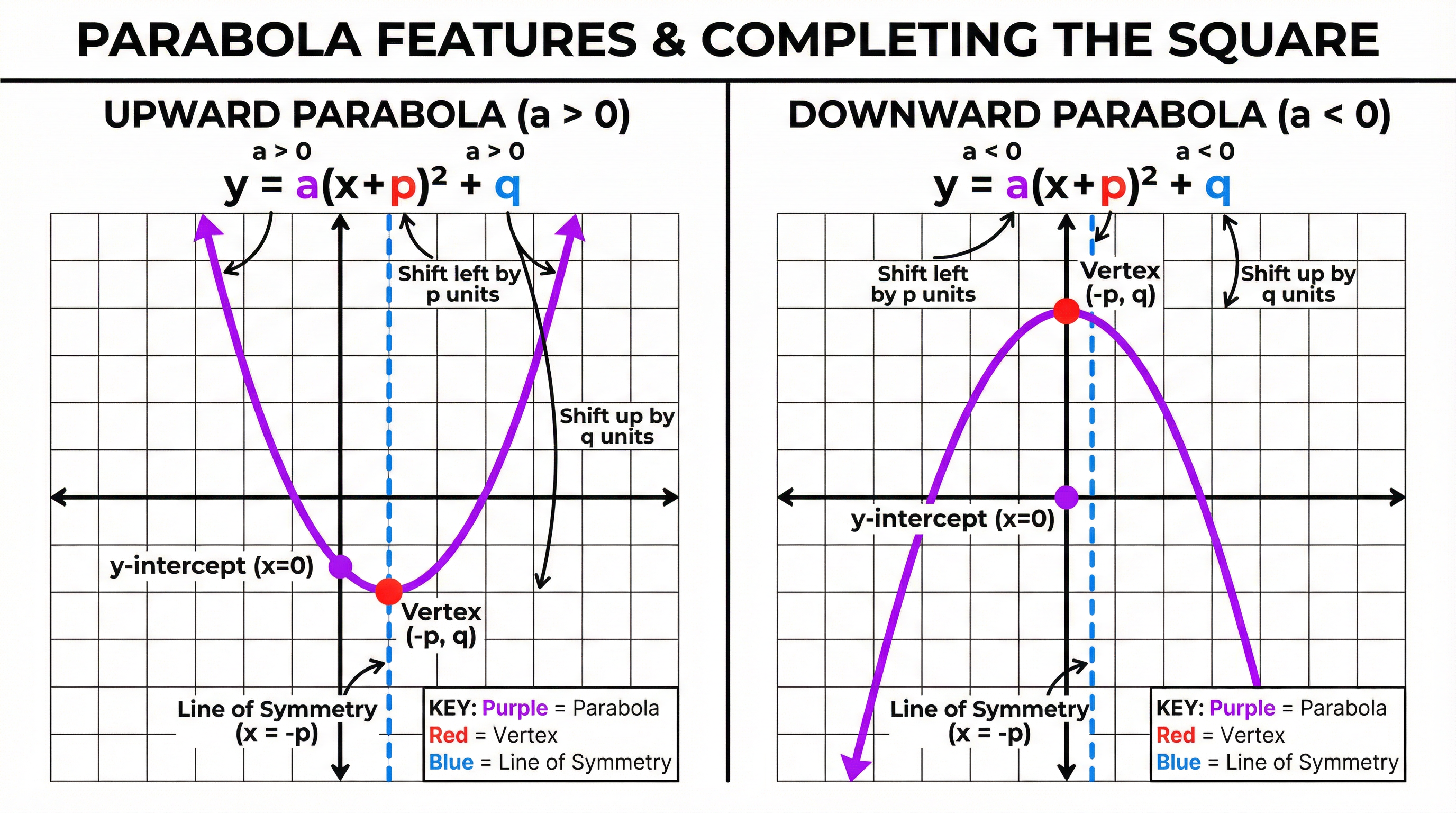
Once a quadratic is in the form a(x+p)^2 + q, it directly tells you about the graph of y = a(x+p)^2 + q. This form is called the vertex form for a reason: the coordinates of the vertex, or turning point, are (-p, q). Notice the sign change for the x-coordinate. If the bracket is (x+4)^2, the x-coordinate of the vertex is -4. If the bracket is (x-5)^2, the x-coordinate is +5. The y-coordinate is simply the constant term, q. The value of 'a' tells you the orientation of the parabola. If 'a' is positive, the parabola is U-shaped and has a minimum point. If 'a' is negative, the parabola is n-shaped and has a maximum point. The line of symmetry is a vertical line that passes through the vertex, and its equation is always x = -p.

Mathematical Relationships
- Standard Form: y = ax^2 + bx + c
- Vertex Form (Completed Square Form): y = a(x+p)^2 + q
Key Relationships:
- The value of p is found by p = \frac{b}{2a}.
- The value of q is the resulting constant after completing the square, calculated as q = c - a(p^2).
- Vertex Coordinates: (-p, q)
- Line of Symmetry: x = -p
- Nature of Turning Point:
- If a > 0, the parabola has a minimum value of q at x = -p.
- If a < 0, the parabola has a maximum value of q at x = -p.
Practical Applications
While seemingly abstract, completing the square has numerous real-world applications, particularly in physics and engineering. For example, the trajectory of a projectile under gravity (like a ball being thrown) can be modelled by a quadratic equation. By completing the square on this equation, we can instantly find the maximum height the projectile reaches and the time at which it occurs. In business, quadratic models are used to determine maximum profit or minimum cost, which can be found by completing the square on the profit or cost function. It is also fundamental in optimization problems and in the design of parabolic reflectors used in satellite dishes and car headlights.
Visual Resources
2 diagrams and illustrations
Interactive Diagrams
2 interactive diagrams to visualise key concepts
Conceptual Flow Outline
A flowchart showing the step-by-step decision process for completing the square, covering cases where the coefficient 'a' is 1 and where it is not.
Conceptual Flow Outline
A concept map illustrating how completing the square transforms a quadratic from standard form to vertex form, and the key geometric information this transformation reveals.
Worked Examples
3 worked examples — open one to explore the question and available guidance.
Practice Questions
Test your understanding — click to reveal model answers
Express x^2 - 8x + 3 in the form (x-p)^2 + q.
Hint: The coefficient of $x^2$ is 1, so you don't need to factor anything out first. What is half of the x-coefficient?
Find the coordinates of the turning point of the curve with equation y = 4x^2 + 24x - 1.
Hint: Start by factoring the 4 out of the first two terms. Remember to multiply when you take the compensating term out of the bracket.
A quadratic function is given by f(x) = 10 - 8x - 2x^2. By completing the square, find the maximum value of f(x).
Hint: Be careful with the negative coefficient of $x^2$. Factor out -2 first.
Write 3x^2 - 5x + 4 in the form 3(x-p)^2+q.
Hint: This involves fractions. Don't be afraid of them! Halve 5/3 and proceed as normal.
The line of symmetry of the graph y = -x^2 + 7x + 1 has equation x=k. Find the value of k.
Hint: The line of symmetry is given by the x-coordinate of the turning point. You need to complete the square to find it.
Test your understanding of Completing the Square
Active recall beats re-reading. Take an instant quiz now to test what you’ve learned and lock it into long-term memory.
7 days Premium · Then free forever · No card, no charge