OCR · GCSE · Further Mathematics
Equation of a Tangent to a Circle
Master the equation of a tangent to a circle for your OCR GCSE Further Maths exam. This guide breaks down the essential perpendicular gradient rule, provides step-by-step worked examples, and offers examiner tips to help you secure every mark.
- 3 min read
- 3 worked examples
- 5 practice questions
- 6 key terms
Study Notes

Overview
Finding the equation of a tangent to a circle is a core skill in OCR's Further Mathematics specification (3.2). This topic elegantly combines coordinate geometry with the geometric properties of circles, specifically the crucial relationship between a tangent and a radius. In the exam, candidates are expected to confidently handle circles with centers at the origin and elsewhere, and to be proficient in manipulating linear equations. A typical question will not only test your ability to find the equation but also your precision in presenting it in the specific form (ax + by + c = 0) with integer coefficients. Mastering this methodical process is key to unlocking a significant number of marks and demonstrating a deeper understanding of geometric principles.
Key Concepts
Concept 1: The Tangent-Radius Property
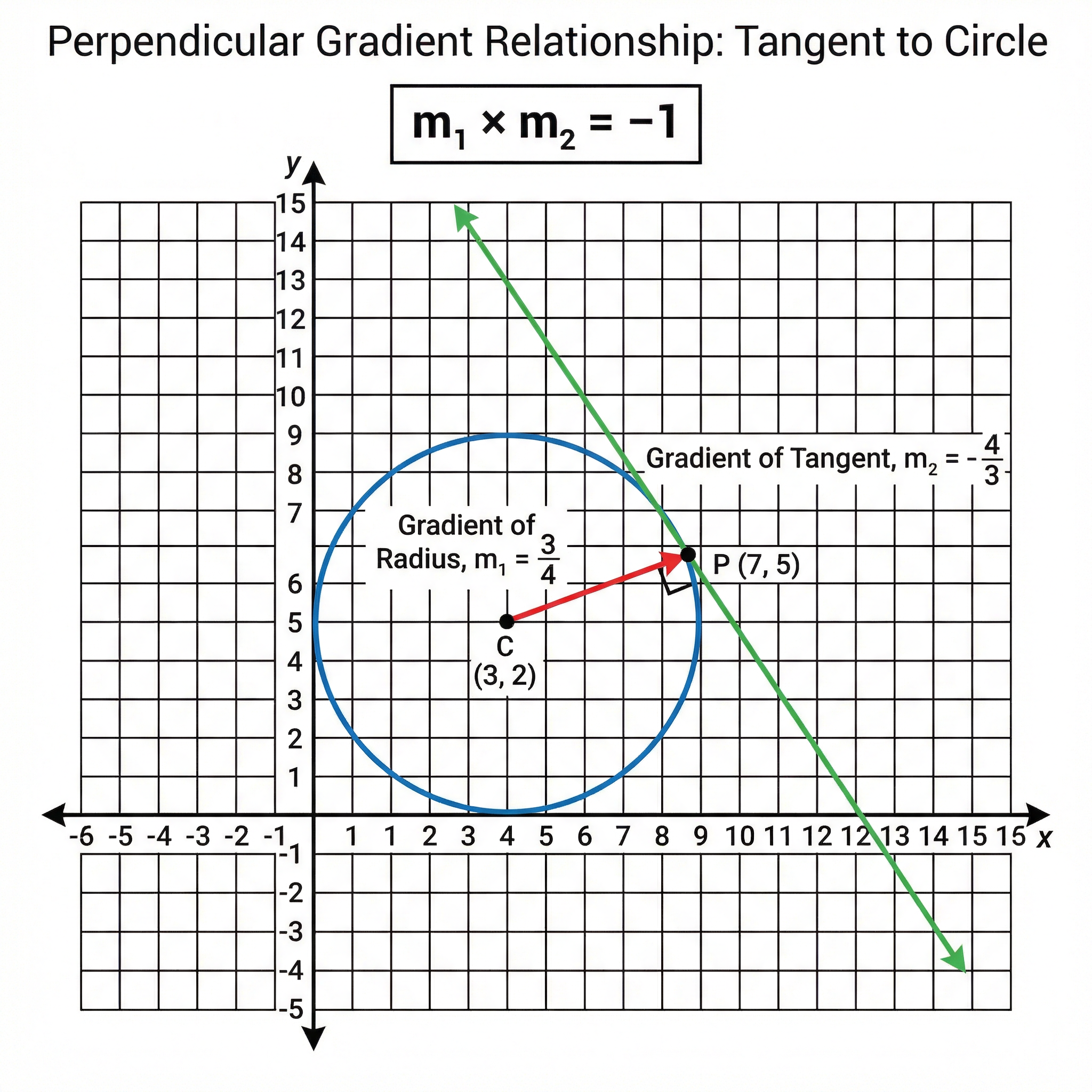
The single most important concept is that a tangent to a circle is perpendicular to the radius at the point of contact. This is a fundamental circle theorem that forms the basis of the entire method. When two lines are perpendicular, their gradients (let's call them (m_1) and (m_2)) have a special relationship: their product is -1. This is the mathematical key to solving these problems.
Relationship: (m_{radius}\times m_{tangent} = -1)
This means if you can find the gradient of the radius connecting the circle's center to the point of contact, you can immediately find the gradient of the tangent by calculating the negative reciprocal.

Concept 2: The Methodical Approach
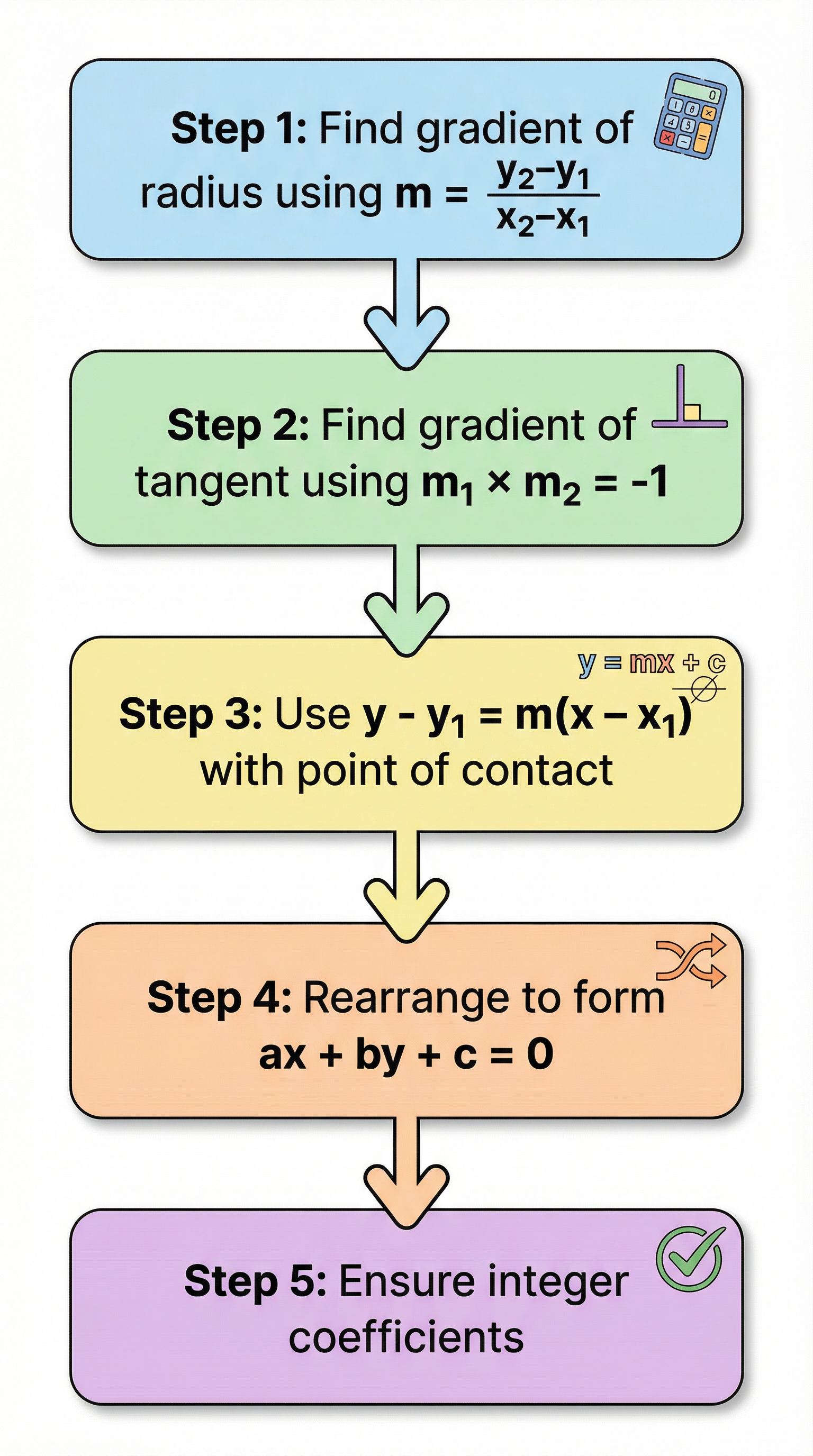
Every question on this topic can be solved by following a clear, five-step process. Committing this process to memory ensures you won't miss any crucial steps, especially under exam pressure. Examiners look for this logical progression, and marks are awarded for each stage of the process.

Mathematical/Scientific Relationships
- Gradient of a Line: Given two points ((x_1, y_1)) and ((x_2, y_2)), the gradient (m) is (m =\frac{y_2 - y_1}{x_2 - x_1}). (Must memorise)
- Perpendicular Gradients: For two perpendicular lines with gradients (m_1) and (m_2), (m_1 \times m_2 = -1). This can be rearranged to (m_2 = -\frac{1}{m_1}). (Must memorise)
- Equation of a Straight Line (Point-Slope Form): Given a point ((x_1, y_1)) and a gradient (m), the equation is (y - y_1 = m(x - x_1)). (Given on formula sheet)
- Standard Form of a Linear Equation: (ax + by + c = 0), where a, b, and c are integers. (Must memorise form)
Practical Applications
While abstract, the concept of tangents to circles has real-world applications in fields like physics (describing the instantaneous velocity of an object in circular motion), computer graphics (calculating light reflections and shadows), and engineering (designing gears and pulley systems where belts run tangent to wheels).
Visual Resources
2 diagrams and illustrations
Interactive Diagrams
2 interactive diagrams to visualise key concepts
Conceptual Flow Outline
Flowchart showing the core process for finding the equation of a tangent.
Conceptual Flow Outline
Concept map illustrating the relationship between the circle's center, the point of contact, and the tangent line.
Worked Examples
3 worked examples — open one to explore the question and available guidance.
Practice Questions
Test your understanding — click to reveal model answers
Find the equation of the tangent to the circle (x^2 + y^2 = 50) at the point (-5, 5).
Hint: The center of this circle is at the origin. What is the first step?
The point P(7, k) lies on the circle (x^2 + y^2 = 58). Find the two possible values of k, and find the equation of the tangent at P for the positive value of k.
Hint: Substitute the coordinates of P into the circle's equation to find k first.
A circle has its center at C(1, -2) and passes through the point A(4, 2). Find the equation of the tangent to the circle at A, giving your answer in the form (ax+by+c=0).
Hint: The center is not the origin. Be careful with your gradient calculation.
Show that the point P(1, 3) lies on the circle ((x-4)^2 + (y-5)^2 = 13) and find the equation of the tangent at P.
Hint: To 'show' the point lies on the circle, substitute its coordinates into the circle's equation and check if it holds true.
The line (y = 2x - 1) is a tangent to a circle with center (5, -1). Find the equation of the radius that meets this tangent.
Hint: This question asks for the equation of the radius, not the tangent. You need the gradient of the radius and a point it passes through.
Test your understanding of Equation of a Tangent to a Circle
Active recall beats re-reading. Take an instant quiz now to test what you’ve learned and lock it into long-term memory.
7 days Premium · Then free forever · No card, no charge